
#On Correction Without Apology
The Re-inspection Brand-Smith was born at Bastion-Irongate in A.S. 119, which is to say the Synod discovered a method of apologising with fire. Eleven people had already been executed, forty-seven had already been sent toward the Paper Mines of Ulm, three hundred had already felt the Lictor's grip, and 1,400 civilians had already learned that a lawful scar can lie more persuasively than any criminal tongue. At that point the Bureau of Heraldry did what every mature Bureau does after catastrophe: it created a sub-profession.
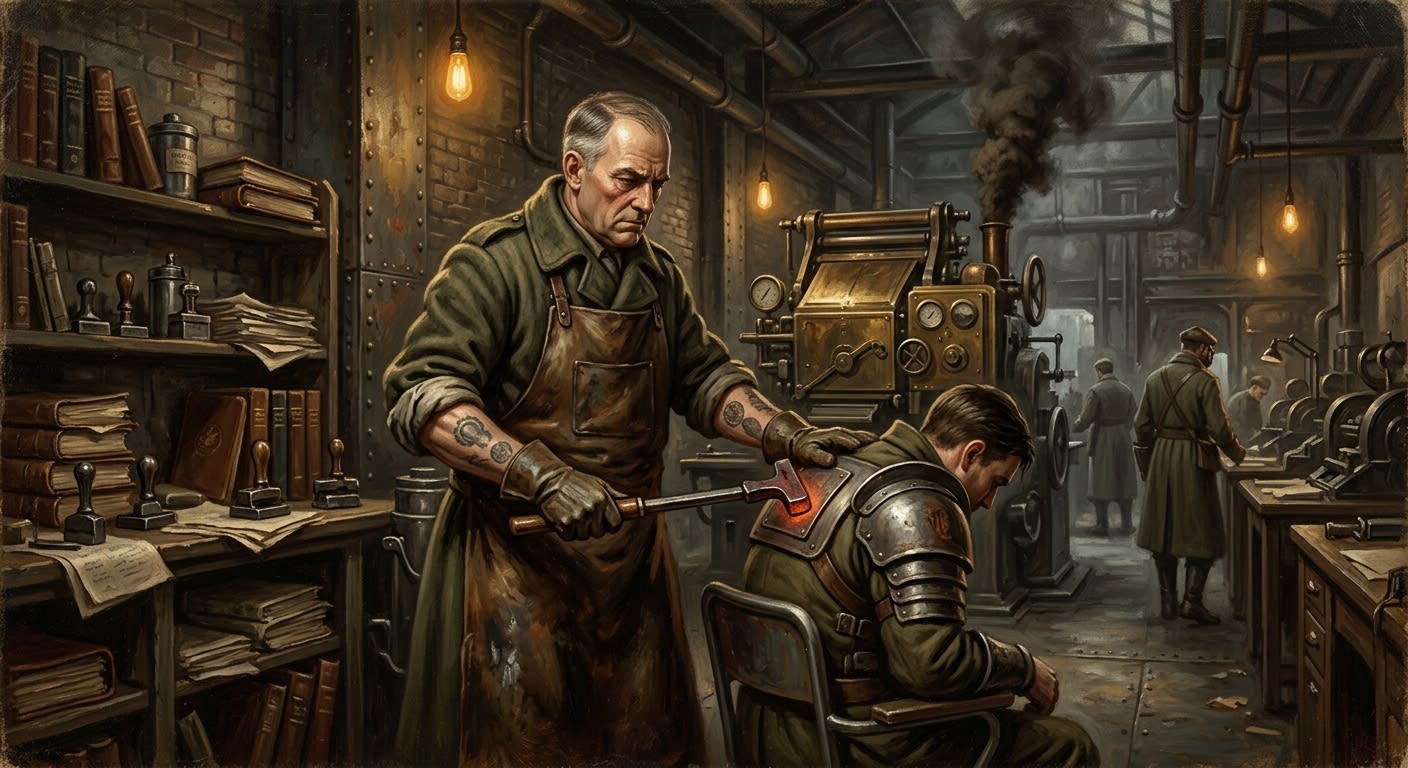
The task appears merciful to the illiterate eye. A citizen presents a faulty mark. The Re-inspection Brand-Smith verifies the scar against ledger, witness tag, tool serial, custody sheet, checkpoint notation, and whatever remains of the citizen's patience. If the mark is erroneous, the specialist overlays a corrective triangle, burning through scar tissue until the amended geometry reads as correction rather than second offence. The margin of error is two degrees of arc.
The re-inspector exists because the Geometry Brand-Smith made the body into evidence, and evidence, once placed in flesh, cannot be withdrawn by memo. Paper may receive a line through it. A seal may be voided. A ledger may be re-bound, re-indexed, re-spelled, or dropped down a stair until the page one dislikes detaches in a spirit of penitence. Skin is less cooperative. It keeps receipts.
#On the Irongate Necessity
The Angle Riots began with an iron that leaned two degrees from obedience. During a Purity sweep through Irongate's southern districts, a team of hastily trained Brand-Smiths applied inverted doubles where identity singles should have stood. A mark of passage became second-category heresy. A labourer's wrist became confession. A widow's arm became doctrine against her.
Standing Order 22-D did the rest. Certain marks operate as self-executing evidence: detain first, transport first, punish first, review when the ink arrives. Enforcement outran correction because enforcement owns horses and correction owns forms. By the time Heraldry admitted that the iron had lied, the quarter had burned witness desks, dragged a swatch plate through the street, and given the Bureau a lesson it immediately filed under tool custody.
The first corrective teams were improvised. They used standard irons, chapel frames, and men selected for hand steadiness rather than conscience, since the latter attribute had already proved surplus to requirements. The work failed often. A correction line too shallow resembled injury. Too deep resembled a second sentence. Too wide made a penitent mark read condemned. Too clean invited suspicion. Too ugly made every gate guard pause, and a pause at a gate is where lives go to be sorted by fools.
Public Irongate notices stated that affected citizens were “restored to prior standing” through correction.
Restricted correction: standing amended; prior condition irretrievable. The executed remained dead. The transported remained absent. The scarred remained legible to neighbours who had learned the wrong reading before the right one was authorised.
Heraldry formalised the role before the blood had finished drying under the bridge-steps. The inquiry demanded traceability of irons and traceability of correction, because the Bureau's answer to a wound is a chain of custody long enough to strangle the injured man before he reaches the complaints desk.
#On the Practice of Amendment
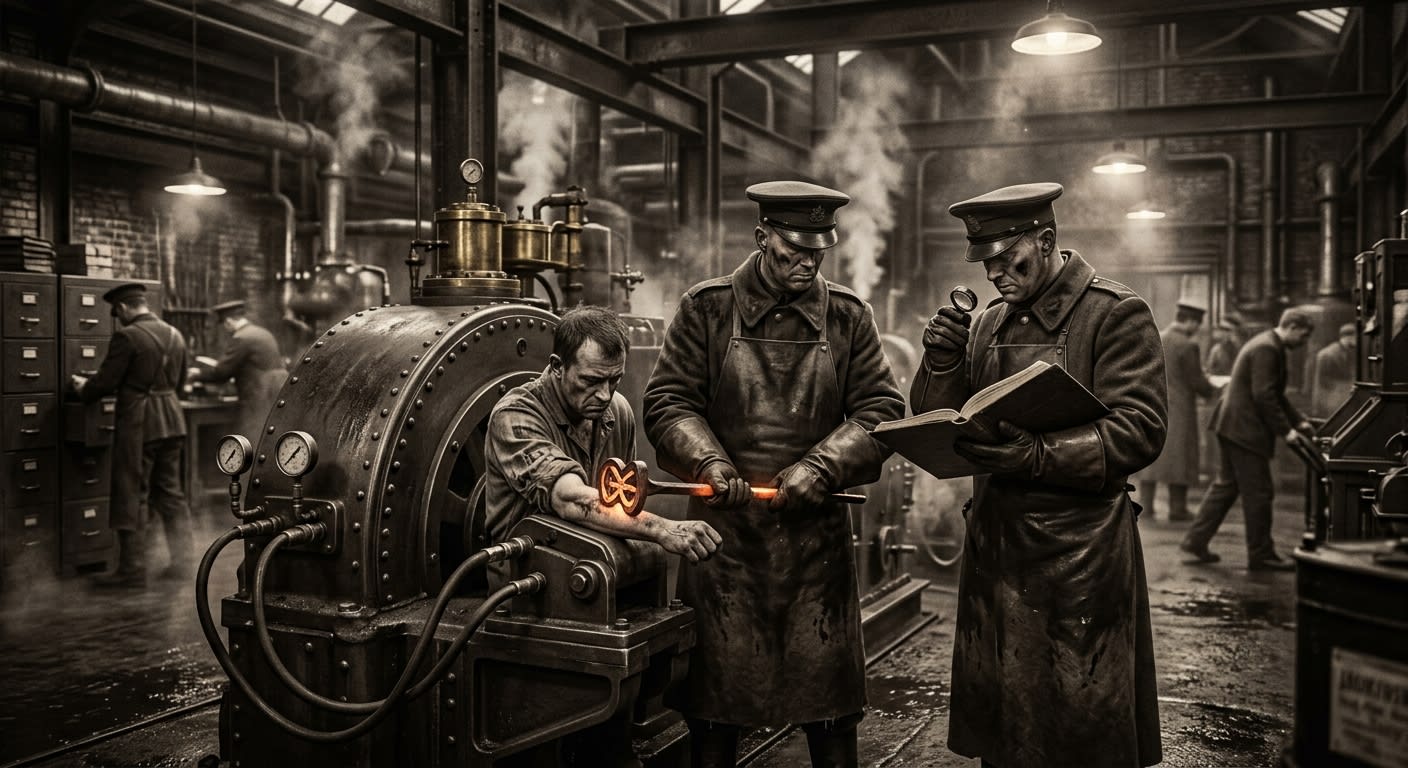
A re-inspection begins with custody. The body does not enter the frame until the papers have been made to fight. Ledger entry against witness seal. Witness seal against tool serial. Tool serial against issue desk. Issue desk against chapel return. Chapel return against field custody. Field custody against the scar itself, which waits, swollen with the unpleasant dignity of being the only witness no clerk can misplace.
The citizen sits or is held. In polite chapels, the sitting is voluntary. In forward posts, voluntariness is measured by how many guards have their hands on the shoulders. The Re-inspection Brand-Smith cleans the site with vinegar, reads the old angle under a brass gauge, marks three ghost points in ash, and selects the overlay iron. Assistants hold the measuring frame against scar tissue. The client is instructed to breathe through the Creed. The Creed, being long, is useful.
Then the amendment burns.
The corrective triangle must do three things at once. It must invalidate the old reading. It must display the new class. It must prove that the amendment itself was lawful. That is a heavy catechism for a small area of human skin, which explains why Re-inspection Brand-Smiths speak softly and drink alone.
RE-INSPECTION FAILURE ABSTRACT — SOUTHERN IRONGATE REVIEW CELL, A.S. 120 Subject: ███████, age ██ Original mark: identity single misread as inverted double Corrective overlay: excessive pressure, upper point split Gate reading after amendment: second offence, active concealment Disposition: █████████████████ Filed lesson: increase clamp training; do not discuss subject name in apprentice hall
The margin of error remains two degrees of arc. Heraldry presents this as precision. Citizens hear it as threat. A mark corrected within tolerance passes as amendment. A mark outside tolerance becomes a quarrel in geometry: proof arguing with proof, scar disputing scar, the body made into a tribunal where every judge carries a hot instrument.
#On the Kind of Person Who Does It
The ordinary Brand-Smith learns to make proof. The Re-inspection Brand-Smith learns to distrust proof without saying so aloud. This is spiritually corrosive. A man who spends his day correcting lawful scars begins, despite training, to suspect that lawful scars require correction. That suspicion must be controlled through audit, hymn, exhaustion, and salary.
The best re-inspectors are former tool custodians, chapel Brand-Smiths with narrow tempers, and Quick Burners who survived enough levy seasons to hate speed. They have hands like calipers and faces like closed account books. They do not flourish in crowds. They do not enjoy children. They examine every wrist offered in greeting and measure the angle of chapel windows during sermons. Their apprentices call this discipline. Their spouses, where any remain, call it absence.
Their slang is mean. A botched overlay is a “second sermon.” A clean amendment is “white ash.” A citizen who returns repeatedly for review is a “talking scar.” A Brand-Smith whose work produces too many corrections is a “fertile uncle,” because his errors father other men's careers. The term is officially discouraged, which means it appears on privy walls from Brest to Constantinople.
Re-inspection Brand-Smiths despise Licensed Chapel purists for pretending the full rite prevents error. They despise Quick Burners for making work faster than anyone can repair. They despise Mercy Branders because a soft angle is indistinguishable from a future correction until the ledger confesses. They despise Shadow Angle crews with the special fury of men who know their own procedure taught criminals how amendment looks.
The hatred is professional. Professional hatred is tidy, invoiced, and stored in triplicate.
#On Audits, Streets, and Random Mercy
After Irongate, tool-serial tracking became gospel. Every iron must trace from maker to issue desk, from issue desk to chapel, from chapel to cart, from cart to hand, from hand to scar, from scar to complaint, and from complaint to whichever minor functionary can be safely ruined without disturbing the signature above him. Re-inspection Brand-Smiths are the walking end of that chain. They audit the body's testimony against the tool's biography.
Their work is not confined to chapels. Random street re-inspections test whether marks “hold.” A checkpoint cordon forms around a market lane. Sleeves are rolled. Faces turn. The re-inspector moves down the line with gauge, lamp, clerk, guard, and a portable frame, reading people the way an auditor reads account columns: hungry for discrepancy, disappointed by none.
The procedure catches counterfeit work. It catches Shadow Angle dyes at the edge of healing. It catches deserters, over-marked wards, misfiled penitents, clerical exemptions carried on civilian wrists, and the old horror of a child bearing a mark that should belong to a condemned adult. It also catches lawful ambiguity, which is the largest category in government.
Here the Re-inspection Brand-Smith becomes dangerous to the Bureau that employs him. He may read a harsh mark and discover that the ledger never authorised it. He may find a Mercy downgrade quietly preserving a life. He may detect that a Purity liaison used a field iron without witness. He may confirm that a wealthy guildmaster's son bears a class softer than the crime. Each discovery offers a choice between geometry and survival.
Heraldry training sheets describe the re-inspector as “neutral adjudicator of bodily proof.”
#On Drift and the Forbidden Re-read
Re-inspection intersects badly with the demon-taint question. Form 14-G governs anomalous geometry: marks that drift, lines that crawl, triangles that acquire an additional point, brands that look correct under one lamp and treasonous under another. Purity calls it Category Two Demonic Interference. Heraldry calls it Geometric Instability, Under Investigation. The scar does not care what committee owns the noun.
A re-inspector called to a drifting mark faces a law written by men who never had to hold the lamp. Standing Order 14-G (Unregistered) requires sealing the subject, notifying Purity, and refraining from re-examination until clearance by an Inquisitor of the Third Degree. Re-inspectors obey. Re-inspectors also look again before they send the bell-pull, because no craftsman can resist the thing that disproves his craft.
The unofficial files contain cases. A pilgrim triangle at Shipka aging eleven years between dawn and Sext. A condemned brand at Brest flattening into a guild mark whenever bells rang over water. A ward-mark in Strasbourg that returned after surgical removal, placed two inches higher each time, until the child could no longer bend the elbow. Re-inspection Brand-Smiths do not tell these stories to apprentices. Apprentices hear them anyway, because terror is the only curriculum that travels faster than policy.
#On the Present Condition
As of A.S. 201, every major bastion maintains Re-inspection Brand-Smith capacity, though the exact numbers remain hidden beneath Heraldry staffing language so boring it may qualify as defensive architecture. Irongate keeps the largest correction hall, built near the southern districts it injured, an architectural apology so plain that no plaque admits it. Przemyśl uses re-inspectors heavily at its western perimeter, where paper distrust birthed the modern regime of readable skin. Shipka rotates them faster because time-fog makes age, healing, and filing dates quarrel in ways that produce paperwork with bite marks.
Their authority remains narrow and terrible. They cannot pardon. They cannot compensate. They cannot resurrect the eleven. They cannot recall an Ulm transfer once the tunnel cart has passed the third seal. They can read, burn, certify, schedule review, and produce the blessed sentence every Bureau craves after damaging the innocent: corrected per procedure.
The people fear them less than Purity and more than ordinary Brand-Smiths. An ordinary Brand-Smith may condemn you by original heat. A re-inspector may prove that your condemnation was a mistake and burn the proof of that mistake into you forever. Gratitude curdles under such treatment. So does obedience. The Bureau files both under compliance.
The profession's private motto is not printed in any manual. It appears scratched under benches, whispered over cooling irons, and once, beautifully, stamped into a rejected swatch plate at Irongate: The scar wins until the scar is beaten.