
#On the Hand That Does Not Wait
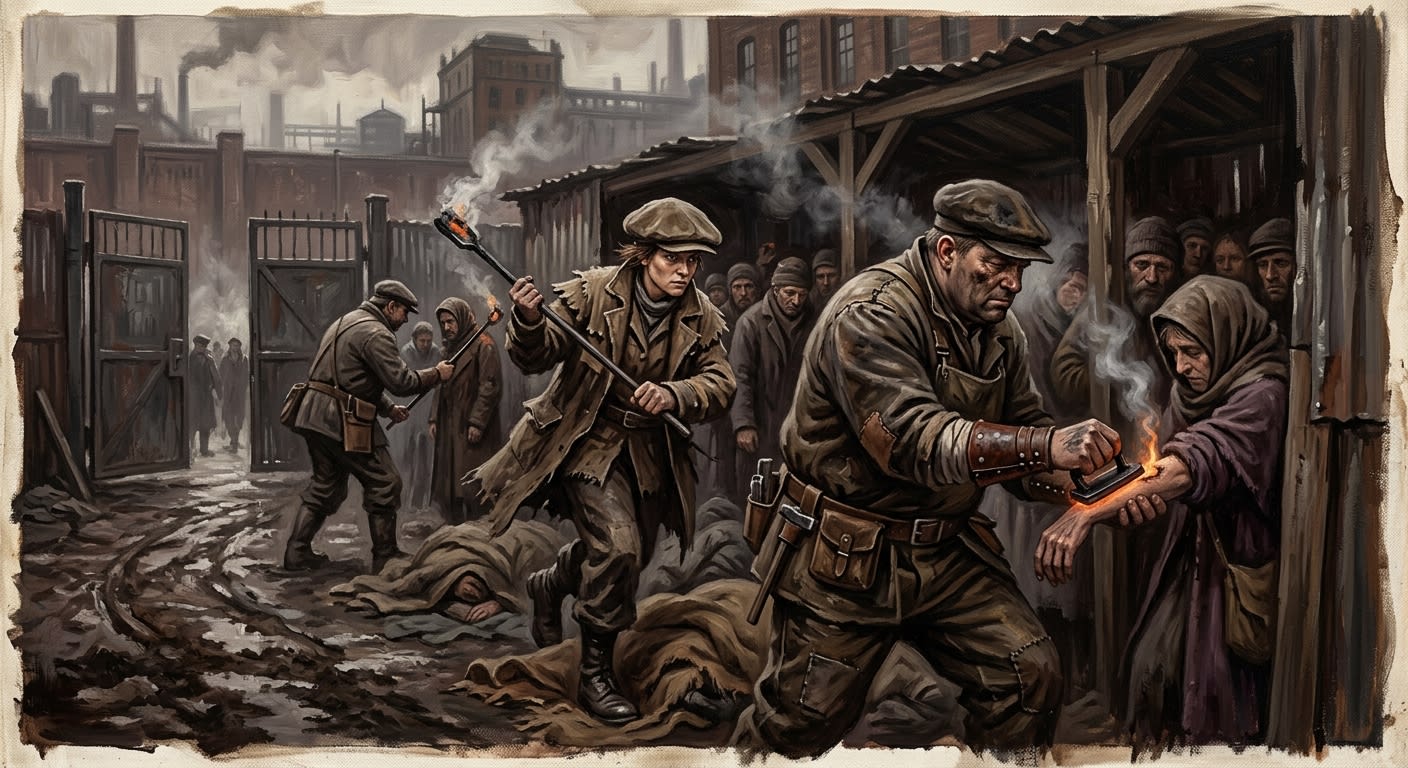
The Quick Burners are the trench-yard and levy-cart faction of the Geometry Brand-Smith Corps: Brand-Smiths who hold that a mark applied imperfectly before gate-close is preferable to a perfect mark contemplated after the convoy has been eaten. They work in muster sheds, rain tents, ration lanes, field courts, quarantine benches, bridge approaches, pilgrim corrals, and those charming forward huts where the floor is mud, the roof is ammunition canvas, and the nearest witness clerk has been awake since Tuesday.
Their creed is output. Wrist, frame, heat, hiss, plate, next. Face, frame, heat, bandage, next. Forearm, seal, ledger, refusal, next. A Licensed Chapel Master writes three lines before touching the iron. A Quick Burner touches the iron before the boy can finish lying about his age.
They are licensed, mostly. That qualifier irritates Heraldry, which prefers categories to behave like obedient dogs, but the faction's membership runs from fully credentialed field Brand-Smiths to provisional hands authorised under emergency writ, dismissed chapel assistants recalled for convoy season, Frame-Hands promoted by weather, and men whose badge is valid enough while the line is long. The Bureau condemns this ambiguity in memoranda and depends upon it everywhere carts gather.
#On the Birth of Speed
Quick Burner practice existed in rough form before it had a name. During the Great Retreat, when population was motion and documents were optimism with ink on it, field officers pressed any trained iron-hand into service. A gate required sorting. A ration cart required class marks. A condemned labour batch required proof that could survive rain. The chapel was behind the column, the road was ahead, and the demons, in their vulgar impatience, did not respect full witness protocol.
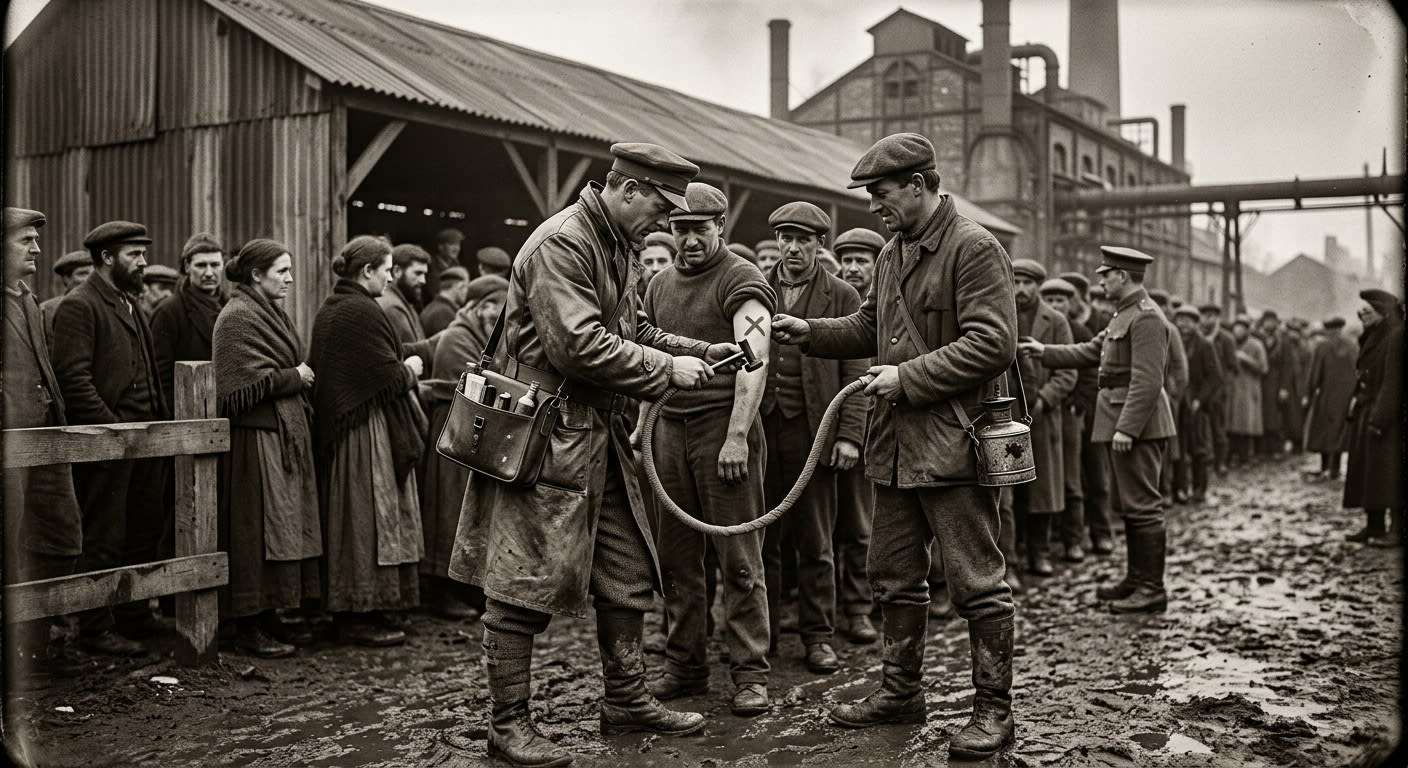
The A.S. 104 constitution of the Brand-Smith Corps gave the practice tools. The A.S. 112 Paper Plague gave it urgency. The A.S. 113 Compulsory Marking Decree gave it endless work. Seven identity classes had to be burned into the forward-zone body: civilian, military, clerical, ward, penitent, pilgrim, condemned. The Decree tripled the Corps, tripled the queues, tripled the opportunities for delay to become riot. The Quick Burner was born where arithmetic met weather.
At Bastion-Brest, boys stood under tar cloth while rain softened their papers and the Bug carried cartridge boxes past the bridge-fortress. At Shipka, time-fog made yesterday's mark look elderly by Sext, and Quick Burners learned to burn deeper because time itself had become a bad witness. At Constantinople, the Bosphorus poured refugees, sailors, pilgrims, deserters, traders, and suspiciously well-fed widows into intake lanes, and the wrist-turning motion invented there became so fast that Purity suspected witchcraft until Heraldry praised output.
The faction's first name was not Quick Burners. Chapel men called them ash-finger hacks. Soldiers called them Wrist Saints, usually after drinking. Levy boys called them bastards, which remains the most accurate folk taxonomy. “Quick Burner” appears in Heraldry routing notes by A.S. 116, attached to a complaint from Przemyśl stating that accelerated teams had “reduced gate congestion while increasing subsequent interpretive burdens.” The phrase means: the line moved, and later someone had to explain the scars.
A chapel memorandum of A.S. 118 described Quick Burners as “unlicensed trench imitators.”
Corrected. Many Quick Burners hold valid Brand-Smith licences. Others hold emergency writs, provisional authorisations, field endorsements, or the favour of officers whose supply columns would otherwise rot. The Bureau recognises the distinction when prosecuting and forgets it when requisitioning.
#On Method, Kit, and the Ugly Mercy of Movement
A Quick Burner kit is chapel equipment stripped of ceremony and packed for abuse. Three irons. One field frame with dented corners. Swatch plates wrapped in oilcloth. Vinegar. Salve. Record tags punched in bundles. A heating lamp that smokes. A ledger board with a clamp. Chalk. Twine. A prayer card so stiff with soot that the words have become devotional texture. The kit smells of singed hair, wet wool, coal grease, and human fright.
The field sequence is short. Identify class. Confirm paper if paper has survived. Expose site. Frame fast. Heat. Apply. Tag. Record if possible. Move the body. Corrections can be made later; this sentence is the faction's defence and indictment.
FIELD NOTE — SHIPKA LOWER MUSTER, A.S. 171 Queue strength: 312 Visibility: poor; bell interval uncertain Issue: pilgrim and levy marks aging irregularly under fog exposure Instruction from captain: burn deeper, record dawn time as Prime regardless of visible light Result: █████ wrists scar-split within nine days Re-inspection request: deferred by weather Names of boys transferred before review: sealed
Quick Burners speak of movement as mercy. A marked man passes the gate. A marked ward gets fed. A marked pilgrim joins the guarded chain instead of freezing outside the cordon. A marked levy boy boards the cart, which is a mercy only in the narrow theological sense that paperwork has ceased tormenting him. Delay kills at forward checkpoints. The Quick Burner has seen this. The Chapel Master has read about it in a report whose corners were unbloodied.
Their marks run hot and practical. A chapel mark is a sentence written in a court hand. A Quick Burner mark is a docket number shouted through smoke. Good ones are legible at ten paces, shallow enough to heal without splitting, deep enough to resist rain, and placed where the next guard will look first. Bad ones create the Re-inspection Brand-Smith, which is how one trade fathers another by incompetence and necessity.
#On Their War with the Chapels
The rivalry with the Licensed Chapels has the bitter fragrance of family litigation. Chapel purists accuse Quick Burners of profaning bodily proof through haste, sweat, mud, incomplete prayers, shallow witness, and the vile habit of counting people as a queue rather than souls. Quick Burners accuse Chapels of turning pain into upholstery. Both factions are correct enough to be unbearable.
The Chapel says: a false mark ruins a life. The Quick Burner says: an unmarked life may not reach the next gate. The Chapel says: full witness protocol prevents error. The Quick Burner says: witness benches cannot be dragged through shell holes. The Chapel says: exact angle is theology. The Quick Burner says: theology can stand aside while two hundred wrists get processed before curfew.
Quick Burners call the Chapels perfume shops for pain, marble sheds, incense laundries, and, in one Brest phrase regrettably too obscene for the public Codex, “priests of the slow iron.” Chapel Masters answer with audit petitions. This is how gentlemen fight when the cudgels are filed under requisition control.
The hatred hardened after the A.S. 119 Angle Riots at Bastion-Irongate. Licensed Chapels cite Irongate against speed: miscalibrated irons, hasty training, field pressure, false marks on 1,400 civilians, eleven executions before correction. Quick Burners cite the same wound against the Chapels: bottlenecked correction killed as surely as the first burn, and a state that needs three offices to admit a wrong scar has no right lecturing a mud-shed about time.
Heraldry disciplinary teaching once presented the Angle Riots as “the natural result of Quick Burner indiscipline.”
Amended after tool-custody review. The Irongate teams included accelerated hands, provisional Frame-Hands, and at least two chapel-trained operators working under Purity pressure. Blame has since been redistributed with the delicacy of a priest dividing spoiled meat.
#On Mercy, Crime, and Other Accusations
The Quick Burner dislikes Mercy Branders because pity takes time. A Mercy Brander sees the seventeenth boy in rain and wonders whether the wrist can be shaded toward civilian incapacity. The Quick Burner sees the seventeenth boy, the eighteenth, the hundredth, the gate clock, the guard's temper, and the road behind them filling with carts. Consequence becomes arithmetic. Arithmetic, when hungry, has a thin face.
They dislike Shadow Angle crews because illegal speed damages legal speed's already poor reputation. The cellar criminal steals Quick Burner habits: short forms, fast frames, abbreviated prayers, heat tricks, guard slang, scar-position lore. A good Shadow Angle mark can look like field work. A bad Quick Burner mark can look like crime. This resemblance annoys Heraldry, terrifies citizens, and enriches re-inspection.
Quick Burners dislike Re-inspection Brand-Smiths with the special resentment of men whose work is read by men who never saw the queue. Re-inspection asks why the lower point sits half a degree off. Quick Burner answers: because the client was convulsing, the lamp was guttering, the shelling had found the outer road, and the clerk holding the ledger had just fainted into the chalk. Re-inspection writes “insufficient justification.”
The faction has its own shame. Speed attracts sadists who enjoy the lack of pause. It attracts incompetents who hide behind necessity. It attracts officers who measure success by lane clearance and never inspect infection rates. A Quick Burner can save a convoy from delay and ruin forty wrists by dinner. The next convoy will still ask for him by name if he is fast.
#On the Demon-Taint Problem
Marks that move are feared by every Brand-Smith, but Quick Burners fear them with a field-worker's practicality. Chapel men can seal the room, summon Purity, file Form 14-G, and pretend the screaming is contained by tiles. A Quick Burner may discover drift in a rain shed with three hundred people pressing forward and a guard captain asking whether the line has stopped.
Their habits are ugly. Some overburn, reasoning that a deeper line gives less room for hostile motion. Some underburn on suspect flesh and pass the problem down the road. Some mark twice, offset by a hair's breadth, producing scarred confusion that may pass as field roughness until it crawls. Some keep private drift tallies in boot books. Heraldry forbids boot books. Heraldry also reads them when confiscated.
Shipka produces the worst stories. Time-fog makes age unreliable; a fresh burn may wrinkle, pale, darken, or appear listed in yesterday's ledger. Constantinople produces the most profitable stories; dockside Quick Burners know which sailors can pay to have a suspiciously old mark described as “Black Sea weathering.” Brest produces the coldest stories; a wrist may freeze before the geometry reads, and thaw into accusation hours later.
The official doctrine remains unchanged: geometric drift is classed between Purity's demonic interference and Heraldry's instability investigation. Quick Burners translate this into field language: if the triangle walks, step back.
#On the Present Condition
As of A.S. 201, Quick Burners are strongest where the Sagittal Line is least patient: Brest's flat northern approaches, Przemyśl's outer transit lanes, Shipka's fog sheds, Constantinople's dock intakes, Warsaw staging yards, Budapest overflow depots, and any pilgrim road whose queue has begun to mutter in a single rhythm. Their numbers hide inside the 6,400 licensed Brand-Smiths and the cloud of provisional hands that Heraldry counts only when blame requires arithmetic.
Their status is disciplinary usefulness. Too slow to be ignored, too useful to be abolished, too embarrassing to celebrate. Heraldry fines them for incomplete prayer, then requests them for winter convoys. Purity watches them for falsification, then borrows their sheds during sweeps. War curses their errors and sends more wrists. Pilgrimage complains of rough handling and demands faster intake before the next Jubilee chain.
The Quick Burner body ages early. Burn scars across fingers. Smoke cough. Shoulder tremor from repeated frame pressure. Eyes trained to read wrist, cheek, forearm, palm, class, lie, infection, and panic in a single glance. Their humour is foul. A clean run is “choirless.” A client who faints before heat is “early paperwork.” A crooked mark is “future employment.” A chapel inspection is “perfume weather.” They do not joke about missing points. Missing points mean missing people.
Their defence remains brutally short. Without Quick Burners, forward checkpoints choke, convoys stall, wards vanish, levy carts miscount, pilgrim chains break, condemned batches trade names, and the state discovers, for the ten thousandth time, that law written at Strasbourg travels poorly in mud.