
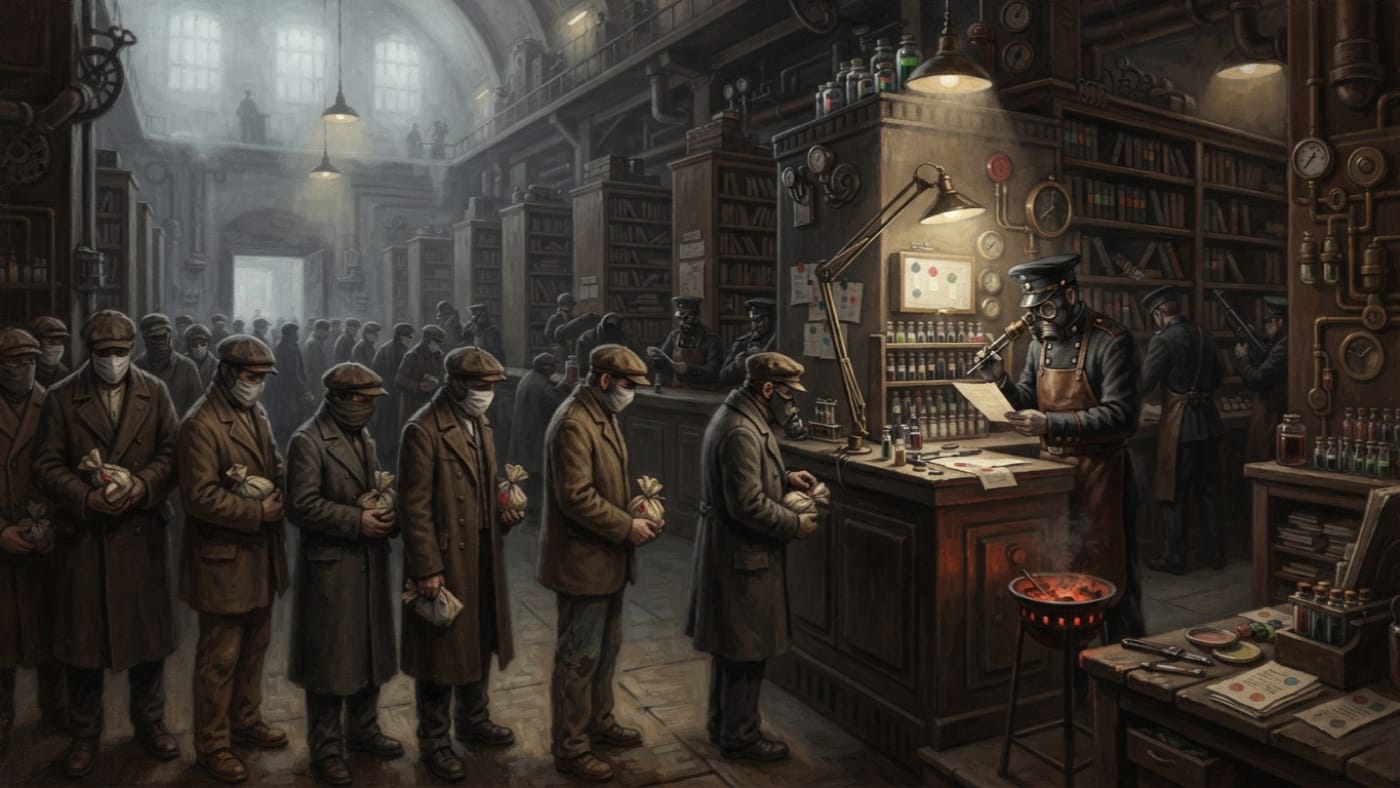
#On the Reconciliation
Chromatic reconciliation is the name the Chromatic Registry gave to the mass revalidation it imposed on the Candlewick Palatinate in A.S. 199. That was the year sealed pages across the River-belt began losing their words. In the dye-house the phrase is innocent. It describes two batches brought into agreement beneath a lamp, a drift corrected and a bolt made uniform. In the Palatinate it means purge. Candlewick likes its knives labelled in the language of quality control.
The programme belonged to the Registry, and through the Registry to the Bureau of Records annex that has kept Candlewick's lawful colours since the vault years. The Seal Provosts carried it out. Its subjects were all the people whose standing rested on a sealed page. In Candlewick that is a census of the living with a few of the dead attached. Baptismal copies, ration books, apprentice contracts, lock chits and mask-ration renewals all bear a shade. Each shade answers to a master phial in a lacquered hall between Bottle Quay and the Records porch.
#On the Emergency Standard
The Fading Winter supplied the occasion. Documents lost their text while wax, signature, registry shade and fee stamp stayed intact, like an honour guard around an empty coffin. The Registry declared heresy, which invites the Great Deceiver into the file and spares the vault any blame. House Vatmarsh declared a failure of mordant salts. The Black Canal declared a market. Behind the quarrel lay Hungry Ink, the Category Two Localized Scribal Anomaly first correlated with ash in A.S. 143. That was fifty-six years of pending classification that nobody had been permitted to promote into a cause. It remains unpromoted. This file records what the Registry did. What emptied the pages belongs to someone else's file, and that someone is welcome to it.
The Registry raised the standard. It fixed new purity tolerances for the sanctioned hues, and documents that had passed under north lamp for years failed overnight. About half the Palatinate's working documents stopped being lawful between one bell and the next. On most of them, not one word had moved.
Every household received a shade-revalidation summons. Candlewick already knew the rite. For years, annual Shade Revalidation has sent clerks into homes for samples, and the city submits with the sullen piety of a parish paying tithe. The queues, sample cards and phial racks were already in place. Reconciliation fed the whole city through that machinery in a single season and widened what it was entitled to swallow. Workshops had to produce ink recipes, wax records, apprentice contracts, mask-ration ledgers, dye quotas and family papers. That is the drawer every sensible household keeps shut, and it was opened on the counter under armed light.
#On Inspection and Reclassification
The notice runs to three sentences, and each one drives the next. A shade the Registry has not verified is suspended. A document carrying a suspended shade is void until reviewed. A person holding a void document keeps whatever standing the Registry chooses to extend while the review waits its turn. The queue for review was the queue for everything.
The inspection itself is old and exact. The clerk lays the page beneath the shade frame and checks the paper stock and watermark. He reads the fee stamp and warms the wax under a breath-screen. Then he slides reference glass across the ink and compares it under north lamp, gas lamp and Registry neutral glass. He measures it against a hue whose master phial he will never touch. He records the variance in gradations. Under reconciliation, that record became a verdict.
The verdict reached the rest of a person's life through the shade token. Without lawful colour, the mask market refuses filter cloth and the bread queue refuses measure. The lock bridge refuses passage. The Charter Court refuses complaints, because a complaint must be filed under a colour the complainant no longer holds. A suspended household could eat on sufferance and had no standing to protest.
The Seal Provosts brought the method to the workbench. They arrived under audit cover with shade knives, sample phials, armed clerks and portable braziers for confiscated palettes. The brazier was lit before the findings were written. A one-quarter gradation of variance could shutter a workshop. An unregistered blue could hang a printer. A worker with an expired mask filter could be detained for pigment exposure, then questioned about procurement irregularities while in detention. He could then be released without employment, papers or legal colour. Each stage was lawful on the strength of the one before.
Canal brokers and several shuttered masters allege that certain Provosts carried their own outlaw blue and found it wherever convenient. The allegation is unproven. It is also priced into every bribe, and in Candlewick that is the kind of evidence courts decline to hear.
#On the First Month's Account
Eighteen workshops closed in the first month. Forty-seven workers across the Palatinate were reclassified as unlicensed. Bottle Quay lost six ink-bottling rooms, with benches sealed and furnace books seized. The Lantern Mile lost two wick halls. These district losses fall within the citywide count. The reader who adds them to the eighteen has invented workshops, and the Registry has enough of those already. Rooms and workshops are different units anyway, and the surviving tally does not say how the forty-seven divide among the districts.
According to the surviving account, Vatmarsh Row lost nothing worth naming. Note the wording. It does not claim that no Provost crossed a Vatmarsh threshold. It claims that nothing worth naming was taken there. Reports have circulated of concessions bought with scarcity: slower inspection of House casks and reduced Provost access to the upper vats. The Records Annex denies making concessions. The House denies requesting them. The mordant shipments resumed.
Purge Ledger 199-CR/Amber lists forty-seven reclassified workers. Eleven names are visible. Twenty-three have faded from the ledger itself. Thirteen survive only as wax impressions without corresponding text. Registry annotation: "Persons successfully reconciled." Bureau of Doctrine annotation: ██████████████████████████.
The ledger records entries, and entries are what it lost. It proves no deaths and no disappearances. Thirty-six reclassified persons are now attested only by the seals that condemned them. The Registry considers this a satisfactory archive.
#On the Price of Revalidation
Inspection needs light and permanence. House Wickwarden sells the first and House Vatmarsh the second. No shade can be compared without Wickwarden candles and wax, and no lawful ink holds without Vatmarsh mordant. The Registry's reach stopped where its suppliers' leverage began, while ordinary workshops lost their standing by the dozen.
Both Houses found the season profitable. Vatmarsh hoarded mordant salts while insisting that supply was stable. Wickwarden's wax shortages arrived in step with the audit cycles. Its overcoat wax, made mandatory for vulnerable documents, is reported to have tripled in price. Priests then began asking for it on marriage records and on baptismal copies sewn into infant clothes. Each House blamed the other's product for the fading, and each accusation sold goods. Profit after a calamity proves appetite. This file accuses neither House of authoring the winter.
The revalidation counter created its own customers. A household with a suspended licence needs a paper that will pass once. The Black Canal Syndicate and the Black Canal workshops beneath the dikes supplied replacement papers. They sold blank-backed licences under genuine seals, with the text to be added later. They also sold fade-proof ink in three grades: false, dangerous and effective. Effective samples reached the Bureau of Alchemical Standards and other offices that deny receiving them. The effective grade is the most expensive and the least advertised. No reliable general remedy has been certified. The Provosts' accusation that the Canal caused the winter remains an accusation.
#On the Continuing Review
A.S. 201 finds the Fading Winter still running, and reconciliation with it. The Registry declines to quantify current losses. Masked queues still form in the fog outside the Registry porch, clutching oilcloth bundles. Barges at the Seal Locks still wait on shade tokens. High Registrar Sable Vorn has asked for authority over shade tokens throughout the River-belt. The Bureaus of Passage, Tithes and Purity object, each to protect its own receipts.
The official claim is that reconciliation stabilised the outbreak. The supporting observation is that fading slowed where Registry authority expanded. The measures may have worked. The Registry may have learned to count differently in districts where it now controls the counting. Or some third cause may have shifted at the same time. The correlation proves none of these, and the Registry has published no figures that would let anyone else decide.
Earlier assessments described the Fading Winter as "a contained incident."
Withdrawn. As of A.S. 201 the incident is ongoing, its loss rate unpublished and its review unfinished. "Containment" describes the Registry's jurisdiction better than it describes the anomaly.
The remedies that act on the page are known and imperfect: salt-stopped margins, wax overcoats, triple copies, and names recited aloud before the seal comes down. They slow the fading. Closing workshops and reclassifying apprentices act on something else, and the Registry finds that supply far more plentiful than mordant salt.