
#On the Roads That Pretend to Be Natural
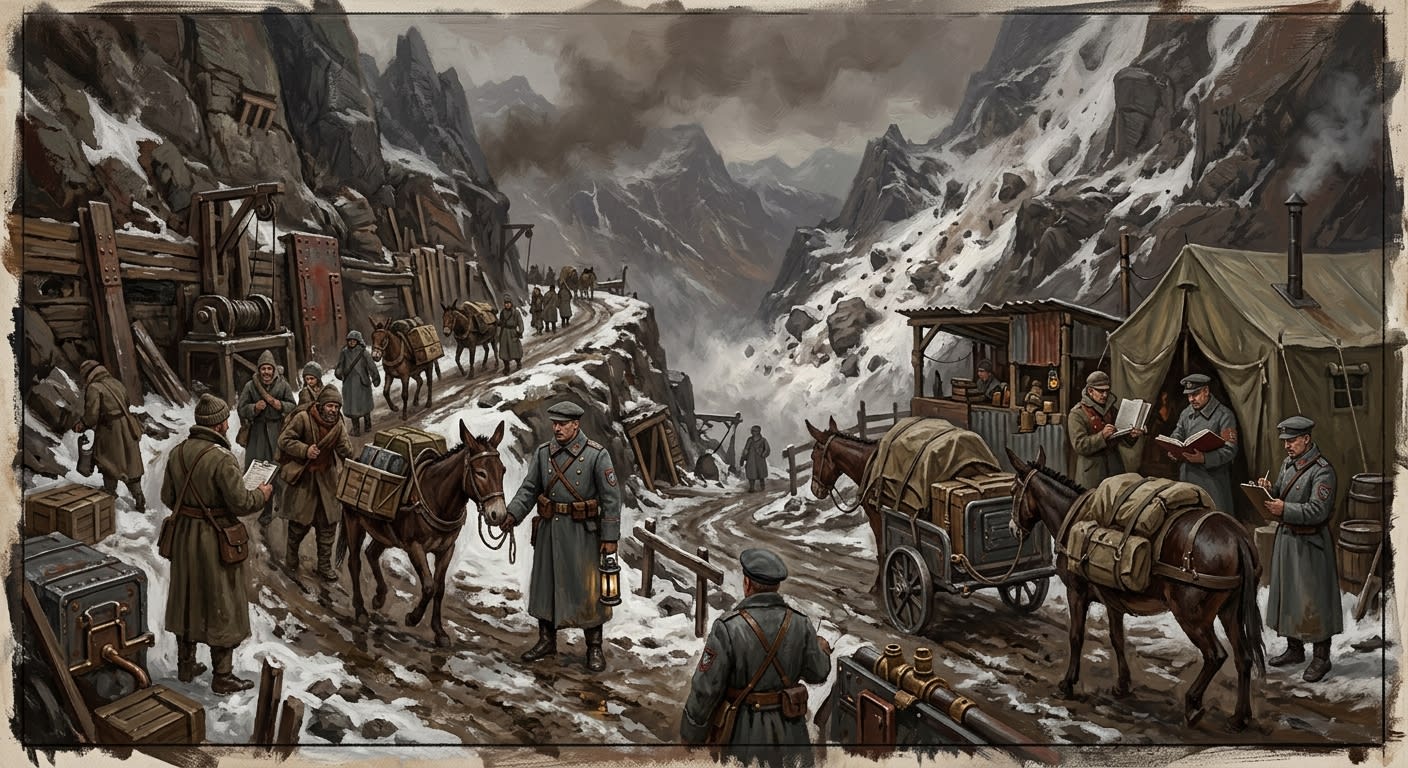
The Carpathian passes are the sanctioned wounds by which the Synod permits men, relics, mules, soldiers, penitents, flour, artillery mouths, fever, rumour, and contraband piety to cross the middle mountains without admitting that the mountains have final jurisdiction. They lie within the greater Carpathian defensive spine, feed the Carpathian Gates, serve Bastion-Przemyśl and Bastion-Sibiu, and irritate every Bureau that has ever attempted to convert slope into schedule.
A pass is a road when the weather is obedient. A pass is a grave when the weather remembers its ancestry. A pass is a shrine when enough bodies have been buried beside it to justify a fee.
The Bureau of Records classifies the Carpathian passes as “approach corridors, military-pilgrim mixed use, Zone Four pressure.” The Bureau of Pilgrimage classifies them as holy roads. The Bureau of War classifies them as supply necessities. Tithes classifies them as opportunities. Purity classifies them as infection vectors with scenery. The passes classify all these opinions as snow.
#On Old Tracks and New Ownership
Before the Sundering, these passes carried salt, cattle, timber, iron, wool, wine, miners, letters, bride-carts, smugglers, monks, brigands, and tax fugitives whose moral status depended entirely on whether one asked the lord at the eastern tollhouse or the lord at the western one. Old powers understood the passes as income. They built chapels at turns, chains at bridges, inns at water, and little gallows where the view was good enough to instruct approaching travellers.
Hell improved the traffic.
After A.S. 45, refugees poured west through the same cuts. Relic crates rode under blankets. Priests hid bones in grain sacks. Engineers chalked slopes for guns. Local guides sold wrong directions to enemy scouts and right directions to Synod officers at prices that Doctrine later described as devotional facilitation. Every pass that held for a week became a military route. Every route that held for a season acquired a shrine. Every shrine acquired a clerk, a tariff, a bell, a dispute, and a dead man alleged to have smiled at the correct moment.
Early pilgrimage broadsheets described the Carpathian passes as “ancient roads freely offered by faithful mountain communities.”
Corrected. The communities offered what they could not defend, sold what they could, hid what they loved, and returned when the smoke thinned. Their faith was real. So was the invoice.
A.S. 65 fixed the Sagittal Line in principle. A.S. 67 made Przemyśl the northern choke of the western Carpathian passes. The A.S. 72 winter loss of eleven wagons and three hundred mules gave the signal chain its first mandate and gave lowland planners a rare glimpse of their own stupidity. By A.S. 74 the Sixth Carpathian Route Audit had widened the old shepherd track that became the Reliquary Switchbacks. By A.S. 75, the Wire Orchard had begun changing every approach into a question asked by metal.
The passes were old. Synod ownership was new. Ownership, in Strasbourg usage, means the paperwork survived longer than the previous claimant.
#On Pilgrimage, Tokens, and the Confraternity of Saint Edras
The Bureau of Pilgrimage did not invent devotion in the passes. It strangled competitors and inherited the corpse.
Before the Harmonized Routes Edict, the Confraternity of Saint Edras held much of the Carpathian pilgrim traffic by custom, rope, bell, and local terror. They knew which shrine steps cracked in frost, which inn watered broth with corpse-melt, which bridge chaplain would accept a hymn in place of coin, and which ridge should be crossed in silence because the echo answered with names from the death rolls. This knowledge made them useful. Usefulness made them independent. Independence made them offensive.
After the Belgrade miracle swelled pilgrimage across the continent, eight private pilgrimage guilds carved the roads into fiefdoms. Santiago's toll riot in A.S. 121 supplied the excuse. The Harmonized Routes Edict of A.S. 123 supplied the blade. Guilds were absorbed, immured, or encouraged toward England, that damp receptacle of our administrative refuse. The Carpathian passes became Bureau roads, their older customs copied into manuals after being denounced in sermons.
Tokens rule the passes now. Bronze for local shrine circuits. Silver for inter-provincial road. Gold for the Great Passage toward war-bastions and Line shrines. The token's little stamped face carries more authority than a hungry man, which is why hungry men steal tokens and the Bureau brands hungry men rather than revising the system.
#On the Peregrine Wardens in the High Roads
The Peregrine Wardens are the Bureau's armed answer to altitude, banditry, guild nostalgia, counterfeit tokens, lost penitents, private tolls, and mountain villages whose definition of “licensed route” begins with “my grandfather said.” They patrol the passes in files of six to twelve, road-grey coats stiff with sleet, pilgrim-blue sashes frozen into boards, token-hooks at the belt, voidance seals in glove-pouches, halberds polished only where use has removed the grime.
Their protection is real. Bandits avoid Warden roads unless hunger, pride, or arithmetic has failed them. Pilgrim columns under Warden escort reach waystations with more living bodies than columns led by cousin-guides, devotional enthusiasm, or maps purchased near taverns. Wardens drag sleeping penitents from drifts, slap muleteers awake before Syrionic fog turns delay into doctrine, cut rope-lines before crush pressure breaks ribs, and charge rescue notation afterward with admirable consistency.
Their cruelty is real too. Both facts may sit in the same file without quarrelling. Tyranny that works remains tyranny. It also arrives on time.
Earlier Warden manuals used the phrase “pastoral firmness” for high-road discipline.
Corrected after the Lyon Road review and three Carpathian complaint bundles written in the same injured hand. Current terminology: licensed compulsion. The broken arms remain historically valid.
A Warden's voidance seal is the terror of the pass. Pressed onto an inn licence, route writ, caravan clearance, shrine approach card, or guide charter, it turns legal movement into trespass at once. A pilgrim becomes an unregistered pedestrian. A porter-guild becomes a crowd with rope. A mountain inn becomes sheltering infrastructure under suspicion. The seal is small because power enjoys travelling light.
In winter, Wardens tie columns by wrist-cord before the tree line. In thaw, they post rear-watchers for mud loss. During red snow, they issue cloth-mouth orders and forbid singing unless a licensed cantor walks in the file. During mirror-weather, every pilgrim must keep his gaze below shoulder height. A noble once objected that this posture demeaned his rank. The Warden voided his token and let the mountain explain equality.
#On the Reliquary Switchbacks
The Reliquary Switchbacks are the most famous of the Carpathian passes because they combine every Bureau vice into four miles of uphill penance: relic custody, military necessity, devotional theatre, local tolls, contested naming, martyr-credit, mule misery, and the sort of view that causes poets to speak until sensible men push them into snow.
The Bureau of War's A.S. 74 audit identified the old shepherd path as the sole viable relic corridor between lowland spurs and the forward bastions. The path was widened. The cliffs objected. A.S. 76 brought the avalanche that killed forty-seven porters. The dead were declared martyrs of supply, a classification requiring no miracles and little shame. Their femurs were driven into shale at the worst turns. By A.S. 82 every bend had a name. By A.S. 92 a Relic Registry Office had licensing authority. By A.S. 178 the Shrine-Court of Seven Nails had a special dispensation to bless damaged crates without opening them, which is either trust or cowardice wearing incense.
Name-drift is the current nuisance. Certain turns answer to names not in any route book. A bend called Saint Ilvar's Knee may, in fog, become Widow Step. A shrine marked Seventh Nail may demand prayers due to Third Nail. A porter who speaks the stamped name at the wrong turn hears his own funeral toll from the valley below. The Bureau has classified this as Amber. The porters have classified it as “shut your mouth until the mule chooses.”
SWITCHBACK INCIDENT REPORT — A.S. 199 Column reported nine turns on a seven-turn route. Third additional turn contained fresh femur markers with names of porters still alive at departure. Relic crate arrived before column. Crate seal intact. Crate contents warmer than permitted. Disposition: ███████████.
#On Vienna's Shadow Across the Passes
The Siege of Vienna in A.S. 95 hardened the western road system because fear moves faster than masonry. Vienna's nine months of famine, Rationalist artillery, daemon-cult convergence, and the Blow of Saint Rupert taught Strasbourg that shrine-roads could decide war before armies reached the wall. Supplies that fail in a pass become hunger in a siege. Pilgrims delayed in a pass become mobs at a shrine. Relics misrouted in a pass become miracles unavailable when the cathedral doors break.
Vienna became the warning nailed to every Carpathian route desk. The shrine-ruins now stand west of the passes as a living instruction: holy ground must be approached, supplied, licensed, narrated, and monetised before terror does the work for us. The Bureau of Pilgrimage built route discipline from that lesson with its usual delicacy, by which I mean chains, tokens, voidance seals, and clerks whose handwriting could flay bark.
The A.S. 95 route hardening also fed pilgrim habit. Men and women walked to Vienna's warm basalt columns, to Saint Rupert's altar, to the old breach, to gift shops that smell of tin reliquary reproductions and moral compromise. Many came through the Carpathian approaches on their way eastward afterward, convinced that hardship purchased grace. The Bureau agreed, then priced hardship by grade.
#On Present Passage
As of A.S. 201, the Carpathian passes remain licensed, armed, overused, under-mended, and profitable in the sour way of necessary things. The Beaconchain reports answering fog. Peregrine Wardens report more counterfeit silver tokens with correct weight and wrong sorrow. Przemyśl reports forged transit papers after the old Paper Plague made every clerk suspicious and every suspicious clerk slower. Sibiu reports warm coins in convoy purses and mule lines that remember routes their drivers never learned. Pilgrimage reports increased demand for martyr-credit on routes where no martyrdom has been budgeted.
The faithful keep walking. Soldiers keep cursing them for blocking road width. Wardens keep counting them before rescue, after burial, and during disappearance when the numbers still have a chance to behave. The passes keep their own account in frost, shale, snapped harness, swallowed wheels, and little bells found under snow where no chapel stands.
A pilgrim who survives the Carpathian passes arrives changed: poorer, hoarser, stamped, footsore, and better instructed in the difference between faith and footing. The Bureau accepts both as valid proof of passage.