
#On the Instrument
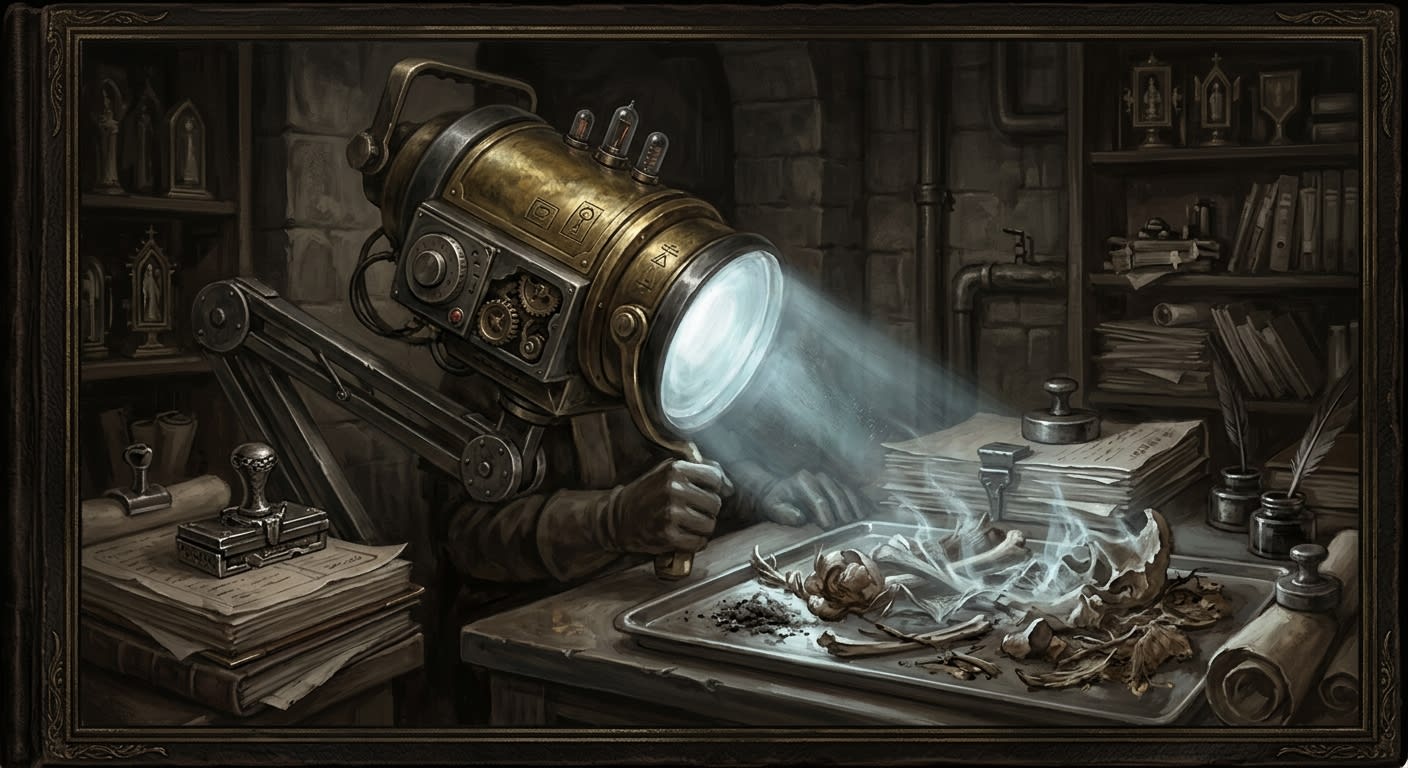
The Blessing Lamp is a brass-handled examination device used by the Bureau of Relics during physical and response testing, designed by the Bureau of Engineering and explained by neither Bureau to anyone’s satisfaction. It resembles a chapel lantern made narrow for surgery: lens hood, thumb shutter, reliquary collar, insulated grip, calibration screw, and a bulb whose manufacture has caused more interdepartmental profanity than several minor wars.
The Lamp does one thing with intolerable authority. It makes relics answer.
A bone placed under common light remains bone: yellow, pitted, impolite to look at over breakfast. A bone placed under the Blessing Lamp reveals grain, heat, shadow-colour, internal fracture, and those small luminous objections by which sanctity announces that it has not finished being inconvenient. The same light has embarrassed Caldre’s disciples, unsettled Counter-Relic Examiners, and made several Vault custodians request duties involving fewer opinions from calcium. Engineering calls the effect anomalous refraction. Relics calls it sanctified luminescence. Both phrases describe the same offence against humility.
#On Its Manufacture
The bulb is made in a sealed workshop in Strasbourg’s Foundry Quarter (Unregistered), behind three doors, two oath-screens, and one elderly foreman who has never smiled in the presence of glass. The glass is cut with relic-dust. Engineering’s requisition forms list the dust as “optical additive, Category: Consecrated,” which is the sort of phrase a man writes when he wants funding without theology. Relics files the same substance as “approved sanctified particulate,” which is the sort of phrase a man writes when he wants theology without liability.
Foundry workers assigned to bulb casing wear lead-lined gloves and throat masks. They are searched before entry, searched after exit, and asked once per quarter whether the bulbs have spoken. Three have answered yes. One heard plainchant before assembly. One heard a single syllable repeated in a child’s voice. One refused to describe the sound until a Purity clerk was removed from the room, after which he described it and was removed from the payroll.
Early Engineering inventories classified worker reports of sound from unassembled bulbs as “fabrication-floor superstition.”
Revised classification: acoustic anomaly. The Bureau of Relics files identical copies under miracle, provisional. Both labels remain active because cancelling either would concede jurisdiction.
The relic-dust source is filed under restricted custody. The public answer is that the dust derives from broken votive fragments retired from service. The private answer is that several batches have included ground Third Class ash, failed saint-bone lime, shavings from authenticated reliquary hinges, and the occasional residue from confiscated relics that should have stayed peacefully mislaid. The forbidden answer is kept in a ledger I have read and will not cite, because even vanity has survival instincts.
#On the Examination Rite
The Lamp enters the seven-stage relic examination during Physical Examination and Response Testing, after provenance has been read and before verdict drafting has begun to smell of fear. It stands between the Candle Proof and the final seal, though the manuals refuse to admit that the Lamp often decides what the seal later pretends to discover. The Relic Authenticator places the object on black felt, opens the shutter to the first degree, and records base response. Second degree follows if the object remains quiet. Third degree requires a witness. Fourth degree requires a superior Examiner. Fifth degree is forbidden outside quarantine chambers, which has naturally made it popular in at least four provincial offices.
Under the Lamp, Ward-safe relics usually show inward warmth: veins of amber light, small halos along fracture lines, a leaning of brightness toward the named saint’s axis if such an axis can be established without making Medicine irritable. Votive relics glow politely or sulk. Frauds remain dead except when embarrassed by fresh paint. Contaminants misbehave.
Misbehaviour includes backward shadows, cold bloom, lens fogging from the inside, heat without illumination, illumination without heat, saint-names appearing in incorrect grammar, and the rare but expensive event known as table ascent, in which the tested object rises several inches and the Examiner discovers whether his knees still remember prayer.
AUTHENTICATION HALL OF BASTION-SIBIU — A.S. 174 Object: glass shard, attributed provenance disputed. Lamp degree: fourth, unauthorised solitary use. Reported phenomenon: “overwhelming.” Structural result: eastern wall displaced outward by ███ feet. Examiner status: reclassified. Shard status: reclassified. Wall status: rebuilt without original stones.
#On Engineering’s Complaint
Engineering hates the Lamp because it works without obeying. The Bureau can calibrate lens angle, bulb heat, glass thickness, handle insulation, and current feed. It can measure refraction through bone, ash, wire, and pre-Sundering scrap. It can produce charts so handsome that even Doctrine would hesitate before burning them. The moment a relic responds, the chart becomes a devotional object and the engineers begin muttering into their coffee.
Relics hates the Lamp because it tells the truth before paperwork is ready. A clean provenance chain may meet the beam and rot into fraud. A confiscated splinter may glow with the serene insolence of a saint wrongly filed. A Counter-Relic Examiner may carry a Lamp into a forward chapel and discover that the soldiers’ lucky finger-bone is neither lucky nor finger, while the cracked medal tied to a dead corporal’s rifle strap throws a light bright enough to shame a cathedral.
The standing compromise is cowardly and sound. Engineering may maintain the housing, lens, and current assemblies. Relics controls bulb issue, dust allotment, calibration rites, and examination authority. Broken lamps return to Strasbourg in sealed crates. Missing bulbs trigger Purity inquiry. Unregistered bulbs trigger executions, though not always of the guilty; guilt is a luxury when glass is singing.
#On the Afflictions of Lamp Hands
Apprentice Authenticators spend their second year learning the Lamp and their third year pretending they do not fear it. Lamp Hands develop crescent burns across the wrist where heat escapes the shutter. Their eyes redden during feast-season surges. Their gloves yellow at the fingertips. Some acquire a habit of turning their faces away from ordinary candles, as if all flames might suddenly begin judging their paperwork.
The old ones become worse. They can identify bulb strain by hum. They can smell adulterated relic-dust before the requisition is opened. They tap the brass housing twice before use, once for function and once for apology. They speak of the Reliquary Schisms as lamp-men speak of all catastrophes: by wattage, by burns, by which superior signed the wrong form. They do not joke about plainchant. They do not stand between a Lamp and a sealed reliquary. They do not allow junior clerks to say “it is only glass.”
Training manuals once described the Blessing Lamp as “safe when used according to instruction.”
Current manuals read: “safer when used according to instruction.” The additional letter cost six hearings, three resignations, and one commendation from a man who died before receiving it. Records preserved the draft with tender malice.