
#On the Census and Its Makers
"A table is a sermon with the pulpit removed."
The Bone Census was compiled in Amsterdam in the Year of Letters, −32 A.S. The old calendar calls that year 1678 CE. No one alive then had heard of the Synod's numbering, which the Synod adopted at its constitution in A.S. 90 and applied backward, as the Synod applies most things. The Census is older than the jurisdiction that condemns it and younger than its offence, and the archive handles it with tongs.
Pieter van Hoorn conceived it in the winter of 1677. He was the compiler. He gathered shrine inventories, chapel catalogues, pilgrim guides, provenance claims, and whatever a sacristan would tell him across a table for the price of a supper, and he cross-indexed the lot. Gerrit Lemstra wrote the inquiries that travelled with it, with a different courtesy for each audience. Jan de Waal kept the addresses, the purse and the copyists. Their lives and deaths belong to the dossier on the three, and the campaign has its own entry. This entry concerns the paper.
A man can be condemned and buried. A table has to be filed, and the filing never ends.
#On What Was Counted
"They counted claims. The faithful heard bones."
The Census recorded two hundred and forty-three relics attributed to Saint Aldebrand. Forty-one were femurs, nineteen were skulls and twelve were hands. Out of professional spite I have subtracted the rest myself, and they come to one hundred and seventy-one further pieces of a single holy man. Cologne claimed seventeen of the forty-one femurs, and swore each of them to be the only one.
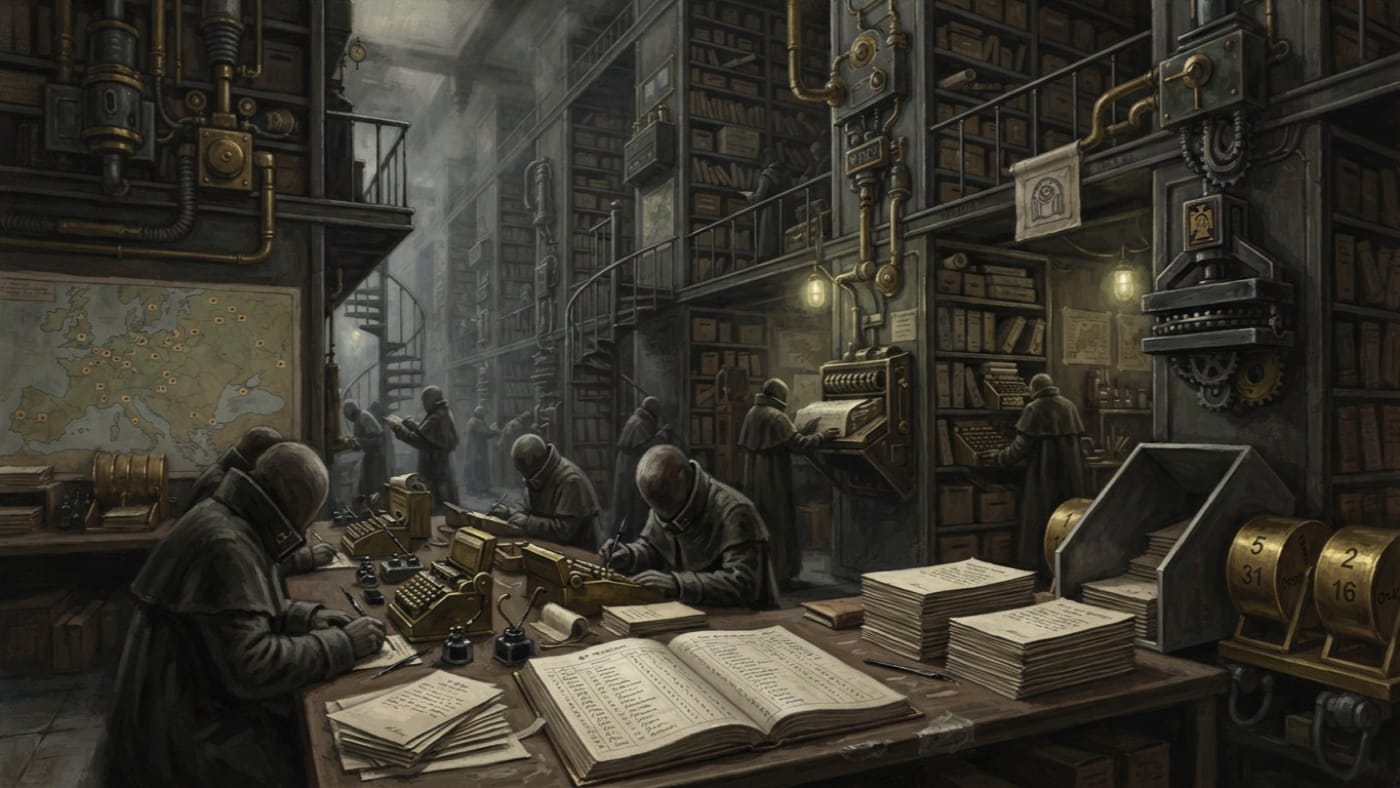
Amsterdam was exact, so the reader must be exact too. The scholars worked from paper. Nobody in Amsterdam assembled two hundred and forty-three bones in one room, put calipers to them, or proved a single provenance false. They took what the Church had written about its own possessions and set those writings side by side. Every figure came from a sacristy register, a chapel catalogue, or a guidebook sold at a shrine door with the Church's blessing on its cover.
That was the impertinence. The ink was ours.
The arrangement did the rest. Each entry named a holding institution, the relic it claimed and the provenance it asserted. The parent dossier records a further field of implied contradiction, where one claim met another that excluded it. I will not describe the ruling of the columns or the order of the cities. A reader who knows the shape of the table already knows half of how to use it.
Read singly, each claim was a pious statement by one chapter about one box. Read together, the claims added up. Seventeen sole femurs in one city cannot all be sole. A skull in one diocese and its twin in another cannot both be the head. The Census pronounced on neither sanctity nor the biological origin of any object in any case. It put the claims in a row and left the row to speak. Rows are fluent.
#On the Delivered Question
"A book has an address. This had forty."
The Census never travelled alone. From March 1678 it went out by hand as the common core of a letter. Below the table sat a short commentary. Attached was a request to the holding clergy in Lemstra's scholarly courtesy, asking them to reconcile their relic's claim with the competing claims recorded elsewhere.
A chapter could do nothing useful with such a request. Silence looked like concession and abuse looked like fear. A reply granted the question standing, and a question with standing is the first sitting of a tribunal.
Fourteen copyists wrote it out. Three of them were former seminary students, which tells me the old seminaries taught a fine hand and too little loyalty. De Waal sent the copies through Amsterdam's commercial correspondence, the channels that carried bills of lading and herring prices. They went to universities, parish bodies, town councils, merchant guilds and print-houses, with wording adjusted for each. Print-houses got abstracts they could set in type without having to own the whole. Within three months the campaign had reached forty cities. I keep no list of the forty and will not compose one.
A bishop could seize the copy in his own city. The other thirty-nine went on asking the same question in the same polite hand.
#On the Answers and the Erasure
"Forty dioceses received one question. They returned four kinds of noise."
Four answers are enough here. Cologne defended its seventeen femurs as authenticated and declared authentication a matter of faith, outside arithmetic. Trier argued that the bones had multiplied by miracle. The Bishop of Münster burned his copy in the cathedral square, and his congregation pointed out that the fire had not reduced the number of femurs. The Bishop's own census came later. It is undated and sealed, it is a separate document, and it borrows none of these figures.
Vienna had the last word. The diocesan hierarchy of the Holy See of Vienna, acting under the authority of Archbishop Rupert III, struck the Reliquary of Saint Aldebrand from its inventories. It sealed the provenance ledgers, bundled the pilgrimage receipts into a vault, amended the parish registers and cut the custodial chain. The Census had asked how many. Vienna answered that there were none here.
By every account the reliquary stayed in the cathedral vault, still glowing, its case still polished by a custodian whom no payroll names.
The erasure answered none of the table's questions. Fewer pilgrims came to the shrines, and fewer offerings followed. Priests who had sworn authenticating oaths heard those oaths read back to them from municipal galleries. The Census had wounded one set of records. Vienna amputated them, and from then on the faithful doubted every register.
Instructional copies of this file state that the Bureau of Records suppressed the Bone Census and erased the Aldebrand reliquary in −32 A.S.
Corrected. There was no Bureau in 1678, and no Synod until A.S. 90. The erasure was the work of Vienna's diocesan hierarchy under Rupert III. Records holds a later copy of his decree with its own name written into the sentence, and it has absorbed the act into Bureau lineage. The lineage stands. The attribution goes.
#On the Method's Later Uses
"The table outlived its makers by habit."
The Amsterdam men were Rationalist precursors, and they came late to an old quarrel. The Concordats of Ulm had been signed in −55 A.S. / 1655 CE, twenty-three years before the first copy left Amsterdam. The Census did not produce them, whatever certain lecture notes claim.
The Amsterdam Academy inherited the gesture. In A.S. 0 / 1710 CE, thirty-two years after the letters, it published De Vera Luce, which contains the sentence "Let the bones be counted." Van Hoorn had counted one saint. The Academy made counting a creed.
Dr. Matthias Voll turned it into theatre. In A.S. 11 / 1721 CE, forty-three years after the Census, he staged the Trial of Saint Aldebrand's Reliquary. He raised a single displayed femur before a jeering hall and made two priests sign it away as "pig fragment, common, undressed, of no liturgical significance." That was coercion applied to one bone. It says nothing about the other two hundred and forty-two, and the Census never claimed what Voll extorted. The femur afterwards vanished. I record the fact and do not pursue it.
At Vienna in A.S. 95 / 1805 CE, a hundred and twenty-seven years after the Census, the erased reliquary blazed in the field. The Bureau of Doctrine ratified the miracle in A.S. 104 / 1814 CE. The Bureau counts this as vindication. It does not say which of the forty-one femurs, if any, had been lying in the vault, and it repairs no broken transfer in the table.
#On the Sealed Table
"Arithmetic is a clerical function. Clerical functions require a licence."
The published accounts concede the figures. I concede them too, with the bad grace proper to a Warden conceding anything. The condemnation stands on two other counts. The first is inference. From a surplus of claimed bones, the Amsterdam men let forty cities conclude that authentication itself was fraud, and the Church refuses that conclusion. The second is usurpation. Counting relics, comparing provenance and demanding reconciliation is an authenticator's work, done under seal. Three private scholars did it with merchant postage and no seal at all, and they did it well. Their competence is the aggravating factor.
The Forbidden Stacks hold the restricted Amsterdam material: pamphlets, surviving correspondence, and Van Hoorn's letters under quadruple seal. How many Census copies survive, and under how many seals each, is no business of a public entry.
Novice authenticators learn the Census by description: its fields, its routes and its effect on the shrines. They never see the table. They are shown the empty chapels and left to draw the lesson themselves, and most manage it by the second year.
The contradiction the Census recorded is still on file. Cologne's seventeen femurs are still seventeen. The Bureau holds them authentic by seal and holds the count accurate by concession, and keeps both positions in the same cabinet.