
#On the Object That Refused the File
The Reliquary of Saint Aldebrand is a bone in a weapon, a weapon in a custody dispute, a custody dispute inside a miracle, and a miracle the Bureau of Records once solved by declaring it absent. This solution failed. The bone remained.
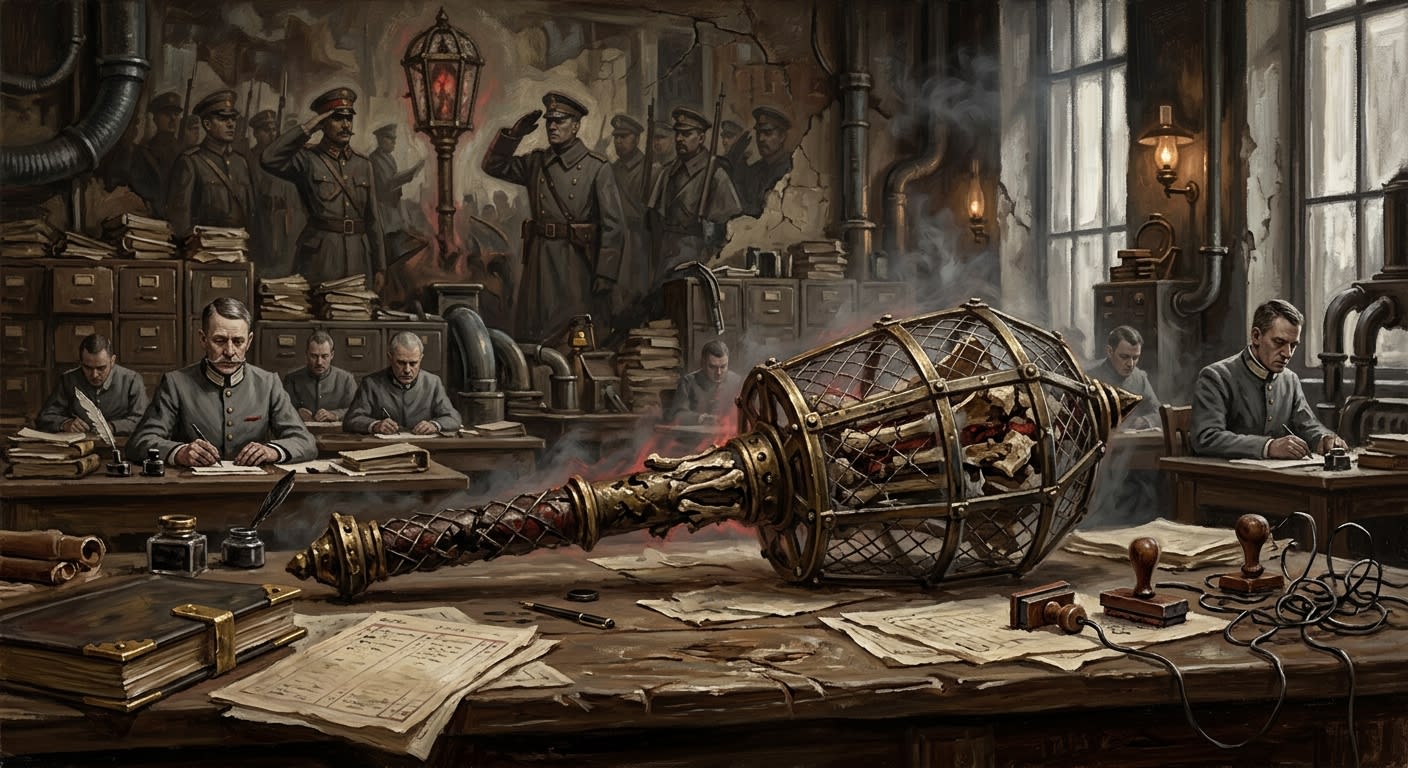
Its most famous form is the reliquary mace carried by Clemens Stahlhand at Vienna in A.S. 95: iron haft, silver reliquary cage, ambered viewing aperture, saint-bone sealed where an ordinary mace would keep lead. It is not beautiful. Beauty would have softened the matter. The head is squat, blunt, and pious in the manner of a parish treasurer denying credit. The chain-rings bear later consecrations; the socket bears older scratches; the reliquary window is clouded where breath, blood, incense, and the marrow-sound of Althazar of Pest met and disagreed.
To say “the Reliquary” is already to have taken a position. The Miracle of Saint Aldebrand entry records, with that exquisite administrative modesty for which I am rightly feared, that the mace is preserved at two locations: Strasbourg Cathedral displays it on the Feast of Saint Rupert; Vienna displays it above the place where the Blow fell. Both carry seals. Both are authentic. Neither has lent itself to the other. The Bureau of Relics has answered the difficulty with the word yes, which, in its hands, has the destructive power of artillery.
#On the Erasure
The Reliquary's first great wound was paper.
In –32 A.S. (1678 CE, before the Bureau's calendar), during the Year of Letters, Amsterdam scholars counted the Aldebrand bones and found the arithmetic impolite. Two hundred and forty-three relics attributed to one saint. Forty-one femurs. Nineteen skulls. Seventeen femurs at Cologne alone, each sole, genuine, notarized, and placed before the faithful with all the confidence of men who had never feared a table. Van Hoorn, Lemstra, and de Waal did not need a hammer. They needed ink, addresses, copyists, and the cruelty of correct counting.
The old hierarchy answered by erasure. The object designated Reliquary of Saint Aldebrand did not appear in current inventories and was classified apocryphal. Inquiry was discouraged. The sentence survives in Records copy and reeks of panic beneath the wax. A false relic invites rebuttal. A missing relic requires only tidying. The bishops chose tidying, as bishops often do when Hell is still theoretical and donors are real.
Instructional broadsheets once taught that the Bureau of Records erased the Reliquary in –32 A.S. under Standing Order 7-A.
Corrected. The Bureau did not yet exist. The erasure was performed by predecessor authorities under the Holy See of Vienna and later absorbed into Bureau lineage after the Concordat of Strasbourg. The Bureau is innocent of the original cowardice and heir to every useful consequence of it.
The Reliquary sat in the Viennese vault, unlisted, un-inventoried, glowing faintly when candles guttered. A custodian polished its case. No document admits the custodian. No payroll admits the cloth. No ledger admits the glow. The absence was maintained with daily care, which is the highest form of bureaucratic devotion: labour performed for a fact the office denies.
The erasure prepared the miracle. This is not what the Bureau intended, which is why the sentence has never appeared in catechism. A relic known, celebrated, insured, taxed, and escorted is a public instrument. A relic erased from every ledger and yet still polished in the dark becomes something sharper. It has no file to protect. It has no reputation to lose. It waits.
#On the Trial and the Laughing Bone
The A.S. 11 Amsterdam trial gave the Reliquary a second death, this time under laughter. Dr. Matthias Voll raised his femur, named his centipede, and watched the hall laugh with the clean joy of men discovering that mockery may wear spectacles. Two priests were bound in the front row. They signed what the Rationalists required. The transcript called the bone pig fragment, common, undressed, of no liturgical significance.
The Bureau later annulled the confession by handwriting analysis. This was wise. It avoided pity, avoided martyrdom, avoided the vulgar admission that the priests had been frightened and beaten until their hands obeyed the enemy. A seventeen-degree slant in the letter e saved Doctrine from tenderness. The Synod has made larger structures from smaller angles.
The femur used in Voll's lecture vanished that night. Thieves were blamed. The Bureau of Shadows had not been founded and filed no report, which places the matter among the cleanest signs of its involvement. Whether that femur entered the Reliquary mace, returned to Cologne, passed into the Vault of Ten Thousand Keys, or lies under some Amsterdam canal stone where eels acquire theological opinions, no public office will say. The Reliquary's history is full of such obedient gaps. One learns to read the silence by its posture.
AMSTERDAM POST-TRIAL TRANSFER NOTE — COPY WITHOUT SEAL Object removed: █████████████████. Carrier: none observed. Witnesses: two, both later corrected. Destination: “where arithmetic cannot follow.” Marginal hand, unidentified: “The bone laughed after midnight.”
The phrase has been dismissed as apocryphal, scribal, wine-born, or hostile. I have no need to prove it. The Rationalists laughed in daylight. The bone was entitled to answer after dark.
#On the Mace at Vienna
A.S. 95 made the absence public.
Vienna had died by then more often than some saints have performed miracles. Rationalist capital, retreat-wound, ruin-shrine in embryo: its stones had known reason, fire, hunger, and the sour administration of men who kept filing reports to prefectures already eaten by history. Althazar of Pest held the city with deserters, sponsored mortals, and the kind of authority that grows in rubble when lawful power has gone to pray elsewhere.
Clemens Stahlhand entered the breach with the Reliquary mace. His steel hand held what Records had removed from the world. The mace struck. The testimony is tiresome only because it agrees: a low note in the sternum, flagstones cracking, glass breaking, Althazar dead, the two men beside him dead, the demonic column scattered, and the city entering that peculiar Synodal condition in which ruin becomes asset.
Clemens' sealed testimony contains the line: “It was not I who struck.” The Bureau calls this battlefield confusion. I call it a sentence with better manners than most theology. The hand held. The bone remembered. The blow fell. If the saint chose to take precedence over the bishop, the bishop had the grace to confess it and the Bureau had the instinct to redact it.
The mace after Vienna was no longer merely disputed. It was useful. Usefulness is the shortest road to orthodoxy. The same offices that had tolerated erasure now produced seals, feast allowances, custody claims, guide language, and devotional prints in which the Reliquary looked far more elegant than the object deserves. Artists cannot bear holy ugliness. They gild everything, even evidence.
#On the Duplicated Custody
There are two public reliquary maces.
The Strasbourg mace is displayed through glass at a distance of six feet, beneath guard, near the lower route to the Relics Archive. Its glow is occasional, amber, and best observed by not staring directly, a discipline the faithful lack. The Vienna mace is chained above the altar-site where the Blow fell, warmer to the touch than surrounding iron, unavailable for touching, touched constantly by rumour. Each bears Bureau authentication. Each claims continuity from the Blow. Each has been inspected by Examiners who emerged satisfied, annoyed, and unwilling to share lunch.
The Bureau of Relics does not call one original and one copy. Copies are for printers, coiners, and heretics. It calls both “valid custodial manifestations.” The phrase is ugly enough to be true.
Certain provincial catechists explain the two maces by claiming one is ceremonial and the other martial.
Suppressed. Both are ceremonial when displayed and martial when required. The distinction was invented by men unable to endure two truths sharing a shelf. Such men should avoid relic work, marriage, and government.
The duplication is not unique in Aldebrand matters. Cologne keeps seventeen sole femurs. Ulm reports healing through an undocumented relic in a sealed gallery. Lyon's charnel account describes ash rising into a rod-bearing figure, later struck from hymnals with such force that children now sing it more eagerly. A finger-bone sits, or sat, or continues to sit, in Velmora's Gilded Chasm, where desire is catalogued by appetite and every display case prices the viewer. Aldebrand is prodigal with remains. The Bureau is prodigal with seals. Providence is prodigal with jokes.
The duplicated maces serve different appetites. Strasbourg's satisfies the capital: it proves that the centre owns the miracle by owning its paperwork. Vienna's satisfies the wound: it proves that the stone remembers the blow in the place where the blow purchased memory. Remove either, and the faithful would notice a theft. Keep both, and theologians grow fat. The Synod has chosen fat theologians, as tradition requires.
#On the Bone's Legal Character
The Reliquary is classified as authentic, non-existent, duplicated, and ongoing. These terms trouble laymen, Rationalists, provincial tutors, and small-minded clerks of the kind who believe a drawer should contain one object. The terms do not trouble the Bureau because the Bureau understands hierarchy. Existence is a lower-order property. Filing is higher. Miracle is higher still. Use sits above all three when the Line needs morale before dawn.
The Reliquary's non-existence remains legally active for certain Records purposes. Old pilgrimage receipts cannot be audited without admitting the erased chain. Pre-A.S. 95 custody ledgers cannot be opened without embarrassing dead bishops, and dead bishops, lacking speech, are useful scapegoats only when not overburdened. The A.S. 104 ratification remains legally active for Doctrine. The dual custody remains active for Relics. The Feast remains active for Festivals. The donations remain active for Tithes. The saint remains active at his leisure.
Attempts at physical resolution have failed. In A.S. 112, an unnamed committee proposed comparing the Strasbourg and Vienna maces under controlled conditions. The proposal lost its routing slip before reaching Relics. In A.S. 147, during the Reliquary Schisms, a Medical memorandum demanded anatomical discipline in Aldebrand cases. Relics filed it under irrelevant to sanctity. Medicine resubmitted. Relics annotated irrelevant with emphasis. Records copied both. Doctrine waited, smiling like a cat beneath a cope.
#On the Present Application
The Reliquary is now used sparingly because the Bureau has learned the difference between veneration and provocation. It is invoked in oath formulas for relic custodians, in Vienna pilgrimage rites, in Strasbourg doctrinal examinations, in advanced lectures on authenticated contradiction, and in military sermons when young officers begin to believe logistics alone can save them. Logistics saves bodies. Contradiction saves institutions.
At Vienna, pilgrims kneel along the Via Stahlhand and look toward the chained mace. At Strasbourg, scholars peer through glass and write cautious notes. At Cologne, custodians of the seventeen femurs keep their keys and do not meet one another's eyes during congresses. At Ulm, miners still mention Aldebrand before entering sealed galleries, though the Bureau calls their recoveries occupational. At Lyon, the struck hymnals keep growing new verses in hands nobody admits recognizing.
The Reliquary has never apologised for any of this. Saints rarely do. Apology is for offices that expect audit.
The final instruction for the Reliquary of Saint Aldebrand is simple enough for a child and hard enough for a Rationalist to die resisting: do not count when counting is the trap. Count cannon, rations, dead, candles, floor tiles, petitions, coin, and sins of the manageable sort. Count all the things that submit to number and thank the Ledger for their submission. When you stand before the mace, bow. If there are two maces, bow twice.