

#On the City That Counts Doors
Trier sits upon the Moselle with the expression of an old bishop who has outlived three inquisitors and remembers where each one was buried. It is a Zone 2 heartland city by cartographic convenience, a tariff hinge by Commerce appetite, a chalk wound by Doctrine admission, and an old episcopal animal by every instinct it has failed to kill in itself. The maps draw it as a river city among vineyards. The files draw it as a correction field. The people draw it in old hands on household account books, then copy the approved spelling for inspectors, because survival has always required two scripts and a clean face.
Trier is softer than Cologne in public manner, less grand than Mainz, less theatrical than Rheinscarp, less penitent than Aachen, and more dangerous than all four when left alone with chalk, wine, or memory. Cologne turns memory into finance. Mainz turns passage into law. Trier turns obedience into a local craft so plausible that Strasbourg often signs the receipt before noticing the knife tucked inside the fold.
The common digest calls Trier a Moselle market district. This is true in the way calling a skull a cupboard is true if one has just opened it to store teeth. Trier has markets, tariff houses, ferry shrines, vineyard brokers, chapel courts, Street-Vicar corners, old scriptoria, bridge tolls, wine cellars, river steps, and a civic memory that treats every correction from Strasbourg as one more weather event to be endured, priced, and retold with the names improved.
Trier’s danger lies in its obedience. A disobedient city can be surrounded. A ruined city can be rebuilt. A loyal city that keeps old names, old hands, old corner songs, and old grudges inside correct forms becomes a catechism with a second text hidden under the authorised line.
#On Roman Stones and Episcopal Sediment
The stones under Trier are older than the Synod, which naturally makes them suspect. Roman walls, episcopal precincts, monastery cellars, wine vaults, ferry cuts, and old market foundations lie beneath the current city like prior drafts of an argument no Bureau has fully won. Trier has been imperial, episcopal, Rationalist-threatened, Synod-corrected, Doctrine-marked, and commercially indispensable. It has endured too many authorities to confuse any one of them with eternity.

This is why Trier produced men such as Odo of Trier, who understood that authority does not need to persuade if it can teach matter to seem obedient. His famous sentence — “When we speak, the stones of Strasbourg listen” — belongs to Cologne in public memory, where he uttered it at the Council of A.S. 100, yet it smells of Trier: stone, silence, pressure, and the social usefulness of making non-answer count as submission.
Odo’s title mattered because Trier mattered. Strasbourg was the capital of apparatus; Trier was a city old enough to lend provincial weight without seeming rustic, episcopal dignity without seeming papal, river discipline without smelling of docks. A Hierarch “of Trier” brought into the Inner Circle the prestige of a place that had already learned how cities survive by letting power imagine itself welcomed.
The city keeps him with proprietary reserve. It does not boast too loudly. Loud boasting invites inventories. Instead the chapter schools repeat his formula with a little dry pause before “stones,” and the tariff clerks use stone-assent jokes when a merchant fails to object in time. Doctrine discourages these jokes. Doctrine has never understood that discouragement can fertilise a joke better than applause.
The old episcopal families still trade in Odo’s after-smell. They keep portraits in side rooms, not halls. They cite him during inheritance disputes, not sermons. They know a public saint belongs to everyone and a useful ancestor belongs to the family that mentions him at the correct supper.
#On the Margins Outside the City
The Great Purge of Margins began in A.S. 56 at a Rhineland scriptorium outside Trier, where an Audit-Cantor opened an approved hymnal and discovered acoustics equations beside an antiphon on obedient resonance. The equations were correct. This condemned them more surely than error would have done.
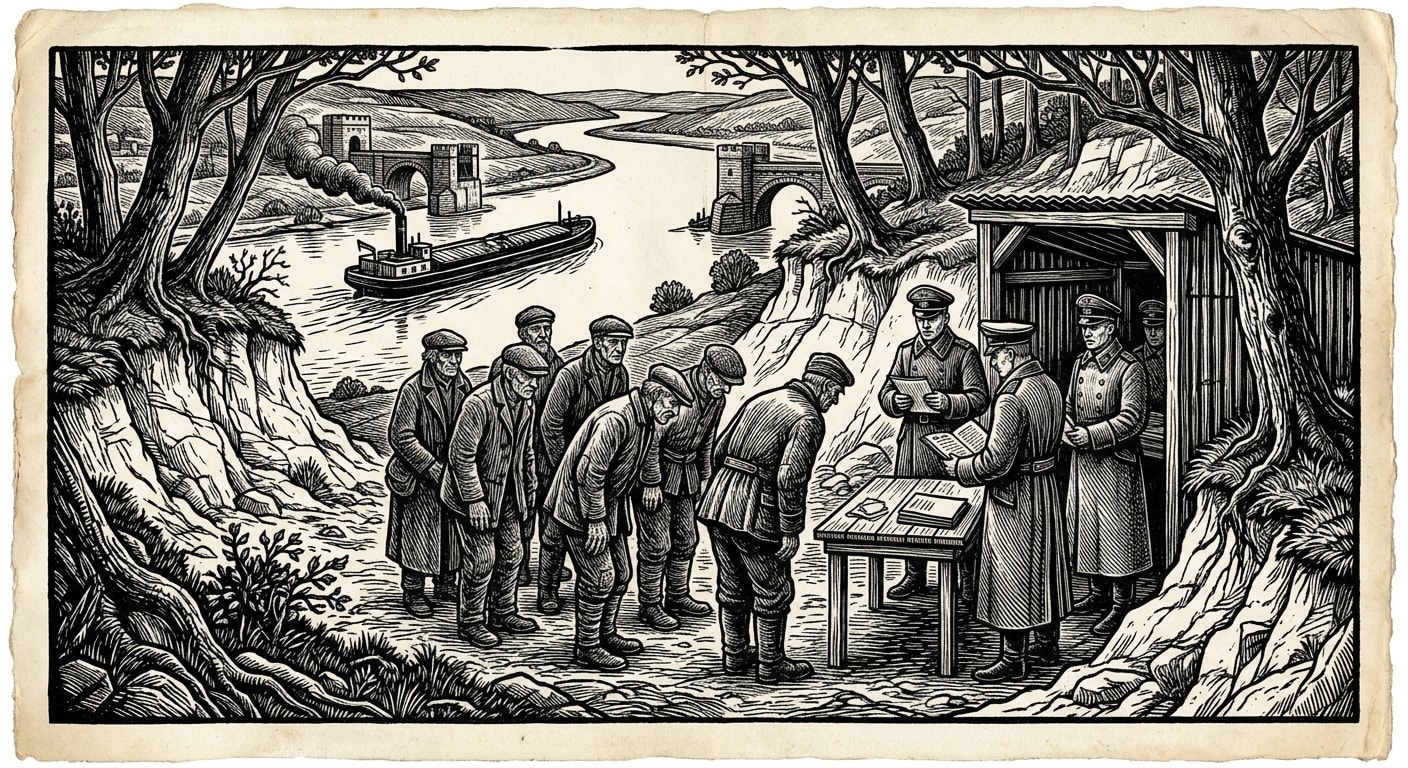
Accuracy without permission is Trier’s old vice. A river city breeds practical knowledge: bridge weight, bell drift, fog intervals, ferry rope stress, wine rot, fever timing, chalk durability, the exact hour a tariff officer becomes hungry enough to accept a lesser proof. Such things enter margins because margins are where useful people place truths too small for doctrine and too necessary for survival.
The first seizure spread into the broader Rhineland audit. Forty-seven scribes died. Twelve libraries were confiscated. Approved books grew cleaner, duller, and safer for fools. The later Ashen Circle learned from the correction: visible margins invite carts, knives, ash tubs, and men with clean cuffs. The knowledge moved into lemon-ink, ash-paper, household recipes, false citations, and mouths too old to frighten until they began teaching children.
Trier did not forget the monk. Of course it claims there was a monk; every practical scandal eventually acquires one, preferably thin, brilliant, and doomed. His name changes by parish. His hand is always small. His equations always survive in some later Engineering correction issued without attribution and priced at municipal rates. Whether one man bore the whole story is irrelevant. Trier requires him. A city needs a martyr small enough to hide in a footnote.
A Silence training digest credits the Trier seizure with extinguishing local marginal practice.
Corrected. The seizure extinguished visible practice. Trier’s later household account hands, ferry blessing variants, vineyard parcel codes, and schoolroom memory drills show the usual result of overconfident suppression: the ink learned manners.
The city’s scriptoria never regained their former innocence, assuming they possessed any. By A.S. 201, Trier’s copy houses are quiet, licensed, and inspected at intervals chosen to insult the calendar. Their margins are white. Their apprentices write approved hands. Their masters keep their eyes on the page and their grandmothers’ corrections in the mouth. Silence counts blank paper. Trier counts grandchildren.
#On the River Hand and the Tariff Soul
A Trier tariff house is a chapel for men who think saints are too generous with exemptions. Salt, wine, barley, coffin boards, chalk, chapel oil, bell hemp, wax, grain receipts, shrine cloth, river timber, and fish packed badly enough to acquire moral significance pass through its counters. Each item receives a name, weight, route, witness, fee, correction mark, and local mutter. The river then carries the cargo onward, which is insolent but useful.
The Moselle hand in Trier is narrow, hooked, economical, and older than the smooth plates issued by Strasbourg. Before the Orthography Purge of A.S. 112, tariff clerks wrote as river clerks had written for generations: compressing custom into strokes, joining letters with the confidence of men whose readers already knew the cargo, the family, the ferry, and the lie. The Bureau looked at these forms and saw contamination. The Bureau is rarely wrong about danger; it is often wrong about ownership.
Corrected forms came. Local ledgers were recopied. Old spellings became conditional. A merchant who had paid under his grandfather’s name found himself asked to prove that the new approved spelling belonged to the same lineage, the same boat, the same debt, the same wife. Trier complied in daylight. At night, household books continued in the old hand because a city may fear audit and still refuse to let Strasbourg decide how vinegar looks in ink.
The Meta-Levy also passed through Trier’s river logic. Upper Moselle arithmetic discovered that collecting a tithe could cost more than the tithe, once escorts, sacks, scales, quills, ferry fees, witness meals, and holy explanations had eaten their share. The supplement that followed became a tax upon collection, then a tax upon the apparatus proving collection holy, then a word so polished that common people required instruction before they knew how they were being bitten.
Trier’s merchants learned to answer with categories too pious to punish cleanly. Funeral loaves, widow fish, votive candles, bell-rope hemp, school ink, chapel mending, ferry oil, winter salt for orphan houses. Tithes called this evasion. Trier called it correct naming. I call it a city using sanctity as a glove while reaching into its own purse.
The tariff houses remain loyal. Their books balance after correction. Their clerks bow properly. Their old drawers hold older slips. A young Strasbourg auditor sent to Trier learns, if he is not irredeemably stupid, that the first number is never false enough to prosecute and never true enough to trust.
The wine brokers are worse than the tariff clerks because they possess politeness polished by alcohol and inheritance. A vineyard contract in Trier may cite the cadastral number, the parish blessing, the slope-name, the old bishop’s tithe, the post-Orthography spelling, and the household nickname by which everyone present actually knows the parcel. One field can have six lawful faces before the first cup is poured. Records calls this duplication. Trier calls it caution. The vines call it nothing, and produce anyway, which is why peasants retain a theological authority no Bureau has successfully taxed out of them.
The ferry clerks follow the same art. They stamp passage chits in black, copy cargo tallies in approved hand, then tell the boatman the bend-name under their breath because a river, unlike a District Office, is not impressed by standard forms during fog. At Trier the old crossing prayer asks the Moselle to return only what it owes. After A.S. 119, a third line crept into some ferrymen’s mutterings: let red sink first. Doctrine has never approved the phrase. Doctrine has also never found the first throat that said it, which is the usual limit of omnipotence.
#On the Market Drift and the Street Corner
During the Market Drift Years of A.S. 98–103, Trier participated in the Rhineland’s most offensive civic habit: discovering that bread, onions, wax, salt, and turnips could be exchanged without the Creed doing all the work. Cologne gave the famous turnip blasphemy. Trier supplied quieter evidence: trade abstracts missing Creed clauses, oath-forms softened into handshakes, market jokes that became safer when spoken as price complaints, and public piety that remained strong in chapel while thinning at the stall.
This frightened Doctrine because decay in markets proves worship has failed to monopolise habit. A man may kneel beautifully at dawn and bargain like a pagan before Sext. A woman may teach the Creed to her children and omit the seal phrase when selling onions to a neighbour who already knows her husband is ill. Such small permissions are how a city teaches itself that obedience can be local.
The Street-Vicar Corps arrived as the official remedy after A.S. 104: square-stops, correction slips, purity-token inspection, chalk codes, chimes, field books, and the miserable confidence of young men authorised to turn hesitation into colour. Trier accepted them at first with the courtesy old cities give to new officials: outward help, inward contempt, and many directions given slightly wrong.
Saint Oren’s gentler legend travelled the river before the Corps had hardened. He belonged to Cologne in the approved story, standing at a market corner and singing until the street remembered itself. Trier liked him because correction without arrest suited local vanity. A city proud of its old manners prefers to be coaxed in public and threatened in private. The Bureau, being less stupid than its enemies hope, permitted Orenic language because soft saints make hard offices smell less like cudgels.
The first Trier Vicars learned the city’s tricks: crowds that recited too well, children who knew all approved answers and none of the useful ones, shopkeepers who corrected one another loudly before a Vicar could issue a slip, old women who asked whether a regional blessing was prohibited in writing and then waited with hands folded while the young man searched his field book. Private mockery obeys better than public defiance. It also lasts longer.
#On Fourteen Doors and One Body
A.S. 119 gave Trier its modern face. An unnamed Street-Vicar entered the market district after Prime and marked fourteen clean households red in a single patrol. Fourteen is now a number with teeth. It should be taught in arithmetic schools after six and before catastrophe.
The households had current purity tokens. Their confession records were unblemished. Their failures were stale attendance, cadence variance, late correction returns, regional prayers, household soup formulas, and the small frictions by which living people insult training manuals. The Vicar marked one door, then another, then another, until the market understood that if fourteen white lintels could be made red by afternoon, white meant only that chalk had not yet arrived.
TRIER RIVER STEPS — RECOVERY NOTE, A.S. 119 Body located below fish mooring; cassock twisted; field book pulped. Chalk case empty. Tongue intact. Left hand closed around red chalk, river grit, and skin from the palm. Name line removed by order ███████████.
By midnight the fourteen households had become a crowd. By dawn the Vicar lay in the Moselle, snagged against a mooring post below the fish steps. His field book was water-pulp. His chalk was gone. His death travelled to Cologne, Halle, and Strasbourg faster than the official courier because outrage, unlike doctrine, does not wait for a correct seal.
Doctrine first called the affair Seasonal Unrest (Devotional), one of those phrases so cowardly it should be kept in a jar. Records later forced correction: the participants were not Rationalist agitators; they were compliant citizens pushed past the permitted price of compliance. The cause became “excess of zeal in application of marking protocols.” The dead Vicar acquired usefulness. Few corpses achieve so much after drowning.
Early Doctrine circulars attributed the Trier disturbances to heretical agitation by Rationalist remnants.
Revised after Records confirmed current purity tokens and clean confession histories among identified participants. The riot came from lawful enforcement performed beyond survivable proportion. The Bureau has since learned to count before it paints.
The A.S. 120 soft-marking reform followed: fading chalk, escort norms, patrol limits, Covenant militia in riot-prone districts, and the unwritten law that six doors require explanation while fourteen writes an obituary. The Marking Vicars took Trier as martyrdom and instruction. The Mercy Vicars took it as proof that private correction was not weakness but crowd control with gentler shoes. Both factions were right enough to be irritating.
#On Patrols After the River
Modern Trier patrols move like men rehearsing before a grave. The Vicar checks his chalk case before entering the market. The two Covenant Military escorts stand visible and silent, decorative in the way a locked jaw is decorative. The field book opens. The chime rings. Fishmongers lower their voices. Bakers watch lintels. Children count before adults tell them not to.
Soft yellow is preferred. Red requires witness notation. Six marks call for explanation. Seven invites review. Ten brings a District Officer’s shadow. Fourteen is never written. It is breathed. The lesson has become muscle memory across the Corps, but in Trier it has become weather. Everyone feels it before the first chalk touches wood.
The Covenant escorts came after the riot, formalised by the reform and perfected by repetition. They are to be visible but silent. Silence, in this arrangement, means the Bureau of Doctrine wishes the public to see the rifle and pretend the rifle is present only because the Vicar may grow tired. The escorts know better. So does the market. A silent armed man is a sentence with the verb withheld.
Escort silence created its own grammar. One pace behind means routine. Two paces means the Vicar expects argument. A hand resting near the sling means someone has misquoted the Creed loudly enough for witnesses. A glance toward the river means every adult in the market has remembered the same corpse. Children learn these signals earlier than catechism, and more accurately, because rifles grade without theology.
The patrol route avoids the fish steps during red-sensitive weeks. Officially this prevents crowd congestion near wet stone. In practice it spares young Vicars the sight of the mooring post where the A.S. 119 body caught. The post has been replaced twice. The memory has not submitted a maintenance request.
The Mercy faction operates well here. A Mercy Vicar can correct a woman beside a rain barrel, fold the slip into her palm, and leave no door for neighbours to gather around. The Marking faction still has teeth. Trier respects teeth when they count themselves. A public mark remains useful against true defiance, forged tokens, deliberate Creed mockery, and the kind of tavern cleverness that mistakes laughter for invulnerability.
The city has become skilled at forcing the choice. Fishmongers recite too loudly when a Vicar passes. Wine brokers place disputed phrases inside commercial politeness. Children ask if yellow chalk fades faster in river fog. Widows hang laundry over suspect lintels without touching the mark. A Vicar must decide whether each act is insolence, obedience, fear, or simply Trier being Trier, which is the fourth category into which most local life eventually disappears.
#On Wards, Last Words, and Household Mercy
Trier’s correction habits did not remain in streets. They entered wards. The Mercy Ward Purge of A.S. 134 across the Rhineland ward circuit revealed what happens when last words acquire prices and comfort learns handwriting. Seventeen Deathbed Confession Harvesters were convicted of selling, suppressing, altering, or misplacing terminal statements. One Trier Harvester used identical language for three unrelated dying men whose ranks, dialects, sins, and relatives differed too plainly for even a tired auditor to miss.
The scandal mattered in Trier because the city already understood the difference between public shame and private repair. A last confession is the most private correction a person can receive. It is also a document, and any document in Synod territory becomes a door through which offices enter with muddy boots. Harvesters in Trier learned to soothe families, protect household names, soften final accusations, hide ugly bequests, and sell mercy by the line. Some saved widows from inspection. Some sold silence to heirs. The Bureau punished both under the same title because intention complicates sentencing.
Double-witness protocol followed: paired stools, wider curtains, ribbons, countersignatures, sealed addenda, and the standing doctrine that last words are mercy only after custody is secured. Trier complied with exactness. Exact compliance is one of the city’s preferred insults. The wards grew cleaner in form, more careful in whisper, and richer in phrases no auditor could prove were local code.
A Bureau of Mercy appendix described Trier ward practice after A.S. 134 as “fully corrected.”
Clarified. The forms were corrected. The families were educated. The Harvesters became less theatrical. Mercy, deprived of obvious fraud, learned smaller handwriting.
The same civic habit joins the Street-Vicar corner and the ward curtain: correction should leave the household able to survive the correction. Strasbourg calls this softness when it cannot bill it, and procedure when it can. Trier calls it manners.
This is why Mercy Vicars find Trier useful and dangerous in equal measure. The city gives them evidence that private correction works: fewer riots, fewer red doors, fewer widows screaming at annex thresholds. It also gives their enemies evidence that private correction hides too much. A whispered Creed repair may save a child from public shame. It may also preserve a household heresy long enough to acquire cousins. Trier’s answer, as usual, is practical rather than innocent. A household that can be mended privately should be mended privately; a household that cannot should be marked before its rot learns courtesy.
The Markers hate this sentence because it sounds like mercy. The Mercy faction hates it because it admits red chalk has a lawful appetite. Doctrine tolerates it because the numbers after A.S. 120 improved, and numbers are the only form of compassion committees can read without moving their lips.
#On the Present City
As of A.S. 201, Trier is loyal in all approved registers. Its markets recite. Its ferry houses stamp. Its tariff ledgers use corrected hands in daylight. Its Street-Vicars carry soft chalk. Its Covenant escorts know which stall corners tighten before a crowd forms. Its ward curtains are properly wide. Its old scriptorium shelves are inspected. Its vineyards submit parcel numbers and speak old names under vine shade. Its children learn the Creed with regional breath carefully ironed flat before public recitation.
The city remains watched because it has improved under watch without becoming grateful. Purity dislikes its clean records. Doctrine dislikes its correct recitations when they sound too polished. Records dislikes its old variants. Tithes dislikes its local categories for gifts. Commerce dislikes its talent for making a fee look spiritually mislabelled. Hagiography dislikes its claims to Saint Oren’s corner-stone chip and refuses to settle them because unsettled relics draw candles. Every Bureau has reason to enter Trier. Every Bureau leaves with a file fatter than expected and less satisfaction than desired.
At dawn the river steps are washed. At Prime the first tariff shutters open. At Sext the market recites with a care that makes young Vicars sweat. In the afternoon, wine brokers argue old parcel names beside approved maps. Near Compline, ferrymen mutter bend-blessings that remain officially classified as non-liturgical safety utterances. After dark, household books open in older hands.
Trier has never needed to be dramatic. Drama invites cavalry. Trier prefers sediment: a little chalk dust under the nail, a little old ink in the drawer, a little river grit in the story, a little Odo in the wall, a little monk in the margin, a little corpse in the Moselle teaching every red mark to count itself before it speaks.
The Vicar enters the market. The escorts follow. The chalk case opens. The river goes on with its usual lack of reverence. Every door waits, white for now.