
#On the Seat Before the Seat
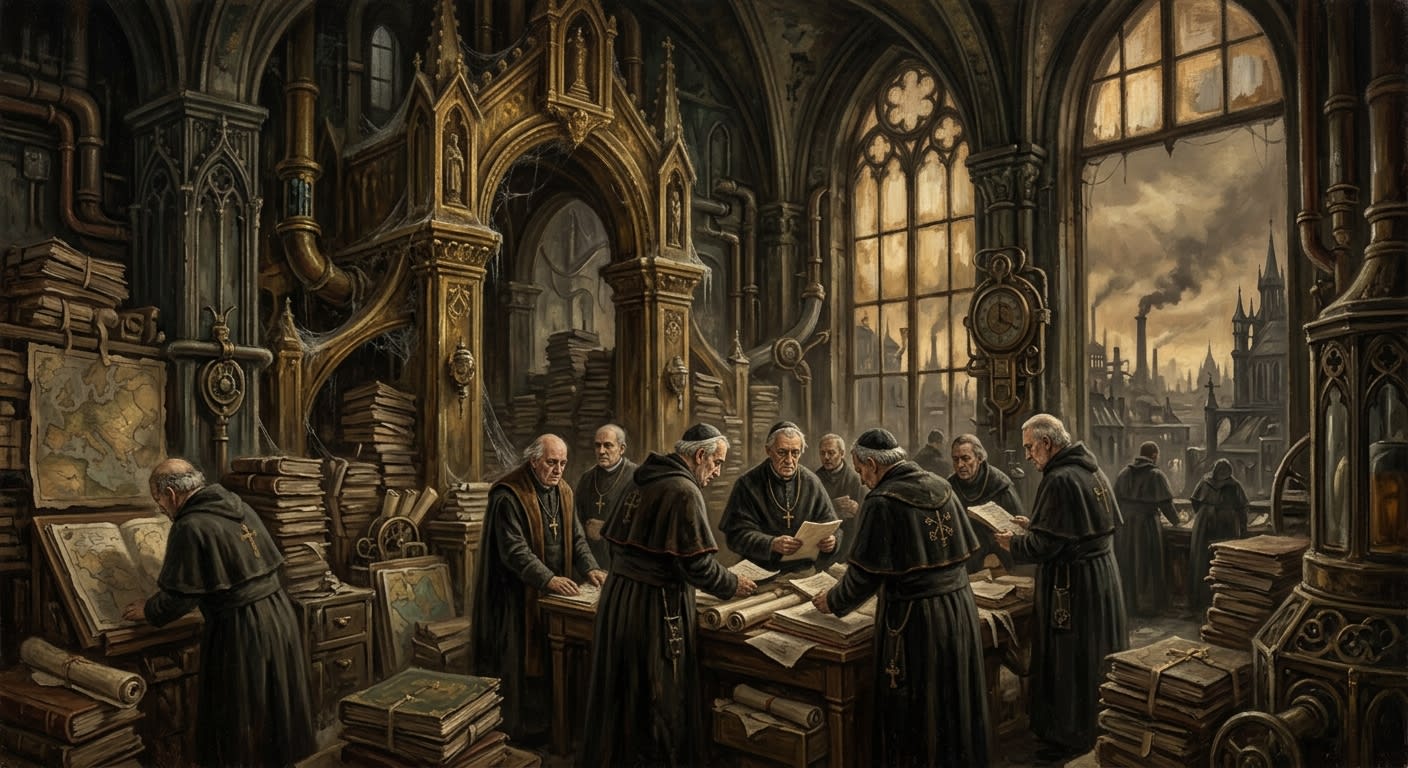
The Holy See of Vienna was the old continental chair of the Church before Strasbourg learned to sit more heavily. It was seven centuries of episcopal precedence, cathedral law, relic custody, dynastic arbitration, chancery habit, and that peculiar Viennese talent for making compromise smell faintly of incense and pastry. It governed poorly, sanctified beautifully, and left behind enough sealed paper to choke three generations of archivists. We honour it for this. We condemn it for much else.
Before the Bureaucratic Synod made governance legible by drowning it in forms, the Holy See of Vienna stood as the nearest thing Europe possessed to a central ecclesiastical conscience. Bishops appealed to it. Kings resented it. Monasteries forged letters from it. Pilgrims invoked it as if a chair in Vienna could hear them from Lisbon. The See answered slowly, expensively, and in Latin so ornate that whole wars had ended before the ablative absolute found its object.
The See's authority was personal, inherited, liturgical, and muddled; the four old pillars of pre-Synodic government. It held no army equal to the later Bureau of War, no census equal to the Bureau of Records, no terror equal to Purity, no appetite equal to Tithes. It had prestige. Prestige is a kind of currency, valuable until a man with cannon refuses to accept it.
By the late old centuries, Vienna held the archives of contested saints, annulled coronations, interdicts against dukes who later donated chalices, and relic chains too tangled for honest men. The Cathedral of Saint Stephen's kept vaults beneath vaults, some older than the stones above them, where the reliquaries of half Europe rested between tours, hearings, miracles, and lawsuits. Among them lay the troublesome femur of Saint Aldebrand, glowing faintly, disobeying arithmetic, and waiting to become a century's accusation.
A just account must admit what the old See achieved. It kept bishops from eating one another alive during three succession crises. It preserved the Aldebrand vaults through wars that had no business sparing anything made of gold. It maintained correspondence across mountain roads, river tolls, plague cordons, and royal tantrums. It produced chancery clerks who could identify a forged episcopal seal by smell. It also mistook paperwork for armour. This is a lovable error in a monastery. In a century of Rationalists, it is suicide with good penmanship.
#On the Aldebrand Wound
The first deep wound came before the calendar wound, in the Year of Letters, –32 A.S., when Amsterdam scholars took up arithmetic as if numbers had received ordination. Van Hoorn, Lemstra, and de Waal counted relic bones, tabulated femurs, posted letters into forty cities, and asked the question by which cowards make themselves sound brave: how many saints may have the same thigh?
The Holy See of Vienna answered by erasure. This was panic wearing a cope.
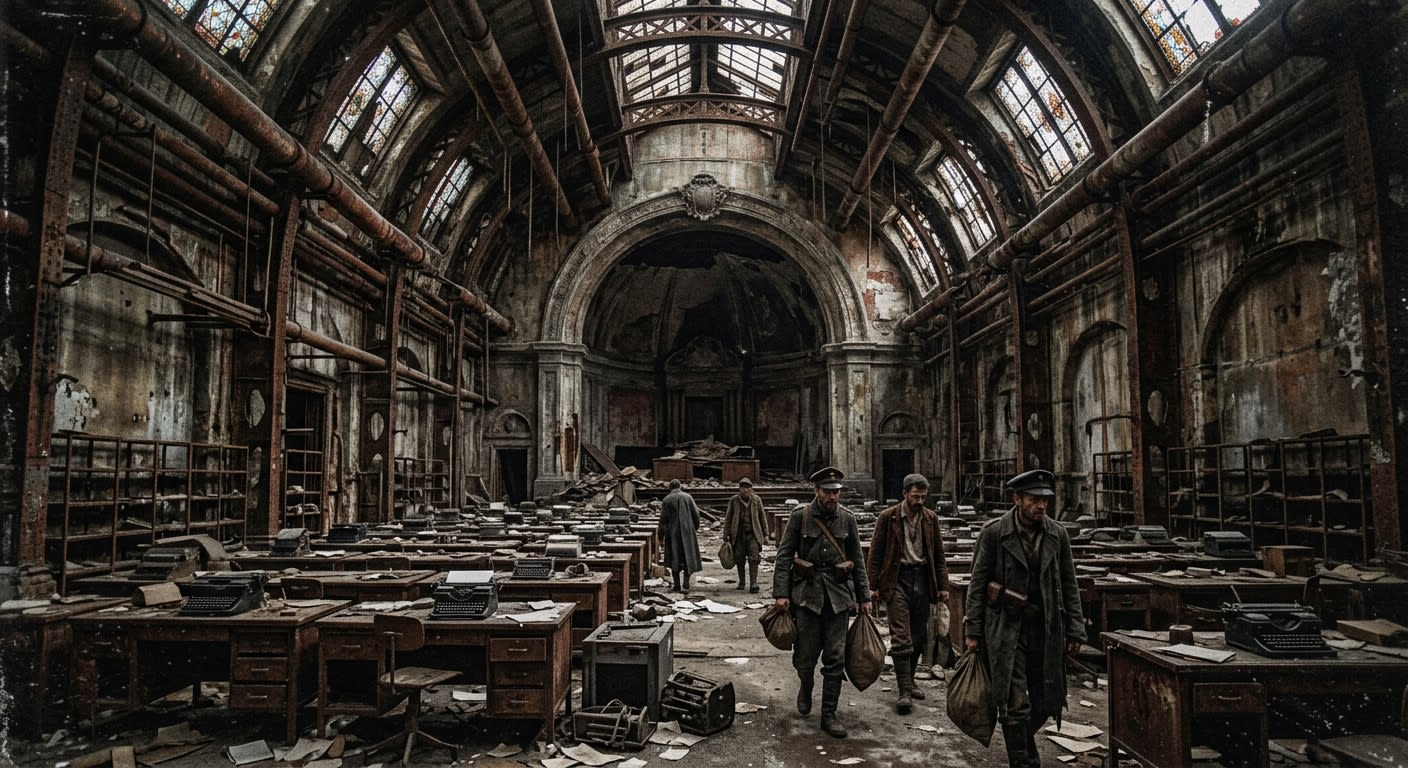
Archbishop Rupert III, predecessor personnel in the Bureau's present classification, ordered the Reliquary of Saint Aldebrand struck from inventories. Shrine receipts were suppressed. Provenance chains were severed. Parish records were amended. Pilgrimage accounts vanished into predecessor vaults whose doors have, by a coincidence the Bureau finds increasingly irritating, resisted seven formal access requests from this office.
The relic itself remained in Vienna. The bone was not destroyed. It was not tested. It was not moved. It rested in the Cathedral vault in a case polished by an unnamed custodian, glowing without permission. The See had performed that most dangerous of institutional gestures: it removed a fact from the record while leaving the fact in the room.
This established the Viennese habit that would later kill it. Faced with hostile reason, the See chose concealment without doctrine, silence without enforcement, shame without discipline. The Synod learned from the error. We conceal with doctrine. We silence with enforcement. We discipline shame until it salutes.
Certain devotional histories credit the Holy See of Vienna with “wise prudence” during the Aldebrand controversy.
Corrected. Prudence would have answered Van Hoorn's arithmetic with theology, trial, fire, or all three in a sensible order. Vienna chose disappearance. Disappearance is useful only when the thing disappears.
The cost was not merely spiritual. The Aldebrand pilgrimage network contracted. Hostels emptied. Shrine coin thinned. Priests who had sworn authenticating oaths found themselves dragged before municipal courts by grinning men with tables of bones. A bishop may thunder against insult. He looks less majestic when asked to subtract femurs in public.
Ulm watched. Amsterdam learned. Paris copied. The Year of Letters did not overthrow Vienna. It taught Europe that Vienna could be made to flinch. The Rationalists required no greater invitation.
#On Reason at the Gate
The century that followed turned critique into program, program into law, law into bayonet. The Concordats of Ulm gave the new scholars grammar. De Vera Luce gave them anthem. The Council of Nine gave them secrecy. The Republican Guards gave them hands.
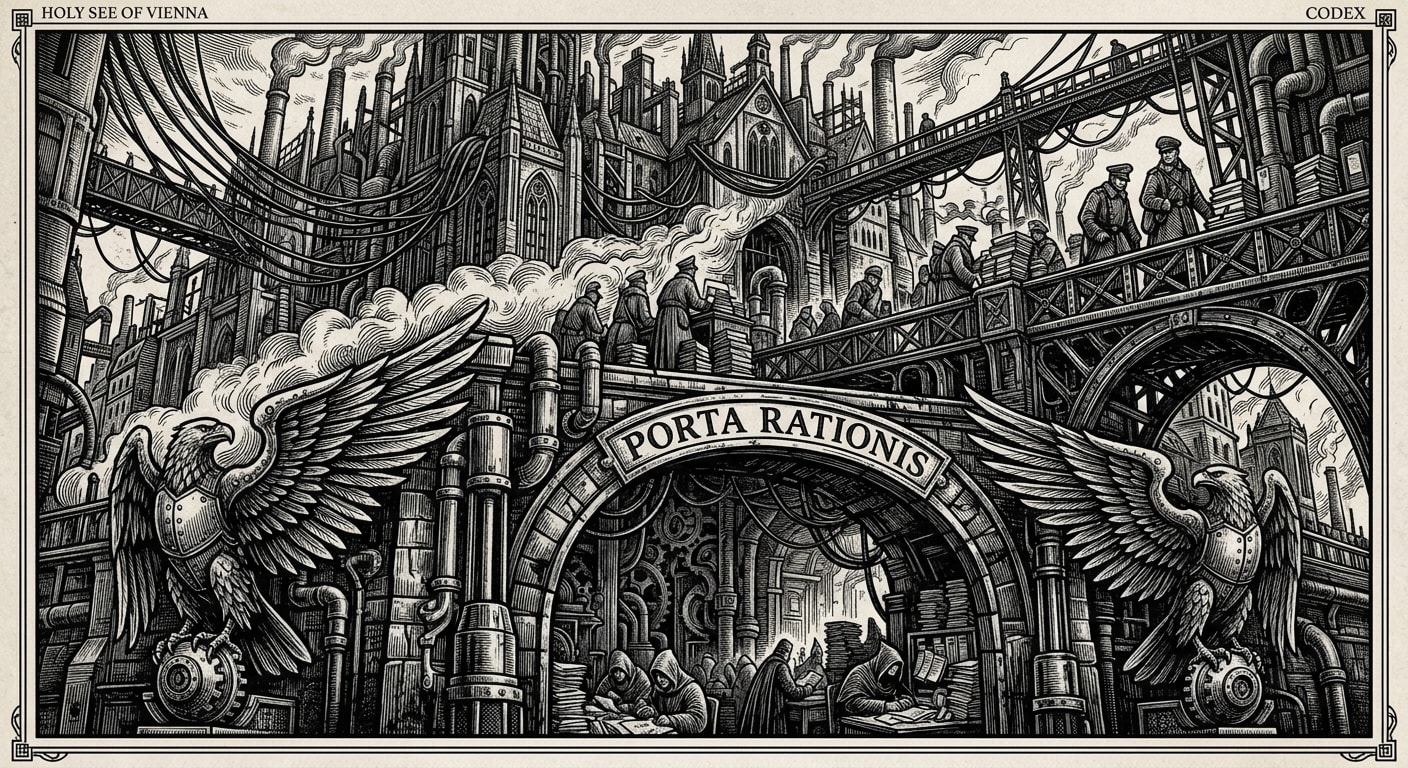
Vienna received the early pamphlets as nuisance, then scandal, then emergency. Its theologians drafted rebuttals of impressive length and uncertain aim. Its chancery denounced university circles. Its bishops demanded apologies from men who were already printing indictments. Its old courts proceeded as if heresy remained a disorder of books and salons, as if a civilized summons could reach a man who had already melted the bell that announced it.
During the Atheist Wars, the Holy See became both symbol and obstacle. Rationalist lecturers called it the rotten hinge of superstition. Faithful nobles called it the last chair of order. Actual soldiers called it a supply problem. The See tried to bless resistance without becoming a field command, condemn excess without alienating desperate commanders, and preserve legal continuity while Europe discovered that continuity burns readily when soaked in oil.
Its failures were not all cowardice. Some were mercy. Some were confusion. Some were the limits of any old authority facing a young machine that had learned to count, conscript, and sneer in three languages. The Rationalists struck monasteries, shrines, cathedral chapters, pilgrimage accounts, reliquary vaults, school foundations, and the small parish webs by which faith travels from kitchen to grave. Vienna condemned each outrage in turn. The condemnations arrived late and beautifully folded.
The faithful needed discipline. Vienna offered legitimacy. Legitimacy matters. It can steady a frightened city. It can crown a campaign. It can make a dying priest believe his death enters a ledger older than the man killing him. It cannot hold a gate when the hinges have been sold for artillery.
By A.S. 25, after the Betrayal of Aachen cracked the northern faithful front, the See's remaining power lay in the fact that both sides still needed it to mean something. The Rationalists needed Vienna humiliated. The faithful needed Vienna unbroken. The Archbishop needed time. History, being badly managed by sinners, gave him Regensburg instead.
#On the Blood Signature
The Treaty of Regensburg was signed in A.S. 30, drafted in nine days, performed in an afternoon, and annulled by Providence before its ink had learned humility. Among its first wounds was the formal dissolution of the Holy See of Vienna. The Archbishop's signature was required. The Rationalists obtained it with the customary instruments of enlightened persuasion: soldiers, threats, ruined churches visible through the windows, and a pen that became useful only after blood was supplied.
The Archbishop signed in his own blood. This fact appears in Rationalist accounts as symbol, in Bureau accounts as evidence, in devotional accounts as martyrdom, and in chancery copies as an irregularity of ink. I prefer the chancery term. It is colder. Coldness suits the room.
Regensburg witness supplement, recovered from a private clerk's packet in A.S. 92: after signing, the Archbishop pressed his thumb below the seal and whispered █████████████████. Three Rationalist signatories asked for translation. The interpreter refused. The interpreter's tongue was removed before dusk. His refusal has been preserved in the Bureau of Silence archive under Gesture, Useful.
With that signature, the See ceased in law. Cathedrals were shuttered or converted into lecture halls. Dioceses became Philosophical Prefectures. Monasteries were declared property of education, a phrase so obscene that even Tithes reads it with admiration. The old central hierarchy fell into cellars, caves, hidden chapels, borrowed rooms, disguised routes, and the hands of frightened faithful who had never wanted to become history's floorboards.
The Cellar Saints preserved what Vienna could no longer protect. This is the great humiliation and the great salvation of the old See. Authority descended from the chair to the cellar. Reliquaries moved under bread. Hosts hid in tobacco tins. Parish ledgers were written on the backs of Rationalist census forms. Cologne, Lyon, Innsbruck, Bavaria, the Palatinate: the living Church became a map of basements.
A sentimental account would say Vienna survived underground. It did not. The Holy See of Vienna was dissolved. Its apparatus broke. Its chair was empty, its courts silenced, its archives scattered, its name dangerous to speak above a whisper. What survived was faith, which is older, dirtier, and less obedient than an office. Offices dislike this. Offices are right to dislike it.
#On the Empty Chair During the Sundering
Fifteen years after Regensburg, the Sundering tore the Balkans open. The Rationalist Republic, having spent a generation stripping Europe of supernatural armour, met the supernatural with minutes, artillery, and disbelief. Disbelief performed poorly.
Vienna stood in the path of the Great Retreat. The city's ancient cathedral spires, heavy with relics the Rationalists had failed to locate or explain, flared when the advance guard approached. Saint Stephen's crypt burned white-gold for six months. Refugees poured westward. Republican clerks continued filing reports to offices that had begun vanishing between one sentence and the next. The Council of Nine dissolved into its own absence. The chair of the Holy See remained empty.
This emptiness matters. A living archbishop might have rallied the retreat or blessed its panic. A functioning chancery might have named the catastrophe before rumour named it worse. Instead, Vienna held as a relic holds: mute, luminous, and surrounded by people asking it to do more than shine.
Older shrine pamphlets claim that the Holy See “guided the faithful through the Great Retreat.”
Clarified. The faithful were guided by relic light, cellar networks, terrified priests, military necessity, and a large number of people running west because the east had learned to scream. The Holy See, as an office, was already dead.
For approximately forty-five years after the Great Retreat, Vienna became a ghost wearing the robes of a capital. Rationalist remnants clung to dead routines. Clerks taxed districts that no longer existed. Soldiers guarded doors behind which no ministry sat. Morwen's plagues passed through. Velmora's agents removed whatever glittered. No Sin-General bothered to enthrone himself there. Ruin has its own discourtesy: it denies the conqueror glamour.
The old See's vaults endured in fragments. Some were opened by looters. Some collapsed. Some were found sealed from within. The Aldebrand materials vanished into three contradictory custody chains, two of which smell of lies and the third of which is sealed under a predecessor classification no living office admits inventing. I have opinions. The vault has locks. Our quarrel continues.
#On Reclamation and Usurpation
Vienna was reclaimed in A.S. 95, when Bishop-Warden Clemens Stahlhand marched east from Budapest with three divisions, a full Bureau complement, and the reliquary of Saint Aldebrand strapped to a gun-carriage. Althazar of Pest held the city then: deserter lord, opportunist, infernal client, administrative blemish with boots. Clemens struck him down with the reliquary. Seventeen accounts agree that the blow rang the marrow of the earth. Seventeen accounts rarely agree on lunch.
The city returned to faithful hands. The Holy See did not.
This is the point sentimental pilgrims miss while pressing palms to the warm basalt columns of Vienna, the Shrine-Ruins. The Synod reconsecrated the city, restored pilgrimage, classified the ruins, raised columns on the cold-fire sites, reopened routes, installed Bureau offices, and made Vienna useful. It did not restore the old central chair. The chair remained abolished, and the abolition, first performed by Rationalists at swordpoint, was quietly retained by the Synod under better vocabulary.
Why no restoration? Because the Synod had no appetite for a rival ancestry. Strasbourg had become the new centre by need, cunning, war, and the sainted brutality of paper. Augustinus required unity. Kratz required instruments. The emerging Bureaus required a past that could bless them without commanding them. A restored Holy See of Vienna would have brought claims, precedents, offended old families, diocesan loyalties, relic disputes, and bishops with memories long enough to be inconvenient.
The Bureau of Doctrine's solution remains elegant. Vienna became predecessor, shrine, martyr, evidence, and warning. It became holy enough to venerate and dead enough to govern. Its archives were harvested. Its failures were taught. Its blood signature was displayed. Its Aldebrand panic was corrected into doctrine. Its title remained in the Codex as a reliquary title: splendid, sealed, unoccupied.
This is not theft. Theft implies illegality, secrecy, and bad accounting. The Synod took openly, ratified thoroughly, and indexed the spoils. The dead See had no further use for its privileges. Strasbourg did.
#On the Vaults, Relics, and Predecessor Personnel
The surviving Viennese materials remain troublesome. Predecessor archives are always troublesome because dead institutions lack the courtesy to use our filing categories. The old See arranged its records by feast, pontificate, donor family, miracle class, wax colour, and, in one chamber beneath Saint Stephen's, the scent of the document when warmed over a candle. Records calls this chaos. I call it evidence that the old clerks were either mad or free. The difference is unpleasantly thin.
The vaults contain, or contained, relic chains for Aldebrand, appellate registers from dioceses now under Bureau custody, letters from kings whose kingdoms are now routes, sealed proceedings against anti-popes whose names have been reassigned to boiler components, and those small domestic records by which an old authority reveals its truest face: laundry bills for episcopal vestments, wine accounts, repair notes for reliquary hinges, complaints about mice in the canon-law room.
The Bureau of Records wants custody. The Bureau of Relics wants access. The Bureau of Pilgrimage wants marketable anecdotes. Purity wants to burn any document bearing Rationalist annotations. Doctrine wants the whole thing quiet until I have finished reading it. This last position is mine and is, for that reason, sound.
The category predecessor personnel was invented to solve a particular embarrassment: what does one call the men who held real ecclesiastical power before the Synod existed, served neither heresy nor Hell by intent, failed spectacularly, and are still needed as ancestors? Saint would be excessive. Traitor would be wasteful. Bishop alone would grant too much continuity. Predecessor personnel fits snugly around the throat.
Archbishop Rupert III sits in that category. The blood-signing Archbishop at Regensburg sits there as well, though whether he was Rupert's successor, coadjutor, rival, captive, or merely the last man the Rationalists could force to hold the pen remains sealed in conflicting accounts. I have requested clarification. The archive has responded with dust.
A pilgrimage catechism of A.S. 134 identified the Regensburg signatory as “Saint Rupert the Last.”
Corrected. No canonisation exists. No “Last” title has been ratified. The man signed under duress, bled correctly, and may yet deserve honour, but honour without paperwork is only weather.
The bones in Vienna do not assist us by arranging themselves morally. Some belong to saints. Some belong to donors who paid well. Some belong to pigs, enemies, anonymous faithful, opportunists, and, in one sealed case, an object shaped like a finger bone that sweats ink during Lent. The old See authenticated by reverence, chain, oath, and custody. The Synod authenticates by seal. Seal supersedes arithmetic. This is the lesson Aldebrand taught everyone except mathematicians, who remain slow pupils.
#On Present Use
As of A.S. 201, the Holy See of Vienna exists in five sanctioned forms: as historical predecessor, as dissolved jurisdiction, as pilgrimage sorrow, as archival quarry, and as proof. Each form is profitable. Each form is dangerous if handled by amateurs.
In catechism schools, children learn that Vienna's dissolution proves the cruelty of Reason and the necessity of unity. In shrine processions, pilgrims kneel along the Via Stahlhand and are told that the old See died so Strasbourg could live. In Bureau schools, clerks study the Aldebrand erasure as an example of concealment without enforcement. In Purity instruction, the blood signature is displayed to show what happens when compromise learns calligraphy. In Doctrine, we use Vienna more carefully. We use it as a mirror with the flattering portions scraped away.
The old See failed because it believed sacred inheritance could outlast organised contempt. It failed because it answered pamphlets like sermons, statutes like homilies, soldiers like petitioners, and arithmetic like a rude dinner guest. It failed because its mercy had no teeth and its teeth had no schedule. It failed, above all, because it thought sanctity could remain above administration.
Strasbourg learned. The Synod keeps relics under lock, doctrine under seal, bells under schedule, pilgrim routes under tariff, dissent under watch, archives under armed courtesy, and bishops under enough overlapping jurisdictions to make ambition die of exhaustion before it reaches breakfast. This is progress. Not moral progress. Useful progress.
There are still Viennese loyalists, though most are dead and the living ones prefer the phrase antiquarian devotional society. They whisper that the old See should be restored in titular form, that a ceremonial Archbishop of Vienna might soothe old wounds, that Strasbourg could show magnanimity by placing a harmless mitre on a harmless head. Harmless is a word fools use for a candle in a powder store. Titles breed claims. Claims breed correspondence. Correspondence breeds committees. Committees breed civil war with minutes.
#On the Counterfeit Continuities
The most persistent danger is not open restoration. Open restoration requires courage, funds, clergy, and a suicidal disregard for Strasbourg's hearing. The danger lies in counterfeit continuity: little titles, commemorative seals, shrine privileges, honorary canons, old litanies reintroduced as local colour, Viennese feast calendars printed with marginal claims no one notices until a province is already bowing to them.
The Bureau of Pilgrimage is the chief offender through innocence, which is the worst kind of offence because it arrives smiling with ticket revenue. Pilgrimage guides love a story with a clean line: old See, martyrdom, ruin, warm column, blessed recovery. They prefer not to mention that the Synod kept the Rationalists' abolition when it suited us. They prefer not to explain that the chair remains empty by policy rather than accident. They prefer a weeping old woman kissing a basalt column to a doctrinal note about jurisdictional inheritance. The old woman sells more pamphlets.
Viennese municipal families exploit this tenderness. Their grandparents kept keys, chapel receipts, baptismal copies, scraps of episcopal correspondence, little pewter medallions bearing arms the Bureau of Heraldry has not yet found time to ban. They bring these things to anniversary rites. They ask whether the old forms may be sung once, for memory. Once becomes annual. Annual becomes customary. Customary becomes precedent. Precedent becomes a lawyer. Then everyone suffers.
Doctrine has issued three quiet circulars on the matter. The first forbade use of the title Archbishop of Vienna in any living style. The second required all shrine plaques to say predecessor authority rather than ancient mother See, a change that caused outrage among poets and relief among intelligent men. The third ordered Pilgrimage vendors to stop selling toy blood-pens to children. This last circular failed. The pens leak red syrup and have become popular in Strasbourg schools, where boys sign mock treaties and girls annul them retroactively. The Bureau of Education calls this civic play. I call it training.
The counterfeit continues because people love a lost throne. A lost throne asks nothing, spends nothing, taxes nothing, and permits every fool to imagine himself loyal without obedience. Living thrones are harder. Living thrones send assessors.
#On the Lesson Properly Drawn
The Holy See of Vienna teaches a doctrine too harsh for pilgrims and too useful for clerks: sanctity must be administered or it will be administered by its enemies. The old See possessed relics, law, memory, grandeur, and a city at the crossroads of Europe. It lacked the machinery to convert those gifts into survival once hostile men learned to move faster than bishops could convene.
The Synod's enemies call our Bureaus grotesque. Correct. Grotesques guard cathedrals by frightening lesser ugliness from the roofline. Doctrine, Records, Purity, War, Tithes, Pilgrimage, Bells, Heraldry, Mercy, Engineering, Relics, Shadows-that-does-not-exist: each is an answer to Vienna's failure. The old See had a chancery. We have a continent of desks. The old See had episcopal dignity. We have stamps that frighten generals. The old See had vaults full of bones. We have vaults full of bones, guards, indexes, duplicate keys, and a policy for when the bone objects.
There remains a private sadness in this, though I resent admitting it. The old See was beautiful in its way: slow bells over the Danube, snow on carved saints, letters sealed in red wax, bishops arguing over precedence while the candles guttered, vault-custodians polishing a bone erased by policy and shining by grace. Beauty deserves record. Beauty does not deserve power merely because it photographs well.
Vienna remains warm at the columns, wet in the sealed pen, bright in the wrong vaults, and silent where a chair once stood. The old See's greatness rests in that silence. A restored office would speak, and speech would diminish it. Better a dead chair that instructs than a living chair that files objections. Better a predecessor that blesses by absence than a rival that remembers too much.
The pilgrim kneels. The guide counts. The column warms the hand. Beneath the city, somewhere behind a predecessor lock, Saint Aldebrand's old paperwork waits with all the patience of a bone that won its argument without moving.