
#On the Schoolhouse That Numbered the Wound
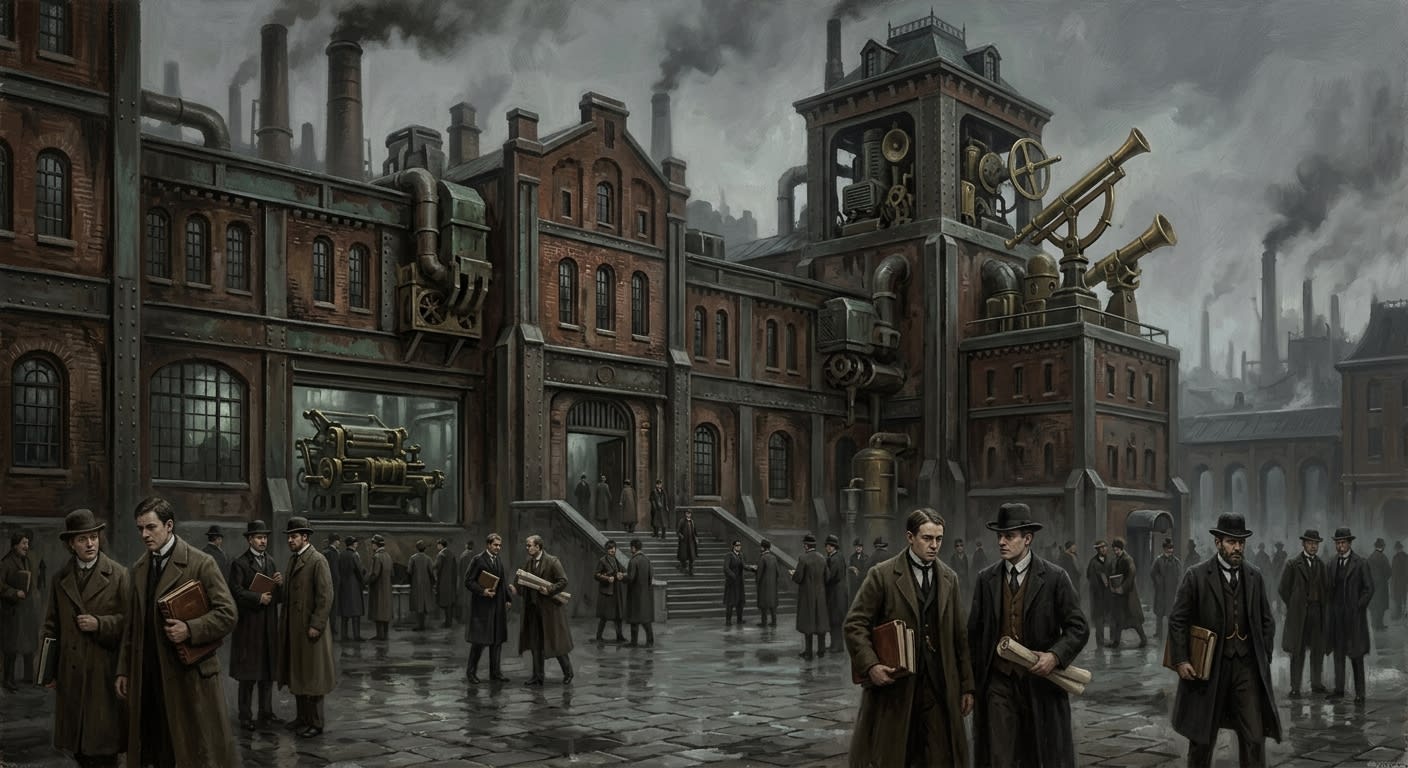
The Amsterdam Academy was founded in A.S. 0, which is to say that it had the indecency to become an institution on the same day it became a crime.
Its defenders, Dutch envoys especially, prefer a gentler formulation. They call it the Academy of Natural Philosophy, a civic school of inquiry, a press-house of comparative method, a modest fraternity of physicians, anatomists, astronomers, printers, and municipal gentlemen whose only wish was to place truth under public inspection. They speak in clean cuffs. They smell faintly of canal water and profit. They expect gratitude for their moderation.
The Bureau of Doctrine (Unregistered) records the matter differently. In A.S. 0 the Academy published De Vera Luce, thirty-two leaves of articulate poison bound under the compass-and-cross device inherited from the Concordats of Ulm. By that act, Amsterdam licensed unbelief, fixed the calendar wound, and gave scattered Rationalist correspondence a public altar, though the altar was called a lectern so that its priests could pretend they had abolished priesthood. Later catalogues would call the Academy merely one Rationalist institution among many. This is mercy by misfiling. Amsterdam made the wound printable.
The Academy was not born innocent. Nothing in Amsterdam is born innocent; even the herring arrives salted in commercial suspicion. The Year of Letters had already passed through the city thirty-two years earlier, when Van Hoorn, Lemstra, and de Waal made the Bone Census portable, posted it to forty cities, and taught bishops that arithmetic could laugh. The Academy inherited that method: count, tabulate, distribute, ask politely, let the victim supply the scream.
#On the Ulm Machinery and the Dutch Hand
The Academy's machinery was built before Amsterdam claimed the chair. Ulm supplied the compact. Amsterdam supplied the appetite.
In -55 A.S. (before the Bureau's calendar), twelve professors signed the Concordats of Ulm: three articles, one crimson seal, and a phrase — “rational fraternity” — so smooth that one sees why it slipped past men who should have had rougher hands. Article One freed inquiry from theological supervision. Article Two arranged annual congresses and harmonised curricula. Article Three gave the movement its emblem: compass bearing down on cross, geometry seated over salvation like a magistrate over a prisoner.
By -10 A.S., the Ulm Congress drew thirty-one institutions. Amsterdam sent observers, then delegates, then directors in everything except name. The old Ulm men liked structure. The Dutch liked movement. Where Ulm built a table, Amsterdam put wheels beneath it and charged admission.
The Academy's first rooms stood near the printing lanes and canal warehouses, close enough to paper, freight, credit, and rumor that no idea had to walk far before acquiring legs. Its lecture benches held physicians with wet cuffs from anatomical theatres, merchants eager to convert piety into negotiable skepticism, students whose fathers had bought them Latin and expected influence in return, and former clerics with the sour brightness of men who have exchanged obedience for applause.
The institution called itself natural-philosophical because “anti-clerical coordination office” tests poorly in civic charters. It issued invitations to Leiden, Ulm, Paris, Prague, Vienna, Basel, and lesser towns that have since been corrected, eaten, or promoted beyond their deserts. Correspondence moved through merchant packets. Proof-sheets moved inside invoices. The Academy learned quickly that a ship's cargo manifest can carry more than hemp and cheese.
Its earliest surviving subscription roll lists lecturers, surgeons, map-makers, guild creditors, two civic magistrates, one glove merchant, and an anonymous donor marked only as amicus lucis, Friend of the Light, which is exactly the sort of phrase a guilty man chooses when he wishes posterity to admire his cowardice in Latin. The Bureau has searched for the donor for ninety-six years. We have found three plausible families, fourteen implausible ones, and a Dutch lawyer willing to deny all of them for a fee. The fee was not paid. The denial was assumed.
#On De Vera Luce as Founding Rite
De Vera Luce was the Academy's baptismal certificate, except that baptism cleanses and this dampened the continent with intellectual sewage.
The pamphlet's genius was restraint. It did not snarl. It did not paint horns on priests. It praised charity, medicine, instruction, inquiry, mothers, sick children, public good, honest doubt, and every other citizenly virtue by which a man may carry a knife through a checkpoint. It asked why relics should not be tested, why claims should not answer evidence, why authority should hide behind sacred language, why the physician's knife should bow to the reliquary, why the printer's press should wait for a bishop's permission.
Older Purity broadsheets state that the Amsterdam Academy founded its programme upon open hatred of charity.
Corrected. The Academy praised charity, which made the programme worse. Hatred warns its target. Pity enters the sickroom, sits beside the bed, and measures the pulse before announcing the priest unnecessary.
The Academy's seal appeared on the Amsterdam printing beside the inherited compass-and-cross: a jurisdictional claim stamped in ink. The pamphlet told Europe that evidence would sit above tradition, that instruction would replace catechism, that public welfare would outrank sacrament, and that Reason could liberate without ruling. The final phrase was the cleanest fraud. Reason alone shall not tyrannize, it said. Reason shall liberate. Within a generation, Republican Guards would enforce secular law with bayonets and tongues would learn what liberation tastes like when administered by men in boots.
The Academy had done what the Year of Letters prepared. It moved from particular ridicule to general doctrine. Van Hoorn had asked how many femurs Saint Aldebrand possessed. The Academy asked whether any altar possessed authority over inquiry. Van Hoorn wounded a shrine network. The Academy wounded the grammar by which shrines defended themselves.
#On Curriculum, Instruments, and Clean Violence
The Academy taught inquiry as emancipation and arranged its rooms like chapels without admitting the theft. The anatomical theatre supplied the nave. The demonstration bench supplied the altar. The lecturer supplied sermon, vestment, and vanity in one long coat. Students sat in rows, took notes, laughed at approved moments, and emerged convinced they had escaped ritual by practicing a newer one with better lighting.
Its curriculum had five teeth. Anatomy, to dethrone the relic. Astronomy, to tame the omen. Mechanics, to exalt the engine. Jurisprudence, to subordinate canon courts to civic boards. Print discipline, to make every conclusion reproducible before any bishop could strangle it in one town. The order was deliberate. A body cut open becomes matter. A comet measured becomes weather. A machine repeated becomes authority. A court secularized becomes a scaffold with minutes. A printed page becomes a mob that never has to meet.
No Bureau existed yet to counter it. The old Church possessed bishops, chapters, relic-keepers, theologians, and the heroic administrative incompetence of men who think inherited authority files itself. Amsterdam exploited the gap. Its lecturers challenged provenance ledgers. Its printers reproduced challenges faster than dioceses could convene replies. Its correspondents quoted reluctant clergy out of order. Its physicians made public theatre of failed charms and private silence of recoveries that followed prayer.
The Academy's violence was clean because it first operated through permission. Permission to ask. Permission to examine. Permission to laugh. Permission to treat refusal as confession. Permission to define the terms under which Faith would be judged, then to condemn Faith for speaking another language.
ACADEMY LECTURE NOTE, COPY ATTRIBUTED TO A.S. 3 “Where the priest says mystery, ask for the object. Where he says sanctity, ask for the chain of custody. Where he says miracle, ask who profits.” The fourth instruction is burned through the page. The ash stain resembles a tonsure.
#On the Men Who Sat in Its Chairs
The Academy's founders are less usefully remembered as names than as functions. The Bureau has names, of course. The Bureau has names for lice on condemned coats. Yet the Academy's danger lay in how replaceable its men became once the method had been installed.
There was the anatomist who supplied the posture: sleeves rolled, knife clean, expression grave, every cut a little sermon against mystery. There was the printer who supplied velocity. There was the merchant-patron who supplied immunity by money and contacts. There was the philosopher who supplied the Latin phrases that made confiscation sound like hygiene. There was the former seminary student who supplied insider contempt, the hottest-burning fuel in any anti-clerical stove.
Some had studied under Ulm men. Some had corresponded with Van Hoorn's circle. Some would later feed the Rationalist learned societies and, through them, the Council of Nine. A few died before their work reached blood. This has offended moral dramatists since the first catechism plate was carved. Wicked men often die in beds. Providence sometimes prefers their ideas to stand trial in public after their bodies have become unavailable.
The Academy did not need a single genius. It needed a room in which ten competent men could make each other braver than conscience permitted. That is the academic miracle, if one must use so fine a word on so foul a mechanism. Cowardice, when collectivized, calls itself consensus.
#On Its Children in War
From the Academy came papers, from papers came societies, from societies came policy, from policy came guards. The descent was deliberate. The Academy gave the Rationalist century its moral grammar: priestly interference, public order, civic instruction, relic fraud, medical necessity, educational freedom. Each phrase had a polite face and a cudgel hidden behind its back.
Saint-Malo did not begin in a guard's musket. It began in rooms where processions were classified as disorder and pilgrims as bodies requiring management. The Trial of Saint Aldebrand's Reliquary did not begin when priests were mocked before a lecture hall. It began when the Academy taught audiences to treat devotion as claim and claim as fraud pending laboratory mercy. The First Relic Auctions (Unregistered) did not begin with a merchant's hammer. They began when sacred custody was redescribed as monopoly.
A Dutch memorandum submitted A.S. 194 described the Academy as “non-political in origin.”
Rejected. An institution that teaches courts, schools, physicians, printers, and magistrates to disobey the altar is political before its first breakfast. The memorandum has been retained as evidence of the Dutch belief that a lie becomes diplomacy when folded twice.
By the time the Treaty of Regensburg proclaimed Reason's triumph, the Academy's direct authority had been absorbed into larger Rationalist structures. Vienna governed. Paris declaimed. Ulm printed under older guilt. Amsterdam continued to supply what Amsterdam had always supplied: paper, credit, methods, and the calm assurance that commerce is innocent when the invoice is legible.
#On Dissolution, Survival, and Dutch Manners
The Sundering ended the Academy as sovereign intellectual engine because demons are poor seminar participants. When the Balkan wound opened in A.S. 45, theories that had glided through lecture halls encountered entities uninterested in citation. The Academy's eastern correspondents stopped writing. Its Vienna contacts vanished mid-sentence. Its explanations for the omens multiplied until they required more faith than the Creed.
The original Academy dissolved, or renamed itself, or was absorbed into municipal boards, maritime colleges, hospital faculties, and printing associations whose charters contain enough civic virtue to choke a saint. Dutch records are very clear on the question, which is how one knows they are concealing something. No criminal institution ever dies in its own paperwork. It becomes a committee.
Amsterdam remains independent, non-Synod, non-enemy, and perpetually suspect. Its envoys insist modern Dutch academies serve shipping, medicine, finance, and public instruction. The Bureau of Silence purchases their books under false names. The Bureau of Tithes borrows their tables and denies the debt. The Bureau of Doctrine keeps De Vera Luce warm in the Stacks. The Academy's ghost has good manners. It writes thank-you notes. It funds lectures on maritime fever. It asks whether some relic protocols might be modernized.
The answer is no.
At Strasbourg, the Academy is taught as an object lesson in institutional sin: the moment private doubt became public curriculum, public curriculum became policy, policy became war, and war left Europe unroofed before Hell. A school may be smaller than a fortress. So is a key smaller than a prison.