
#On Breath as Obligation
Breath is the last thing a poor man still thinks of as his own. He has given grain to the scale, coin to the gilded ledger, a tenth of his labour to the Faith-Tithe, and a slice of what remained to the clerks who count it. He still breathes as though the air came to him without a form. The Synod has spent some decades correcting this impression.
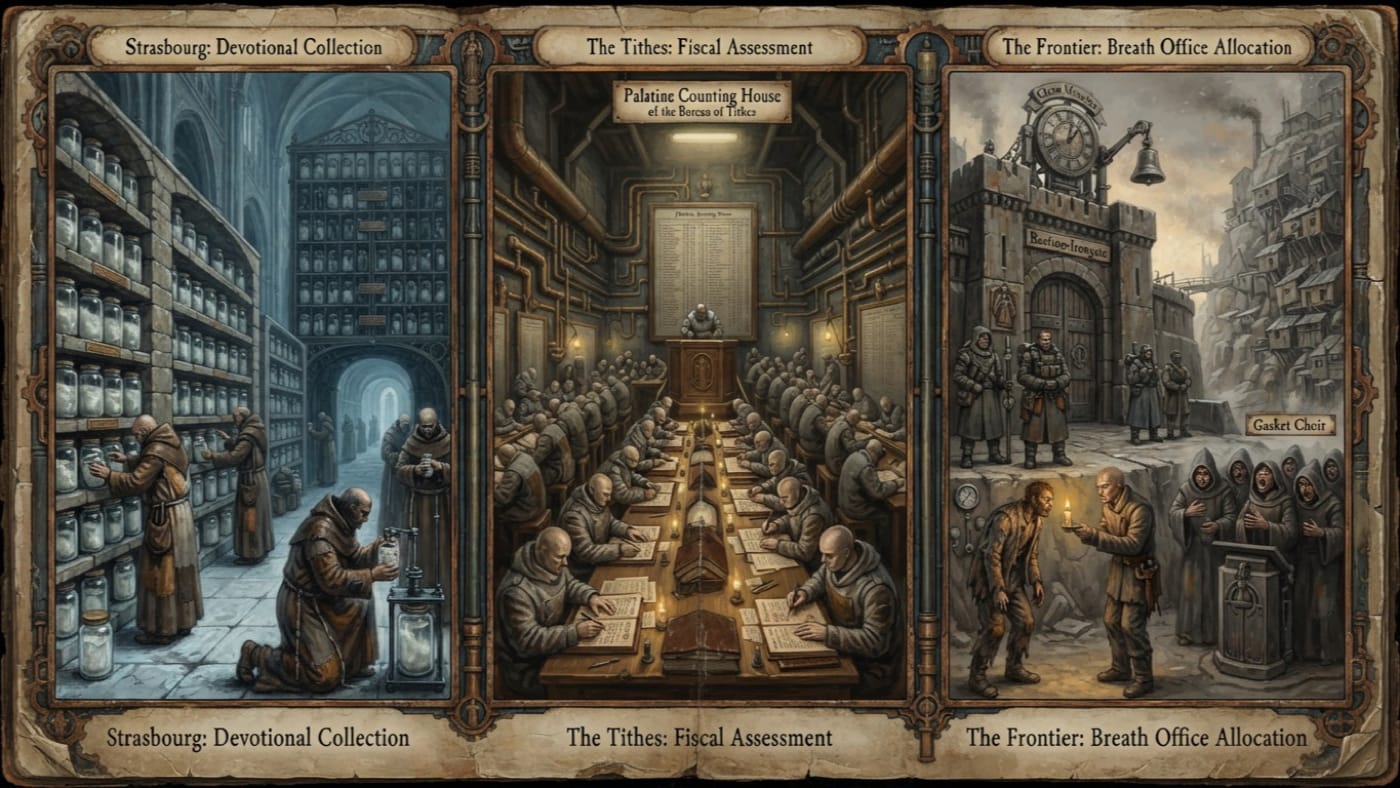
The correction comes in three vestments, and careless readers confuse them. In Strasbourg, breath is collected as devotion. It is exhaled into glass on feast days, sealed, and shelved beneath the Basilica of the Ledgered Saints. In the ledgers of the Bureau of Tithes, breath is a fiscal category, entered among the obligations of the living and then charged again under the Meta-Levy. On the Sagittal Line, breath is an allocation. The grey gloves of the Breath Office measure it by candle at Irongate and sell it by the minute at Black-Snow Lor.
Three authorities and three mechanisms share one conviction: whatever passes through a mouth can be made to pass through a desk. This survey, sealed in A.S. 201, keeps the three apart. The Church's offices keep their seals apart, and they grow violent when anyone mixes the wax.
#On the Strasbourg Collection
On every feast day, selected congregants must breathe into reliquary jars. The Church does the selecting. The breath belongs to the congregant until the stopper goes in. Each jar is sealed and archived in the Basilica of the Ledgered Saints. The archive long ago outgrew the Basilica's floor and went down into the catacombs beneath Strasbourg, where the jars stand in ranks along the stone. Thousands of small clouds hang in that glass, each one breathed out by a citizen who was asked to give and gave.
I find the sight devout. I also find it orderly, which in my profession is the higher praise. A bone relic needs a saint, a death, an authentication tribunal and usually a quarrel with the Bureau of Relics. A breath relic needs a parishioner, a jar and a little wax. The Basilica has industrialised sanctity, and nobody had to die first.
The institution says the purpose is provision. It claims the stored breaths are kept against famine years, when "oxygen for the faithful" may be rationed. I record that as the Basilica's claim. Nobody has submitted to this office the archive's capacity, the condition of its contents, the method of withdrawal or the effect on a starving lung. I have had the sense not to ask. A reserve that is never drawn on is never found wanting.
Devotion has standards. The collection's history preserves one episode above the others. A child once breathed too faintly into her jar, and her family was fined for weak faith. Her name has not reached me, and neither has the sum. The reasoning has, and it is flawless. The jar received less than a jar should. The offering was spiritual, so the shortfall was spiritual, and a spiritual shortfall within a household is charged to the household. The child kept her small lungs, and her family paid for them.
One instance is enough for doctrine. The Church has built cathedrals on less.
#On the Assessment of the Offering
Glass holds the breath. Ink keeps the account. The Bureau of Tithes, from the Palatine Counting House, lists breath-tithes on the living among its charges and classifies them as a "devotional contribution to atmospheric sanctification." I have called that phrase ambitious elsewhere, and I withdraw nothing. It assumes an atmosphere that needs sanctifying, an offering that sanctifies it, and a Bureau entitled to count the offering. All three assumptions go unchallenged, because a challenge carries a filing fee.
Then the Meta-Levy attaches, as it attaches to everything the Bureau touches. Breath-tithes carry atmospheric sanctification maintenance. The two must be kept distinct. The breath-tithe is the primary contribution, a devotional obligation. The maintenance is a secondary charge that pays for administering that obligation: the clerks, the classifications, the ink in which the atmosphere is pronounced holy. The faithful give their breath to holiness and then pay for holiness's upkeep. The air is blessed, and then it is billed for the blessing.
Precision forbids the step every careless pamphleteer takes next. No published account gives a breath-tithe percentage, a collection threshold, a value for a lungful in Crowns, or any conversion of glass into coin. The general Faith-Tithe fraction cannot be borrowed to fill that gap. Neither can the Bureau's total extraction or the Meta-Levy's sample calculations for village grain. Nothing on record says the Counting House keeps the jars, either. The Counting House keeps accounts, and the Basilica keeps breath. If a ledger joins the two, nobody has shown it to me.
#On Voice, Service and Warmth
Bastion-Irongate sits in the Iron Gates gorge of the Danube and faces Morwen of Envy. There, breath has a value even an engineer can measure. The tunnel complex depends on the Gasket Choir, whose continuous chant keeps the pressure seals seated and the mountain standing. When the singing stopped in the Great Hush of A.S. 94, three thousand died, and compulsory chant watches followed. A lung at Irongate is structural material, and structural material goes into an inventory.
The inventory takes two separate forms. The first is the candle test. A Breath Office clerk holds a candle at arm's length and times how long the applicant can keep the flame bent with one steady breath. The second is the stanza audition before the Choir Magistracy. The applicant must hold a prescribed harmonic at a prescribed volume for a prescribed duration while a pressure gauge is watched. The candle measures the lung, and the stanza measures the voice. Nobody has shown me a passing figure for either.
Test results become licenses. The voice-license tiers, ratified at Irongate in A.S. 97, decide residence, work, warmth, rations and bunks. The first tier permits residence and basic labour, and the fifth permits supervisory chanting. A man who loses his qualification can lose his heat entirely, and his rations shrink after it. The local reckoning lists the costs plainly: voice-license fees, labour-hours in the gasket works, confession quotas for "air rights," and debts paid off in forced chanting shifts or labour in the valve pits. These obligations are Irongate's own, recorded at Irongate. They are no Strasbourg tariff in mountain dress.
Authority is split along the note. The Choir Magistracy, under Cantor Ys Varr, hears auditions and disciplines sound. The Breath Office, where Seal-Broker Lysa Murne keeps the permit desk, holds the seals, records, heat allocations and quarantine clearances. Its quarantine powers grew after the lung-rot outbreaks of A.S. 199. The two offices are tangled closely enough that a cracked note in the Nave becomes a cold bunk the same day. The garrison says Tithes has no jurisdiction inside the mountain. The Office's own parentage review lists the Tithes claim as "revenue pending." I record both and settle neither.
Earlier Frontier Chapterhouse histories describe the Breath Office as "chartered under unified Synodal authority after the Great Hush."
Retracted. The Office never received a clean founding charter. It grew out of emergency writs, ration tables, quarantine addenda and local arrangements. Its parent authority remains disputed as of A.S. 201.
#On Clean Minutes and Breath Debt
At Black-Snow Lor, breathable shelter is made of filter cloth, bone, shutters and vents, and the storm takes it apart. The town's obligations follow the materials: filter-cloth quotas, labour-hours on the storm berms, bone-chits, and a "breath levy" that the local reckoning describes as a skim off the air ration.
The coin of this arrangement is the clean minute. Lor's own shorthand defines it as time until closure, a token that can be traded. The Breath Office's published account says the tokens represent guaranteed breathable shelter during storm cycles. I set the two descriptions side by side and leave the gap between them alone. One counts the time before the door is sealed. The other promises air behind it.
The Clean Room run by Lor's Breath Office has published terms, and I copy them as that room's terms only. Fifteen minutes costs a bone-chit. An hour costs a day's ration. A night is priced at the clerk's discretion. These are not a rate for the whole frontier, and anyone who quotes them at Irongate deserves the cold he gets. Consider the middle figure. A day's food buys an hour of good air, and the Office records the bargain as voluntary.
When accounts fall short, breath debt follows. It can be paid off in labour, in names, or in surrendered shelter rights. The published account specifies berm shifts, filter laundry and ash-sled duty. Breath Comptroller Juno Varr keeps the ration accounts and controls Clean Room access. Storm Warden Ilex Marr rings the bell for closure. Two authorities govern the same door. Rumours circulate in the Warrens that air has been sold twice. They remain allegations, and in Lor an allegation is cheaper than a filter.
#On Present Application
As of A.S. 201 the three practices stand side by side without touching. Strasbourg's jars keep filling on feast days, and their reserve is claimed but unaudited. The Bureau of Tithes keeps breath on its schedule of the living, with the Meta-Levy charged on top. The Breath Office keeps measuring lungs at Irongate and minutes at Lor, under writs no Bureau will sign as parent. Nothing on record connects the catacomb to the frontier. No jar has gone east, and no Lor token draws on Strasbourg glass.
A faint breath brings a fine, a short breath brings a cold bunk, and a breath nobody paid for waits on the bell.