
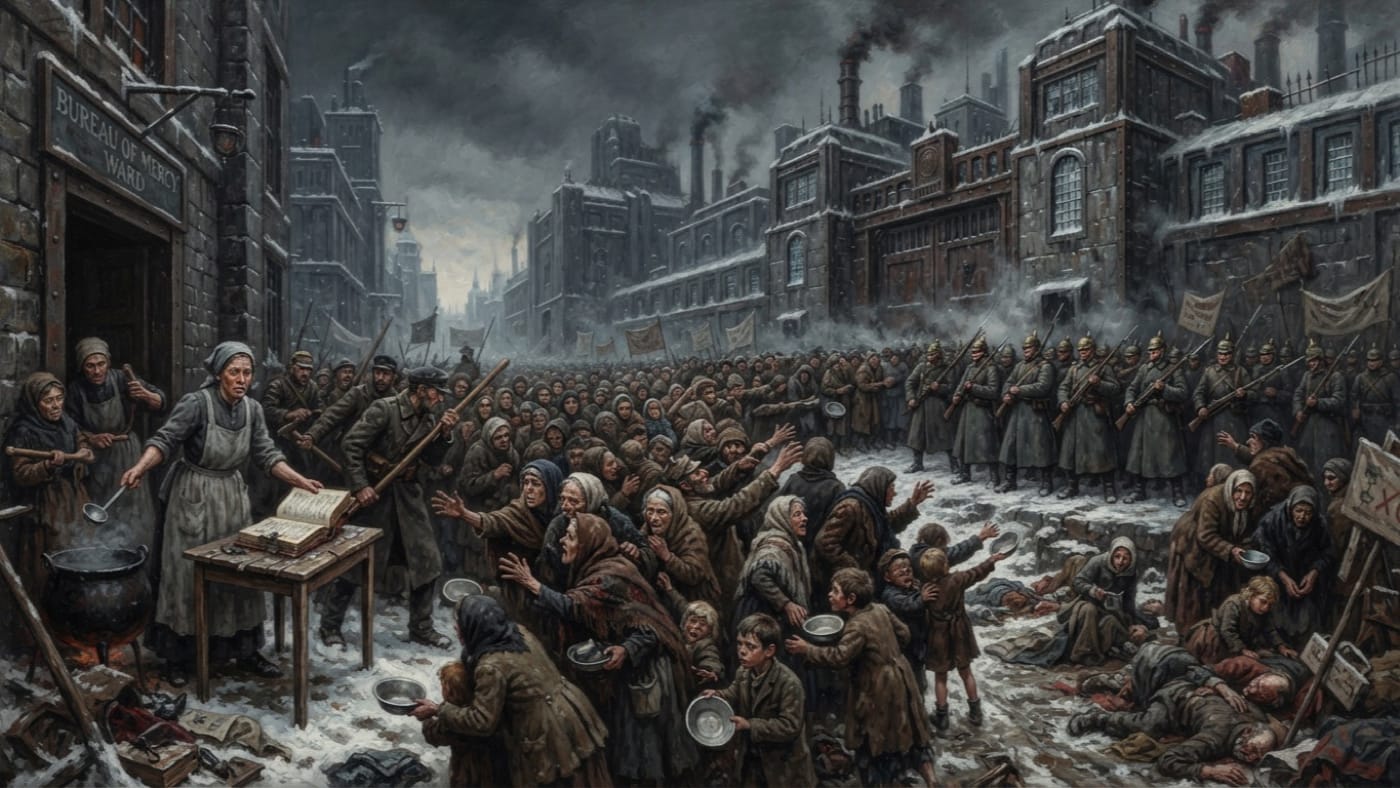
#On the Winter of A.S. 112
"If it is not stamped, it is not mercy." — the Mercy Line, as recited at Lauds
In the winter of A.S. 112 (1822 in the secular almanacs) the broth ran out across the northern bastions. Three garrison populations then walked toward the granaries to see whether the grain had run out as well. The unrest lasted eleven days. The Bureau of War ended it with rifles and the Bureau of Purity followed with arrests. The Bureau of Mercy was the last to arrive and has stayed the longest. It answered with the Ledger Laws, and those have not ended at all.
The Church calls this sequence the Broth Riots. The name is accurate and a little unkind. Nobody riots over broth. They riot over the empty bowl, the ladle scraping iron at the bottom of the pot, and the line that stands still because nothing waits at its head. Broth was only the last promise the Synod had made them in a form they could hold.
#On the Winter Shortage
That year winter grain shortages struck the northern bastions of the Sagittal Line. Mercy's supply chain was chiefly a sequence of promises written in warmer rooms, and it collapsed under them. The pamphleteers have since offered sabotaged convoys, hoarding quartermasters and a demon in the silo. I decline all three. The record supports a shortage. A shortage is sufficient, since hunger has never needed a conspiracy to recruit.
Consider what a Mercy Ward was to a northern garrison in A.S. 112. It was the warm room, where the sick lay and their families waited. Soldiers came off the wall for wraps and a bowl. Any child with papers, and several without, could expect something hot at a fixed hour. The ward kitchen fed the people least able to feed themselves, and it fed them in public, in a queue, at a door. A queue is a congregation that has not yet decided what it believes.
When the pots thinned, the queue thickened. When the pots emptied, the queue turned and looked at the granary.
The ward-hands stood between that look and the granary door. These were the grey aprons, the Ward-Sisters and Ward-Brothers, holding ladles and lists. It fell to them to tell people they had fed the week before that today there was salt in hot water. They became the face of the shortage because theirs were the only official faces present. Policy is rarely in the room when it fails, but its staff always are.
The office was older than the crisis. Ward care began in the Great Retreat of A.S. 48 to 65. After the Sundering, cholera and typhus ran through the refugee columns, and the provisional authorities learned that a camp left without care became a riot within days. The Concordat of Strasbourg gave the formal Synod its constitution in A.S. 90, two years before Mercy received its charter. By A.S. 112 the wards had broth, bandages and a charter. They lacked only a law that made every ladle answer for itself.
Earlier devotional primers described the ward office as the spontaneous flowering of charity in the war-hospitals of the Great Retreat.
Corrected: the office began as emergency care under epidemic collapse, intended to keep the frightened from becoming the ungovernable. It took its present form only after the winter of A.S. 112. Charity was present throughout, though it never held the pen.
#On the Eleven Days
Three garrison populations moved on the granaries. I write "three" and stop, because the account that survives in Mercy's own literature gives that number and nothing more. It records no first day and no last, no ringleader, no commander and no tally of the dead. Later clerks have been less disciplined. I have read summaries that give each population a bastion, a ward number and an opening outrage. No account I trust supports them, and I do not lend my seal to a clerk's imagination merely because it is vivid.
The shape of the thing can still be stated. A garrison population is more than its soldiers. It includes the laundresses and widows, children on ration papers, pensioned cripples and the sick in their cots. Its cooks have run out of reasons. People of this kind do not storm a granary for sport. They had queued at the ward door and found nothing there, so they went to the building where they believed the grain was kept. They were not wrong to think grain was there, only wrong to think it was theirs.
Eleven days is long. A riot that lasts an afternoon is a temper, but one that lasts eleven days has become a dispute about policy, with crowds that rest and return. It was a negotiation conducted in the only language the hungry had left.
The Bureau of War restored order with rifles. The phrase is War's own and I cannot improve on it. It does not say how many cartridges order required. In War's vocabulary, order is the condition in which the granary door stays shut.
Purity followed with arrests, as Purity follows everything, because a crowd that has been dispersed still contains names. Purity took no interest in the grain. Its question was why a hungry woman had come to believe she was entitled to any.
The conduct of the ward-hands during those eleven days was never recorded. That silence says everything about the period: before A.S. 112, nobody was required to record it.
#On the Ledger Laws
The Ledger Laws were Mercy's answer, and they answered a question the crowd never asked aloud. The crowd at the ward door had asked who decides who eats. The Laws replied that the ledger decides, and a ward-hand signs.
Every ladle was counted and every bandage measured. Every dose was signed in triplicate, and every death was stamped against a cot number. The ladle bore a mark, the pot bore a seal, and the string-tied ledger bore the names. A bowl of broth used to be an act. It was now an entry, and an act that had not been entered had not occurred.
The genius of the arrangement lay in where it placed the hand. Before A.S. 112, a ward that ran dry was a failure of Mercy, and the Bureau stood exposed before the queue. After A.S. 112, every portion carried a signature. If the portion was short, the ledger could show it matched the allotment. If it did not match, the signature showed whose hand had erred. Responsibility left the Bureau and settled in the ward-hand's inked fingers. A Bureau cannot be stormed for withholding broth when it can show you, column by column, that the broth went out in accordance with law.
That same signature also protected the woman who held the ladle. A crowd that demanded more could be shown the ledger. An auditor who accused her of theft could be shown it too. The ledger was a leash and a shield at once, and the ward-hands have never agreed which of the two it is more often.
In time, need became classification. The mature ward regime gives full allotment to clean, enough to remain quiet to grey, and "sufficient" to black. Those categories took their settled shape over later decades, and I do not credit the winter of A.S. 112 with every ward-screen in the Synod. The arithmetic behind them is the arithmetic of the Ledger Laws: a body, a class, a ration, a signature. Once a ladle can be counted, it can be divided, and once it can be divided, someone must be handed the smaller part.
The Ledger Laws produced no grain. This is the point most often missed by those who praise them and most often hidden by those who drafted them. No law can thresh barley or bring a convoy through snow. The Laws could only establish, to the spoonful, who had been refused, and that turned out to be what the Synod wanted. Scarcity that cannot be cured can at least be documented, and documented scarcity no longer counts as a scandal.
What had been emergency practice became ordinary procedure. The ward bell was struck, the line formed, and the ladle went down and came up. The clerk entered the portion and the ward-hand initialled it. A wound had its dressing logged by length and a fever its draught by measure, while the dead had their tags. Medicine took the dosage columns. Records took the deaths. Mercy kept the rest and called the whole of it care.
#On the Continuing Account
As of A.S. 201 the Ledger Laws are eighty-nine years old, and no ward in the Synod operates outside them. The auditors still come with Form M-17 and still ask where the extra broth went. Spoilage, spillage and pending reconciliation are still recorded as the answers. The answer the ward-hands mean is still forbidden: it went to the hungry.
Because the ledger survived, the second ledger survived beside it. That one is unwritten, and its entries are favour, debt and omission. Every veteran ward-hand keeps it in memory, and it explains the ghost bowls entered for patients who do not exist so that broth can reach the ones the schedule has abandoned. It also explains the split signatures on morphine, the salt sewn into apron seams and the clean cloth that disappears into black-zone cabinets. The Bureau calls this mercy fraud. The ward-hands have other words, and I would not print most of them.
The Bureau of Mercy will not say aloud that the Broth Riots are still in progress, at a lower temperature. They go on in every ward where a Ward-Sister stands before a line of the hungry, works out what she has against what she must refuse, and decides which of those two figures her pen will record. The crowd of A.S. 112 went to the granary. The crowd of A.S. 201 waits at the ward door with its papers ready. Between them stands the same grey apron, with her ink and her salt, where the ledger has kept her for eighty-nine years.