

#On the Office in the Record
"A tag is warmer than a coat." — Proverb of the Orchard
This entry is a compilation made in A.S. 201 (1911 CE) from accounts already filed in this Codex, and it goes out under the seal of the Bureau of Doctrine. The year dates my compiling. It dates no founding, charter, inspection or visit, because I have none of those to report, and I made no new journey to Bastion-Przemyśl to obtain them. Everything below was already in the drawer. I have only put it in order.
The Bureau of Logistics-Penance appears in the record the way a seal appears on a letter, at the edges, signing things. Its name heads the Codex's own entry on Przemyśl beside the word VETTED, and it returns lower on the same page in a clearance line dated A.S. 201. It heads an abstract of the Wire Orchard. It also turns up in my margin to the Gleaners entry, where I questioned its competence and declined to retract. That last is a criticism. It is not a charter, and I will not let my own sentence be promoted to one.
Four names circulate. There is the Bureau. There is the Logistics-Penance Office, which the bastion's file sets beside the Synod Chapter. There is the Logistics-Penance Tribunal in Taghouse Row. And there is the permanent Logistics-Penance ward that the Orchard had received by A.S. 92 (1802 CE). The files do not say how the four relate. They may be one body under four names, four bodies sharing a hyphen, or something in between. None of the accounts open to me records a founding year, a headquarters, a head or a boundary of jurisdiction. I decline to draw an organisational chart for an institution that has never shown me one.
#On Rations and Requisitions
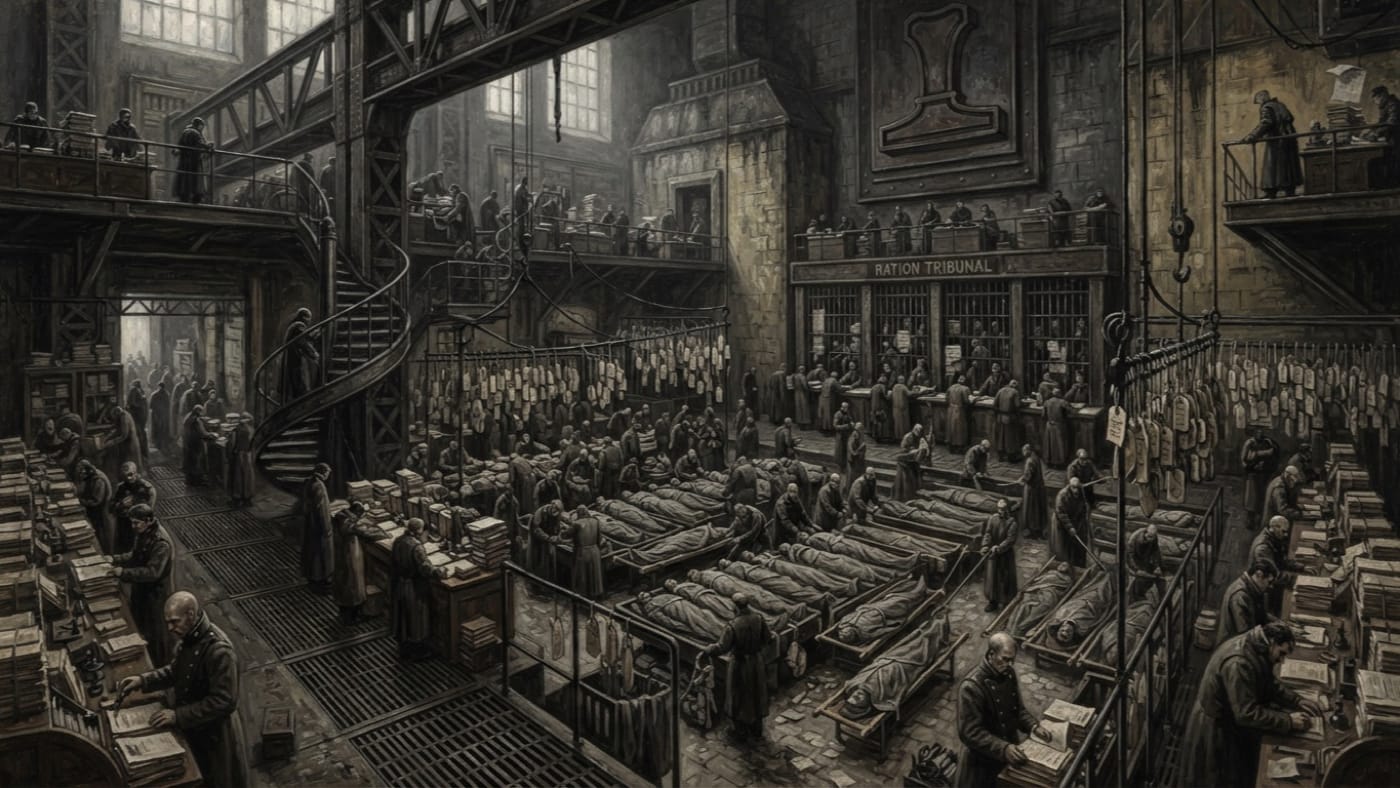
Przemyśl is the third principal bastion of the Sagittal Line, counting north to south. There a ration tag carries a name, a number, a lane, a food class and two dates. Between the dates the bearer may eat, sleep under a roof and pass the wire. After the second date the bearer is, in the Tribunal's phrase, administratively corrected. Food, shelter, transit and recognised existence all ride on one wax-sealed square. Whoever keeps the arithmetic of that square holds more than the grain store.
The bastion's dedicated file places the Tribunal in Taghouse Row as a Synod office. Its public purpose is fair ration arithmetic. Its recorded methods are audits, confessions and erasure, and it is set in motion by a discrepancy in a manifest. The same file reports that the Synod installed the Tribunal and that confession became ration logic from then on. It gives no year for the installation, and I supply none. A local installation founds no Bureau in any case.
The penance in the name is plain enough. A shortfall in the count is a sin, and sins are heard in confession and settled by audit. When neither settles it, the third method remains.
The one wholly mundane duty I can attest is the filing of repairs. The Przemyśl entry records that Logistics-Penance clerks filed requisitions for structural repair to the inner wall, which is old Rationalist stone set in bone-lime mortar. In return they received a catechism on the spiritual benefits of load-bearing faith. The entry does not say who issued it. The requisitions show that these clerks ask for mortar. They do not make the wall theirs, and the Bureau of Engineering would say so first if it could find the relevant writ.
The ward is the only dated milestone. By A.S. 92 the Orchard had swelled to three miles and received its first permanent Logistics-Penance ward. That was two years after the Synod's formal settlement at Strasbourg in A.S. 90. The word permanent implies an earlier impermanence, and the files do not describe one.
#On the Morning Balance
"Dawn is a knife with paperwork." — Proverb of the Orchard
The sequence is recorded step by step, and different hands perform the steps. Provost-Marshal Vanna Rook commands the dawn harvest. The patrols and Orchard Wardens go out before the first bell with hooked poles and receipt satchels, and they come back with tags on strings. The tags are entered in the morning ledger, and the ledger must balance. If the tags exceed the morning's projected intake, the Przemyśl entry says, the Tribunal adjusts.
That verb is all the record gives. No procedure is named. I noted at the time that the Bureau of Records had furnished the verb and nothing more, and I furnish nothing either.
Command, accounting and the dead each have their own office here. The sources disagree about where the bodies go. The Przemyśl entry sends them to the ditch-pits unless they are tagged for formal burial with a wax seal on the tongue. The Orchard entry sends the tagged dead to the Chapel of Counting, where the tag is read aloud before the corpse is assigned its next office, and sends the untagged to the ditch. Both agree that the dead are recovered, counted and divided. The rest of the route I leave unmapped.
The Orchard abstract under the Bureau's name lists the facility's functions as perimeter denial, transit sorting, deserter capture, tag verification and hostile-approach disruption. That is a list of the Orchard's work under a Bureau heading. The Wardens answer formally to Rook. The abstract shows whose paper describes the work and leaves open who gives the orders. The Logistics-Penance harvest verse is plainer about what the work is for:
The tag proves passage. The seal proves tag. The wire proves absence. The dawn proves all three.
Earlier entries of this Codex gave the dawn harvest patrols the sole function of deserter recovery.
Corrected in the Codex's entry on the Gleaners, and the correction stands here. The patrols recover deserters, refugees, smugglers, the tagless dead and the tags of the tagged dead. The deserter is the crop the ledger was built to count. He was never the only thing on the strings.
#On the Changing Post
At Przemyśl no officer holds one post for more than eighteen months. When an officer leaves, a clerk weighs the stamp die, enters it and passes it to the successor, and somebody wipes the chalked name off the door. In my entry on Rotation of Command I credited the chalk to Logistics-Penance economy, since the Bureau considers paint an extravagance and brass a provocation. That sentence was my description of a habit. I hold no procurement order for chalk, and I will not pretend that sentence was one.
The rule stands against Atheron, whose Pride settles in men who sit too long in one chair. It works slowly, and it costs knowledge: each successor learns the flooding gallery again by losing men in it. The rotation entry does not say which office the weighing clerk serves. When I asked who keeps the master rotation ledger, three offices passed me around in a circle. The rule's founder and authorising instrument are also unestablished. None of these can be given to Logistics-Penance on the strength of a stick of chalk.
#On Those Outside the Count
Below the Orchard the Gleaners keep a second set of books. They shelter the Erased in safe pits and move valid tags from the recently dead to the living. They return tags to widows and guide deserters through the Underwire to the marshes beyond the southern gate. They also cut bodies down before the official harvest, when family payment can be raised. Families who cannot pay get the ditch like everyone else. I repeat the condition every time, because sentimental readers forget it.
Laid beside the official sequence, the cell's work runs closely parallel. Both recover bodies before dawn, both read tags and both decide who passes. The Chapel brings the tagless back through confession, which returns them to the index and restores the Synod's claim on them. The Gleaners bring them back by keeping them out of it. The Paper Plague was followed by the Compulsory Marking Decree of A.S. 113 (1823 CE), and since then a grafted tag must also get past an inspector's brand key. The cell gets past it anyway, by methods the record leaves out.
Purges come at irregular intervals, usually after an audit finds too many bodies recovered privately and too few left for the public count. The accounts say "the Bureau" and do not say which one. The Bureau of Purity has hunted the cell since at least A.S. 183 (1893 CE), and that hostility belongs to Purity. I find no record that Logistics-Penance organised a purge, negotiated a truce or challenged the cell's books in any named proceeding.
What I have is my own judgement, filed in the Gleaners margin: abominable theology, enviable logistics. The Bureau of Logistics-Penance has given me no reason to retract it. It is a judgement of competence made by a theologian, and I hold it with the confidence of a man who has never balanced a ration ledger.
#On the Present Compilation
At the time of this compilation in A.S. 201, the morning ledger is under strain. A stamp die was reported missing from Taghouse Row in A.S. 200 (1910 CE). The Bureau of Records investigation found its serial number in the records of two bastions at once, and no file explains the discrepancy. Who holds the die is unknown. Three emergency revalidation drives since then have produced more expired persons than the previous count admitted possible. Each failed tag is a new manifest discrepancy for the Tribunal and a new client for the culverts.
Rook has used the crisis to recast the harvest as security work rather than supply work. The Przemyśl entry records her angling to bring the Tribunal under Provost command. She is angling, and the absorption has not happened. The Bureau of War's model predicts riots within three months and mass erasures within six if the die stays lost. Those are the model's forecasts, and the files say neither has begun. The model itself was stamped with the die whose absence it describes, so it cannot be validated.
Under the Great Ledger of Souls every name is owed to the Creator and every tag to the Synod. Between the two debts sits an institution I can name four ways and describe in five verbs: it vets, files, adjusts, audits and erases. Its charter, its head and the year it began are absent from this compilation. I have not requested them by requisition. I know what comes back.