

#On the Present Compilation
Compiled for the Codex in A.S. 201 / 1911 CE, by the Hieromnemon's own hand. A.S. 201 is the year of this compilation. It is no founding year, inspection year or anniversary, and any clerk who files it as one of these will explain his reasoning in writing, standing up.
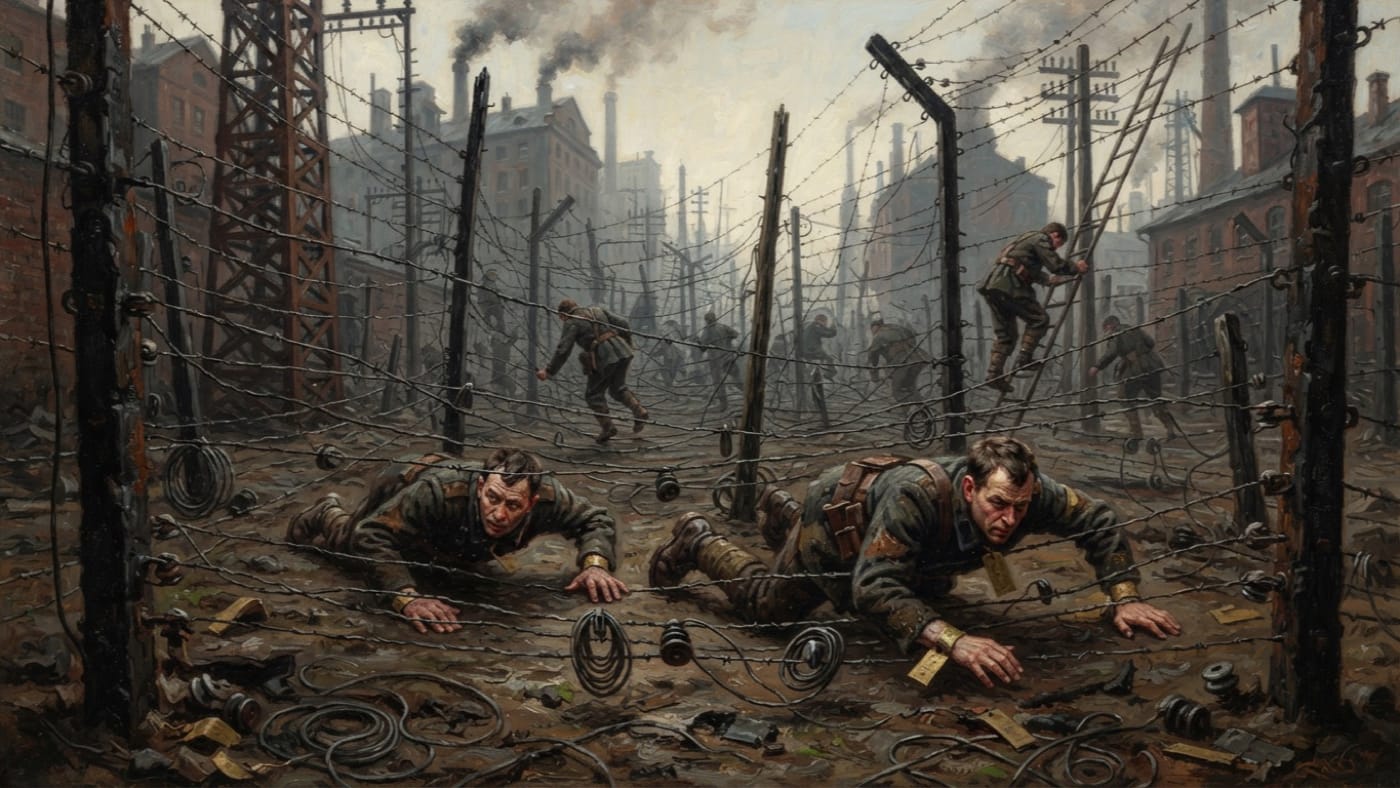
In the whole record available to this office, the inner nursery of the Wire Orchard occupies one paragraph. I have read it more often than I have read some Councils. The paragraph says this: "Training begins at the inner nursery, a fenced practice yard where new Wardens learn to move between live strands while wearing a tag at wrist, throat, and boot."
It goes on to say that the boot tag matters, that men crawl, and that the Warden who forgets it ends up in the infirmary. Then the survey returns to the Wardens' tools, and the nursery is never mentioned again.
A lesser archivist would treat that silence as an empty lot and build on it. He would add a founding prior, a chief instructor with a limp, a yard so many paces square and a casualty table rounded to flatter the Bureau. I have read such entries. Some carry my seal, applied in a weaker year. This entry will carry only what the record bears, and the record bears less than the reader would like. The reader has been disappointed before and survived it.
#On the Name, Which Misleads Twice
The nursery grows nothing. It raises no seedlings, grafts no stock and keeps no beds of young pear under glass. The few fruit trees that survive inside the Orchard's outer lanes, according to the published survey, are wrapped in rust-iron and used as anchor points, and maintenance patrols cut their blossoms before the petals can fall into the signal coils. That is the Orchard's horticulture, and the nursery has no part in it.
Nor does it keep infants. Taghouse Row has its catechisms, the holding pens have their births and the census windows have their unhappy arithmetic of the not-yet-counted. None of that belongs here. A widow looking for somewhere to leave a child should not come to this yard, and a gardener looking for rootstock should not come either. Both would find a fence, live wire and people with no time to explain the name.
The name follows the Orchard's own logic. Soldiers called the grid an Orchard because its posts looked like dead trunks and things hung from it. If the grid is an orchard, the place where the new hands learn it is a nursery. Who first said so is not recorded. The joke is clear enough without its author, and I would not credit a man I could not name.
Inner is the harder word. It suggests the bastion side of the wire, somewhere toward the Orchard Ring and the towers rather than the eastern groves. But that is only what the word suggests, and the published survey gives no position, no sector and no map. This office does not survey by etymology.
#On Wrist, Throat and Boot
Three tags, placed at the three points where a body meets the wire in three different postures.
The wrist goes first because the hand goes first. A Warden reaches before he steps. He reaches to part a strand, test a post, free a snag of paper or take hold of a sleeve that may still have an arm in it.
The throat is the height where things catch. The Orchard's published survey keeps returning to it. Catechism leaves blow in from Taghouse Row and catch at throat height. Sleepers in Barrack-Ash wake from nights of Wire-Hymn with wax in their ears and a bruise at the throat. I claim no link between those reports and this tag. I note only that the Orchard has a favourite height, and the nursery puts paper there.
The boot is the one the record defends in its own words: "The boot tag matters. Men crawl. Men lose arms. Men become horizontal paperwork." A standing man shows the wire his wrist and throat. A man on his belly shows it his soles. A man who has lost the arm that carried the wrist tag still has his boots, unless the morning has been very bad. A tag kept only at wrist and throat assumes a Warden will stay upright, and the Orchard does not let men stay upright.
What the tags do in the yard is not recorded. They may catch, ring, be checked by hand or simply hang there as reminders, and I will not supply the mechanism. The Bureau of Engineering would deny it on principle and the Wardens would deny it from experience. I prefer to leave both denials unused.
In the nursery, the strands are said to be gentled to a schoolroom current, so that the novice learns fear before he learns injury.
Corrected. The record says live strands. Nothing in it gentles them, and the paragraph closes with the infirmary because that is where it ends for some. The struck sentence came from this office's wish to be kind. That wish has been reassigned.
#On What the Yard Is For
The published survey sets out the Warden's trade, and a novice would do well to dread all of it. The Orchard Wardens maintain the grid, patrol it, prune it, keep people out of it and reap it. A Warden must know current by its sound, wire age by its colour and a forged tag by the bloom on its wax. He must tell a man caught by accident from a man hung there to draw a patrol onto a blind hook. At dawn he goes out in a pair, one with the pole and one with the shears, one reading tags and one recording them. He cuts down bodies where they can be reached and collects paper where it has survived. He carries what he recovers back toward the Chapel of Counting, or leaves it for the ditch.
The record does not say which of these duties the nursery rehearses. It may rehearse none of them. It names one skill only: moving between live strands. Every other duty depends on it. A Warden who cannot move among the wire cannot mend it, cannot patrol it and cannot reach the dead hanging in it. He can only add to the morning's count.
The tools come later in the survey and should stay there. The mother-hook, the widow-shears, the priest-pole and lamb's tooth belong to Wardens who have been through the yard. Nothing says a novice holds one inside the fence. A novice is equipped first with three pieces of paper and his own body, which he is expected to bring back in one piece.
#On Tags That Permit Nothing
The reader will confuse the nursery tag with the ration tag, and the confusion should be addressed before it reaches print.
According to the published survey, the ration tag is the Orchard's sacrament. It carries a name, a number, issue and expiry dates, a permitted lane, food and labour classes, confession status and a wax seal whose colour can raise or ruin a household before breakfast. In the tag lanes it passes flat against the body through iron combs set at shoulder and waist. It is a permit with an expiry date, administered for the bastion by the Bureau of Logistics-Penance and the clerks of the Stamp Hall, and it is stolen, forged and mourned in the Underwire below.
The nursery tag, as far as the record goes, grants no lane, opens no comb, earns no ration and meets no clerk. It sits at three points on the body, and those three points match neither the comb heights of the lanes nor any procedure the survey describes at a working gate. Nothing suggests the yard copies a particular lane, gate or recovery exercise. I will not invent one to make the parallel tidier.
Readers who like numerology will notice that three tags sit uneasily close to the bodily tri-marks required by the Compulsory Marking Decree of A.S. 113, which followed the Paper Plague of A.S. 112. The record notices no such thing. The decree governs identity at forward checkpoints, and nothing filed with this office says it ever touched a novice's boot.
#On Command, Injury and the Distance East
The Wardens answer formally to Provost-Marshal Vanna Rook. That is a statement about the chain of command and says nothing about who teaches inside the fence. The record does not say whether the Provost-Marshal has set foot in the nursery, and this office will not send her there to fill a paragraph. She has enough enemies without being made a character.
The injury is the one consequence the record does state, and it states it with a sneer: the Warden who forgets his boot tag "learns humility in the infirmary, assuming the infirmary has not been closed for fumigation, budget review, or mercy surplus." That clause promises less than it seems to. It does not promise an infirmary will be open, and it does not promise a recovery. It certainly does not make the yard safe. The published survey calls safety a rear-area word, like upholstery, and the nursery is not in the rear area.
East of everything, beyond the groves, stand the heights where Atheron crowns his ridges with spires and asks every observer below to look up. The nursery has no recorded quarrel with him. He is distant, and nothing places him at its fence. But the Orchard's long war with Pride has been fought partly with posture. In the published survey, the eastern strands were rehung after A.S. 195 so that an advance could not go upright without shame. A body trained to go low among live wire, at the risk of its boots, has at least started on the opposite lesson.
#On the Present Condition
This compilation, A.S. 201, finds the inner nursery exactly as one paragraph left it: a fence, live strands, new Wardens, and a tag at wrist, throat and boot. The ground has never been paced by this office and its founding was never logged. Its instructors are unnamed and its dead uncounted, at least in any document I am permitted to cite. Anything more would be invention, and I have struck enough of my own inventions from this entry already.