
#On the Specialist's Station
Among those who survive the Unauthorized Melody Smuggler trade long enough to grow careful, a few become Cadence Surgeons. The ladder is short and ungrateful: runner, then courier, then route owner, and at the top the surgeon or the broker, for anyone whose ear has outlived their colleagues. A surgeon edits forbidden tunes into bell-safe ranges. That is the whole of the documented office. The rest is reputation, which in this trade usually comes before the arrest.
A route owner commands paths, drops and debts. A surgeon commands an ear. The two functions sometimes share a body, though a prudent cell keeps them apart. A man who owns the stairwells and also knows how every tune in them was altered is one confession away from ending a district's repertoire.
The Stitch-Score Couriers prize them for a plain reason. A middle bar that has passed three searches in a cuff is still worthless if it cannot be breathed in a tenement without pulling a Counter-Toll Operator's attention up the stairs. The surgeon makes a fragment survivable in the room where it will be used. The surgeon cannot make it lawful.
The draft abstract of this survey stated that Cadence Surgeons "render forbidden melodies lawful by bringing them within bell-safe range."
Struck before sealing. Range is a matter of pitch. Licence is a matter of the Bureau of Orison and Song, which has granted none. A tune can sit comfortably beneath the bells and still hang the woman who hums it.
#On Editing the Air
The difficulty is simple to state and miserable to solve. A lullaby that no longer sounds like itself is one no mother will trust, and no child will settle to. A lullaby that sounds exactly like itself is evidence. The surgeon works in the narrow space between those two failures, keeping the tune recognisable to the cradle and as forgettable as possible to the stairwell.
The Bureau holds no recovered manual, and I distrust anyone who claims to own one. From seized objects and the testimony of the turned, I can say what the work might involve. The whole air might be set lower, so that it sits under the sermon-horns and does not rise above them. A leap that carries through plaster might be flattened into a step. A held note that rings in a stone stairwell might be shortened into a breath. Sometimes the edit is a single interval which the trade, in its unlovely slang, calls hungry, and which the surgeon replaces with a duller neighbour and hopes the meaning survives.
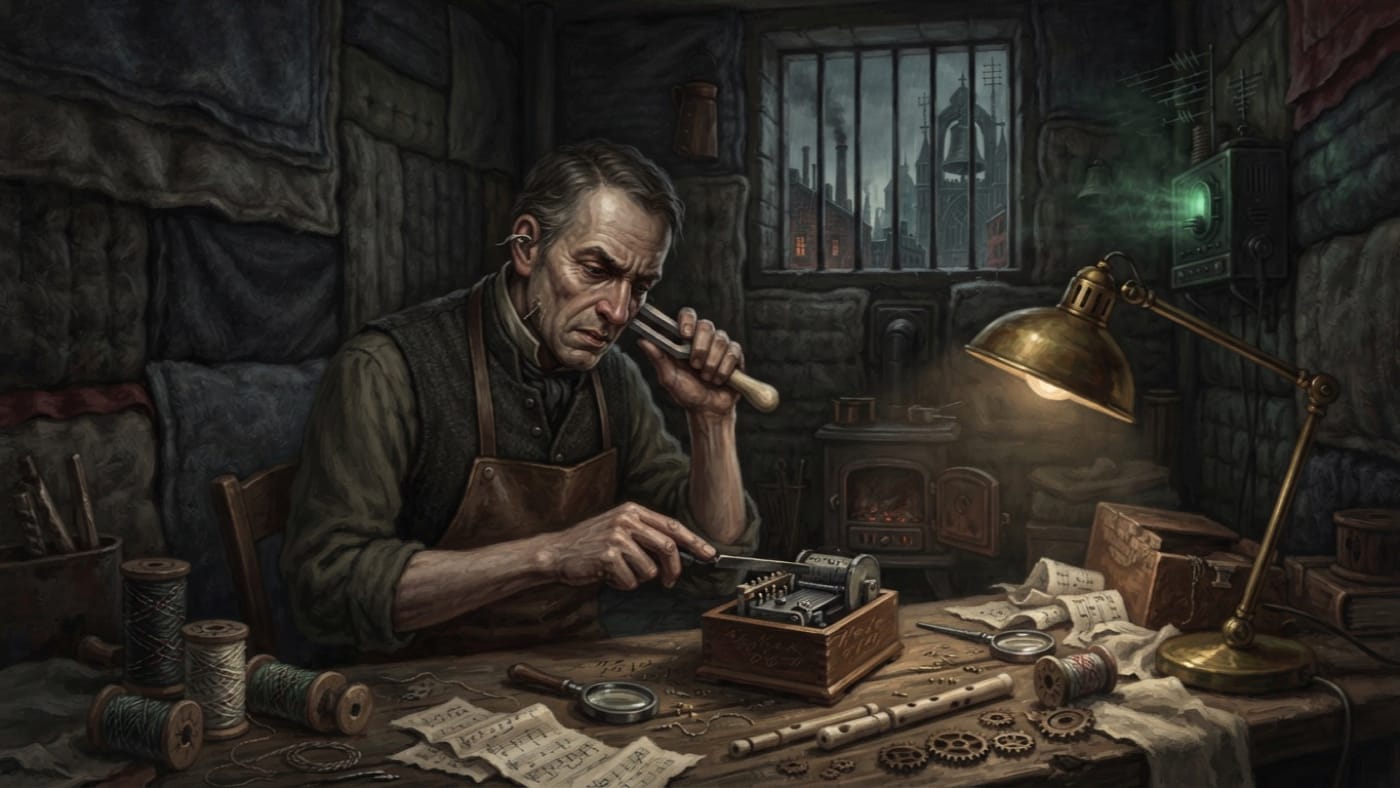
The instruments are modest. A tone fork is struck on the knee and pressed to the jawbone, where the surgeon hears it and the corridor does not. There is a partial music-box drum with three teeth filed down and the rest left alone, and a bone flute ground to a range the Bells will tolerate. The rooms are lined with damp wool. Far off, a receiver hisses whatever Orison is broadcasting that hour, and the surgeon uses it the way a cutpurse uses a crowd.
No edit is guaranteed. The surgeon's own proverb says so: if it comforts too fast, it kills. A surgeon who promises a perfect result has already changed trades, from craft to sales.
#On the Divided Score
Surgeons work on fragments because that is all a disciplined cell will hand them. A Whisper Runner brings the opening by mouth or finger-tap. A courier brings the middle bars in thread. A Listening Cell Host teaches the ending behind coats hung thick on the walls. The middle reaches the surgeon's bench on a cuff or a pillow-hem, and the surgeon has to edit it to agree with an opening they may never hear and an ending someone else will teach.
Here the two crafts depend on each other. A courier can carry a phrase but has not been trained to judge whether it will betray its singer. A surgeon can hear the danger but cannot read a cuff from a district whose code they never learned. Codes change from district to district on purpose. When a surgeon reads a Marseille knot with Strasbourg habits, the altered middle comes back wrong. When an altered middle meets an unaltered ending, the singer stumbles at the join, and frightened people stumble back toward the version they remember. That reflex is exactly what the bait-cadences of the Tone Inquisitors are designed to catch.
The trade's first law binds the surgeon as tightly as anyone: never carry the chorus. Nothing exempts the surgeon from it. That is the profession's private torment, because a good ear wants to hear the whole and judge the whole. A surgeon who starts keeping complete tunes "for reference" has written their own indictment, and has only to wait for someone to read it.
#On Those Who Buy the Work
Mothers buy most of it, usually at second hand. A surgeon edits the turn, a courier stitches it into an infant band, a neighbour supplies the opening, and a child in a thin-walled tenement sleeps without crying loudly enough to bring a complaint, which would bring Orison, which would bring the rest.
Ward-sisters of the Bureau of Mercy buy with more caution and more cynicism. A ward of forty cots needs a tune that forty children can hear without one of them carrying it into the corridor next morning. Mercy officially reports compliance with approved sleep schedules. Mercy also keeps records, and a ward-sister who pays a surgeon in medicine has put her own name somewhere nearby.
Trench captains in the rear wards of Bastion-Przemyśl buy morale. They want the ending everyone knows, and that ending is the most identifiable passage in any song. Port buyers in Marseille bring sailor airs that never fitted Synod cadence, and they need them bent until they do.
Payment comes as food, filters, medicine, a favour of passage, or a dry night under a roof. Some surgeons take what a widow can spare. Others have noticed that only a handful of people in a district can do this work, and charge famine rates for it.
#On False Safety and Pursuit
The worst product in the market carries the surgeon's name without the surgeon's work. Corrupt sellers offer "surgeon-edited" sleep, meaning a tune that drops a child into stillness at once. Smugglers have their own word for that stillness: sleep that watches. A cadence the Church has good reason to fear does not become clean because someone lowered its pitch. Editing changes the range. It does not expel whatever rides along with a melody, and the trade's own horror stories, about rooms that answer with a harmony nobody taught them, show that the smugglers know this too.
Pursuit does not depend on pitch either. A Tone Inquisitor listens for recognition and intent. An edited lullaby is meant to be recognised, and the mother who sings it knows exactly what she is singing. A Sky-Sermon Attendance Auditor notes who hums during the broadcast. A former courier who has turned informant remembers which ward-sister received a cuff, and which surgeon's bench it came from. The charge is Melody Intent, and quiet is no defence against intent.
The legal ground has not changed since the Orison Licensing Acts of A.S. 94. The branding stations of the Vienna account showed how far the state would go over one folk lullaby. The Dormition Canticle showed how little official comfort could do, and so kept demand high. The laundry-women of Candlewick showed what a complete written melody costs. None of it encouraged surgeons to hope for clemency. The penalty can reach beyond the body, to a family's removal from the Great Ledger of Souls.
Some surgeons work from stolen broadcast fragments that an Orison Signal Engineer has sold them. Those engineers are suppliers. The Bureau's early habit of assuming every surgeon was a former engineer filled the cells with technicians and left the benches empty.
#On the Present Practice
At the time of this survey, A.S. 201, Cadence Surgeons are still at work wherever couriers can reach them: in port wards, rear-line tenements, and orphanage corridors where the linen circulates oddly. They have no guild, no charter and no register. They have no proven patron either, though some of them tie Saint Hessa's knot like the rest of the trade, and deny it as readily. They keep a fork, a filed drum, wool on the walls and a stove for whatever fragment has to be burned before morning.
Their value depends on the same few things that endanger them: the couriers, the cuff, the ear and the mother. Lose any one of those and the edit is useless, or it becomes a confession.