
#On the Allotment
In the Dorm Rows of the Cloister of Miscounted Beads, on Strasbourg's outskirts, light is issued as a ration: one taper per six detainees per night. The rule governs Housing Row Four through Nine, Detention-Berth Annex, Pilgrim Reconciliation Estate, which its residents call Awaiting. It governs nothing else. The Synod has no general candle ordinance, and provincial chaplains who cite this one as if it applied in their own parishes may stop doing so.
I cannot tell you who first fixed the figure at six. The ledger I was shown is already obeying it on its first page. The ratio operates under the joint authority of the Bureau of Records and the Bureau of Pilgrimage, and the Cloister Chapter administers it with the calm of men who have never been asked to defend it. What interests me is its form. A candle in a dormitory might have been counted as a fixture, like a roof beam or a drain. Instead it is an allowance. It is counted out, measured against the wall, logged and recalled at the bell. Anything that is allowed can be withheld, and anything that can be withheld will eventually be used to correct someone.
#On Issue and Extinguishing
The procedure is short, and every clerk recites it as though it were long.
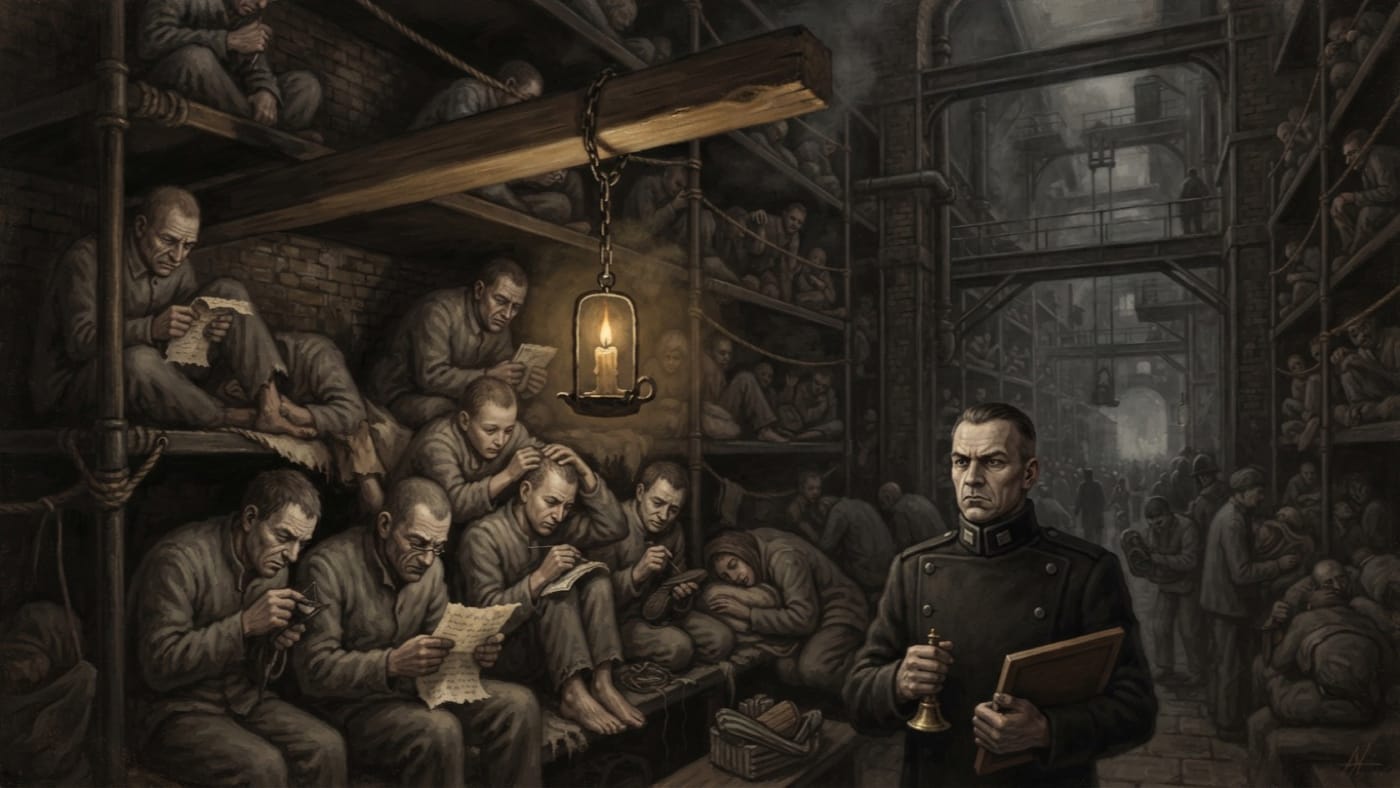
First the taper is held against a wax-mark on the brick. The mark is old and greasy, and the hall trusts it more than any witness. Nobody I asked could tell me who made it, and nobody admitted to wanting it changed. Once measured, the taper goes into an iron cup chained to a beam. The chain keeps the cup where the clerk left it, which is the clerk's whole idea of order. Then the dorm clerk writes the hour on his slate. From that line onward the candle belongs to the record, and the six who sit under it only borrow its light.
Two bells divide the night that follows, and the distinction between them matters to the clerk.
At third bell, speech is curtailed. The candle keeps burning. For whatever interval remains, six people must share one flame without arguing about it aloud, which in practice means they argue with elbows, glances and the slow theft of space nearer the cup. Appeals are read with moving lips. Lice are hunted in silence. A mother who cannot hum to her child rocks it instead, and rocking takes room.
At fourth bell the clerk comes back with snuffer and slate and puts out whatever has outlived its allotment. After snuff, nobody moves without the clerk's permission or an urgent need he recognizes. Need is classified on the spot by a man holding a snuffer, and he rarely errs toward generosity.
#On Six Claims to One Flame
Consider what the flame is asked to do. One detainee holds an appeal returned from a desk with a correction he cannot read by feel. Another holds a route slip from the Lost-Procession Yard whose chalk has begun to smear. A third is searching a child's scalp for lice. A fourth has a shoe open at the sole and one needle, borrowed against a crust. The fifth watches the bundle that holds everything she owns, because a Row in the dark is a market. The sixth wants to sleep, and resents every one of them.
That is the doctrine of the ration, whatever its authors meant. The evening is the only stretch of the day that the Cloister does not claim with intake, labour or count. The candle claims it instead. Who reads tonight and who mends tonight is decided at the cup, and so is whose appeal goes back to the desk corrected tomorrow and whose waits another night. The Pilgrim Reconciliation Statutes invite the detainee to pursue his correction. The ration fixes how many minutes he gets to do it in, and it splits those minutes six ways before he has opened his slip.
I have called rationing the Rows' native sacrament, and I stand by the phrase as rhetoric. No Office of the Church has numbered it. It is administered nightly to the faithful by a man in a clerk's collar, and the faithful receive it on their knees, because the beam is low.
Violence follows. Men who slept in ditches for weeks without complaint have broken fingers over four extra minutes of light. A mother has struck another mother's hand away from the cup for the sake of a lice comb. The Bureau of Mercy has studied the matter and issued a pamphlet of thirty-two pages on candle-related violence. It recommends prayer.
#On Revision and Illicit Exchange
The ration cannot be transferred except by clerk revision. In the language of Records this means the candle does not move unless the clerk moves it. A revision has no published grounds, schedule or form. A detainee who wants his group's taper reassigned, or his own place moved under a different beam, applies to the clerk's judgement. That judgement has its moods, and like every judgement in the Cloister it has its prices.
The ratio is the same for everyone. Nothing else is. Jossa Rill's intake classification sends each body to its berth, and the dorm matron checks wrist tag against berth slate. Yellow sponsor-interest cases get the better cots. The poor sleep where the poor are put, nearer the drains, while dorm fees pile up against them and a clerical debt is credited in labour hours. A man who has carried ration tubs and scrubbed fever cloth all day comes back to a cot far from the cup, with his appeal still unread. His debt grows because his file is slow, and his file is slow partly because he cannot see it.
Earlier Cloister pamphlets stated that Dorm Row assignment is performed "without regard to means, influence, or status."
Corrected. The candle ratio is applied without regard to status. Every other condition of reaching the candle is assigned by status.
The prohibition on transfer has produced a busy trade in transfers. Wax scrap buys silence. A pinched wick buys a berth exchange. Candle ends go into hems and come out after snuff, and a daughter has reported her mother for it. Stubs are pressed flat and used as tablets for messages too short to justify paper, then wiped with a thumb before the matron passes. None of this is lawful. A practice that happens every night still has no standing, and the clerk who looks away has made no revision. He has only failed to notice. The ledger cannot hold failures to notice. They show up on the slate as nothing at all, which is the most common entry in the Rows.
#On Snuff Patrols and Sealed Nights
The worst moment of the ration is when it ends. Snuff falls, the hall goes black, and six people who have been quarrelling over a flame for hours are suddenly equal and blind. The Quiet Thread recruits in that moment. A whisper comes from the next bunk. Someone slips a bead under a sleeping mat. Someone promises that the count can be directed, and that the original count is waiting somewhere behind sealed wood. These are the cell's beliefs, and I report them as such. The cell also invokes a "Mother Thread". Archivist Keth, who keeps the Bead Vault, has never put her name to their catechism where a wall could repeat it.
Row watch memoranda for A.S. 201 recorded Thread language in Rows Four, Six and Nine and prescribed more snuff patrols. The answer to whispering in the dark, then, is more men walking through it with cudgels wrapped in cloth.
During the Anomoly Weeks declared under the Anomoly Protocols, the night tightens. Names are not spoken. Counting is not done aloud. Active strings undergo salt-wax inspection, and no string may lie against bare skin. Children are tied to adults by wrist ribbon. Movement narrows further, and dorm rations are adjusted. No order I have seen alters the candle ratio during those weeks, and I will not invent one. What changes is the hour after snuff. If a detainee answers to the wrong name, he is moved. If a tag has changed, the clerk covers his slate and sends for Prior-Scribe Erem Vale, whose clearance and emergency authority settle what the clerk cannot. If the slate itself has changed, everyone waits for Keth. I do not say what changed it. Neither does the Chapter.
#On the Present Application
As of A.S. 201, Awaiting is over capacity, as it has been since the surge after A.S. 198 filled the Cloister's halls. Extra rope cots hang between the tiers. Average processing runs to nineteen days for anyone who cannot buy speed at the Supplementary Entry Office, and that is an average, not a sentence. Each of those nights is lit by one taper for every six bodies, at whatever share of the flame a given cot can reach.
The ratio has not changed. To raise it, someone would have to revise the supply ledgers, and supply ledgers in the Cloister are guarded more jealously than eyesight. Records calls the figure stable. Pilgrimage calls it sufficient. Mercy has its pamphlet.
I have submitted a request that the wax-mark be reviewed. The matron of Row Five took it into the complaint box herself and assured me it will be read upon clearance.