
#On the Law That Counted Mercy
The Pilgrim Reconciliation Statutes were promulgated in A.S. 97, three years after the Cloister of Miscounted Beads began swallowing the western pilgrim roads and one year after the Bureau of Records admitted, in language so dry it should have caught fire from shame, that bead discrepancies required “standing procedural remedy.” A lesser civilization would have said the prayers did not match the strings. The Synod produced statutes. This is why we survived.
The Statutes govern the correction of pilgrim bead counts, route stations, confession addenda (Unregistered), sponsor seals, second-string issuance, supplementary entries, dead-name appearances, and every other little rupture by which devotion becomes inconvenient to the Ledger. They are administered jointly by the Bureau of Records and the Bureau of Pilgrimage, two offices whose partnership resembles a marriage between a lockbox and a road shrine. Records wants correctness. Pilgrimage wants movement. The Statutes permit both, at tariff.
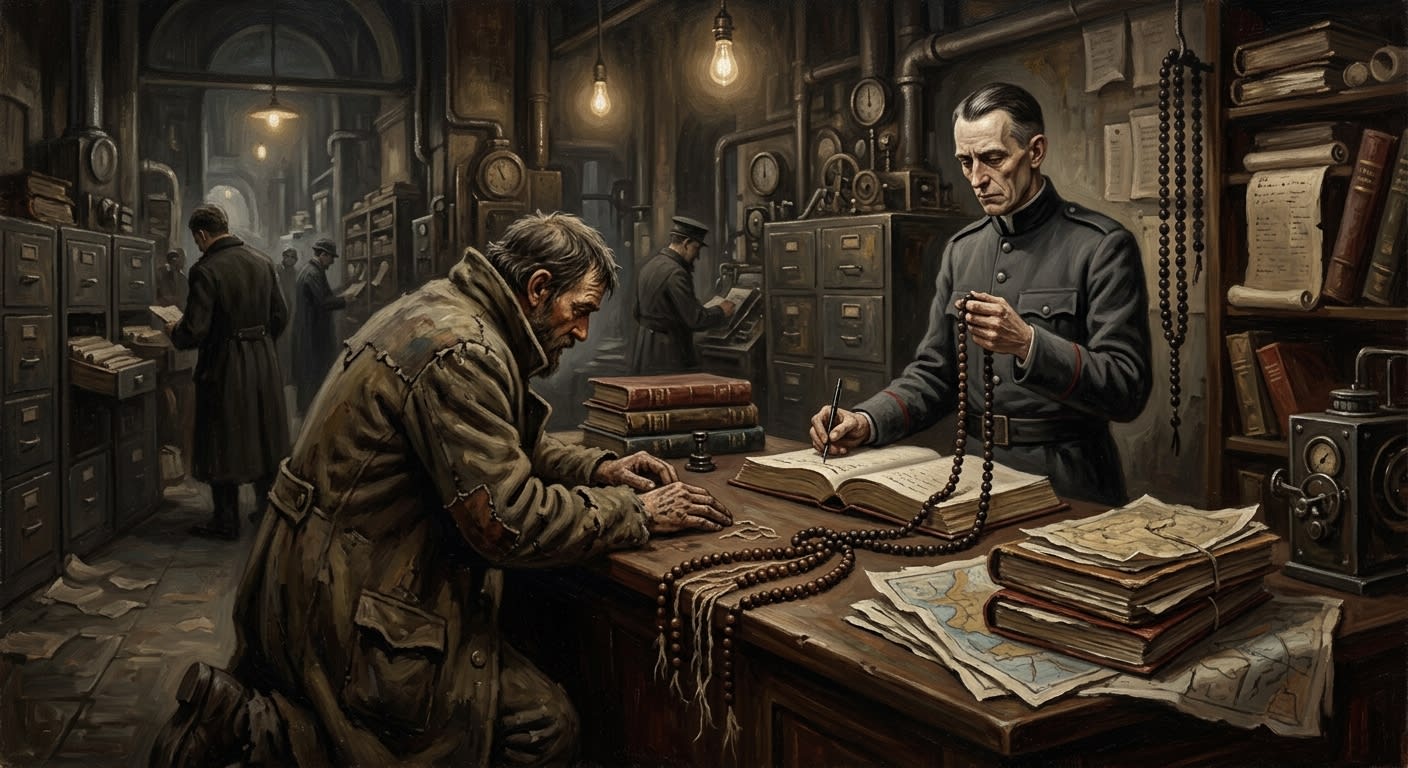
Their first purpose was simple. Pilgrims arrived at Strasbourg with bead strings that recorded prayers, stations, vows, penances, road deaths, and indulgence claims. The counts failed. One string held thirty-nine beads after the pilgrim swore thirty-seven. One station mark belonged to a shrine bypassed by forty leagues. One widow carried a dead husband’s string still warm after burial. One child entered through the Intake Gate with three beads no one in the procession had seen, each bearing a name from the Great Ledger’s deceased column. Too many discrepancies for local kindness. Too many ghosts for ordinary filing.
The Statutes turned the miscount into an office. That is their genius. Before them, a wrong bead invited argument: priest against pilgrim, road marshal against clerk, widow against ledger, dead man against everyone’s composure. After them, the wrong bead acquired sequence. Sequence is the Synod’s preferred anaesthetic.
#On Their Making After the Cloister
The Cloister accreted in A.S. 94 after the Concordat had fixed the administrative skeleton of the restored faith and pilgrim traffic had begun arriving in volumes piety could praise only from a balcony. The western gates clogged. Processions lost leaders. Waystation marks contradicted route slates. Dead names returned in intake. The Queue Road coughed bodies toward the city wall, and the city wall, displaying the cowardice common to masonry, refused to solve doctrine.
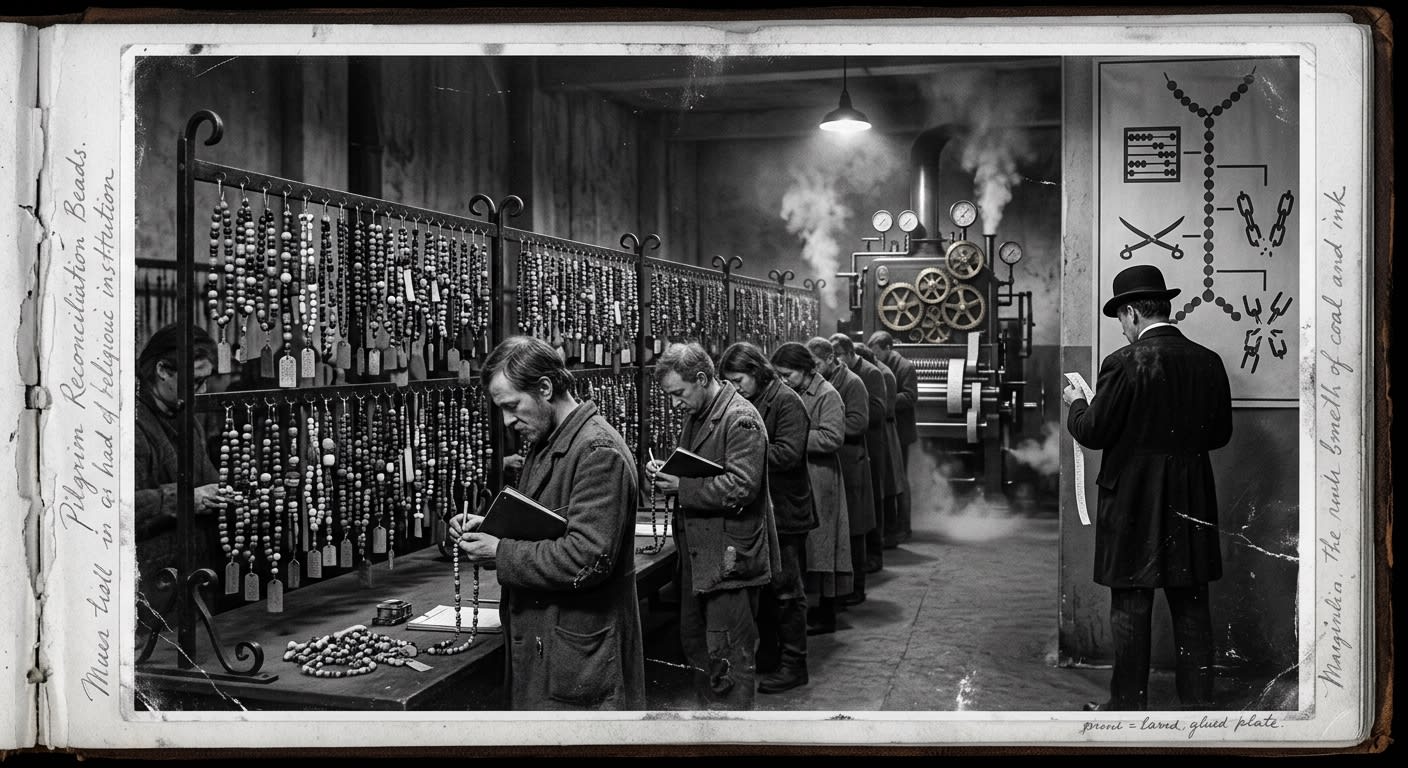
Records first tried temporary handling orders. Temporary orders are the larval form of permanent bureaucracy. A table outside the western gate became two tables, then a holding yard, then dormitory rows, then the Counting Hall, then the Supplementary Entry Office, then the Chapel of the Second String, then the Bead Vault, each new room proving that the prior room had lied about sufficiency.
The original A.S. 97 Statutes were modest in declared scope. They defined a pilgrim string as admissible devotional evidence. They authorised clerks to compare bead count against approved station rosters. They permitted supplementary entry when count and route differed. They created clerical debt for unpaid filing fees. They established second-string correction for cases requiring ritual closure. They declared that a reconciled record outranked an original claim. There, in that last sentence, sat the whole machine, still small enough to fit in a legal folio and already large enough to eat a life.
Records supplied the language. Pilgrimage supplied the holy varnish. The first preamble praised mercy for the delayed traveller, protection for the honest penitent, clarity for the road, and preservation of the faithful from the dangers of irregular devotion. It did not mention sponsor brokers, missing-page rings, fever tents, corpse-cart labour, or the sound of beads clicking in sealed cases between third and fourth bell. Law, like portraiture, begins by selecting the flattering angle.
Early Pilgrimage handbills described the A.S. 97 Statutes as “pastoral relief for pilgrims caught in innocent discrepancy.”
Corrected. Relief was one effect. Revenue was another. Surveillance was a third. Innocence, where present, was processed at the same desk as fraud and charged similar wax.
#On the Articles of Count
The Statutes begin with definitions, because every legal horror first baptises its instruments. A bead string is more than a keepsake. It is a portable devotional record. A station is more than a place where a tired pilgrim wept, ate hard bread, or kissed stone. It is a licensed node in the route table. A prayer attached to a counted bead is also a claim. A miscount is more than a mistake. It is a discrepancy pending reconciliation.
The first articles describe admissible strings: cord material, bead class, knots, witness bead, route tag, mourning bead, sponsor knot, and the marks by which a clerk may distinguish prayer-weight from common handling. Cheap strings are suspect. Fine strings are also suspect, but more politely. A string lacking the black witness bead is held. A string with two witness beads is held under cloth. A string that stains the desk receives salt. A string that moves after receipt is not described in the articles because the articles, at least in A.S. 97, retained the innocence of men who had not worked enough nights.
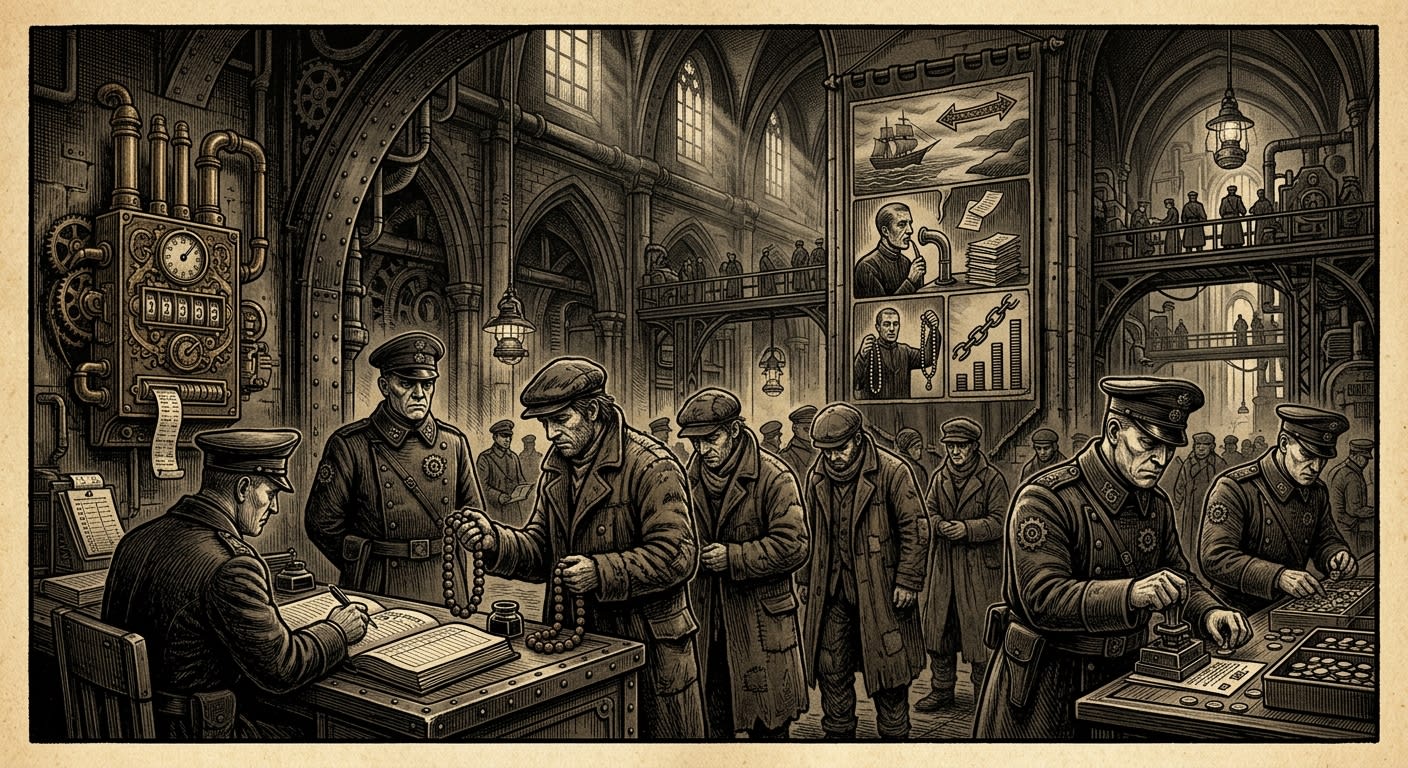
Article Seven created the standard reconciliation sequence: string received, name checked, route compared, count pronounced, discrepancy named, correction priced, disposition sealed. The Clickery still chants this sequence in brass, wax, lamp smoke, and clerkly breath. Pilgrims believe the count is the dangerous portion. They are wrong. The dangerous portion is naming the discrepancy. What is named can be priced. What is priced can be delayed. What is delayed can be owned.
Article Eleven made route testimony subordinate to bead evidence except where bead evidence displayed heat, moisture, doubling, dead-name attachment, or “other handling irregularity.” This clause is the Statutes’ first little window into dread. It does not admit bead drift. Nothing admits bead drift. It admits only that objects sometimes behave in ways that require senior handling and a denial drafted in advance.
#On the Supplementary Entry
The supplementary entry is the Statutes’ favourite child: obedient, expensive, endlessly fertile. One missing bead becomes Form S-1. The pilgrim’s explanation becomes S-2. The clerk’s dissatisfaction becomes S-3. Witness requests, confession addenda, route corrections, identity amendments, debt conversions, appeals, appeal denials, and labour obligations follow in their little grey procession. Paper breeds faster than rabbits and with less honest appetite.
In the Supplementary Entry Office, a life is repaired by addition until the original can no longer be accused of simplicity. The Statutes authorise this mercy with admirable breadth. A discrepancy may be supplemented by testimony, confession, sponsor attestation, route adjustment, station substitution, second-string rite, labour credit, death correction, or sealed review. A poor pilgrim receives the full splendour of the system because poverty cannot purchase abbreviation.
The confession addendum became the most profitable form of spiritual parasitism after the A.S. 187 revision. Before that year, pamphlets claimed confession data remained privileged. This was a beautiful fiction with a knife already inside it. The revision clarified that confession addenda are spiritually privileged within the usable range of Records, Pilgrimage, Purity, Tithes, Mercy, and tribunals bearing sufficient seal. In other words: the soul remains covered while the paperwork is shared. Modesty preserved. Information harvested.
A.S. 187 REVISION HEARING — PARTIAL MINUTE Objection from Pilgrimage delegate: “The penitent may refuse confession if administrative use is known.” Records reply: “Then administrative use must be phrased as care.” Vote: █████ in favour. Marginal note in unknown hand: “Care bills better.”
Supplementary entries also gave legal shape to clerical debt. Filing fee unpaid by third day becomes labour. Labour accrues dorm charges. Dorm charges require appeal. Appeal requires fee. The Statutes do not call this a circle. They call it continuing reconciliation. A pilgrim scrubs the desk that delayed him, copies the form that priced him, carries sealed packets to the Vault that may contain his first string, and thanks the clerk if released before winter. Gratitude is easiest to obtain from the exhausted.
#On the Second String and the Authority of Correction
The second string (Unregistered) is the Statutes in cord form. It proves the doctrine most dear to the Cloister: correction outranks origin. The first string may have travelled five hundred miles, touched licensed shrines, absorbed rain, sweat, tears, fever, road dust, and the thumb oil of prayer. The second string may have been tied that morning by a debt apprentice with glue on his cuff. The second string is lawful. The first string is evidence.
Under the A.S. 97 Statutes, second-string issuance required failed count, completed penance, clerk witness, chapel entry, surrendered original string, and a corrected-name tag. Under later practice the surrendered string may be marked absent if swallowed, stolen, hidden, disputed, warm, singing, claimed by the dead, or already in Vault custody. The law is stern. Practice is clever. Clever practice is how institutions remain alive after their rules discover weather.
The corrected string governs movement, dorm release, station credit, and clearance review. The original string retains evidentiary value only. Correction outranks origin. Hatred of the corrected string does not impair its authority.
The Chapel imposes the rite on stone. Kneel. Hear the failed count. Hear the corrected count. Repeat only the corrected count. Accept the lawful cord across the palms. Kiss the witness bead if ordered. Do not count under breath. Do not answer if the basin water says your childhood name. The Statutes are less poetic about this than I am, naturally, but not more precise.
An A.S. 121 devotional commentary states that second-string issuance restores the pilgrim’s original road.
False. It restores admissible movement. The original road remains where it was: under mud, memory, disputed testimony, and whatever the first string chose to remember before Records took it away.
The poor hate the second string with admirable theological instinct. They know replacement when they feel it. The Statutes insist no replacement occurs, only correction. Both positions are true in the useful Synodal sense: materially replacement, legally correction, spiritually whatever the chaplain can make stick before supper.
#On the A.S. 187 Revision
The A.S. 187 revision changed the Statutes from a reconciliation instrument into a mature apparatus. The proximate cause was threshold failure and bead evidence behaving in a manner not conducive to official confidence. The Intake Gate received its iron leaves that year. Threshold discrepancy became administratively usable in richer detail. Gate observations moved from preliminary kindness to evidentiary seed. A wrong name spoken before entry could follow a pilgrim to Desk Four, the Office, the Chapel, the Vault, and the labour roster. The road began testifying before the traveller had crossed the wall.
The revision also introduced weight discipline. This came after a string gained seven beads overnight in the Vault while losing no length, no knots, and no dignity. The revised rule ordered weighing alongside counting, with special handling for strings whose mass contradicted visible beads. A string counting thirty-seven and weighing forty-one is trouble. A string weighing less after a widow holds it is sent to chapel salt. A visible string weighing nothing is covered and mentioned only upward. Weight tells what arithmetic conceals.
Sponsor seals were regularised with the same revision, which is to say corruption received grammar. The Patrons of Correction became no more lawful in public and much more useful in practice. A sponsor mark could shorten review, alter dorm assignment, accelerate witness routing, soften a route failure, or cause a missing page to be reconstructed with extraordinary theological charity. Records condemned abuse while improving receipt formats. The moral life of an institution may be read by its invoices.
Confession routing expanded. Purity gained standing access to sour words. Tithes gained access where debts touched inheritance or pledged property. Mercy gained access to illness, despair, and death in Awaiting. Pilgrimage retained the right to describe all of this as care. The Bureau of Records retained the copies, which is the closest any Bureau comes to owning the event.
#On Ninth-Ratification and the Denial of Drift
Ninth-Ratification protocol governs severe cases: dead-name reappearance, autonomous roster amendment, strings warming in sealed cases, second-string echo, gate tags written before issue, desk records reverting, basin water speaking, or any event that requires more denial than an ordinary clerk can produce without sweating. The term sounds majestic. It is, in essence, a set of instructions for how to panic with good posture.
Seal the file. Cover open ink. Stop spoken names. Route the string to the Vault. Hold the body if present. Hold the absence if no body is present. Notify the Prior-Scribe. Notify Records by sealed packet. Notify Purity only if speech, cult, counterfeit, or unauthorised hope appears. Notify Pilgrimage last, lest it comfort someone prematurely.
The Statutes never use the vulgar phrase bead drift. Circular 881-R of A.S. 199 stiffened the denial into doctrine: bead counts are fixed at the moment of filing and do not change; later discrepancies reflect handling error. The Cloister obeys this doctrine while employing silence hours, vinegar cleansing, salt-wax sleeves, Desk Eleven, lower cabinets, chapel basins, backward-written name slips, and Archivist Keth’s deaf ear. Denial is not ignorance. Denial is discipline.
The Quiet Thread interprets the same events as holy address. They believe the beads count because someone is counting, that dead names surface because the Ledger remembers what offices erase, that the First String waits in the Vault as original measure against all correction. The Statutes classify such claims as illicit devotional speculation where harmless, red-lane infection where organised, and evidence if useful. Heresy often becomes valuable once confiscated.
#On Vale’s Hand
No living officer embodies the Statutes more completely than Prior-Scribe Erem Vale, confirmed in A.S. 194 and refined, like a blade, by delay. His clearance seal is small, black-horned, and more feared in the Dorm Rows than winter. The Statutes give him power to seal, amend, reconcile, delay, suspend intake, suspend clearance, and route anomaly conditions through files so thick that no clerk can see both ends without permission.
Vale never says mistake. The Statutes do not require this habit, but they have taught it to him like prayer. Mistake implies accident. Discrepancy implies jurisdiction. He never says detained. Under reconciliation. He never says extortion. Sponsor-responsive. He never says panic. Protective narrowness. Language is how Vale keeps the Statutes from smelling of the bodies they hold.
Vale fears unratified irregularity: an event that proves the system wrong before the system can name it. He can survive cruelty, corruption, overcrowding, sponsor scandal, canal fever, missing pages, and city magistrates whining about cleared vagrants. Such things have forms. He fears the file that corrects itself, the dead claimant whose string pays no fee, the basin that answers without subpoena, the bead that moves because no office authorised stillness. The Statutes arm him against these insults. They do not comfort him. Good law rarely comforts the men who understand it.
#On the Present Use
As of A.S. 201, the Pilgrim Reconciliation Statutes hold the Cloister together in the manner of wire around a cracked reliquary. Intake has exceeded design capacity since A.S. 198. Annual intake stood at 14,200 in A.S. 200. Clearance rate: sixty-seven percent. Average processing time: nineteen days. Mortality: 4.2 percent, chiefly canal fever, exposure, despair, and the ordinary effects of waiting under Bureau care. Five anomaly weeks are projected. The Sponsor-Seal Brokers have tripled their prices. The Lost Procession Yard is mud with jurisdiction. The Clickery is behind by weeks. The Office is choking on appeals. The Chapel floor remembers water. The Vault is warmer than stone permits.
The Statutes continue to function. That is the indictment and the praise. They receive disorder, price it, delay it, sanctify it, and release what remains under corrected name. They make the road answerable to the desk, the bead answerable to the Ledger, the pilgrim answerable to his own string, and mercy answerable to fee schedule. A soul may arrive exhausted, faithful, terrified, innocent of fraud, and carrying a string his mother tied. The Statutes will ask whether the count matches. If it does not, innocence waits.
Modern critics call the Statutes cruel. This is lazy. Cruelty alone does not build a compound, feed six thousand bodies, process dead names, contain bead anomaly, discipline sponsor fraud, extract confession data, and keep Strasbourg from drowning in unpriced piety. The Statutes are cruel, useful, holy by attachment, venal by practice, and indispensable because the roads keep spilling what ordinary mercy cannot count.
At the Intake Gate, the first chalk mark falls on a pilgrim’s shoulder. In the Yard, Jossa Rill assigns his visible fear a colour. In the Hall, a clerk counts his beads and finds the road guilty of something. In the Office, his life acquires addenda. In the Chapel, he receives a second string. In the Vault, the first string clicks after midnight. The Statutes call this reconciliation.