
#On the Citation and Its Office
"Pain opens. Hymn orders. Truth seals." — Cantor's Primer, Bureau of Purity, Third Revision
Of the Cantor's Primer the Codex holds six words, a title, the Bureau it is attributed to and the number of a revision. The six words are cited in the Codex entry on the Iron Choir Brand-Singer as the work of the Bureau of Purity, Third Revision. They are the only sentences anyone has shown me that the Primer can be held to have said.
I looked for more. The materials consulted for this survey name no compiler, no press, no year of first issue and no year of the Third Revision. They give no page count, no binding, no tally of copies and no rule on who may carry one. I record these as the limits of what I was shown. An archivist who mistakes the edge of his own shelf for the edge of the world deserves the shelf.
I can read the title for myself. A primer is the first book, the one placed in the hand before the hand is trusted. The word suggests a book for the novice: the Ash Chorister holding drone notes in a cold corridor before the Bureau lets him near a chapel of irons. That is my inference from a word. The citation does not say who the book was written for, and I will not invent a lesson plan to flatter the inference.
On its own, the maxim describes a machine with three moving parts. Each clause names a stage. Each stage names a duty.
#On Pain Opening
The first clause is the least theological of the three and the most accurate.
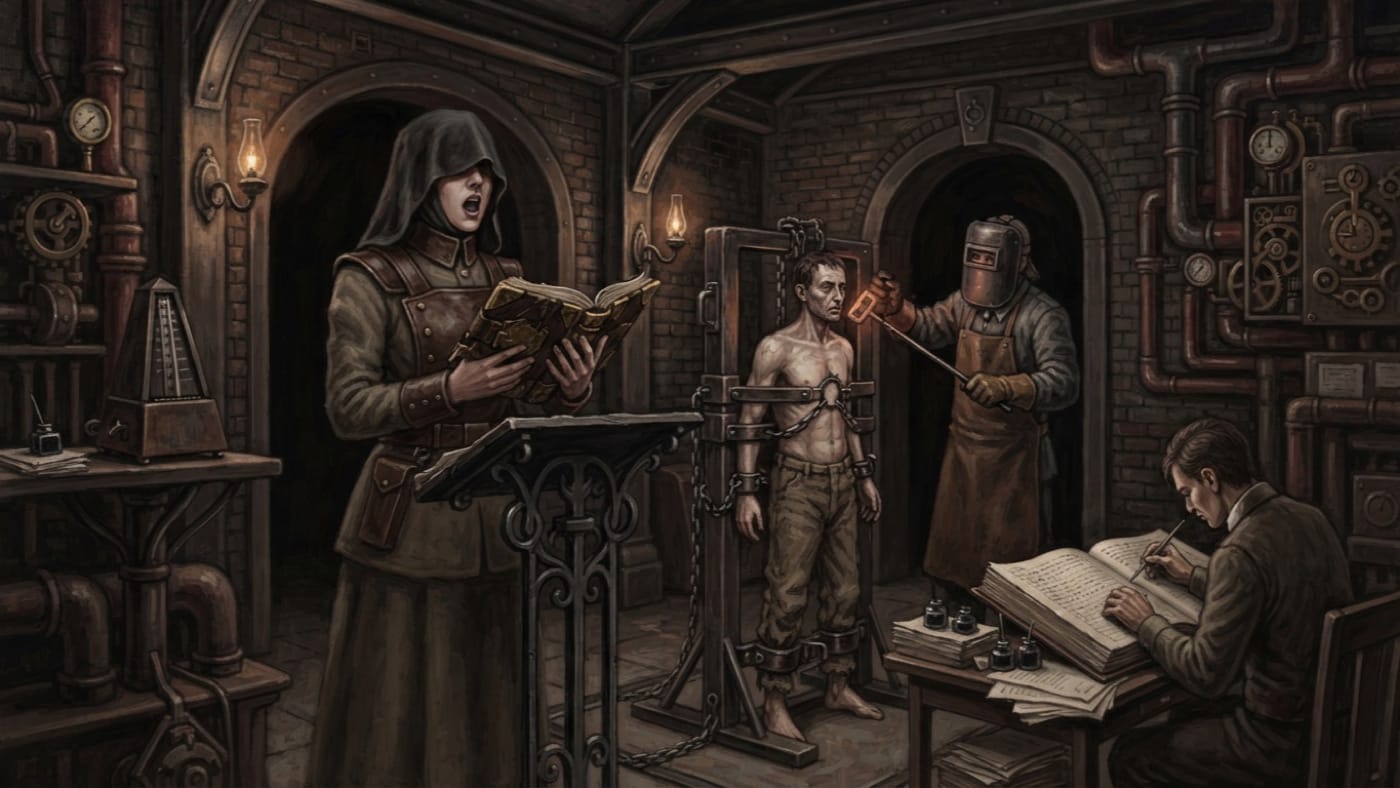
A body under the brand thrashes. The lungs seize and the hips buck. The wrist strains against the chain, and the iron slides off its mark. The Brand-Smith set that iron to a geometry he must later answer for. A slid mark is a smear, and a smear cannot be read. An unreadable confession is invalid. An invalid confession means the condemned goes back to the chapel to be opened a second time, on skin that is now harder to find.
"Pain opens," then, does not praise pain. It records a fact of procedure. The iron breaks the subject's composure as surely as it breaks the skin. Whatever pours out, whether breath, noise or the names of officials whispered in hope of a bargain, must be taken in hand at once. Under that clause the Singer's first task is the breath. She holds a low drone without visible gasping. It enters through the ribs and draws the lungs into its pace. The trade calls this setting the bellows.
By then the condemned has no rhythm left of his own. He breathes on the Singer's count, flinches on the Smith's and speaks into the scribe's waiting column. I once watched a man try to bargain mid-hymn. The Singer did not move her pitch by a hair. The bargain went into the anomaly report and nowhere else.
#On Hymn Ordering
The middle clause carries the work. The Bureau's own surveys of the trade record the rite in six stages. Nobody has shown me the Primer's pages, and I will not dress the trade's sequence up as their chapters.
First, the room is tuned. The Singer taps the tuning rod against stone three times, sets the bell-hour metronome token and listens for what cracked masonry does to a clean pitch. Certain intervals are classified as unclean and must be suppressed before anyone is brought in. Second comes the Opening Hymn, which is the breath work already described. Third come the cues: a rising cadence for the identity clauses, a falling cadence for the list of sins and a sustained tone for the sentencing formula. The approved hymn slate tells the Singer what to sing. The cue tells the Smith when to strike.
Fourth comes application. The Lictors have supplied the irons and the restraint. The Smith lays the geometry when the pitch reaches the approved interval and withdraws when it holds. The scribe records the diameter. A first-rank Singer can cue several chambers at once with small shifts of pitch. Master Cantor Vell served at the Strasbourg penitence halls from A.S. 130 to 147 (1840–1857 CE). He is credited with seven simultaneous rites and not one misaligned inscription. I report the credit. I did not stand in the corridor.
Fifth is the Closing Tone, fixed by Standing Order 22-S: three notes falling by thirds, then silence for fourteen heartbeats. The Order does not say whose heartbeats. That is left to the conscience of the room.
Sixth is the paper. The Singer files her anomalies, the Smith files his alignment log and the scribe files the inscription record. Three ledgers cover one body. By now the scar has a syllable for every mark, and every mark has a witness who heard its note.
I will say it plainly: a confession ordered this way is legible, and a legible confession is a true one. A scar cannot smudge. It cannot recant. It cannot claim the scribe misheard.
#On the Schools That Read the Maxim
Three schools quarrel over the same three clauses. So far as I can show, none of them keeps a separate edition. The quarrel lives in the singing, not in the binding.
The Mercy Tone school leans on orders. It sings slow drones with long intervals and keeps the condemned breathing. A living condemned finishes his confession, and a finished confession files cleanly. The Bureau of Records likes the school's clean inscriptions. The Bureau of Mercy likes its surviving patients. The street insists that families pay for it.
The Judgment Tone school leans on opens. It sings sharp cadences and staccato cues, with intervals chosen to hurry the mouth. Its tribunal prefects have quotas, and the quotas have deadlines. The Bureau of Purity prefers speed, one of its few candid habits, and does not discourage them.
The Silentists lean on seals, which is to say on the silence. They would cut the hymn down to a metronome tick and a whisper, on the ground that any sound in that room is an invitation. The Bureau of Orison and Song regards them as musicians who have deserted music. The Bureau of Purity keeps them because they file the fewest anomaly reports.
Whatever the school, training makes the same demand. Cantor-Marshals test intervals without warning, and auditors compare scar patterns against timing logs. A Singer who drifts may be demoted to drone work or sentenced to silence weeks. Some Singers' cords scar into the rasp the trade calls the scar-voice, and they are kept on, because a ruined voice carries through ruined stone. The maxim takes steadiness for granted. The Singer pays for it in the throat, one salt-and-ash rinse at a time.
#On Truth Sealing
The last clause is the one the Bureau loves best and the one I trust least.
"Truth seals" claims for the silence after the Closing Tone what the paperwork claims for the scar. The fourteen heartbeats are said to stop "echo lies," a leftover vibration the Bureau holds capable of pressing falsehood into raw flesh. The Bureau declines to say whether this is physics, theology or a superstition grown venerable. I decline as well. It is not my department, and departments that guess wrong are reassigned.
After the silence comes the reconciliation. The Singer's anomaly sheet goes beside the Smith's alignment log and the scribe's inscription record. Suppose the Singer notes a pitch break where the scribe recorded a clean strike, or the Smith reports drift where the Singer held true. Then an audit follows, and the auditors of the Bureau of Doctrine arrive with their own tuning rods. Where all three records agree, the confession is certified clean. The hymns themselves are governed by Approved Hymn Protocols, Revision 14, in force since A.S. 199 (1909 CE). That is a different instrument from the Primer's Third Revision. I set the two side by side only so that no clerk confuses them.
This, then, is what the seal achieves. Three officers agree that a procedure was performed on time, on pitch and in the proper geometry. The body carries their agreement out of the room. On the road between Mainz and Strasbourg, the Iron Choir of Mainz displays such bodies in cages. Brand-Singers walk that road to keep the cages within approved parameters. That gallery is a consequence of the rite. I find no evidence that the Primer founded it.
ERRATUM. Above, under On Hymn Ordering, I wrote that "a legible confession is a true one." Strike it. Legibility shows that the rite was performed as ordered and recorded as performed. It shows nothing about whether what the condemned said was so. The scar is a faithful copy of whatever was spoken under the hymn. The Bureau certifies the copy. — V. D.