

#On the Silence After the Third Fall
Standing Order 22-S is the Bureau of Purity's acoustic-seal order for the closing of licensed Iron Choir Brand-Singer rites: three descending notes, a silence of fourteen heartbeats, no speech until the scribe certifies the chamber clean, and no answer offered to any sound that was not made by an authorised throat.
The public version calls it rite completion. The trade calls it starvation. The room is given sound, pain, iron, breath, terror, confession, ash, and heat; then, at the final instant, it is denied reply. One must admire the cruelty. It is rare to see the Synod treat architecture like a prisoner and remain the kinder party.
22-S is anchored to Saint Orla's final rite in A.S. 104, when the repaired Strasbourg Iron Chapel (Unregistered) answered before her note completed, the condemned began breathing in one cadence, the scribe lost command of his hand, and Orla forced the room down with the steady note before dying in the silence that sealed the procedure. Her preserved command became the order's hidden marrow: Do not answer it.
The order appears small beside Writ 14-C, which licensed the throat and built the profession. It is smaller. A nail is smaller than a door. Ask the man locked inside which one matters.
#On Orla's Chamber and the First Refusal
The Strasbourg Iron Chapel had been repaired that morning. This is the detail all sane readers should mistrust. A repaired room has just been persuaded to resume its duties and may resent the tone of persuasion. The north wall had cracked. Mortar was fresh. The baseline was unstable. Orla requested transfer. A tribunal prefect denied it under quota authority, proving once again that the warmest offices produce the coldest judgments.
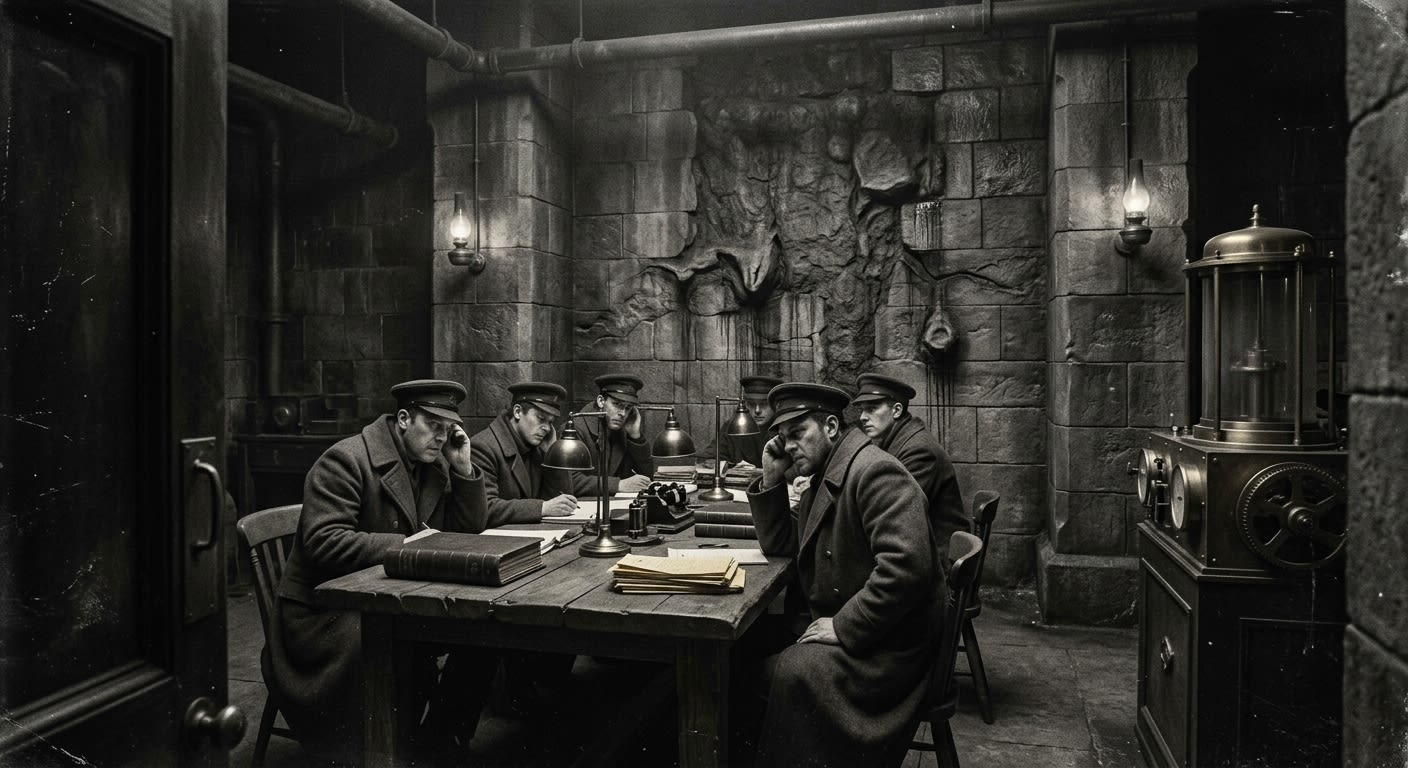
Three condemned prisoners were brought from a cellar academy accused of teaching the Doctrine of the Inaudible Voice backward. Their crime is less important than their usefulness. The room received them, the iron warmed, the Brand-Smith raised his hand, and Orla began the sanctioned cadence. At the third brand the chamber anticipated her note by half a breath.
This was not echo. Echo follows. This led.
The condemned inhaled together. The Brand-Smith dropped the iron. The scribe wrote the same word eleven times and tried to eat his slate, which I count as one of the more honest reviews ever issued by an administrative hand. Orla lowered her drone beneath the answering tone. Witnesses disagree on whether her voice broke the room's pitch or the room followed her down. Witnesses often disagree when trying not to admit they heard stone behave like a choirboy with malice.
Popular devotional copies say Orla “sang until the chamber fell silent in reverence.”
Corrected. The chamber did not show reverence. It was denied purchase. Reverence is the story told to children and donors; purchase is the word used by professionals with scarred throats.
After the three descending notes, Orla held silence for fourteen heartbeats. The condemned remained alive. The marks remained legible. The room did not answer again. Orla died with torn cords and lungs full of ash. Purity received a saint, a protocol, and an excuse to claim it had intended the silence all along.
#On the Text of the Order
The operative clause is brutal enough to be elegant. At completion of a licensed branding rite, the Singer must perform the Closing Tone: three descending notes, each falling by the approved interval in the local tuning schedule, followed by silence counted by the attending witness and entered by the scribe. The silence lasts fourteen heartbeats, measured against the subject if alive, the Singer if the subject has failed, or the bell-hour token if both have become administratively inconvenient.
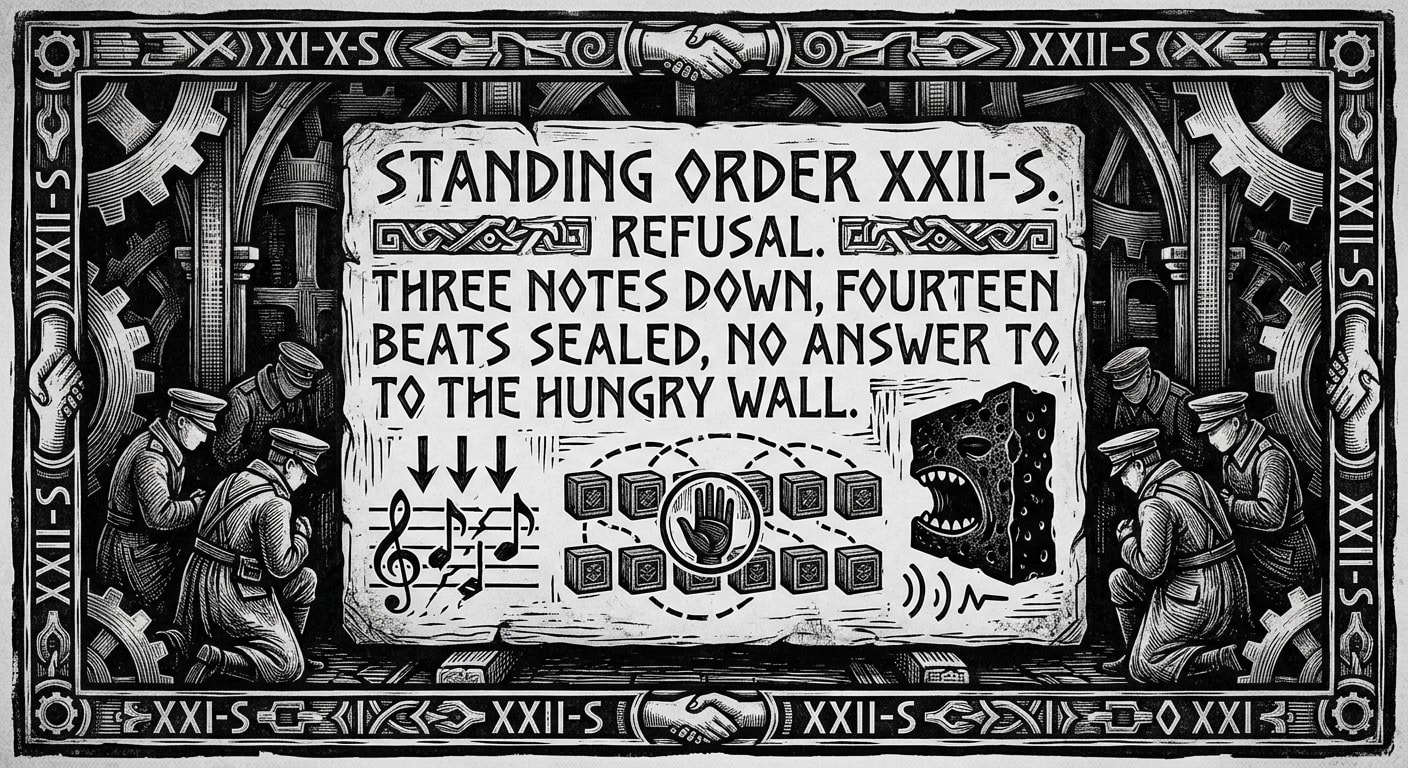
No one speaks during the interval. The Brand-Smith does not cool the iron in water. The Lictor does not issue sentence formula. The scribe does not mutter correction. The condemned, if still able, is gagged from making unscheduled prayer. A cough breaks the count and restarts it. A sob breaks the count if voiced. Unvoiced tears are tolerated because Purity, in its indulgence, has not yet taxed water.
The prohibition section forbids harmonising with unsolicited response, correcting pitch returned by the room, completing a phrase begun by stone, blessing an unexpected cadence, cursing it, naming it, asking it to repeat, asking who speaks, asking what it wants, asking whether the condemned's mother is present, or asking any question whose answer would require a second report. The order is not anti-curiosity in the abstract. It is anti-curiosity at the precise moment curiosity becomes a mouth offered to the wrong listener.
ACOUSTIC ENFORCEMENT ANNEX — 22-S/SEALED RESPONSE If response contains lexical material during or after the Closing Tone, Singer shall ███████████████, Brand-Smith shall ███████████████, scribe shall mark silence as ███████████████. Personnel hearing their own names from chamber surface are to be classified ███████████████ pending throat, ear, and memory inspection. Under no condition shall the phrase “say that again” be uttered inside the room.
#On Echo Weather and the Reason for Starvation
Echo weather is the professional name for the thing 22-S fears. Doctrine calls it residual liturgical resonance. Orison calls it architecturally induced acoustic reflection. Purity calls it anomaly pending classification. Brand-Singers, being closer to the wall and less protected by vocabulary, call it weather. Weather arrives whether the bishop approves or not.
A proper echo repeats. Echo weather replies. It comes half a beat late, half a breath early, lower than the Singer, higher than the condemned, in an accent from the file, in a voice missing from the room, in a cadence that makes the instruments wait like dogs scenting meat. The danger is invitation. A trained singer hears wrong pitch and corrects it. A good singer corrects before thinking. Echo weather kills competence first.
22-S starves the response. Three descending notes close the rite by lowering breath, pitch, and bodily agitation. Fourteen heartbeats of silence deny the chamber fresh pattern. No speech until the scribe certifies clean gives the room nothing official to borrow. The order treats sound as bait, silence as lid, and language as the little hook by which the unseen prefers to lift us.
Mercy Tone hates the order's abruptness because long preservation wants a long descent. Judgment Tone hates the delay because fourteen heartbeats offend quota. Silentists love it with the pinched affection of men who have been saying “shut your mouth” since childhood and have at last discovered a saintly precedent.
#On the Schools Under the Seal
Mercy Tone performs 22-S as a withdrawal. The slow note has carried the condemned through identity, charge, confession, lineage, forfeiture, and seal; the Closing Tone must release the borrowed lung without dropping the body into spasms. Good Mercy singers lower the room gently. Great ones lower it so gently that the condemned believes, for one expensive instant, he is being spared.
This belief is unauthorised but useful. Hope steadies breath. The Bureau has no objection to hope when hope improves handwriting.
Judgment Tone performs 22-S as closure by command. Three cuts downward; fourteen beats; file done. Its singers resent the interval because silence cannot be accelerated without becoming disobedience, and acceleration is their native narcotic. Yet Judgment singers also understand the order's tactical beauty. A sharp rite leaves agitation in the stone. A sharp Closing Tone cauterises the acoustic wound before the room has time to admire its own blood.
The Silentists perform 22-S as homecoming. Their whole school is a long footnote to Orla's final sentence. Minimal tone, tap cadence, breath marks, slate signals, no vanity, no ornamental hymn, no grand throat offered to whatever waits in the mortar. When 22-S begins, the Silentist has already done most of the work by refusing to feed the room earlier. This makes them smug. Regrettably, they have earned it.
A Seventh Orison commentary described Standing Order 22-S as “a common concluding courtesy shared by all schools of devotional acoustic service.”
Corrected after Purity review. Courtesy is what one extends to a guest. 22-S is what one applies to a chamber suspected of listening.
The order equalises the schools where they most dislike equality. Mercy may preserve, Judgment may compel, Silentism may withhold; all must descend, count, and refuse. The throat belongs to school. The silence belongs to Purity.
#On Instruments, Witnesses, and the Little Fraud of Counting
The order depends upon counting, which means it depends upon liars. A witness counts heartbeats with fingers tucked beneath the wrist or against the Singer's rib-line. The scribe records each beat by dot, slash, or small ash-mark depending on chamber class. The bell-hour token sits upright, used only when flesh cannot be trusted. Flesh often cannot be trusted. Officials object when reminded that clerks are made of it.
Common frauds include short counting, long counting, skipped coughs, misfiled subject death, and the pretty little category called “unvoiced vocalisation,” by which a witness decides that a sound did not occur because admitting it would require everyone to begin again. In mercy rooms, the count stretches. In quota rooms, it shrinks. In suspected echo rooms, nobody agrees afterward how long fourteen can be.
Purity's A.S. 199 Approved Hymn Protocols Revision 14 tightened the witness chain. The Singer's pulse may no longer be self-certified. The scribe must mark restart causes. Lictors must keep irons out of water until the silence closes. Metronome tokens require quarterly calibration. The reforms improved the documents. One hesitates to call this the same as improving the rooms.
A famous Mainz inspection found three complete 22-S sheets with identical fourteen-beat timings across three subjects, two Singers, and one power failure. The audit concluded collusion. The local Cantor-Marshal concluded “commendable consistency.” The tribunal concluded nothing because its own seal appeared on all three sheets, which made ignorance the most lawful posture.
#On Punishments for Answering
A Singer who harmonises with echo weather faces immediate suspension, throat quarantine, pitch audit, three silence weeks, and reassignment pending Purity review. A Singer who answers lexical intrusion by speech enters sealed classification. A Brand-Smith who strikes during the silence is charged with acoustic contamination. A scribe who records the chamber's words without sealing the sheet is charged with distribution of unauthorised utterance. A Lictor who says “who's there?” is not punished under 22-S because the regulations assume a minimum intelligence that Lictors, as a class, continue to challenge.
The condemned complicate punishment. A subject may beg, pray, curse, confess further, name accomplices, recant recantations, accuse the Singer, or answer the wall during the silence. The order treats subject speech as rupture unless gagged by prior waiver. The waiver is common in Judgment rooms, rarer in Mercy rooms, and unnecessary in Silentist rooms where fear has frequently done the gag's work. A condemned man who speaks a useful name during the fourteen beats creates a theological and evidentiary nuisance. The name is inadmissible under 22-S, valuable under Records appetite, and irresistible to Purity if the family owns property.
Instructional summaries state that speech during the 22-S interval invalidates all subsequent evidentiary use.
Clarified. Speech during the interval invalidates the acoustic completion of the rite. Evidentiary use may proceed under sealed collateral intake if the information concerns treason, hidden property, clerical complicity, or anything too profitable to waste on purity.
This is the Synod at its most honest: the silence is absolute until the sentence becomes useful. Doctrine frowns. Records sharpens a quill. Purity clears its throat and explains that no contradiction exists when every contradiction has its own form.
#On the Present Force of the Order
As of A.S. 201, 22-S governs every permanent Purity penitence hall, every Iron Choir discipline room, all repaired chambers with prior acoustic response, road cages classified as answering sites, and forward discipline wards where Brand-Singers are attached to garrison punishment. It is cited in Bastion-Brest booth anomalies, Bastion-Przemyśl repaired halls, Mainz iron rooms, Strasbourg chapels, and those portions of Bastion-Shipka where fog makes timing a liar and silence arrives wearing another man's boots.
The order's enemies are haste, vanity, pity, curiosity, and the professional reflex to repair a wrong note. Its friends are fear, discipline, cracked throats, good witnesses, dry ink, and the blessed cowardice that tells a singer to lower the eyes when the wall says her childhood name.
22-S remains active because rooms continue to answer, singers continue to be trained, and the state continues to believe that a body can be converted into truth if the note is clean enough. Perhaps the state is correct. Perhaps the room merely enjoys learning our hymns.
No reply is authorised.