

#On the Riders in the Pens
This survey was compiled in A.S. 201 / 1911 CE. It describes one militia in one district as the present files show them. It founds nothing, and it reports no inspection made for its own purposes. The militia is Patrol Command of the Steppe Gate of Windscript Treaty-Stones. The town calls it the Blue Cords, after the insignia its riders wear. The institutional survey covers the whole command: roads, towers, barracks and flags. Captain Rho Balesh commands it this year, and his dossier is filed separately. The Bureau's index puts his name on this folio in the possessive, because clerks write the way drovers speak. The possessive gives him no title to the riders and no credit for raising them. No file gives the militia a founding year, a founder, a charter or a strength, and this survey supplies none.
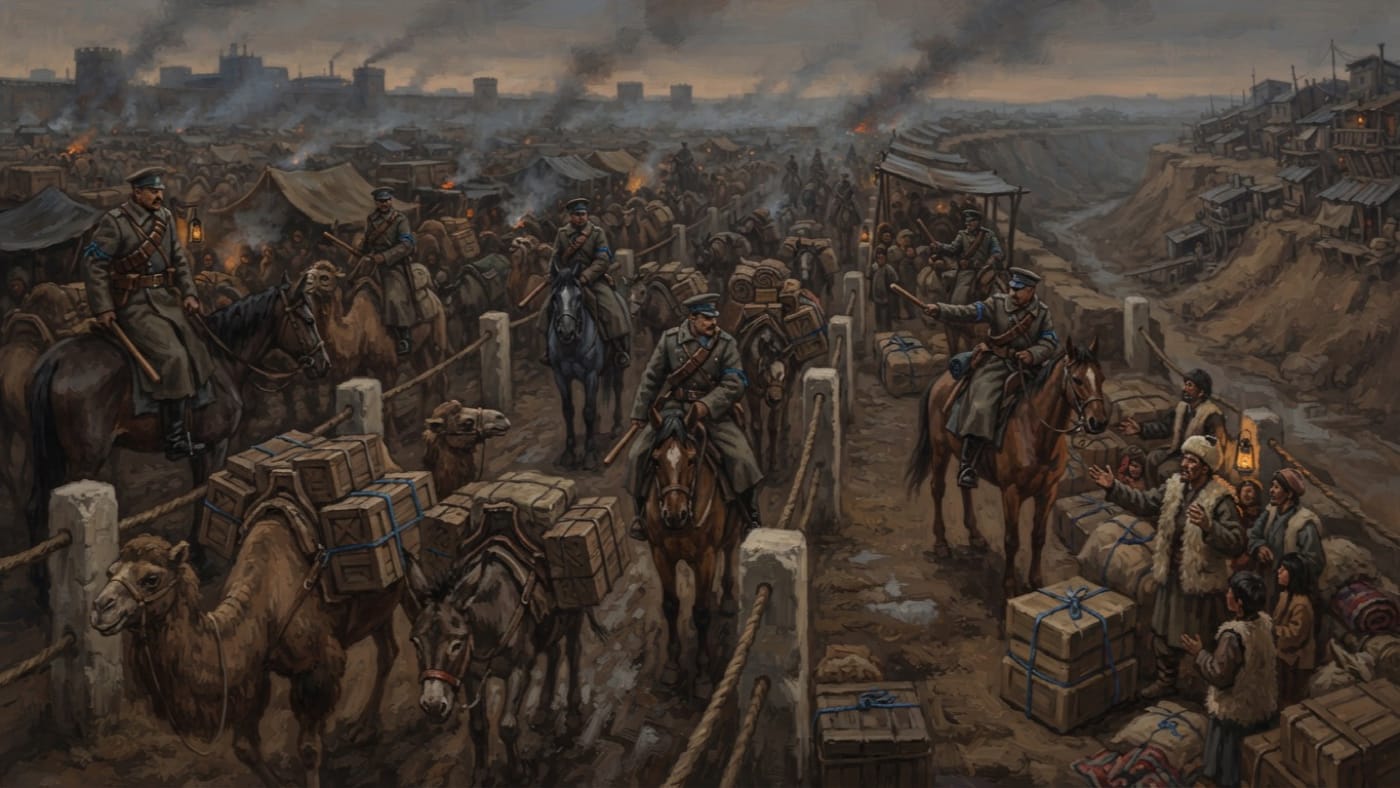
The ground covered here is narrower. It is the Caravan Corrals, east of the Treaty Ring on the Moldavian border steppe. Pens, cargo yards, trough lanes, seal queues and refugee shelters there hold whatever the Gate has not yet decided to admit. A caravan meets a rider on the road. It learns what a rider is in the pens.
#On Horses, Lanes and the Cord
The Corrals are long lanes of beaten dust divided by limestone posts and rope rails. Animal sweat and dung lie over everything. Seal runners carry hot wax through the steam, and in every lane some sack of spice has split. A drover in that dust stands at his mule's shoulder. A rider sits above them both.
In the Corrals that difference in height is the command's first instrument and its most persuasive. A clerk can delay a man. A rider with a baton and a horse can stop him, turn him, and hold him against a rope rail while the lane fills up behind him. The pens hold their people by procedure, and procedure has no legs. The horses supply them. Riders hold the chokepoints between pens, run the cordons that close a lane, and carry out the night inspections. The drovers have learned to read the whistles. According to the Corrals account, some mean inspection and some mean a rider wishes to steal privately. I give the drovers' reading as the drovers give it.
Then there is the cord. The riders wear blue cord so they can be recognised, and they tie blue cord to cargo to claim it. The other lane markings each have a meaning of their own. Red chalk marks a pronunciation hold, black chalk an oath dispute, white chalk a pending orphan intake, and grey wax anything bound for the Burnless Archive. Blue cord marks a Patrol Command seizure claim. The marking says claim, and it means claim. A corded bale has had a claim asserted against it, and that is all. No one has judged it, sealed it, deposited it or transferred it. The owner sleeping beside it remains its owner in law until some other office rules.
#On Force Before the Paper
The Gate divides its authority with the care of men dividing a corpse. The Caravan Court adjudicates, delays and releases. The Seal-Houses under Seal-Mistress Ylena Korr authenticate. The Treaty Office keeps the compact language. The Paper Keepers take custody of whatever goes below. The Blue Cords supply force, and no file grants them any of the other four powers. The formal compact names the Treaty Office, the Court and Patrol Command as the governing three. The Corrals account names a different three, Vark, Korr and Balesh, chosen by who actually closes a fist on the pens. Both lists are accurate. Neither one describes a single command, and I do not merge them.
The Court's posted sitting order is plain. The witness chain comes before any binding term, seal verification before judgement, and Archive deposit before enforcement. Read in that order, the rider comes last and carries out what the ink has already settled. The inner bench of the Nine Weights adds that violence requires a clause. High Arbiter Senn Vark asks for the clause behind each broken rib, and Patrol Command resents him for asking.
The published accounts describe the Corrals running the other way round. The cord goes on, the baton comes out and the lane closes. The clause is looked for afterwards, when the Court can be asked to explain the violence. By the Court's own account, the explanation makes the violence more profitable. I record both sequences. The files name no appeal that reconciles them, no statute that punishes the reversal and no rider disciplined for it, and I invent none.
#On Fees, Fat Horses and Moisture
The Blue Cords' income in the Corrals comes under four attested names: the quiet fee, the escort fee, the protection fee, and the price of escort timing or priority. A cart blocking a lane the riders want clear pays the first. A column that wants to leave while its stamp is still warm buys the last. The Corrals account adds the old frontier fee, owed by a man without a horse to a man with one, which needs no schedule. No file gives an amount, a share, a pay scale, an exemption or a fee charter. The purse is attested, and nobody has counted it.
The Corrals lose cargo every night. Sacks open, wax softens and crates lose boards. Spice measures come up light at dawn. A bolt of linen may travel from Pen Twelve to the Gully Market without crossing any registered path. The district record lists the methods of ordinary theft: cut ropes, softened wax, duplicate chalk numbers, bribed feed boys, and axles loosened just enough to need a helpful reroute. These are methods used in the Corrals. Nobody has audited them as methods of the Blue Cords, and the list names no hand.
The same record observes, in two short sentences, that the Blue Cords patrol the district and that their horses grow fat. I keep the two sentences together because the record keeps them together. It gives no breed, no count of mounts and no fodder ledger. It draws no line from a stolen sack to any particular manger.
Bureau of Records, standing explanation for nightly Corral cargo loss: "atmospheric moisture."
Withdrawn for this survey. Linen that reaches the gullies by no registered path was carried there, and the carrier is not recorded. Some losses are unexplained: sacks emptied under unbroken seals, manifests altered after the fact, crates whose owner no one remembers. This entry resolves none of them. The weather is acquitted. Every named rider is acquitted too, since there is no audited finding against any of them. The original phrase remains authorised for compensation hearings.
My own accusation stands elsewhere under my own seal. In the captain's dossier I wrote that the moisture rides a horse and wears a blue cord. It is an accusation and nothing more. The institutional survey says so, and I say so again here, among the horses. No record ties any consignment to Balesh, to a named rider or to an order from command.
#On the Court Above and the Market Below
In the Corrals the riders face two ways. Uphill they serve the Court. They queue petitioners by claim type and hold the curious at the proper distance. They also escort seized cargo out of the pens to wherever the bench sends it. Each of those duties comes with a quiet fee, collected in the lane before anyone reaches the Ring.
Downhill lie the ravines. The Gully Market sits below the eastern edge of the pens, and its stone steps begin where the Corral dust meets the cutbank. So the riders who hold the chokepoints are watching the ground that anything headed down must cross. The Corrals account records that at dusk the riders turn their horses toward the gullies. The market buys intelligence about cargo and about the patrol: which whistles mean what, which pens are fed late, which axles were already loose. It sells each kind back to the lawful offices in different ink.
That is the whole of the documented relationship. The Gully Ledger Cartel keeps a counter in those ravines and deals in forged addenda, smuggling, blackmail and almost-correct wax. The Cartel does not own the riders, and the riders do not own the market. No file shows a protection agreement, a shared ledger or a division of proceeds. In my tract on the Cartel I declined to claim that the Blue Cords ordered a single counterfeit failure. I decline again here. The quarterly gully raids belong to the Bureau of Purity. The Blue Cords' sweeps are their own and run on a different clock.
#On the Present Pressure
In A.S. 199 / 1909 CE the rubbing of the Third Stone's southern face left the Archive, and a blank folio of wet ink took its place on the shelf. The published town account records the command's answer: Balesh raised the sweeps from twice daily to continuous. The sweep was a response to the loss. It identifies no culprit. The rubbing has not been recovered, and how it left is unknown. In the Corrals the continuous sweep puts riders in the lanes at every hour the curfew rotation allows. The drovers report that fees are rising.
The Living Addenda, first classified in A.S. 194 / 1904 CE, press on the same lanes from below. Vark's Ruling 201-Blue/17 holds that an Addendum which satisfies form binds. The designation belongs to the Court's numbering and implies no tie to the cords. An escort contract bought at a rider's price in the morning may be amended by evening, in wet ink no baton can reach. Merchants now hire readers to check their own manifests at dawn.
Every coin the riders take in the pens arrives with a caravan that chose the Gate. The caravan lords are demanding powers to rewrite the treaty. The town's own doctrine warns that rerouted traffic would starve it without any need for a siege. A cordon is worth exactly as much as the queue standing inside it.