

#On the Present Command
This survey is compiled in A.S. 201 / 1911 CE. It describes the Steppe Gate's security institution as the present files record it. It founds nothing and dates no charter. It reports no new inspection carried out for its own purposes. The Bureau asked what the soldiers at the Steppe Gate of Windscript Treaty-Stones are. The files answered with a colour.
Patrol Command is the Blue Cords militia. Its riders wear blue cords, and the town names them by the cord before it names them by the office. Its public function is treaty enforcement. Its methods, as the local record lists them without embarrassment, are violence and confiscation. Captain Rho Balesh commands it this year. His dossier is filed elsewhere. This survey concerns the instrument, and the hand now holding it appears only where the instrument needs explaining.
The command's paperwork should be listed before its powers, because its paperwork is thin. No file I have consulted gives a rank table, a muster roll, a recruiting ordinance, a pay scale, an appointment warrant or a founding charter. The Gate's formal rule names three bodies: the Treaty Office with its clerks, the Caravan Court with its arbiters, and Patrol Command with its captains. Votes in that compact are weighted by seal-holdings, which is an unkind arithmetic for an office whose chief instrument is a horse. The local order of class places seal-holders first, then arbiters, then senior scribes, and only then patrol captains. A man who can break any arm in the queue ranks below a man who can index it.
The Blue Cords therefore depend on two masters, and they own neither. Their supplies and their revenue come in with caravans that chose to come. Their violence is lawful only when somebody else's paper says so afterwards. Everything below follows from those two dependencies.
#On Roads, Towers and Barracks
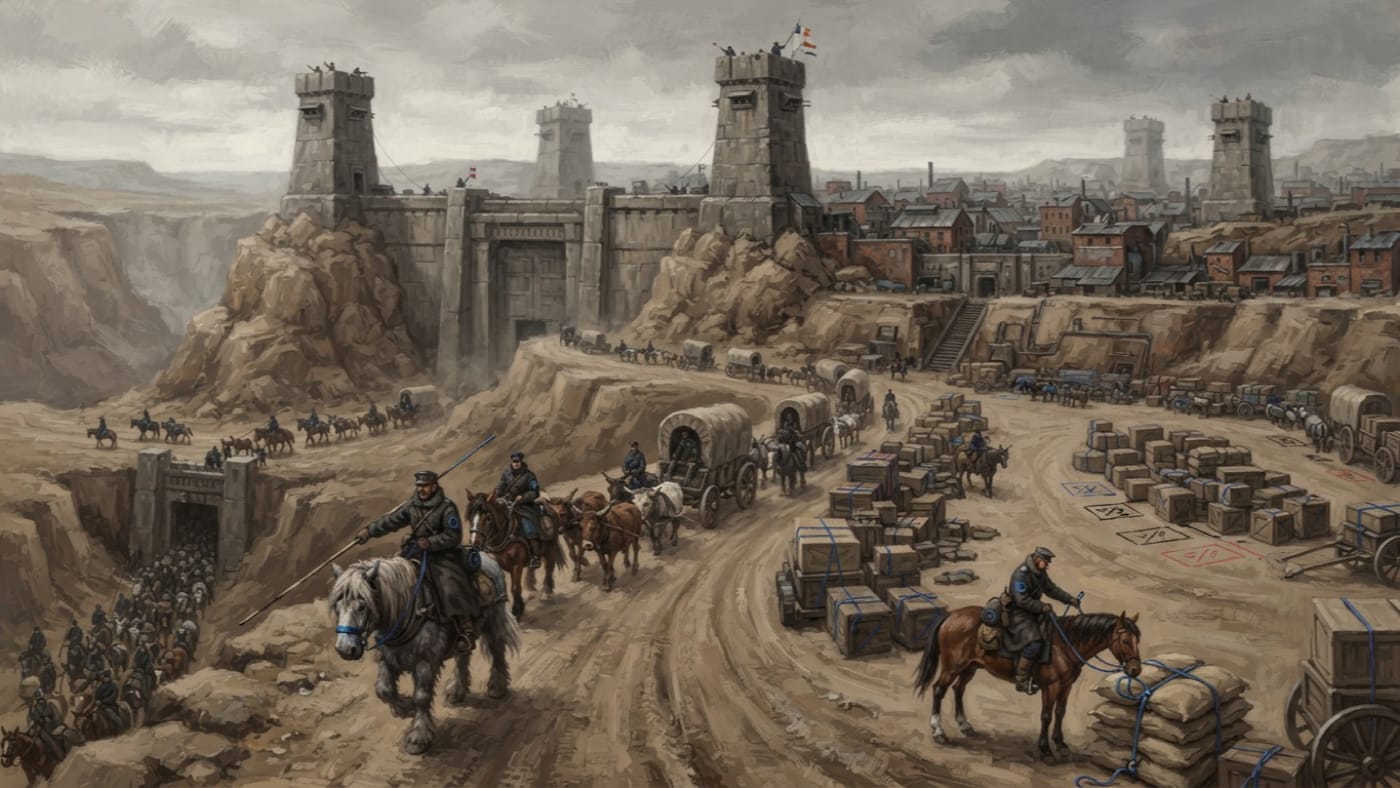
The command's established territory is the approach roads and the towers above them. A caravan meets a rider before it meets a clerk. The rider inspects writs from Seal-House Row, counts the beasts and sends the column toward the Caravan Corrals, where loads wait for days while papers are processed. Refugees enter by a different door. Their queue forms at the Ditch Gate under the lintel proverb, and the files do not let me merge the two lines into one tidy procedure. The Gate keeps a lane for goods and a lane for the desperate, and it charges each in its own currency.
Patrol routes change with curfew. A lane that is lawful at noon becomes an offence at dusk, and lanterns are shaded at night because the town believes the wind reads lips. The Gate also levies labour-hours for the patrol roads, so the drover who pays to use the road may also owe the sweat that keeps it open for the men who stop him on it.
The Windwatch Towers are four stone pylons on the higher cutbanks. They are manned by marksmen and signal-flag operators, and they draw lightning in the storm season, as such towers do. The town's defence rests on three practices: tower sightlines, gully sweeps and Seal-House lockdowns. The third is instructive. When the Gate closes its fist, the fingers that close are wax-gloved, and they answer to Seal-Mistress Ylena Korr rather than to the captain. A siege doctrine that relies on another office's doors is a frank description of rank.
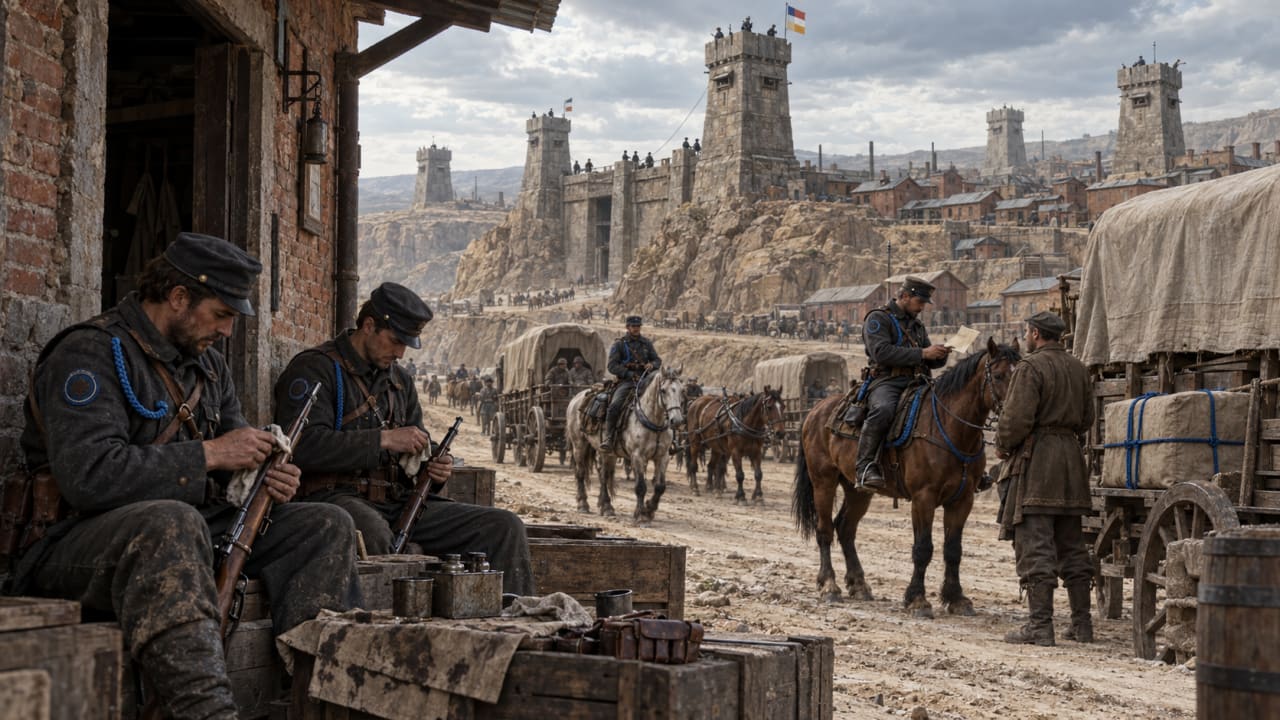
The Patrol Barracks appear in the district list as the enforcement quarter. The record gives them a smell, oil and dust, and my plate on the Treaty Ring finds the men there oiling their guns. That is the whole of the file. It gives no exact position among the districts, no year of construction, no plan of rooms and no armoury count. The garrison's morale is recorded as variable, which tells us the clerk had met the garrison.
#On the Seizure Claim
The most honest object in the Blue Cords' possession is the cord itself.
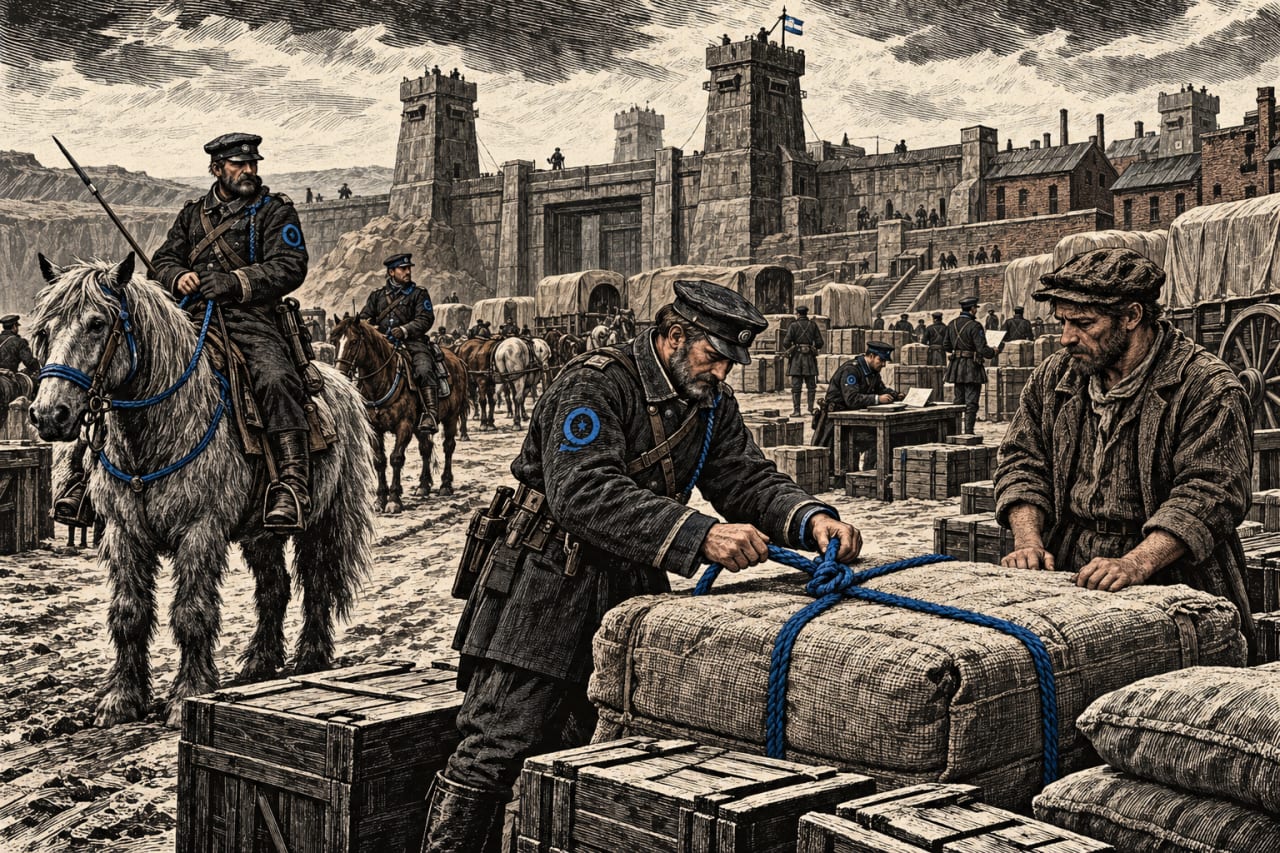
In the Corrals, lanes and lots are marked so that every office can read the state of the cargo from horseback. Red chalk marks a pronunciation hold. Black chalk marks cargo under oath-dispute. White chalk marks orphan intake pending. Grey wax marks documents or persons bound for the Archive. A blue cord marks a Patrol Command seizure claim. The Gate's own lane-markings use the word claim, and the word deserves respect.
A cord tied around a bale establishes that riders have asserted a right to it. It does not establish that the seizure was justified, that ownership has passed, that the Court has ruled, that any seal has authenticated the taking or that any deposit has been made below. The cord is wool. Wax is the Seal-House's business, and the gap between the two materials is the gap between the claim and the law.
Follow a corded bale through the published practice. A rider stops it on the road and inspects its writ. The column goes into the Corrals and waits under hold. If the riders want the cargo, the cord goes on. If the owner disputes the claim, the matter goes to the Court, which controls release and delay and charges for both. The Court's posted sitting order requires a witness chain before any binding term, seal verification before judgement and Archive deposit before enforcement. The inner bench of the Nine Weights adds its own condition: violence requires a clause. Patrol Command resents this condition, and resents it most when the riders have already used the violence and must now go looking for the clause that permitted it.
The order as written puts the clause first, the seal second, the deposit third and the rider last. The practice described in the published accounts often begins with the rider and asks for the explanation afterwards. I record both. I will not invent a statute, an appeal or a schedule of penalties to settle the difference, because the files contain none. They record a sequence that is prescribed, a sequence that is practised, and a High Arbiter who notices the difference.
That arbiter is Senn Vark, and the captain's dossier names him as the man Balesh fears. The reason is specific. Vark asks for the clause that authorised each broken rib. A rider can break the rib, and only the bench can make the break lawful. Only Korr's wax can make the ruling admissible. Only the Treaty Office can file the bundle as administration, and only the Paper Keepers can carry it below, where the paper will not burn. Patrol Command holds none of those powers. It cannot write a binding clause, authenticate its own seizure, give orders to a Paper Keeper or open a restricted shelf. It supplies the bodies required to enforce what ink has done, and it takes its profit in the interval before the ink arrives.
Riders also do work at the Court itself. They keep petitioners in line and hold spectators at the proper distance, close enough to be impressed and far enough that their deaths need not be counted as participation if a syllable goes wrong. They escort seized cargo. They run the cordons and night inspections in the Corrals. In those lanes the command's own bookkeeping has an edge worth noticing: Patrol Command counts seizures and does not count theft. The Court counts disputes, and the Seal-Houses count documents. Each office counts the thing that pays it.
#On the Price of Enforcement
The described economy of the Blue Cords is a schedule of fees with no published figures. Riders collect quiet fees. They sell escort priority and escort timings. They collect protection fees, and my survey of the Corrals adds the oldest frontier charge, which is levied because one party has a horse and the other does not. A column that buys an early escort leaves while its stamp is still warm. A column that does not buys another night's feed, and the feed merchants are on good terms with Patrol Command. I can give no amounts or shares. The files name the practices and leave the purse uncounted, and so do I.
Then there is the cargo that disappears overnight. The Corrals lose sacks, spice measures, bolts of linen and crate boards every night. The Bureau of Records has an explanation for this, and I have one of my own.
The Bureau of Records attributes nightly cargo loss in the Caravan Corrals to atmospheric moisture.
Withdrawn for use in this survey. Against it the compiler enters his own accusation, under his own seal, that the loss rides with patrol riders. This is an accusation and not an audited finding. No file establishes which consignments were taken, by whom or on whose order. The Records phrase remains available for compensation hearings.
My accusation and the Bureau's finding are two separate documents, and I keep them apart, since the purpose of a survey is to show which statements carry a seal and which carry only a grudge. The captain's dossier says plainly that no record connects Balesh to a particular consignment. I repeat that limit here with the same plainness. The Corrals' horses grow fat, and that observation goes into the margin, where it belongs.
The custom is older than the present captain. After the Red Pronunciation of A.S. 94, the Seal-House Consortium won its monopoly on the argument that centralised stamping would prevent another cascade. An earlier holder of the patrol office accepted the Consortium's first facilitation payment. He also set the precedent that enforcing the monopoly was a matter of public safety. The record leaves him unnamed and his payment undated beyond that aftermath. It separates him from Balesh, and I accept the separation as recorded.
Every fee has a ceiling, and the drovers set it. Each coin the Blue Cords take arrives with a caravan, and each caravan can study the long road round. The town's military summary records that the garrison's supplies depend on caravans, and its siege doctrine warns that a siege needs no assault: rerouted traffic would starve the town on paper. An enforcer who squeezes too little goes unpaid. One who squeezes too hard empties the road he lives on.
#On Flags and Silent Runners
The tower flags carry two languages. The first is military semaphore. The second, according to my plate on the Gate, carries illicit reroute instructions, bribery schedules and the coordinates for intercepting caravans. A flag can be read from all four pylons by anyone who knows the second language, and the published accounts suggest that a good many people do.
When a bribe schedule must cross the Windwatch Towers without flags, the Blue Cords use silent runners. The Treaty Office knows this. The Treaty Office files weather reports. The runners carry their messages in hand-cant of the sort that refugees learn in Oath Inn cellars, which has signs for toll, patrol, safe, unsafe and running without papers. A bribe needs little more vocabulary than that.
No file names the runners. They might be adherents of the Null Tongue Brotherhood, gully runners who picked up the cant for wages, or riders taught a handful of signs. Using the cant makes no man a Nullist, and no file makes the captain one. Silence does not make a man safe either. The Brotherhood's own dead include a null-walker who collapsed near the Fourth Stone with ink in his windpipe, and the sources disagree about why. The command uses silence because a flag can be read and a gesture leaves no utterance for Vark to admit. Nothing in the record suggests that silence protects it from the stones or from an audit.
#On the Continuous Sweep
In A.S. 199 a rubbing of the Third Stone's southern face disappeared from the Burnless Archive, a vault from which paper is not supposed to leave. A blank folio with wet ink now sits on its shelf. The Paper Keepers hold that shelf, and restricted access below the cutbank answers to them. Each office at the Gate responded with its own instrument. Balesh used the road. He increased the patrol sweeps from twice daily to continuous.
The sweep answers a loss whose cause no one has found. It does not show that patrols took the rubbing or know how it left. A rubbing that has left a vault might travel by road, so the captain watches the road, because the road is the only thing he commands. The cost of continuous sweeps falls where such costs always fall. Riders are in the gullies at every hour the curfew rotation allows, the horses get little rest, and fees climb at a rate the drovers have noticed. The local record sums up the present tension in three clauses: caravan lords demand rewrite powers, scribes threaten to strike, and patrols extort harder.
Registry Entry 4-ST-199/b described the security situation at the Steppe Gate as stable.
Superseded by Bureau of Doctrine assessment, A.S. 201. Patrol sweeps have run continuously since A.S. 199. A border is stable when the captain's horses are allowed to sleep.
The caravan lords' demand is the greater danger to the command. A treaty that can be redrafted can move a road, and a road that moves leaves the chokepoint with nothing to choke. The Living Addenda add a second pressure from below. Since A.S. 194 the Archive has produced wet-ink amendments with sound form and no living author, and the A.S. 201 reports put them at roughly two a week. Under Vark's Ruling 201-Blue/17, an Addendum that satisfies form binds. An escort contract that the Blue Cords sell on one market day may be amended before the next by a hand that no rider can arrest.
The ruling does not make Patrol Command master of such documents. It makes the command subject to them, like every other holder of a contract at the Gate. The riders enforce what binds. Whether the binding text came from a clerk, an arbiter or a shelf beneath the eastern cutbank is a question for the bench, the seal and the Keepers, and the captain is not consulted. The mechanism behind the Addenda remains unknown, and this survey does not supply one.
#On the Present Application
As of A.S. 201, Patrol Command remains active under Captain Rho Balesh. Its riders hold the approach roads, the four towers, the court queues and the Corral cordons. Its barracks smell of oil and dust. Its blue cords hang on cargo whose fate the Court has not yet decided, and its sweeps run continuously. Its revenue depends on caravans that are already pricing the long road.
The Bureau's handling for the captain's office applies equally to the institution, and this survey adopts it unchanged. Confiscation escorts are to be audited against Caravan Court rulings. A corded bale under escort with no ruling behind it is a claim on the move, and the escort should be treated as such. The clause is to be demanded before the rib. Fees are not to be raised while the roads are under reroute pressure, because the town's own doctrine already describes the siege that would follow, and the command is the one office able to begin it from inside.
No inquiry into the moisture is recommended. An inquiry delays caravans, and a delayed caravan is the threat this militia exists to prevent.