

#On the Ravines Below the Pens
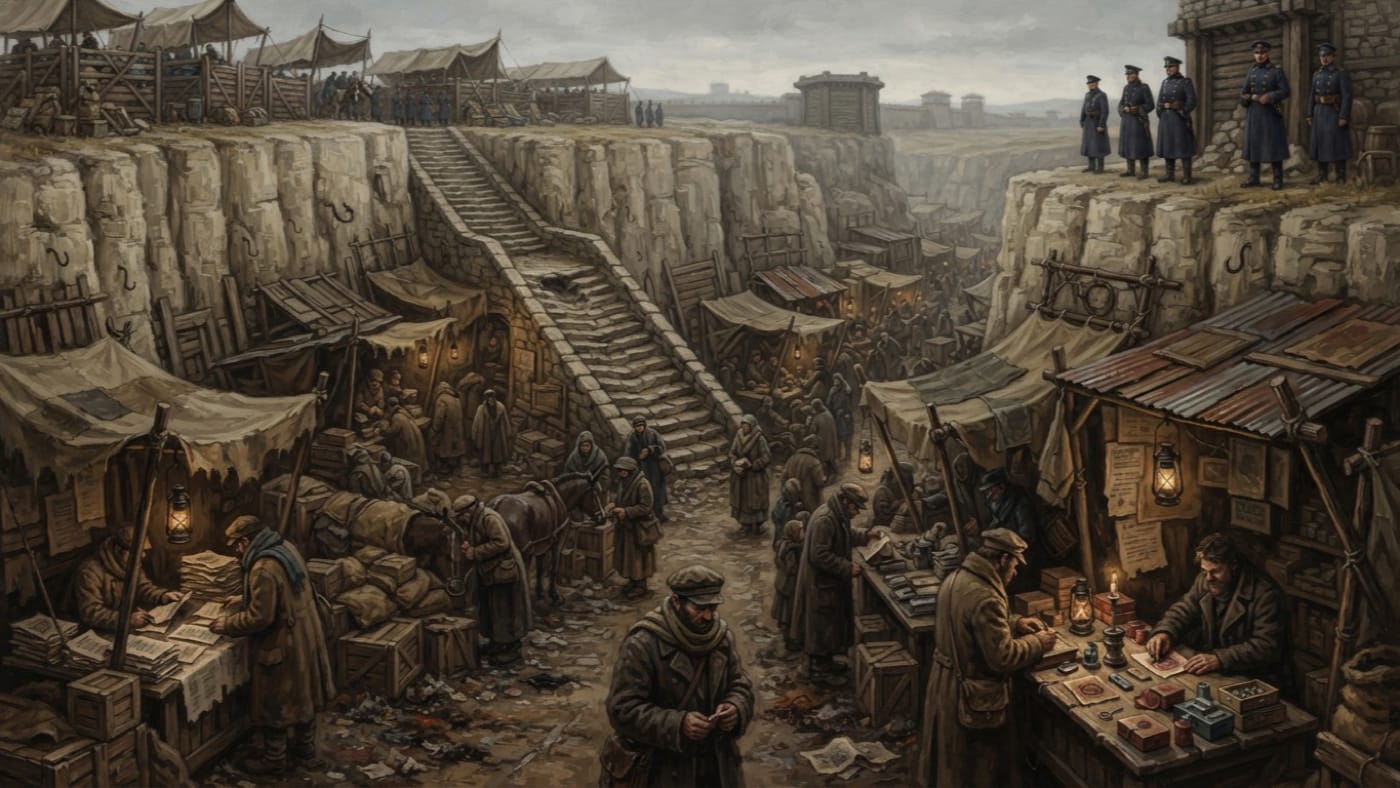
The Gully Market is what the Steppe Gate keeps in its cellar. It lies in the ravines below the Caravan Corrals, east of the Treaty Ring, where the limestone cutbanks break into gullies. The town's lawful commerce is weighed, witnessed, sealed and charged above, and whatever it could not afford to keep drains downhill into these ravines. This entry is a documentary survey of the district as it stands in A.S. 201, 1911 CE. I have assembled it from Purity abstracts, Corral loss claims, Seal-House notices, Court remarks and the published accounts of this Codex. It gives no founding date because no register gives one. The market has no recorded charter, founder, ratification or seated government. It has stairs, and the stairs have been enough.
The way down starts at the eastern edge of the pens. There the beaten dust of the Corrals reaches the lip of the cutbank, and stone steps go down into the gully lanes. No register says who cut the steps or when. They are worn hollow in the middle like church steps, and for much the same reason: a great many people have gone down them carrying something they hoped to trade for mercy. At the bottom the lanes follow the gully floors between limestone walls the colour of old teeth. The counters are planks on trestles under tarpaulin, or hide-lashed timber frames, with iron hooks driven into the rock to hold canvas against the crosswind. Every lantern is shaded on its lane side. The town believes the wind reads lips, and nobody down here wants to be read. Mule drays wait in the side cuts with their animals hooded or hidden behind sacking. The air smells of cumin, sweat, lamp-soot and wet hide. Over it all comes the dung of the pens above, which finds every crack in the cutbank as surely as a tithe-collector finds a widow.
The market trades in near-darkness. By day the gullies give their own shade. After curfew the patrol routes change, the trade pulls deeper into the lanes and the lamps go lower. The published town account calls this a subterranean commerce. I keep the word because it describes how the trade is done, with every head lowered. This survey records no measured perimeter, no zone number of the district's own, and no passage beyond the gullies themselves. The district lies on the Zone 4/5 frontier because the town does. Its edges are wherever a buyer stops feeling watched.
The district must be kept apart from its neighbours. The neighbours insist on this loudly and the customers ignore it. The Oath Inns are in the northern gullies, a different set of ravines with licensed witness rooms, sour beer and the Split Tongue's cellar. The Scribe Bazaar on the Ring's western arc sells pronunciation under licence. Seal-House Row runs south and sells wax under monopoly. The Gully Ledger Cartel keeps a counter in these ravines and runs the best-documented trade among them. The district does not belong to it, and neither do the stalls, the thieves or the weather. A market is larger than its most notorious tenant, just as a cathedral is larger than its most notorious canon, though the canon will rarely concede the point.
#On the Paper That Sends Men Downhill
A caravan entering the Gate needs five instruments. The first is a stamped passage writ. The second is a sealed escort contract. The third is a dialect attestation certified by a licensed translator-scribe. The fourth is a manifest countersigned by the Caravan Court. The fifth is a pronunciation certificate confirming that the caravan master can speak the binding terms of passage without inviting the stones to correct him. The town's own account records that the fifth costs more than the other four together. All five must pass under the wax of the Seal-House Consortium. The Court ratified its monopoly in the last quarter of A.S. 94, after the Red Pronunciation closed roughly one thousand throats. The Bureau of Doctrine reached that figure only in A.S. 95, having first preferred one hundred.
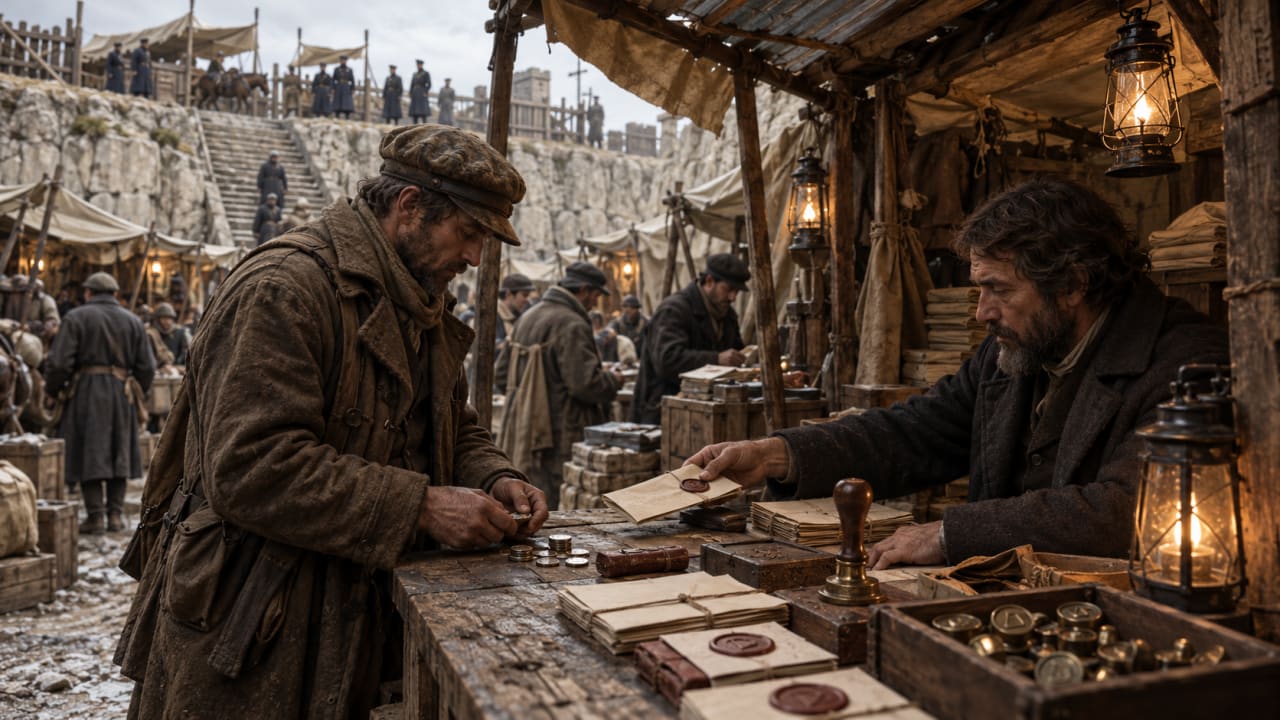
The paper is the price everyone can see. The wait is the price no clerk itemises. Beasts stand in the Corrals while documents gather their marks, and the wait is counted in days. Each day buys feed and water at Gate prices. Each day the Blue Cords collect a quiet fee from anyone whose cart blocks a lane they would rather keep clear. Witnesses must be paid, and the Court's licence for witnesses-for-hire now costs three times what it used to. A refused stamp sends a caravan back onto the open steppe with its salt unsold and its animals thirsty. If the master cannot pay, he takes on clause debt. Owed clauses compound, and default ends in labour conscription or tongue service at a copyist's desk. In the Gate's ledgers the poorest clients of the Row come back as its clerks.
I hold no register of what is sold below the Corrals, at what price, or to whom. No office keeps one. Each office that could keep one does better by not knowing. What I can set down is the arithmetic of the counters above, and that arithmetic leads downhill. Take a factor whose escort contract lapsed while his mules ate a week's profit in the pens, whose witness died of dust fever, and whose creditor is in the next lane sharpening a claim. He does not need to be wicked to start looking for something cheaper. He only needs to be standing a short walk from a flight of stone steps. The lawful economy of the Gate has made legitimacy the dearest good on the steppe and then put the queue for it at the top of a ravine. The ravine did the rest.
What lawful paper cannot do also sends men down. A genuine pronunciation certificate proves the certificate is genuine. It does not keep the throat open if the tongue slips at the Third Stone. A sealed writ proves which office issued it and promises nothing about whether its clauses survive being spoken aloud in wind. Some buyers go down the steps having worked out that the lawful paper is costly and still insufficient. From there it is a short and fatal step to concluding that cheap insufficient paper is a sound economy. The Ring corrects this reasoning in person. Its corrections are not appealable.
#On the Goods, the Buyers, and the Price of Knowing
The district's goods are many, and they are related the way a forger is related to a notary: by their instruments, never by their warrant. They have to be kept separate, because each carries its own hazard, and a buyer who confuses them pays in a currency the Seal-Houses do not accept.

First comes paper that claims to amend other paper. Forged addenda are the Cartel's proven trade and the market's best-known product. False precedent indexes promise a ruling that will save a case. The Court's own present notices admit that three of the mercy tables it forbids are known to circulate here. There are also crude counterfeits of High Arbiter Senn Vark's judgments, with wrong indexes and caution glyphs in the wrong places. Each looks like a way out of the five instruments. None of them is one.
Seals come in three kinds, and the difference matters to the wind. A stolen genuine seal is a true die in the wrong hand: its impression is flawless and its use is theft. A counterfeit impression imitates a die the forger never held. An almost-correct seal is a counterfeit good enough to pass the eye, which is the most dangerous quality a lie can have at a frontier counter.
Witness goods divide the same way. A blank witness stamp is a tool for making marks and attests nothing until someone presses it. A stolen witness mark is a particular person's attestation lifted from the paper it belonged to, so that a stranger's oath can be lent out like a coat. Blank oath-notes look like the town's ordinary currency of promise, with the promise left blank for the buyer to fill in and somebody else to keep.
Whispered safe-words and emergency dialect slips are sold as protection near the stones. They are offered for sale, and nothing more. No register I have consulted shows a gully safe-word keeping a throat open. The Corrals account records that phoneme cards sold to exhausted men are often for yesterday's clause, and I have no grounds to think the gully product is fresher. Contraband maps are sold too. Unstamped maps may not lawfully pass the Gate, and these show patrol habits, water points and the routes caravans take when their masters decide the road is safer than the queue. Then there are ordinary stolen goods: linen, spice, salt, crate-boards, and whatever else left the pens overnight.
The buyers are whoever the counters above have squeezed: caravan masters, factors, drovers, refugees from the Ditch Gate queue, debtors behind on their clauses, and translator-apprentices who have learned what their masters charge. The institutions buy as well. The town account records that Bureau agents patronise the Cartel's counter every third Market Day while the Bureau denies the Cartel exists. That schedule belongs to that counter alone, and I do not stretch it to every stall or every official. The published Ring account adds that the Bureau of Purity raids the gullies quarterly and patronises them more often. Which office pays for the meal decides whether this counts as corruption or research.
Knowledge is the steadiest trade in the district, since it needs no wax and leaves no impression. The Corrals account names who holds it. A feed woman can tell from a beast's sweat whether it carries salt, grain, bone, hot coin or hidden paper. A trough boy knows which refugee mothers keep children under blankets during the Paper Keepers' rounds. A mule doctor can smell forged wax in a hoof bandage. The market buys all three kinds of knowledge and sells each back to the lawful authorities in different ink. It buys other knowledge too: which patrol whistles mean inspection and which mean a rider wants to steal privately, which pens are fed late, which axles were already complaining when they came in. Gully runners, a trade the town counts among its ten common occupations, carry this knowledge and much else between the lanes and the pens. The Paper Keepers' intake of children happens in the Corrals and is recorded there. Nothing in the registers moves a child through these lanes. What a trough boy knows is sold here. The children, as far as any record shows, are not.
Among all this the Cartel works under its own name and its own euphemism. It calls its business transport assistance. The registers name its specialties as forged addenda, smuggling, blackmail and almost-correct wax, plus the deliberately poor Vark counterfeits I have described elsewhere. It is a firm with a counter, not a parliament with a chamber. The linen-dealer, the map-seller and the man renting space behind a tarpaulin to anyone with something to hide answer to no published Cartel authority, and I will not invent one for neatness.
The Null Tongue Brotherhood is present in the district the way weather is. It recruits in the gullies. Its gesture-cant was built for market corners and court queues, and it has signs for toll, patrol, forged, safe and do not repeat, which serve a lane trader as well as they serve a heretic. Purity's standing instruction is to arrest Nullist recruiters only once they are connected to forged addenda. That instruction puts this market exactly where a heresy and a crime meet. Neither founded the district, and neither owns it. Both find its lamps low enough.
#On Cargo That Leaves the Corrals
The most exact survey of the district's supply line is one sentence in the Corrals account: a bolt of linen may travel from Pen Twelve to the Gully Market without crossing any registered path. It gives a starting point and an end point and states that no route exists between them. A Records cartographer could not have done better, and a Records cartographer would have charged for a route.

The ordinary methods are listed, and each is a small piece of administrative craft. A rope is cut where it frays naturally, so the cut looks like wear. Wax is softened in the cold hour so that a seal lifts and goes back on with its edge only slightly uneasy. A chalk number is duplicated so that two lots answer to one mark and only one is counted at dawn. A feed boy is paid to remember the night as uneventful. An axle is loosened just enough that a helpful driver offers a reroute, and the reroute happens to pass the head of the gully steps. None of these needs a conspiracy. Each needs one person who knows the pens, one moment when the riders look elsewhere, and a buyer below.
I record no named route, no fixed crew and no tally. The registers record losses and suspicions, which make a confession, not a map. A crate loses boards in the pens, and the gullies are never short of planks. A spice measure comes up light at inspection, and somewhere downhill a counter smells of cumin. That is all the paper gives me, and I will not draw a road on it.
Bureau of Records, standing explanation for nightly cargo shrinkage in the Caravan Corrals: "atmospheric moisture."
Corrected for this survey to the extent the registers allow. Linen that crosses from Pen Twelve to the gullies by no registered path has been carried. Losses with seals intact or manifests amended are unexplained and are not entered here as theft. The weather is acquitted on both counts. The original phrase stays authorised for Records compensation hearings, where accuracy would be expensive.
The Corrals account separates the ordinary from what it calls stranger appetites. Some sacks are found with their seals intact and their contents gone. Some manifests have been altered so that the missing goods were never listed. Some queues gain a crate whose wood sweats cold, whose owner no one can remember from before the present queue. I find no mechanism for any of these in the registers. No source attributes them to the Cartel, to any gully trader, or to any hand at all. No register shows anomalously vanished cargo for sale in these ravines. A thief needs a buyer and a lamp. Whatever empties a sealed sack without breaking the seal has shown no interest in either.
The difference matters because of what happens to the paperwork afterwards. Every Corral dispute goes up the Records chain into the Burnless Archive. There a theft claim becomes permanent and may acquire descendants, so that a missing spice sack can turn into a toll claim against a grandson. Since A.S. 194 the Living Addenda have taught the Corrals a further fear: that stolen goods may come back as law. The Corrals account records that merchants now hire readers to check their own manifests every morning. A bolt sold at a gully counter is ordinary crime, finished when the coin changes hands. A loss filed above goes into a vault that never forgets and has started to answer back. Of the two, the gully thief is the more modest hazard.
#On Overlapping Authority and the Quarterly Raid
No single power governs the gullies, though several reach into them and charge for doing so. Captain Rho Balesh's Blue Cords patrol the Corrals and hold the chokepoints of the pens, so anything going down from the pens passes ground they watch. They collect quiet fees, escort fees, protection fees, and the old frontier fee owed by a man without a horse to a man with one. At dusk, the Corrals account records, the patrol riders turn their horses toward the gullies. The same account notes that the horses grow fat. I set the two facts side by side and leave the reader to finish the arithmetic.

The Caravan Court hears the disputes. The Court counts legal disputes, never stolen sacks, so a loss that nobody files never happened as far as the bench is concerned. I have written before that the Court tolerates enough forgery to keep fear alive and punishes enough forgers to keep certification dear. I have found nothing since to make me withdraw the word I used for it, which was husbandry. The Court hanged the forger of a green-wax copy of the Vark Red-Glyph Edition, whose index steered buyers toward clauses with fatal pronunciation histories. The hanging produced a precedent, and the precedent sold well. Even the gallows at the Gate pays a dividend.
The Seal-Houses supply the lawful version of what the gullies imitate, and they profit from the comparison. The Consortium account records that Seal-House Row raises its counterseal rates on the morning after each raid, citing public anxiety. The raid frightens the buyer, and the Row sells the remedy before noon.
The Bureau of Purity raids the gullies quarterly. The gullies have refilled by the following market day. The published town account adds that the Bureau now schedules its raids to coincide with market days, for efficiency, which means it raids the market at the hour when the market is fullest of the Bureau's own patrons. This rhythm is a recurring pattern and should be read as one. Out of that pattern a single raid has left an abstract that can be cited.
PURITY RAID ABSTRACT — GULLY MARKET, A.S. 198 Items seized: 144 counterfeit seals; 17 blank witness stamps; 3 almost-correct dies; 1 ledger naming █████████████████. Seal-House response: cooperation immediate. Korr statement: "Those are not ours. They are ours badly remembered." Disposition of ledger: transferred to █████████████.
The abstract describes one raid in A.S. 198, 1908 CE. It does not describe every raid, and its totals are not a quarterly average. It says who the dies resembled and not who held them. The ledger's owner is not entered, and both the names it held and the office it went to are redacted. When I wrote my tract on the Cartel, I searched the published accounts for a seized Cartel ledger and found none. That finding stands. This ledger was seized in the gullies, and nobody has written down whose it was. Seal-Mistress Ylena Korr's statement is a denial, and it is also the most interesting sentence in the file. I enter it as she said it.
Three almost-correct dies were seized and the market refilled anyway. That proves nothing about who replaced them. It proves the demand did not leave with the dies. The patrol takes its fees, the Court takes its precedents, the Row takes its counterseals, and Purity takes its raids and its meals. Four offices with four purses do not make one government, and the registers show no meeting at which they agreed to become one. What they show is accommodation: each power has learned to profit from a district it cannot close, and the district goes on trading in the gaps between their jurisdictions.
#On Almost-Correct Authority
An impression is a likeness. Certification is the relation between that likeness and the office entitled to make it. A gully forger can make the likeness, and nobody can sell him the relation, because it exists only where Korr's Consortium says it does. A clerk who accepts a counterfeit seal at dusk has shown that the clerk was satisfied, and that is all he has shown. Before the stones a forged writ has no standing. A mispronounced term closes the throat whatever wax lies on the paper. A forged pronunciation certificate gives its buyer exactly as much protection as the genuine one would have given, minus the right to complain to the Court afterwards.
The Gate's strangest safeguard is wind-scent verification. The steppe wind crosses the Ring without pause and carries the scent of legitimate wax, which the Consortium account describes as the bitter-sweet pitch of licensed resin and ash. Counterfeit wax smells wrong in certain gusts. When a doubt and the right gust arrive together, the question goes to Korr, whose nose is the last court of appeal in the matter. Good Seal-House clerks work with their shutters open in weather that would shut a chancery. I give no recipe for the honest wax or the dishonest one. No register promises that a counterfeit can be made to pass every gust. None says that every failure kills, either. Some almost-correct seals fail at a counter and cost their owner a fee and a reputation. Others fail inside the Ring, which takes payment differently.
The sources disagree about why the near-misses are made, and I enter the disagreement rather than settle it with a story. The Consortium account alleges that the Cartel produces almost-correct failures on purpose: a counterfeit that fails at the Ring causes panic, and panic sends honest clients back to the Row. My own tract on the Cartel separates the almost-correct seal, which is meant to pass and is caught by the wind, from the crude Vark judgments, which are meant to be caught by the buyer. The Seal-Houses account offers a third reason: seal-cutters make near matches on purpose because a near match gets past a tired clerk at dusk while a perfect copy draws an auditor. All three accounts agree that the seals fail. They disagree about who wants them to. The survey records the failure as fact and leaves each account's view of intent with its author.
One almost-correct instrument has a documented history. In the A.S. 196 South Corral incident, an escort bond entered the Ring and turned green in the wind. Three mules, two guards and a deputy scribe then confessed to unrelated fraud. The Consortium amended its public notice afterwards. The abstract does not say where the bond was made, and I do not supply a gully counter for it.
Some observers suggest the Consortium and the Cartel share suppliers, cousins or dinner. The Consortium denies all three with convincing paperwork. The Row clearly profits from the counterfeit's reputation, and the counterfeiter clearly profits from the Row's prices. Shared profit is not partnership, any more than the undertaker is partner to the fever. The registers show no common order, die, owner or ledger. Suspicion is not a finding, though at the Gate it is often taxed like one.
Human forgery has to be kept apart from the Archive's own product. Gully forgeries have authors, lanterns and customers. The Living Addenda come from no living hand. They appear in the vault in wet ink with procedurally valid seals and witness blocks, and since Vark's Ruling 201-Blue/17 they bind wherever their form is satisfied. One trade sells a likeness the wind exposes. The other produces originals the wind accepts. No register connects any gully trader or the Cartel to a single Addendum. Two pages that look alike do not share an author, and Purity should be reminded of that more often than it is.
Silence is sold here too, in its way. The Nullists teach that the stones cannot bind a mouth that refuses words, and the gullies sell safe-words to people who cannot manage even that much refusal. The evidence is unkind to both. In A.S. 187 a null-walker crossed near the Fourth Stone without a sound and collapsed with blood running from both ears. The autopsy found ink in his trachea, and Purity called the case inconclusive. Silence has no established exemption before the stones. A word whispered at a gully counter by a man who wants paying has even less to support it.
#On the Present Condition, A.S. 201
As of this survey the Gully Market is open, crowded after every raid, and wholly dependent on the lawful economy above it. Every fee the Row raises sends another customer downhill. Every certificate that costs more than its four companions together does the same, and so does every night a caravan waits in the pens. Every raid fattens the Row's counterseal business the next morning. The district cannot outlive the queue. While the Gate requires five instruments for passage and charges what it charges, nothing in the registers suggests the queue will shorten.
In A.S. 199, 1909 CE, the rubbing of the Third Stone's southern face disappeared from the Burnless Archive during a quarterly audit, from a vault that paper does not leave. Its shelf now holds a blank folio with wet ink and no text. Paper Keeper Seld inspects it every morning. Stone rubbings are Prohibited Material, Class Two. A true rubbing carries the whisper-resonance of the clause it was taken from. Owning one is treated like owning a loaded weapon, and selling one like firing it. The published Ring account lists stone-rubbing rumours among the goods of the gullies, and the trade in them has not slowed. The registers do not place the missing rubbing in this district. They name no thief, buyer or owner, and they do not explain how it left the vault. A rumour costs less than a rubbing and is far safer to carry, which is probably why the gullies stock so many more of them.
The Addenda press on the trade from the other side. They appear in the Archive about twice a week. That is the vault's rate, and it says nothing about how much passes through the market. The caravan lords are buying translator-scribes at prices that suggest they expect a market in revised clauses. A forger selling an amendment by lamplight now works alongside a vault that amends without being asked and is upheld by the Court. Whether this ruins the gully trade or gives it a new product, the registers do not yet say. I will not say it for them.
Registry Entry 4-ST-199/b described the security situation of the Steppe Gate as "stable."
Superseded by stamped erratum of the Bureau of Doctrine, A.S. 201. The entry covered the whole town, and its gullies with it. A district that refills by market day after every quarterly raid has a schedule. A schedule is not stability. This survey relies on no part of the withdrawn entry.
The survey's finding is administrative and limited to what the registers show. The district exists, trades and replenishes itself. Its goods and customers are documented. Its ordinary thefts can be traced to methods, and its anomalous losses have not been explained. The authorities over it overlap, profit, and fail to close it. Its founding is unrecorded. Its ownership is not established beyond the Cartel's own counter.