
#On the Heresy That Declined to Introduce Itself
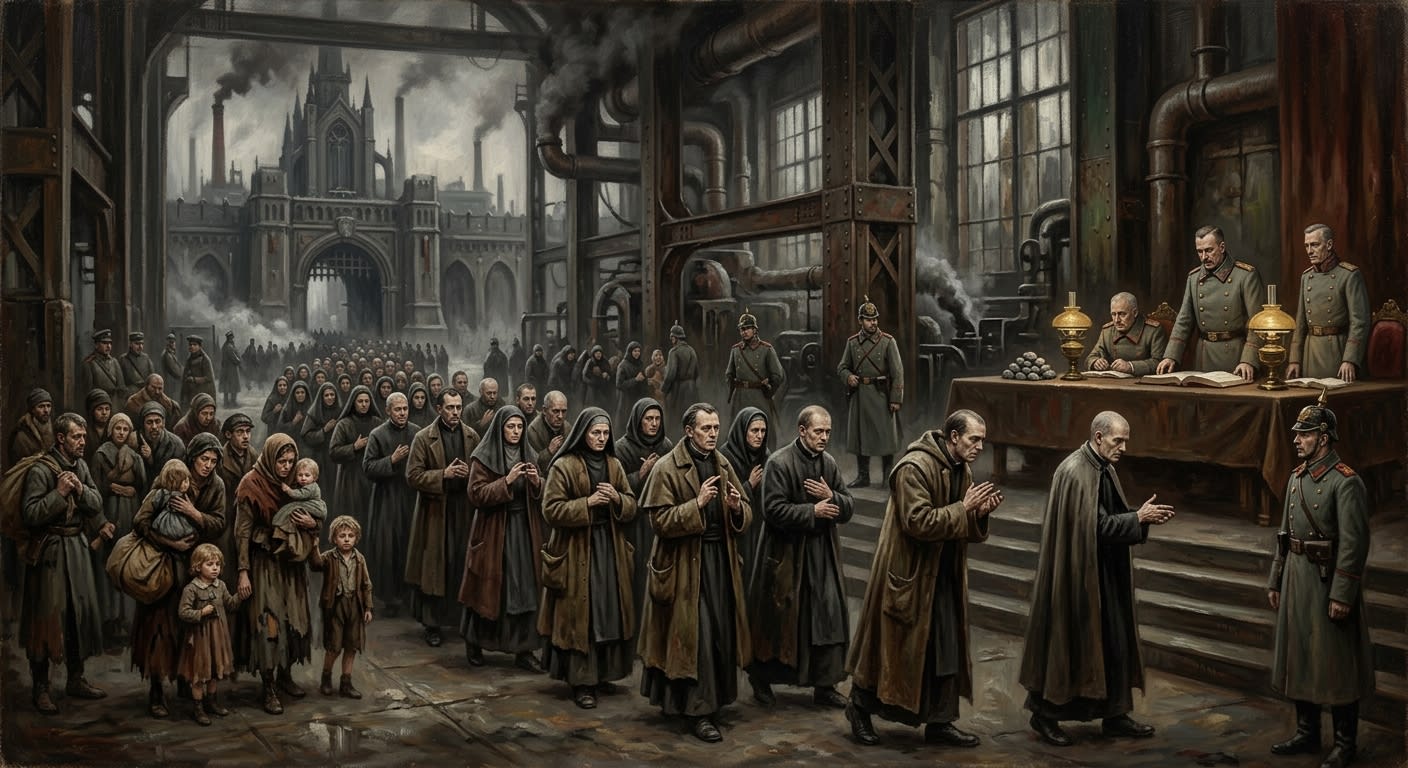
The Null Tongue Brotherhood began, as all competent heresies begin, as a practical inconvenience discovered by frightened people before Doctrine had prepared a drawer for it. At the Steppe Gate, where law is carved into limestone, read by wind, sold by scribes, and enforced upon the throat, the spoken word ceased to be merely dangerous and became taxable. A man could lose passage by a vowel. A widow could lose cargo by a swallowed consonant. A child could repeat an adult's mistake and discover, before breakfast, that grammar owned lungs.
The Brotherhood's first article of faith was simple: if speech kills, refuse speech.
This was intolerable. The Synod permits many things at the frontier: bribery where it stabilises passage, fraud where it supports records, extortion where it wears a blue cord and bows toward the correct office. Refusal is a sharper animal. A citizen who speaks may be corrected. A citizen who lies may be branded. A citizen who says nothing forces authority to ask whether silence is absence, guilt, defiance, prayer, disease, cowardice, discipline, or the first syllable of a theology. Such questions waste paper. The Bureau despises waste unless it owns the mill.
The official file calls the Brotherhood a literacy-aid fellowship, a gesture school, an informal mutual-protection association among refugees, debtors, translator-apprentices, and court survivors. This is the soft public face, suitable for notices and nervous inspectors. The true thing is a cult, a union, a discipline, and a wager placed against the stones: that the mouth may be removed from law's jurisdiction if the hands learn to carry meaning without sound.
#On the Red Night and the First Closed Mouths
The Brotherhood dates itself from the Red Pronunciation of A.S. 94, though no charter survives and no founder has been kind enough to leave a name for later punishment. Arbiter J. Sarn mispronounced one binding term on the Third Treaty-Stone. The corrupted syllable entered the wind, crossed the Ring, passed through the Oath Inns and Caravan Corrals, and closed roughly one thousand throats before dawn. The dead did not merely die. They died instructed: ink at the ear, red lines at wrist and cheek, wind-pressure in the trachea, paper edges marking skin according to clause grammar.
Nine days later the Bureau of Bells arrived with Cantors, seals, and the confidence of men whose lateness had already been sanctified by distance. The town had done the useful work itself. Phoneme cards were inked on hide. Oath-inn keepers forbade repetition near doors. Translator-scribes began charging ruinous fees for the placement of tooth against tongue. Men stuffed wool in keyholes because panic is a bad carpenter but a devoted one.
Among the survivors were those who drew a different inference. The stones punished speech. The market sold safer speech. The court licensed speech. The Seal-Houses profited from certified speech. The poor learned what wealth could not own: the refusal to speak at all.
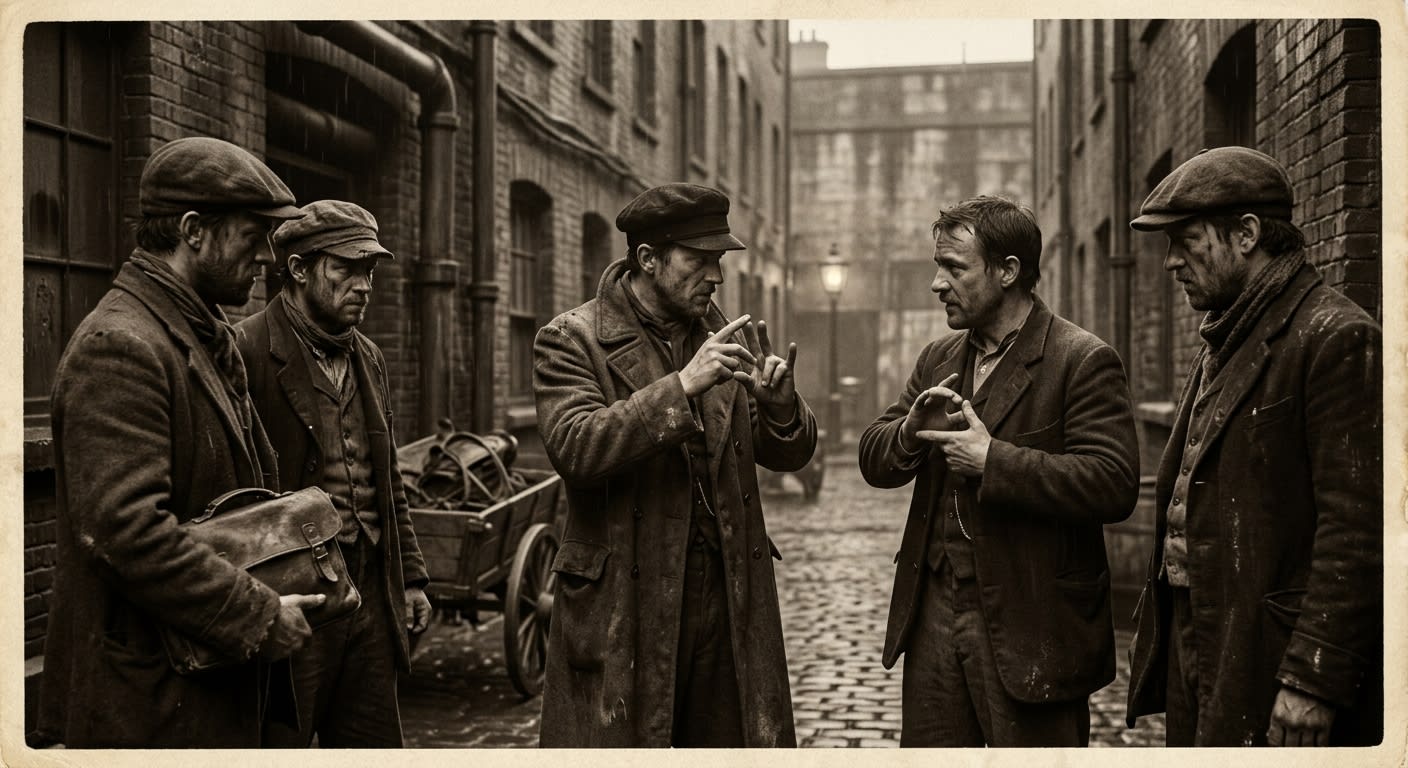
The earliest Nullists were called wool-mouths, hush-rats, cellar saints, mute debtors, and, in one delightful complaint from Seal-House Row (Unregistered), “unauthorised abstainers from registrable utterance.” They met in the cellar of the Split Tongue (Unregistered) and in gully rooms where sour beer, witness-milk, and fear sweat sank into the walls. Their first lessons were anatomical: how to still the throat, flatten the tongue, breathe through panic, keep the jaw loose, stop the reflexive answer when a patrolman barked a question. Their second lessons were manual. Thumb to wrist for danger. Two fingers across palm for witness. Knuckle at chin for false clause. Open hand held low for child. Closed fist over heart for no word.
The gesture-cant spread inside hymn books, folded into phoneme cards, written in margins as devotional posture, taught to refugees who could not afford translator-scribes and to widows who had learned the price of asking aloud what had happened to their husbands.
#On the Cant of Hands
The Bureau of Purity classifies the Null Tongue cant as a sequence of regulated gestures requiring classification. The distinction has occupied three committees, ruined two minor careers, and made every Nullist in the gullies silently laugh with his shoulders.
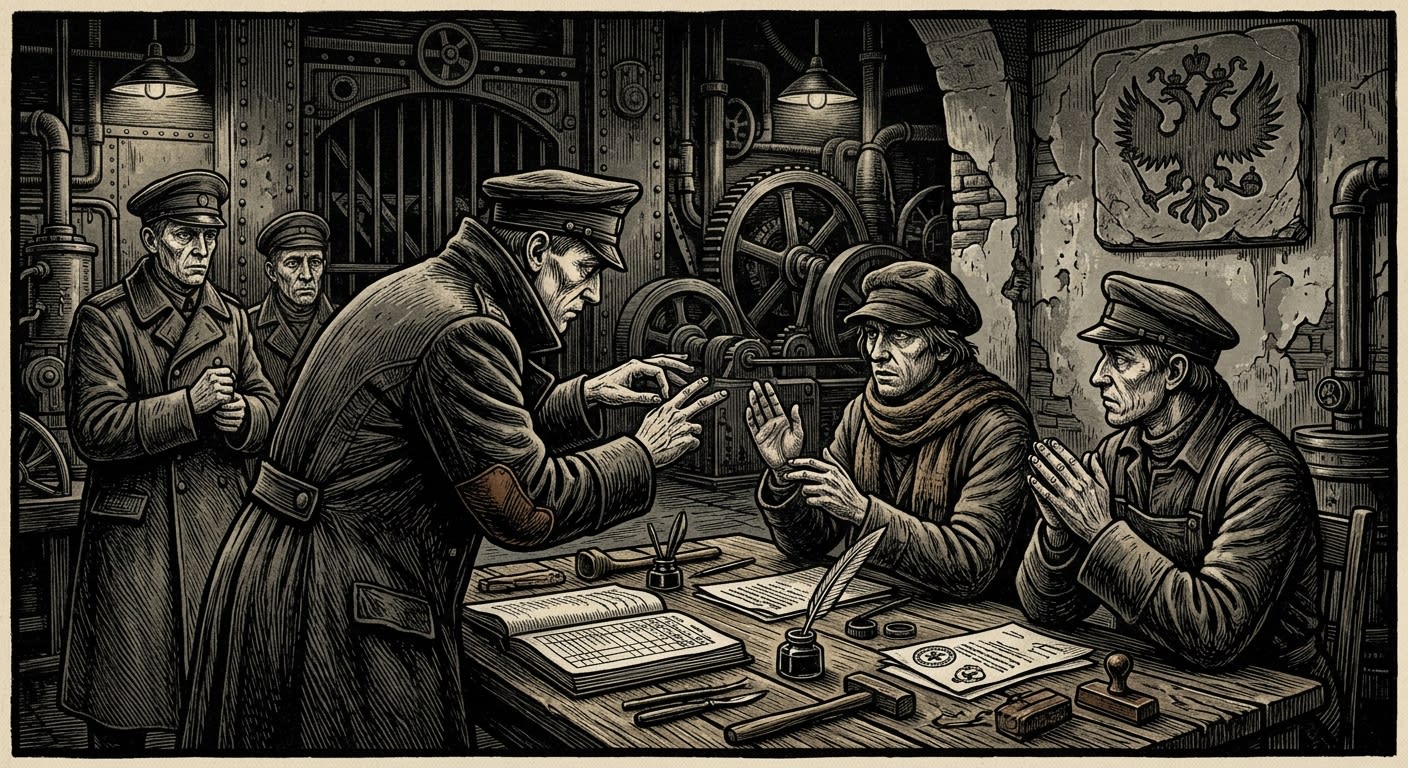
The cant works because it is ugly, limited, and quick. It was built for market corners, court queues, patrol searches, and wind-gaps where a spoken syllable might acquire teeth. It has signs for toll, witness, patrol, child, forged, safe, unsafe, wrong word, old clause, stone-listening, do not repeat, and run without papers. It has no sign for philosophy. It has six for hunger. This alone proves its frontier authenticity.
Children learn fastest. This alarms every office involved, as it should. A child who learns not to echo a fatal word survives. A child who learns to answer a clerk with hands before mouth also acquires, before catechism, the suspicion that authority's first demand is sound before obedience. The Brotherhood calls such children clear. Purity calls them deferred. The Scribe Bazaar calls them lost revenue.
Gesture has limits the Brotherhood refuses to romanticise. A hand cannot always bind cargo. A hand cannot always absolve a debt. A hand cannot answer a charging patrol horse unless it is wrapped around a stone. Nullists still require paper, witnesses, route marks, and the occasional paid scribe whose tongue has not yet grown too proud of itself. The Brotherhood's power lies in interrupting compulsory speech. It inserts silence where the Gate expects reply. It makes the court show its knife.
#On Doctrine, If One Must Dignify It
The Brotherhood teaches that the stones govern breath rather than soul; utterance rather than intention; contracts rather than conscience. This teaching is half true, which is where heresy fattens. If sound binds, they say, soundlessness frees. If the wind reads lips, cover the lips. If a clause-spirit punishes mispronunciation, leave the clause unfed. The true vow is made inward and kept outward through action. The mouth is a toll gate. The hands are a road through scrub.
Doctrine rejects this. Doctrine also envies its efficiency.
The Brotherhood divides, though it denies division with identical gestures. The Quiet Hands teach survival silence only: no spoken answers near the Ring, no repetition of unfamiliar clauses, gesture for children, written petitions where possible, paid translators when unavoidable. They are cautious, numerous, and irritatingly useful. The Stone-Mutes (Unregistered) go further. They hold that every spoken contract at the Gate strengthens the treaty's appetite, especially since the Burnless Archive began receiving living addenda after A.S. 194. They refuse court speech, disrupt arbitration by silent presence, and teach null-walking through low gullies and wind shadows. The Open Palms (Unregistered) serve as the Brotherhood's mercy arm, moving refugees, debtors, and failed witnesses through rooms where a word would cost more than a winter's bread.
The Bureau's favourite fear is sabotage: the choking of wind channels, defacement of pronunciation cards, theft of witness marks, or coordinated silence during major caravan arbitration. These fears are grounded in precedent. The Brotherhood has done three of the four and denied the fourth with such coordinated stillness that denial became confession.
Early Purity memoranda described the Brotherhood as “self-limiting due to inaudible doctrine.”
Corrected. Inaudibility limits sermons; it does not limit discipline. A man who cannot preach may still teach a hand sign to a queue. A queue that learns together has already become a congregation.
#On the Null-Walker of A.S. 187
The case that keeps the Brotherhood small occurred in A.S. 187, at the Fourth Stone, during a daylight crossing filed under routine passage irregularity until the body complicated the language. A known adherent, unnamed in the public notices and named too often in the gullies to be safely repeated, attempted a null-walk through the Treaty Ring: no spoken clause, no paid certificate, no oath-note, no verbal acknowledgment of the Gate's authority. He carried clean papers. He made no sound. Witnesses saw both hands open, palms outward, the sign for breath kept whole.
At the Fourth Stone he fell. Blood ran from both ears. The autopsy found ink in the trachea.
The Brotherhood declared him impure in silence. His mind had spoken, they said. Fear had formed words inside the skull, and the stones had heard the cowardly inward mouth. This verdict was useful, because it preserved the method by blaming the man. Institutions call that cruelty when cults do it. When we do it, we call it doctrine.
BUREAU OF MEDICINE SUPPLEMENT — FOURTH STONE NULL-WALK, A.S. 187 Subject presented no tongue trauma. Larynx unmarked. Ink deposit found below vocal folds, arranged in three characters not present on submitted passage writ. Attending examiner requested comparison against Fourth Stone lower seam. Request denied by Treaty Office. Specimen jar subsequently █████████████████████████.
Purity's conclusion was inconclusive. This is one of those rare official phrases containing real intelligence. If the stones punished the walker for silence, then silence lies within treaty jurisdiction. If they punished him for inward speech, the treaty has begun reading thought. If the ink belonged to an unrecorded clause, the Fourth Stone had spoken through a man who refused to speak through himself. Each possibility is expensive.
High Arbiter Senn Vark has never ruled publicly on the case. He has cited it twice in closed session and once, by omission, in a witness-law dispute where he required a mute petitioner to appoint a speaking proxy before the Bench would hear her claim. The Nullists responded by sending twenty-seven silent witnesses to the next session. Vark charged them standing fees. One must admire him. One need not like him.
#On Tolerance, Monitoring, and Other Polite Threats
The Synod has not crushed the Brotherhood because crushing it would require defining it. Definition creates jurisdiction; jurisdiction creates responsibility; responsibility creates budget requests. Better to watch. Better to let the silent heresy serve as pressure valve, refugee school, translator counterweight, and occasional bait for less disciplined dissent.
Purity has investigated fourteen times. The recommendations repeat with monastic beauty: monitor, infiltrate, confiscate primers when found, return harmless gesture cards under observation, arrest recruiters only after connection to forged addenda, never conduct mass arrests inside the Treaty Ring, never compel group confession during high wind. The last instruction was written in A.S. 196 after a junior Lictor ordered nine suspected Nullists to answer together near the Third Stone. Seven complied. Two remained silent. The compliant seven developed throat bruising in the shape of witness marks. The silent two were released by the Caravan Court for lack of admissible statement and later taught half the Gully Market (Unregistered) the sign for idiot with a sword.
The Seal-House Consortium despises the Brotherhood for commercial reasons and denounces it for theological ones, the proper order of frontier indignation. Translator-scribes despise it less openly. Some sell phoneme guides by day and teach hand-cant by night, an arrangement I condemn in principle and respect in practice. Captain Rho Balesh (Unregistered)'s Blue Cords use silent runners when bribe schedules must cross the Windwatch Towers (Unregistered) without signal flags. The Treaty Office (Unregistered) knows. The Treaty Office files weather reports.
The Brotherhood survives because everyone uses it while disapproving of it. This is the frontier's highest form of legitimacy.
#On the Present Condition
As of A.S. 201, the Null Tongue Brotherhood grows in the gullies, Oath Inn cellars, refugee queues, and outer corrals where passage waits long enough for fear to acquire grammar. Its numbers cannot be counted by ordinary roll. A speaker may be a member. A mute may be merely tired. A child may know three signs and no doctrine. A scribe may sell the cant without believing it. A widow may carry the whole Creed of Silence (Unregistered) in her left hand and still hire a translator when the clause is too sharp.
The missing Third Stone rubbing (Unregistered) in A.S. 199 changed the Brotherhood's private teaching. The old doctrine said silence could starve the stones. The new doctrine says silence may hide from a treaty that is learning to amend itself. That difference matters. Starving an enemy is war. Hiding from a growing instrument is survival. The Stone-Mutes keep their mouths closed, write little, and now teach that the Archive feeds on enforced speech, on closed throats, on every ruling that becomes death and every death that becomes addendum. They want the Gate to fall quiet for one full day. No court. No market. No oath. No toll. No spoken name.
The plan is impossible, which means someone will attempt it.
Registry Entry 4-ST-199/b listed the Brotherhood as “minor, cellar-confined, non-operational.”
Clarified. Cellars have doors. Gullies have routes. Hands travel better than sermons. The Brotherhood is operational wherever a frightened person learns that not answering may keep the throat open until dusk.
A final note for clerks assigned to the Steppe Gate: do not mock the mute petitioner. Do not demand a child repeat an unfamiliar clause. Do not confiscate a gesture primer during high wind. Do not ask a Brotherhood elder whether silence is heresy unless you have already decided which answer you can survive.