
#On the Middle Hands
“I only move wheels.” — the Carter's defence, heard in many confessionals and believed in none
Every Night Wagon Driver was once a hand holding someone else's horse. Between the boy who wraps the spokes and the driver who chooses the road stands a narrower creature. The stable ledgers, which do not exist, call him Carter or Runner, and he is trusted with exactly one thing: a short route and a single pickup.
The Wheel-Boy prepares a wagon he will never take out. He wraps the wheels, hoods the lamp, forks the straw, and gets beaten for the squeal he missed. The Carter takes out the wagon he once prepared, and with it he receives a description, a door and an hour. On the duty board the change is small. Yesterday he made a wagon quiet. Tonight he makes a person absent, alone, in the dark, for a Bureau that will deny him by breakfast.
The trade likes to trace its middle hands back to the First Carter of Strasbourg, the unnamed ancient waiting under the bridge with his lamp hooded in felt. The claim has not survived contact with my archive. What can be attested is smaller. Every Carter now in service has heard of the eleven wagons that left Lübeck in the Year of Smoke, A.S. 180, and every one has wondered which of the eleven carried a man of his own grade. The answer is not on file. Nothing about the Night Wagon is on file. That is the file.
The division of labour is simple: the Carter sits the box, and the Runner goes ahead on foot to buy the gates.
The division of labour is simple: the Carter sits the box, and the Runner goes ahead on foot to buy the gates.
Struck. No stable rota, depot instruction or confession-summary in this office separates the two titles by task. Stable chiefs use the words the way they use “sir” and “you there,” according to mood and debt. Both drive, both walk, and both pay. The tidy division was my own invention, supplied because a pair of titles looked as though it ought to mean something. Doctrine thanks me for the order and declines it.
#On the Short Route
What follows is a composite of what the hands say in their cups and what their confessors pass upward. It describes no single night.
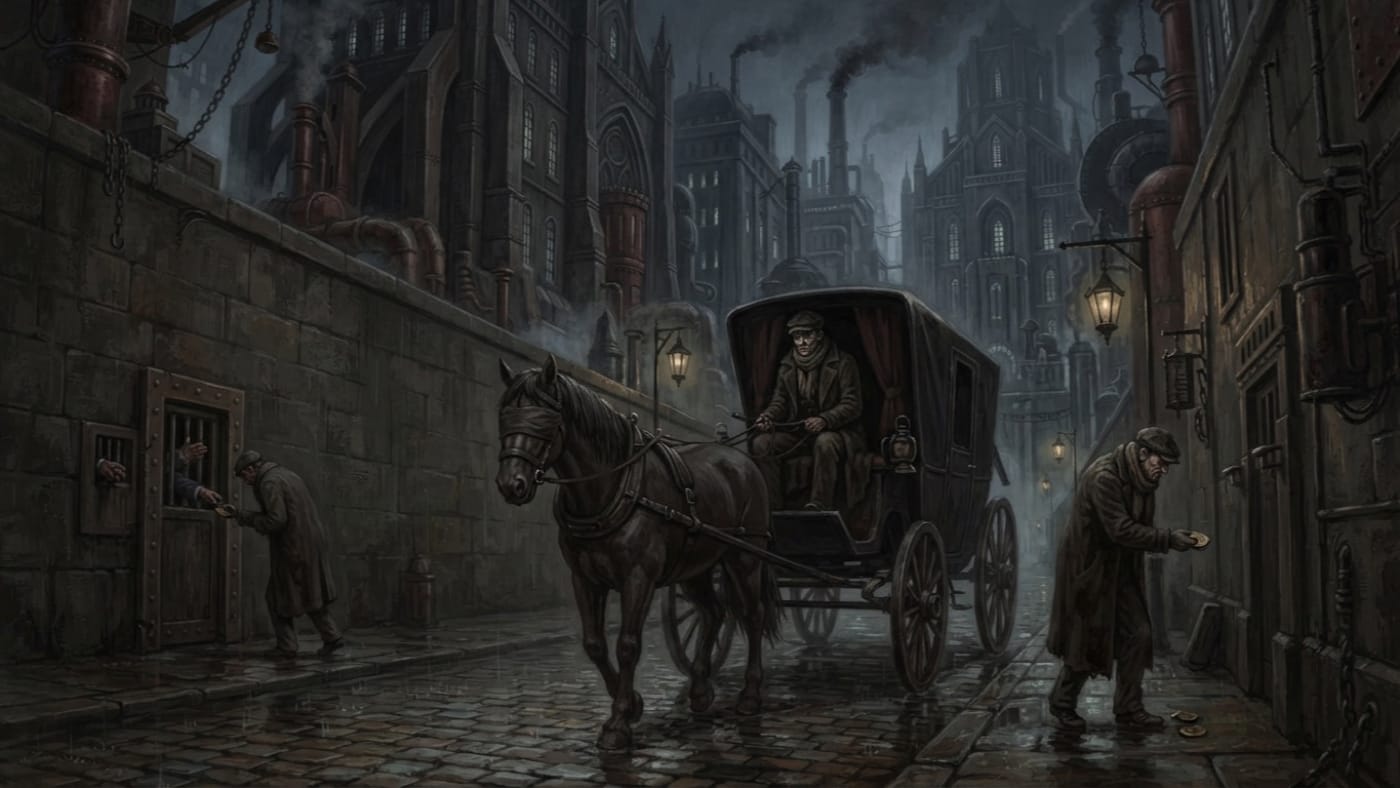
The day goes to cover. The Carter hauls chapel ash out of the River Quarter, delivers coal to a respectable widow, and bores the street until it forgets his face. Late in the afternoon he goes to the yard. The ordinary horse goes into its stall and the blindfold horse comes out, already calm, already insulted. He checks the Wheel-Boy's wrappings, because the Wheel-Boy will not be the one who answers for them. He works cold axle grease into the hub with his thumb until the wheel turns as quietly as a rumour. He counts the rag-bound keys. He hoods the lamp, then lifts the hood twice to make sure no amber leaks at the seam.
His instruction comes by mouth from a senior driver, or under seal on a slip he reads once at the depot and feeds to the lamp. It names a door, an hour and a description. It never names a road. The road is his to make, inside limits a driver has already chalked around him the way one chalks around a corpse.
A short route sounds like an errand. As the crow flies it is three streets, and crows are not required to avoid anything. The Carter must avoid the bell-tower while its bell is warm, the square whose windows face inward, the gate he used on Tuesday, the cobbles that remember iron, and the chapel whose priest asks questions. Subtract all that and the remainder runs halfway across the Warrens, through four competing jurisdictions, over one of the midnight bridges and back. The window opens after the final peal and closes at Matins. A short route can eat every minute in between.
At the door, someone else has already oiled the hinges. A Gauze-Masked Custodian may be waiting there with the passenger, or with a sack, or with nothing at all, which is worse. The Custodian has done the collecting. The Carter does the moving. He speaks no full name inside the wagon and answers no questions.
The handoff takes place at a bridge station or at a depot dressed as a tariff chapel, where a chaplain with grey wax under his own nails signs nothing and receives everything. Then comes the cleaning. The Carter rakes the tracks out of the soft ash, burns the wet straw, and checks the wrappings for fibres from the wrong street. He pays the second coin at the gate on his way home.
#On Passage and Forgetting
The middle grades are where the bribe grammar is learned. The first coin buys passage. The second buys forgetting. The third buys a lie, with embellishments. Hands recite it like a catechism, and like a catechism it describes an ideal no parish achieves. Gate captains post no tariffs. Some take fuel and some take a favour owed. The worst take a name, and a Carter who pays in names soon discovers he has entered the Bureau's own trade from the far end.
He learns which gate captain drinks, which stable chief has a daughter in Marrowgate, which depot chaplain sells absolution slips after midnight, and which bell-warden will ring a quarter late for a sack of coal. He learns that the second coin matters more than the first. Passage lasts a moment. Forgetting is a policy, and the Bureau audits it by contradiction: if two people remember the same wagon, one of them is surplus. A Carter who keeps the second coin for his supper has put a price on a witness. The Bureau will settle that account, possibly with him.
At the front, the grammar changes dialect. In the Latchford permit-yards, Records checks papers, War checks cargo and the Wardens check faces. Passing all three costs wax blocks, clean paper, warm food, or a minute shaved from the bell window. Along the Queue Road the hands meet runners of another kind entirely, union men with no interest in a wagon that is not there. The two trades share mud and nothing else.
#On the Order Arriving Late
Some nights the instruction is already obsolete when it arrives. A Night Papers Courier comes into the yard short of breath, with a grey vellum warrant under his coat, and the wagon that was meant to idle until the second quarter must now outrun dawn.
The courier carries the Paper. The Custodian collects and omits. The Carter moves weight from one place to another and brings the wagon back empty. A quiet arrival does not make him a notary of omission. He could not strike a name from a parish roll if the Synod held the ink-pot for him. His danger is borrowed. The Paper expires at sunrise, and the trade's proverbs are about the bearer caught holding it then. What becomes of that bearer, and by what agency, the courier's own entry declines to say, and so does this one.
The Carter knows only that the courier is frightened and that the fear is now his to transport. The road wants speed and the passenger wants mercy. At the pace required, the wagon cannot carry both.
Every Carter keeps that sentence ready. It holds until the night a senior driver taps the empty compartment and asks whether he would prefer to ride.
#On Wages and Wear
They are paid in whatever keeps them close: ration privileges, a corner of a stable loft, fuel in a rationed city, and silence rights, the immunity from small prosecutions that works as a leash dressed as a pardon. Debt comes with the post. A Carter owes the depot for the hood he cracked. He owes a Custodian for the passenger who screamed and was never reported. In the phrase of the yards, he owes the wax itself. The phrase is not explained to him.
The body keeps its own account from the first season. Grey wax settles under the nails and will not scrub out. The palms take rope burns from harness held short at corners. Sleep shrinks to the hours between the cover work and the harness swap. Some hands catch themselves counting peals at supper. Some notice their answers narrowing to negatives (not late, no one, nothing happened) long before their wives do. The low shoulder, the white hair and the permanent night-squint belong to the old axles. A fresh wheel has years to earn them, if the Bureau grants him years.
The hands also report what my office cannot certify. They say blank space gets hungry. They say certain alleys on a route used too often go wrong: hoofbeats die in them, lamplight leans, and straw comes back wet on a dry night. The yards call these places road-wounds. Carters scratch them into the underside of their seat boards, and so begin the private route map that every regulation forbids and every driver keeps.
#On Advancement and the Present Service
There is no examination. There is a driver watching. A Carter becomes a Night Wagon Driver by finishing short routes until nobody can remember any of them and by surviving dawn orders. The prize is full route authority: a negative route of his own making, the right to redirect to a quiet door, and the rare and educational right to refuse a handoff when the road smells wrong. The Carter has none of these. He may smell the road all he likes. He drives it anyway.
Two temptations wait on the middle rung. The Grey Wax men offer perfect obedience to the Paper: if the vellum says cargo, it is cargo, and conscience belongs to the courier. The second temptation is quieter and pays better. A hand who knows one door, one gate captain and one bridge can sell a single unmanifest passage to a smuggler, a widow, or a Lantern mercy-man with a family to move. That road leads to the Blackwheel trade, which the Bureau hates the way a monopoly hates a gifted apprentice. It runs alongside the ladder and never joins it.
The yards answer the question of priority in their own catechism. Who is sacrificed when pressure rises? Wheel-Boys and passengers, never the wagon. The Carter stands between those two categories and is filed under whichever suits the night.
A hand seen at the wrong door twice does not finish the season. The wagon is cleaned, the horse is fed, and somebody else pays the second coin at the gate.