
#On the Apparatus
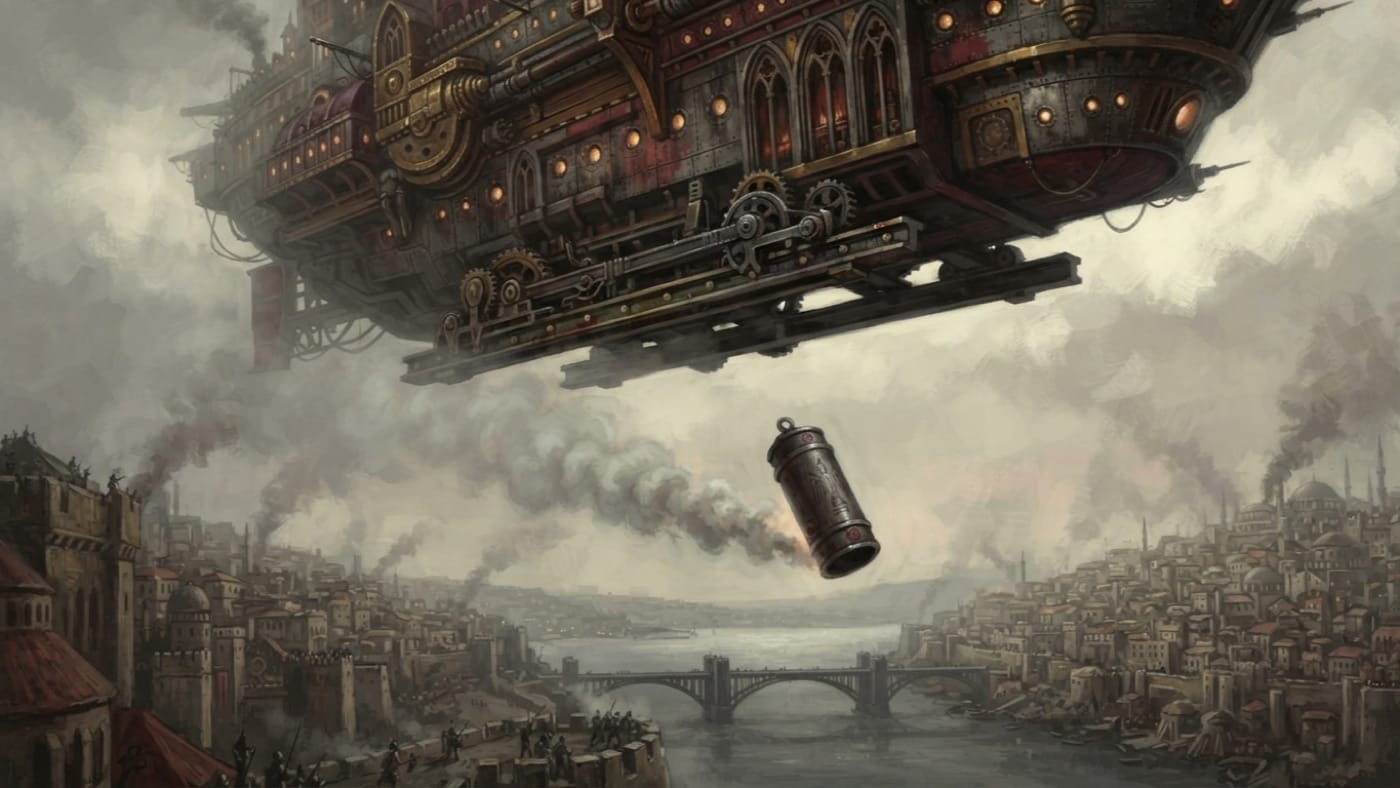
The Bureau's own requisitions regularly confuse the rack with the censer, so I separate them first. The rack is the array: retractable, part of the fabric of the Vigil Ark Saint Barachiel, drawn in when the Ark is preaching and run out when it intends to do something else. The censer is the thing the rack lets go of. At the end of a patrol the rack goes back into its housing. The censer never comes back.
The Ark has three armaments, and the Bureau lists them in this order: four Sermon-horns, the censer-racks, and the reliquary-chapel. The horns broadcast. The chapel sanctifies the air the Ark passes through into a Bellway. The racks are the part that kills things. They come second on the list because the Bureau of Bells operates the vessel through its Catechetical Division, Aerial Wing, and a teaching instrument should not lead with its ordnance.
The record does not say how many racks the Ark carries, how many censers each one holds, or exactly where on the gondola they extend. I will not add to the record. Additions to the record are how heresies start, and also how audits start, and I fear the second more.
#On the Censers and Their Descent
Each censer is the size of a man's torso. I give the measurement the way the source gives it, in anatomy, because the soldiers on the ravelins understand a torso better than any gauge in inches. A torso is something you have carried. A torso is something you have buried.
The Bureau of Rites calls the compound inside sanctified fire. The workers in the Foundry Quarter of Bastion-Constantinople, who make it, call it devil-broth. Both names refer to the same filling in the same casing, and both are liturgically exact in their own way. The Rites name says what the substance is meant to be. The Foundry name says what it is like to make. I do not know what is in it and I have not asked. A Hieromnemon who asks the Foundry Quarter for a recipe gets either a lie or a burn, and I know which I would prefer.
It should not be confused with Compound 7, the Ark's lift gas, which does not burn. Devil-broth burns. That is its whole vocation.
The censers fall slowly. Watchers below see one leave the rack and drift rather than drop, trailing blessed smoke the way a thurible trails it down the nave in procession. The smoke is grey, and then the ground or water underneath it stops being there. Neither the Bureau of Engineering nor the Bureau of Rites has filed any explanation for the slowness with my office, and I do not write explanations for other bureaus. They have their own pens.
The censers detonate on impact. The fourth crew's bombardier says the sound is "the last note of a hymn, if the hymn were very angry." I have heard a great many hymns, and I have heard choirs that were angry: choirs underpaid, choirs over-rehearsed, one choir in Mainz that I am fairly sure was planning a mutiny between the second and third verses. The bombardier's comparison is testimony, and I file it as testimony. As far as I know the Bureau of Bells, which measures everything, has never measured this. A sound that nobody measures is a sound that nobody can dispute, and I do not think the Bureau overlooked that by accident.
#On the Writ and the Target
The censers are dropped on positions indicated by the Legate's writ.
That is all of it. A catechetical vessel, carrying the daily sermon of the Bureau of Doctrine, drops incendiaries on coordinates that an officer of the Church has set down in writing. The Bureau of Doctrine finds this coherent, and so do I. The writ is a document, documents are my province, and the fire that follows a document is just its execution clause. The record does not say who drafts each writ, who countersigns it, or how often it is wrong. The record is a careful animal and keeps its throat covered.
The record lists three kinds of target: positions on the surface, assault craft in mid-strait, and, on one occasion, a threat in the air. It gives no blast radius. It gives no burning temperature, no accuracy figure, no rate of release, and no number of dead. The Bureau of War counts everything. It counts boots, it counts candles, and it counted the forty-three hulls lost in the Black Sea Armada down to the splinter. Here it has either counted nothing or shown me nothing, and I have a view on which.
Nobody guarantees purification either. Sanctified fire is sanctified because the Bureau of Rites says so. What it does to whatever is underneath it is filed under results.
#On the Strait Below
The chains guard the water. The ravelins guard the shore. Since A.S. 168, when the Bureau of War commissioned the Saint Barachiel and Gate-Warden Petra Valenne tied it into the Bosphorus defence, the sky has been guarded too.
The sky had not been guarded before because nobody owned it. Kargath worked that out first. Supply convoys passing under an empty sky reached the fortress with less grain than they had left with. The loss tripped no alarm and showed in no audit, and the granaries filled up with empty sacks. The Harbor of Chains had broken the Armada in A.S. 162, and the forty-three hulls are credited to the chains, not to any rack. Chains cannot look up.
The racks do not feed anyone. They do not put a single loaf back into a single sack. They burn what the writ marks out, above and around the convoys that Gluttony would otherwise eat, and the Bureau calls this protection. In the Constantinople theatre the Saint Barachiel was the first vessel to put that protection overhead. It was not the first Ark of the Church, and readers who remember the Sanctissima Vox will forgive me for not writing about her at length here.
Older descriptive surveys place the Ark's theatre at the "western anchor" of the Line, the fortress-city of Bastion-Lorraine.
The Line runs north to south. Its southern anchor is Bastion-Constantinople, at the Bosphorus. "Bastion-Lorraine" survives in veterans' songs and pre-correction plaques and must not appear on any current map, writ or targeting order. A censer dropped on a position named by the old cartography would fall a very long way from where it was meant to.
#On the Boarding of A.S. 183
In A.S. 183, according to the vessel's record, an unidentified winged entity tried to board the Saint Barachiel.
It was engaged with a censer. The record says the bombardier made the shot. It does not say how a censer that falls at the pace of a procession met something that was climbing toward the gondola, and I will not supply a mechanism the Bureau of War has chosen to leave out. A Bureau of War record with no account of how in it is itself an answer of a kind, though not one I can read.
The entity was not recovered. The censer was not recovered. Nobody recorded where either of them fell, or whether they fell. The strait is deep and the sky is deeper, and the Church has not asked for a survey of either.
The bombardier has since been promoted twice and decorated once. The entry gives no name, and I will not supply one. The record also gives this bombardier a habit: looking up at empty sky, and flinching.
Two promotions and a decoration are what the Bureau of War gives you for hitting something it will not name. Flinching is what you are left with afterward.
#On Present Employment
The fourth crew has flown the Ark since the third was replaced after the Broadcast of A.S. 199, about which this entry says nothing more. They broadcast the daily sermon, they patrol the strait, and they drop the censers. The writs keep coming. So does the devil-broth, out of the Foundry Quarter in casings the size of a man's torso, and it is loaded, run out on the racks, and released over whatever the Legate has written down.
The Bureau of Rites calls it sanctified fire. The bombardier calls it an angry hymn. The Bureau of War calls it an aerial asset, unconventional, pending reclassification, as it has for some time. I call it filed.