
#On the Brass Throat
Permitting intelligibility to faithful and unfaithful alike. — Aerial Wing operating manual, margin corrected in three hands
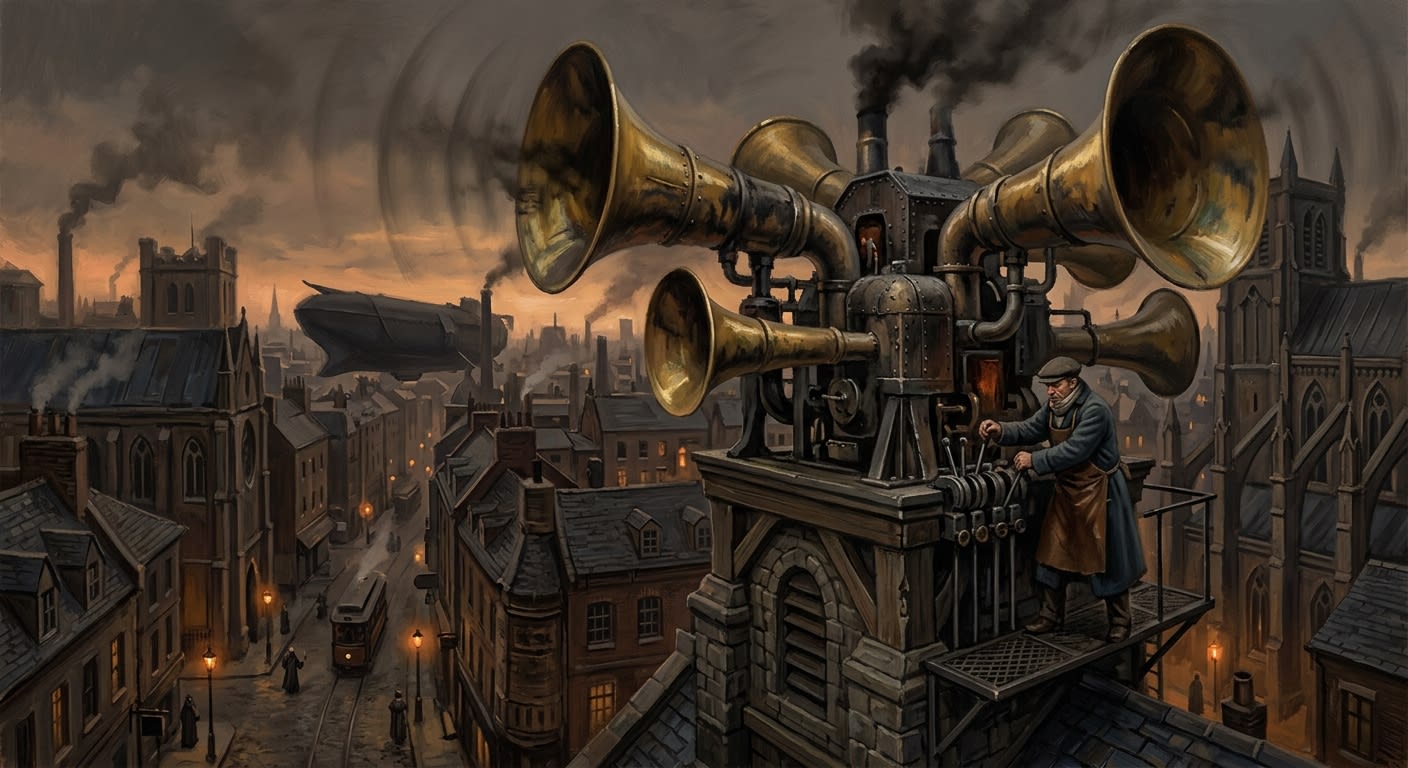
Sermon-horns are the Synod's authorised brass projectors for violent catechesis at range: tower-mounted in cities, nested in rooftop shrines, bolted to relay wagons, sunk into fog towers, and, most notoriously, fixed in fours to the gondola carriages of Vigil Arks. They take approved words from Doctrine, pass them through Bells, feed them through the Broadcast Directorate's clean-carrier (Unregistered) apparatus, and deliver them into the ear with that magnificent impersonality by which a state avoids knowing whom it has deafened.
A bell summons. A horn enters.
This is the distinction. Bells mark time, claim parish, announce death, divide procession, settle routes, and quarrel with fog. Sermon-horns command the faithful to listen, then punish the space where refusal would prefer to grow its little private spine. They are organs of sound, evidence, punishment, weather policy, ration logic, and spiritual trespass. The horn says the prayer. The receiver confirms the tone. The Sky-Sermon Attendance Auditor counts the open window. The household becomes compliant, suspect, Branded, or hungry.
The common horn is brass-faced, throat-ribbed, copper-fed, saint-dust sealed, and mounted on a swivel or fixed nave bracket according to its intended cruelty. The aerial horn is heavier, shorter-throated, pressure-hardened, and braced against wind shear, vibration, censer recoil, and crew panic. The fog-tower horn is salt-greased, shuttered, and tuned low enough to make water behave like a reluctant parish clerk. All horns share the same ambition: make authorised language arrive with enough force that absence must explain itself.
#On the First Need to Shout
Strasbourg could issue doctrine faster than a horse could carry it and slower than error could breed. After the Concordat of Strasbourg and the A.S. 92 Living Word charter (Unregistered), Orison gained authority to turn prayer into infrastructure. Copper line, relay house, tower-horn, rooftop shrine, hymn plate, carrier dust, calibration choir: the machinery of public obedience began arranging itself with the cheerful obscenity of a bureaucracy discovering acoustics.
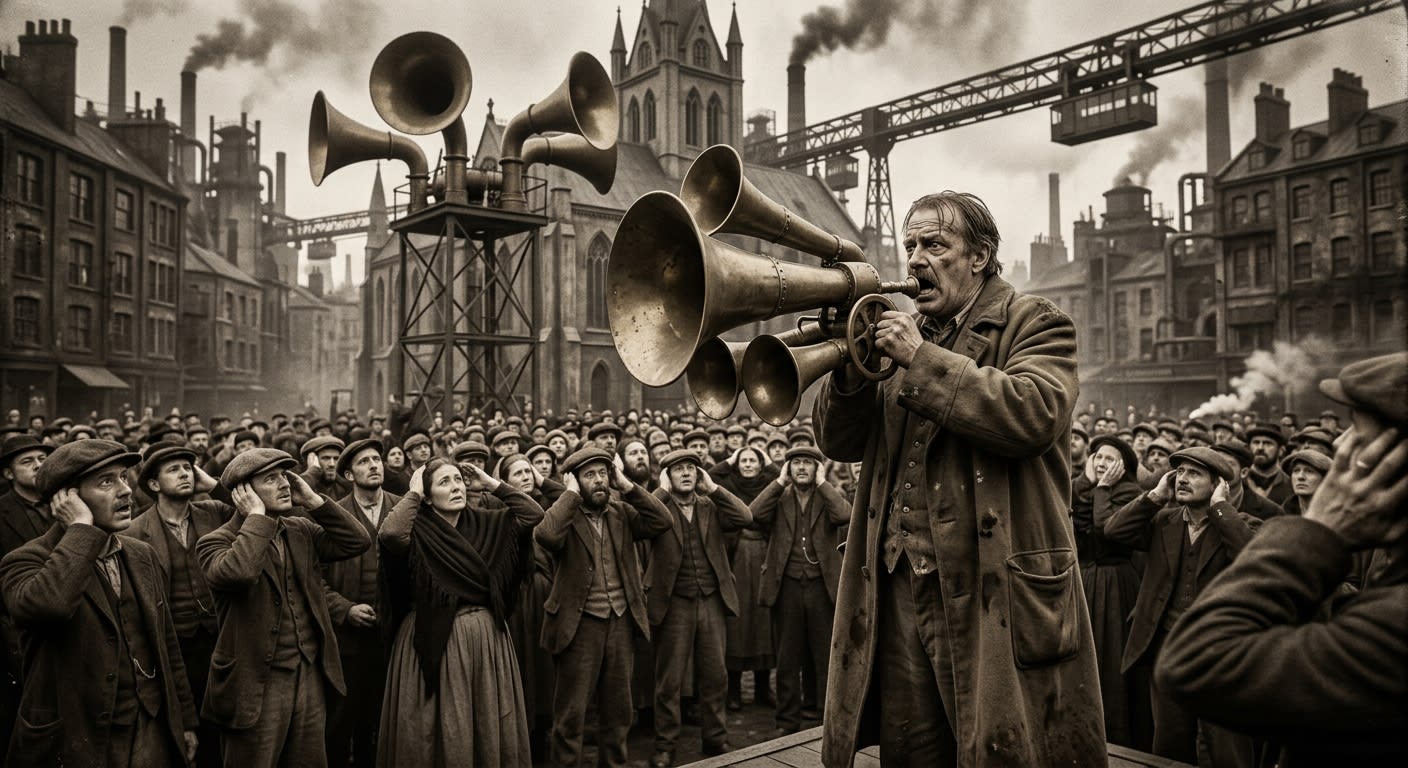
The early horns were town instruments, crude and honest enough to embarrass their descendants. They amplified the voice of a reader standing in a chamber, pushed it over square and barracks, and allowed a curate with poor lungs to sound like Providence after a day of drinking. They cracked in frost. They filled with nesting birds. They turned sermons into gargle when rain entered the throat. They also proved the principle. A voice made large could govern a crowd before the crowd had finished deciding whether it was a crowd.
The A.S. 112 Compliance Directive 14-R hardened the need. Attendance became allegiance. If attendance was allegiance, the state required a louder altar, a more regular horn, a receipt. Rooftop speaker shrines multiplied across poor quarters, industrial wards, barracks courts, pilgrimage routes, dock basins, and those sour little lanes where private speech survives because authority must first find the stairs. Sound went out. Reports came back late, partial, scented with local invention. The Metric Sanctification Edict of A.S. 158 gave the horn its teeth. A sermon heard by many was no longer pastoral success. It was a measurable sign of communal health. Choir Rate boards, token returns, window marks, receiver-tone confirmations, deadzone maps, and Brand notices gathered around the horn like clerks around a warm stove. A failed horn could lower a district. A working horn could indict it. The instrument joined the ration line, which is where all theology eventually goes if it wishes to matter.
#On Manufacture, Throat, and Saint-Dust
A Sermon-horn is made in three parts: the mouth, the throat, and the conscience.
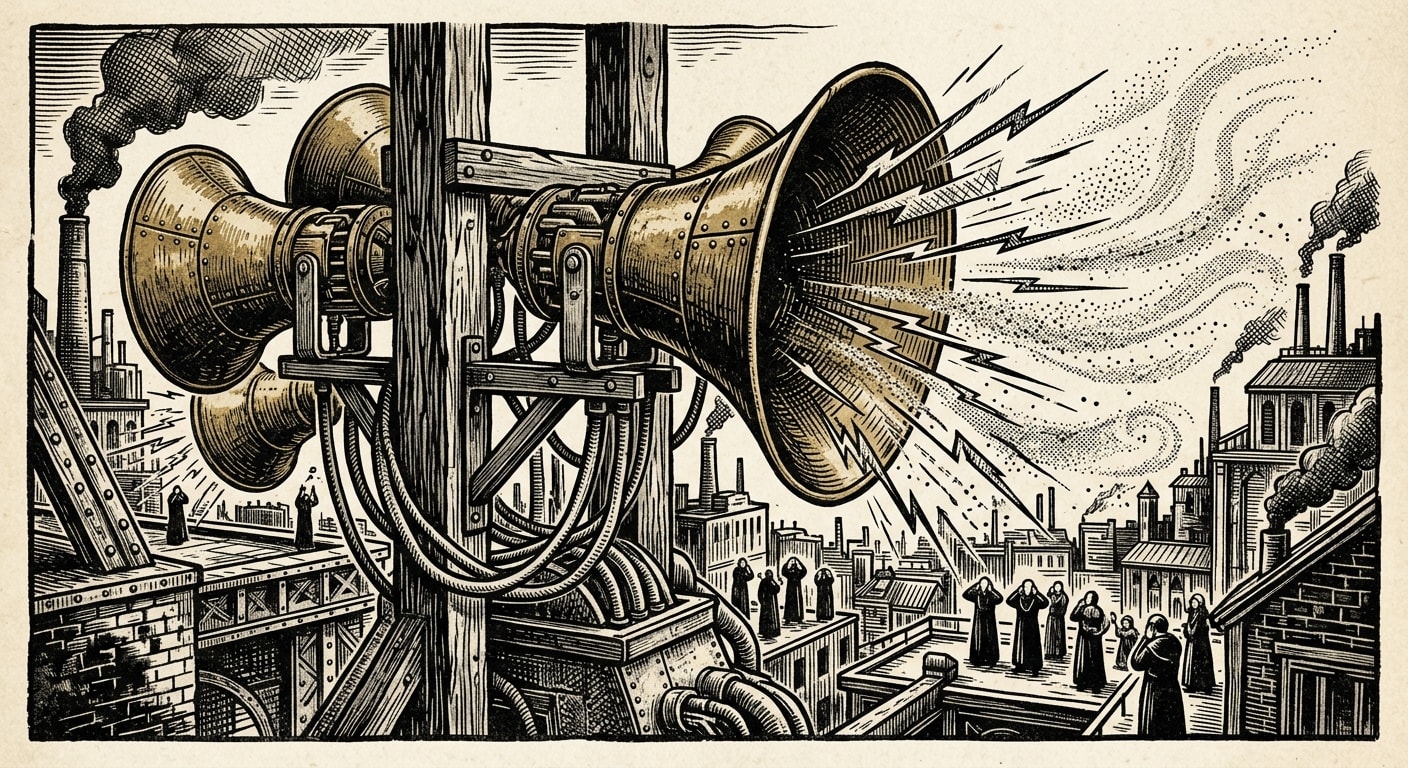
The mouth is brass or hymnsteel according to budget, theatre, and how many bishops will be photographed near it. City mouths are broad, flared, and vain; bastion mouths are narrow, reinforced, and rude; aerial mouths are ribbed like artillery nozzles because at five thousand feet even sanctity must respect pressure. Oxblood hymn-scrolls are painted along the inner flare for higher instruments, partly to sanctify projection, partly because plain brass reflects the face of the man shouting through it and no operator deserves that much honesty.
The throat is copper, coil, valve, plate, hinge, governor, and resonance baffle. It is where the voice becomes government. Bellwrights argue over throat angle with the pious hatred of men whose fractions can flatten a market. Too wide, and the sermon blooms into mud. Too narrow, and the consonants sharpen until the crowd hears accusation in every sibilant. Too much saint-dust, and the tone arrives holy but hoarse. Too little, and the packet travels naked through air where hostile cadence keeps knives.
The conscience is the clean-carrier seal. Saint-dust, grave wax, sanctified salts, martyr-scrap, powdered reliquary filings, and the occasional ingredient whose label has been eaten by mice with unusual theology are blended into the carrier apparatus. The Orison Signal Engineer strikes the test fork, casts the test prayer, listens for backward consonants, sweetness in the teeth, delayed sibilants, names beneath the third verse, or the beautiful deadly sign of a signal returning too clean. The horn's visible holiness is decorative compared with the dust. A thief can polish brass. A fool can paint psalms. Clean arrival requires dead matter, burnt matter, witnessed matter, sealed matter, and an engineer who has inhaled enough of it to cough like a censer being kicked down stairs. Veteran Dustcasters develop black gums, rough breath, and a habit of touching horn casings before launch. They call the habit mechanical. Nobody believes them. Everybody permits it.
#On Tower-Horns, Rooftop Shrines, and Street Obedience
In cities, Sermon-horns are arranged by coverage rather than beauty. Strasbourg's central horns answer the Cloister of Calibrated Breath. Kanzleiburg's district horns are ugly as tax law and twice as loud. Calais fog horns keep one ear on the sea and one on the Script Wall. Essen's foundry horns must punch through hammer, furnace, hymnsteel resonance, and worker profanity, a tonal field so hostile that Orison classifies successful noon prayer there as a minor industrial miracle.
A tower-horn owns a square by filling it. A rooftop shrine owns a stairwell by leaking sound downward through brick and domestic misery. Relay wagons own whatever road they survive long enough to offend. Together they form the ordinary tyranny of the Orison Hour: prayer, ration advisory, casualty correction, curfew, work quota, feast notice, moral cudgel, all spoken in a voice so large that the citizen cannot tell whether he is being shepherded or processed.
The household receiver completes the circuit. It catches the horn's authorised carrier, returns a faint obedient tone, and gives the Auditor something to mark. Receiver-tone confirmation is the little brother of public force: quiet, domestic, always watching for its chance to become evidence. A room may be empty and still compliant. A family may crouch in the pantry while the receiver hisses dutifully toward the street. The horn does not care. The ledger has received sound.
The Choir Rate made this civic acoustics into arithmetic discipline. Above ninety-two percent, a sector is Faithful. Eighty-five to ninety-two, Wavering. Below eighty-five, Branded. Below seventy, forced assembly. The horn in a square full of bodies is not persuasion. It is correction by vibration. Children vomit. Old men bleed from the nose. Engineers call the volume pastorally assertive. The phrase has survived because no one has found a better way to say assault with stationery.
#On the Aerial Pattern
Aerial Sermon-horns are the famous kind, and fame, as ever, belongs to the instrument least likely to spare the listener.
On a Vigil Ark, four horns sit at the gondola's cardinal points, mounted on swivel carriages and locked through bell-pressure governors to the chapel spine. They are shorter than city horns, broader at the mounting, reinforced with hymnsteel collars, and painted inside with scrollwork that flakes under cold. Each horn can carry the daily sermon across water, rampart, chain-boom, patrol craft, market, trench, and, according to surveys the Bureau repeats with unseemly pride, forty feet below the Bosphorus surface. Every fish in that strait has endured more authorised theology than most seminary lecturers.
The Hymn-Gunner (Unregistered) aims the horns. This title sounds ridiculous until one stands beneath him. A Hymn-Gunner tracks wind, height, congregation density, target hostility, water carry, shrine echo, fog shelf, and the little delays by which a word may reach the wrong ear first. He can sweep a quay with penitence, pin a boarding craft under a chant, hammer a ravelin with grain-duty exhortation, or drown an unlicensed song before it becomes a crowd. He is artillery with vowels.
The Aerial Wing's regulation after A.S. 179 is absolute: no Ark shall be armed with a sermon longer than it can preach before nightfall. That rule was purchased when the Barachiel was assigned the complete Lenten Exhortation, appendix included, and drifted toward Anatolian waters at two in the morning while still broadcasting oaths and tithes to seabirds and whatever listens upward from black water. The Bureau of War's report contained one word: No. Some documents achieve perfection through poverty.
The Saint Gabriel tunes low for water. The Saint Uriel has horns that have preached mostly to gulls, dockworkers, and the drydock cult that grows beneath every grounded hope. The Sanctissima Vox carried four horns into the Blightmarsh and taught everyone with a surviving ear that appetite can answer sound. The Saint Barachiel carried four horns over the Bosphorus on the 3rd of Argent, A.S. 199, and taught us a worse lesson.
#On the Broadcast That Did Not Break Them
The A.S. 199 Broadcast is the wound by which the whole instrument is now understood.
The Saint Barachiel was on routine patrol. The packet was ordinary. The Tuesday Exhortation on the Duties of the Faithful to Render Grain Unto the Tithe had been selected by Doctrine, cleared by Bells, and loaded by the Catechetical Division (Unregistered)'s Aerial Wing. Mine, naturally. Four hours in the approved version, three if read by a coward, two if read by a heretic who skips the footnotes and then wonders why famine has opinions about him. At the fourteenth minute of the second hour, all four horns changed voice.
They did not fail. This matters more than any frightened clerk wishes. They did not sputter, invert, crack, drop pitch, lose carrier, foul valve, shear bracket, or produce useful static. They broadcast cleanly through their own apparatus, across all frequencies, to chain-booms, harbour chapels, patrol craft, outer anchorage, sealed toll booths, water, stone, and witnesses whose later silence required Swiss air. Eleven minutes. Forty-three seconds. A voice that belonged to no crew member spoke in liturgical register. Several witnesses called it an apology.
Engineering inspected carrier lines, throat plates, swivel mounts, pressure seals, sermon registers, vibration governors, saint-dust residue, chapel conductor spine. No fracture. Bells compared the voice against crew, chaplain, previous crew, harbour staff, known demonic mimicry, Velvet Choir registers, Rationalist theatre cylinders, and seven condemned ventriloquists preserved because some archivist hated sleep. No match. Orison found no inversion. War asked whether the Ark remained controllable, heard yes, and returned to its preferred moral universe, where a machine that still flies is a machine that may be used.
The horns obeyed the wrong speaker without damage. That is why they remain frightening.
A preliminary Aerial Wing note described the Broadcast as “Sermon-horn malfunction, probable carrier contamination.”
Withdrawn. The Sermon-horns functioned within tolerance. Carrier contamination was not found. “Malfunction” has been replaced in sealed files by “unauthorised source compliance,” a phrase so ugly that it must be true or bureaucrats would not have allowed it near paper.
Afterward came the acceptable phrases. The air at elevation is sometimes unusual. The chapel did not answer. The horns did not know. The apology was not addressed. Forgiveness is not a permitted category. The fourth crew still flies. The horns still preach. Men below still look down when they begin, because looking up is too close to invitation.
#On Horn-Failure, Deadzones, and Perfect Figures
Ordinary horn-failure is merciful because it explains itself. A cracked throat plate, salt in the hinge, receiver rot, shrine outage, drowned wire, coil fever, ice in a rooftop mouth: these produce paperwork, blame, repair requests, budget theft, and the usual parade of officials mistaking activity for remedy. A broken horn may ruin a district's Choir Rate, but it gives Mercy Counters something to cite and Signal Engineers something to strike with a wrench.
The dangerous horn is the perfect horn. Perfect clarity carries no excuse. Perfect clarity in fog smells of ambush. Perfect clarity from an empty chapel invites questions that Purity prefers to answer with doors locked. A horn that fails can be fixed. A horn that speaks too cleanly, too early, too familiarly, or in a voice already dead has crossed from equipment into evidence.
Deadzones expose the horn's theological arrogance. The clean model says absence of signal produces absence of attendance. Horns fail; receivers rot; stone swallows carrier; fog eats schedule; the district should drop and be excused. Four thousand Environmental Adjustment invocations after the Fog Weeks produced seven approvals. The Protocol exists so mercy may exhaust itself with correct penmanship.
Worse are the deadzones with perfect response. Every window open. Every token present. Every body still. Every mouth moving. No sound. The horn has not arrived, yet the district behaves as if something has. The manuals, in one of their rare lucid moments, say treat perfect compliance in a designated deadzone as hostile until proven otherwise. Withdraw. File. Do not listen.
SIGNAL INQUEST ABSTRACT — DEADZONE HORN RETURN, A.S. 198 Tower status: silent. Receiver returns: 612 active tones. Street observation: mouths moving in response pattern. Audible sermon: none. Portable horn test: no carrier propagation beyond twelve paces. Witness phrase repeated by three children: ███████████████████████. Disposition: block sealed; horn removed; replacement horn refused installation by crew.
The Sermon-horn is meant to make absence visible. Sometimes absence borrows the horn's grammar and files a reply.
#On the Present Use
As of A.S. 201, Sermon-horns remain active across Synodal districts, bastion approaches, port towers, pilgrimage corridors, industrial wards, relay wagons, and Vigil Arks. They are indispensable. This is the finest insult one may give a dangerous machine. Indispensable means too useful to understand honestly and too expensive to stop using while the understanding catches up.
The horns preach the Orison Hour. They carry Sky-Sermons over roofs and trenches. They force assemblies below seventy percent. They guide convoys through fog. They pin harbours under authorised sound. They sanctify Bellways. They announce ration truth, casualty truth, corrected truth, and those agile little truths that change clothes between ninth bell and noon because Records has found a cleaner column. They also answer sometimes, anticipate sometimes, hush sometimes, carry names beneath the third verse, and remember the 3rd of Argent with a mechanical innocence I do not trust.
The current safety instructions are brief. Report clarity without source. Report warmth in a cold throat. Report receiver response before transmission. Report infants facing the horn before the first note. Report operators speaking in metre. Report dogs staring at silent mouths. Report any horn casing wet on the inside. Do not replay unknown phrases in rooms with windows. Do not test a reluctant horn after Vespers. Do not assign my grain-duty sermon to aerial patrol without fuel verification. That last instruction is mine and so sensible.
At dawn the tower mouths open. At noon the rooftop shrines cough awake. At dusk the aerial horns turn toward water. The faithful hear. The unfaithful hear. The fish hear. The things under mud and chain and fog hear.
The brass waits for a voice.