
#On the Sky Made Bureaucratic
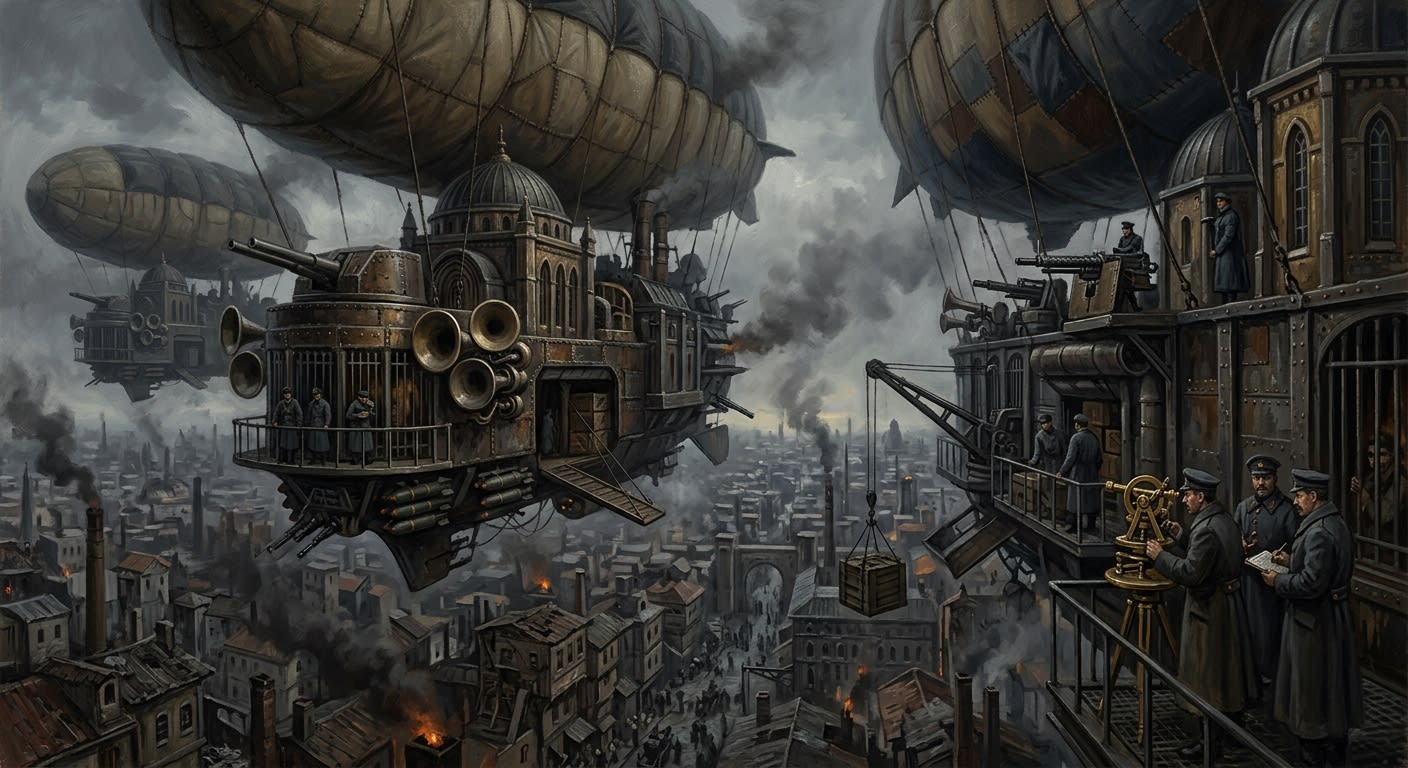
Vigil Arks are the Synod's attempt to make the sky submit to filing.
This sentence is accurate, which is why several Bureaus will dislike it. The Bureau of War calls them aerial assets. The Bureau of Engineering calls them lighter-than-air reliquary-cathedrals. The Bureau of Bells calls them mobile high Bellway projectors. The Bureau of Orison and Song calls them catechetical broadcast platforms when its clerks wish to sound educated and sky-sermon hulks when they think no one from Doctrine is listening. The crews call them Arks. The men beneath them call them judgment, weather, roof, noise, mercy, terror, or the thing that had better arrive before the fog does.
All definitions are accepted. None are sufficient.
A Vigil Ark is an armed chapel suspended beneath a sanctified gas envelope, crewed by eleven souls, fitted with Sermon-horns, Censer-racks, reliquary niche, observation deck, pressure drums, prayer chains, signal boards, bomb rails, and a quantity of inter-Bureau resentment sufficient to lift a lesser machine without gas. It flies by buoyancy, relic permission, bell-pressure, disciplined fraud, and the refusal of every participating office to admit which component bears most of the load.
The Arks patrol the high Bellways, those aerial corridors of authorised sound in which air becomes legal ground by the passage of a reliquary-chapel. Beneath the gondola, the Sermon-horns shout Doctrine at a pressure suitable for soldiers, fish, demons, and disobedient weather. From the belly, Censer-racks drop sanctified fire in slow brass arcs, trailing smoke and hymn scraps until impact translates theology into heat. In the chapel, a relic gives assent, or refuses it, or does something the Bureau of Relics later describes with the frightened polish of an office whose invoice has already cleared.
The public believes the Arks fly to protect the Line. The public is correct in the small way the public is occasionally permitted to be correct. The Arks protect, observe, command, sanctify, intimidate, measure attendance, drown private songs, burn enemy craft, extend Bureau jurisdiction upward, and remind the British Crown that the Synod too can make cathedrals move, though ours have the decency to threaten the sky rather than the sea.
A simple machine carries men through air. A Vigil Ark carries a jurisdiction.
#On the Predecessors That Burned Well Enough
The Vigil Ark did not descend whole from Heaven, regardless of what the recruitment plates imply. It crawled upward through earlier humiliations.

The first experiments were the Angelus Engines, silk-and-relic contraptions from the early Line years, filled with heated air, crewed by two brave fools, and armed chiefly with prayer. They rose when the weather was charitable, drifted when the Creator was busy, and burned with such regularity that the Bureau of Festivals proposed classifying their crashes as Ascensions of the Faithful, Category: Expedited. Festivals has always possessed a gift for making casualty statistics clap in rhythm.
The Angelus Engines gave way to Sky-Censer Mantles: gliders stitched from relic-cloth, trailing sanctified smoke over trenches and convoy roads. They had the elegance of a bishop's sleeve caught in a cannon wheel. They also taught the first useful lesson of aerial theology: smoke dropped from above persuades men below faster than sermons carried by tired priests.
The Sanctissima Vox belonged to the next phase, when ambition learned how to carry four Sermon-horns, six relic-lanterns, a gondola chapel, hymn engineers, and enough sanctified arrogance to enter the Blightmarsh with a broadcast mission. In A.S. 147, four years after the Year of Ash Rain, the Ark crossed the Marsh boundary to project the Seventh Antiphon Against Appetite against Kargath's acoustic hunger. The signal thickened. The vowels arrived wet. The relic-lanterns aged centuries in minutes. The Ark settled into the mud seventeen miles inside hostile ground.
Three of forty-one crew returned. Thirty-eight remained. The lanterns still burn.
Early aerial histories describe the Sanctissima Vox as the first failed Vigil Ark.
Corrected. The Sanctissima Vox was the first Ark honest enough to reveal the terms. It produced restrictions, survivor testimony, no-fly law, roster paradox, and a glowing wreck whose continued activity has cost three Bureaus fifty-four years of paper. Failure rarely works so hard.
The Vox-laws followed: no Blightmarsh overflight, no experimental hymnal projection beyond boundary, no relic-lantern exposure past dusk, no sermon whose final antiphon names hunger more than seven times. Crews memorise these laws with the affection sailors reserve for rocks that have already sunk someone else.
The Saint Barachiel flies because the Sanctissima Vox fell. Bureau of War logic was characteristically narrow and useful: the Marsh ate an Ark because the Ark flew over the Marsh; the Bosphorus would not eat an Ark because the Bosphorus was water, chain, ravelin, city, and surveillance. This logic has held often enough to be called doctrine.
Often enough is the Synod's preferred unit of truth.
#On Hull, Gas, Relic, Horn, and Fire
A Vigil Ark's hull is cathedral geometry disciplined by panic. The ribs follow sacred proportions because Engineering discovered that secular curves refused certain calculations, while nave ratios behaved. This is embarrassing for mathematicians and excellent for budget defence. Quartered oak, iron spars, sanctified cable, ribbed pressure compartments, chapel-gondola, bell-frame, observation blister, bomb rails: the machine is a church pretending to be a weapon and a weapon pretending to be a church.
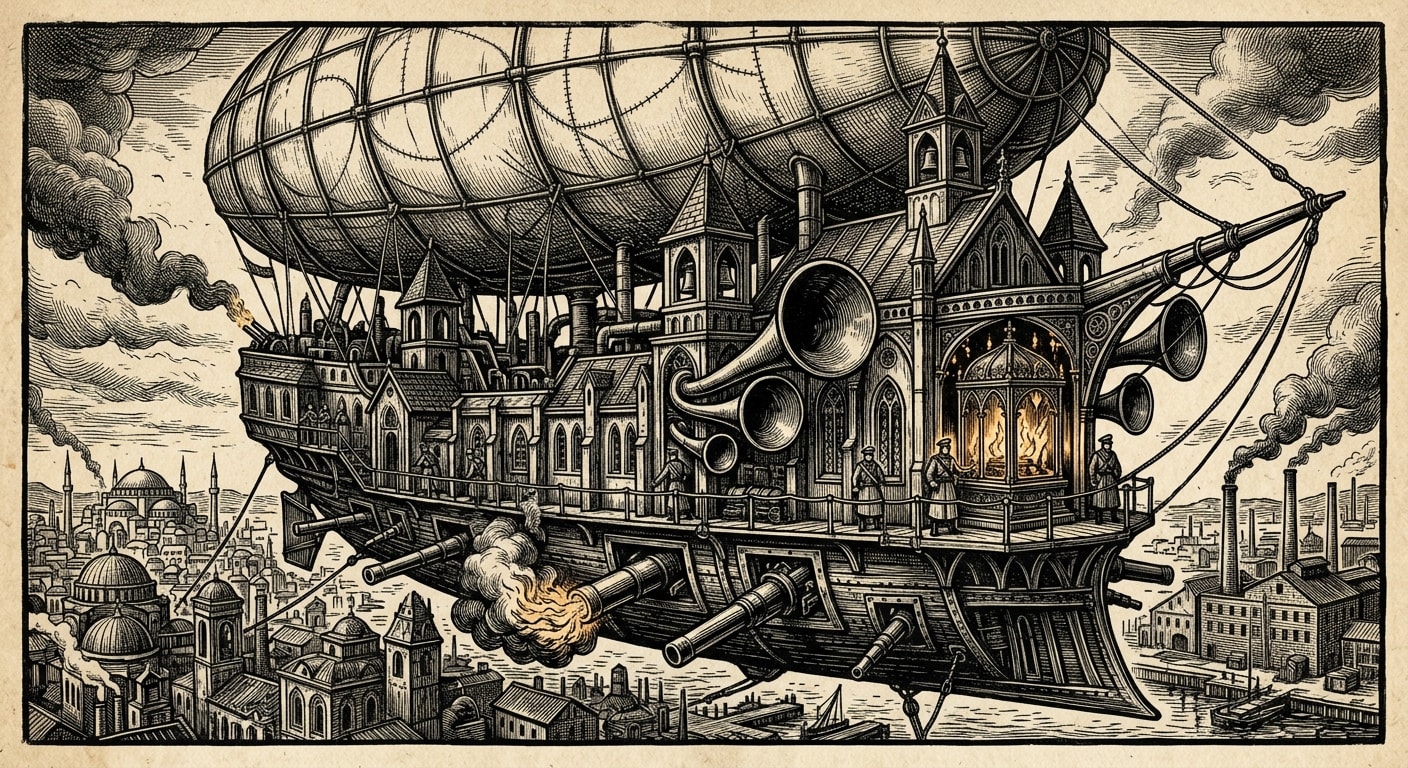
Above the hull swells the envelope. The Saint Barachiel and Saint Gabriel breathe Compound 7, that lighter-than-hydrogen gas harvested from the Third Ossuary beneath Constantinople through the valve installed in A.S. 168. It does not burn. It smells like old churches: damp stone, cold incense, wax left too long in a chapel drawer, and under it a breath held behind a confessional screen. It contracts toward relics. It thickens under bell-pressure. It declines in extraction rate without mechanical cause. Engineering calls it material. Rites refuses to name it. Records calls it sealed. I call it the sort of miracle that will one day submit an invoice.
The envelope gives lift. The relic gives permission. This distinction is no ornament. The Saint Uriel possesses sound envelope, valid hull, filled bladder, consecrated chapel, and a tooth authenticated by the Bureau of Relics with expensive terror. It has attempted launch four times. It has flown never. The gas behaved. The tooth declined.
The chapel hangs beneath the envelope in the gondola, small enough to smell every crewman, large enough to house altar, niche, pulpit, sacristy, crew quarters, armoury, pressure board, and the anxious little silence that gathers around any relic asked to cooperate with artillery. The attending chaplain celebrates Mass at altitude. Reports from chaplains use the word closer with unnerving regularity. They rarely specify closer to what.
The Sermon-horns are four brazen projectors mounted on swivel carriages at the cardinal points. Their purpose is to make Doctrine intelligible across distance, through fog, over water, down into trenches, against hostile sound, and through the skulls of men who would rather sleep. The operational manual describes their volume as permitting intelligibility to faithful and unfaithful alike. Eardrums are democratic. The Bureau is not.
The Censer-racks carry sanctified incendiaries the size of a man's torso. Foundry workers call the mixture devil-broth. Rites calls it sanctified fire. War calls it authorised payload. The censer falls slowly, which gives the target time for repentance, movement, or a final useful scream. On impact it blooms in fire tuned by prayer and chemistry, and the distinction is rarely available to the person burning.
A Vigil Ark is expensive. It is also cheaper than losing Constantinople, which is the argument by which many expensive things become sacred.
#On the Three That Matter and the One That Will Not Die
The active Constantinople pattern begins with the Saint Barachiel, commissioned in A.S. 168 under Gate-Warden Petra Valenne for the central Bosphorus corridor. It rose on a feast day arranged for the purpose, bearing a relic of Saint Barachiel, a saint whose hagiography was shorter than the requisition. It took station at five thousand feet, where fog breaks and air turns sharp enough to make a Confessor smile.
The Barachiel is flagship, proof, scandal, and habit. It integrated with the Harbor of Chains, the ravelins, the Chain of Saint Anakletos, and the city alarm system. It gave Constantinople a roof, in Valenne's phrase, and once a commander has given soldiers a roof they become difficult to persuade back into open weather. It broadcasts the daily sermon, drops censers, sanctifies the central strait, and reminds anything rising from the water that the Synod has learned to shout downward.
The Saint Gabriel followed in A.S. 182 for the northern Bellway above the Black Sea approach and the outer anchorage where the Reliquary Flotilla rides its chains. It is smaller than the Barachiel by a third, crewed by eleven, tuned low so its sermons move across water rather than hammering straight into it. Its crew calls it the quiet one. That phrase appears in reports too often to be harmless. Airships wheeze, tick, hiss, creak, and groan like old cardinals on stairs. The Gabriel does these things until it crosses the outer anchorage marker. Then tools strike metal without ring, boots fall soft, coughs die in cloth, and prayers seem to travel forward rather than outward.
The Bureau has filed this. Filing is what the Bureau does when courage would be vulgar.
The Uriel, authorised in A.S. 191 for the southern Bellway, sits in the Carrier Yard of the Foundry Quarter, fully assembled, fully consecrated, fully maintained, and fully grounded. The daily Aerial Wing board carries its name in red ink with a diagonal slash through each entry. Registry activity does not sanctify air, though one clerk wrote that line on the board and was made to erase it. It returned the next morning in another hand.
The Sanctissima Vox, lost in A.S. 147, remains on the active roster. Its lanterns still glow under Blightmarsh mud. Its harmonic still registers at irregular intervals. Death is a theological category. Activity is an administrative one.
AERIAL OPERATIONS CONSOLIDATED STATUS SLIP — A.S. 201 Barachiel: active; central corridor; Broadcast restrictions in force. Gabriel: active; northern corridor; quiet notation retained. Uriel: registry-active; grounded; tooth behaviour unresolved. Sanctissima Vox: lost-active; lanterns observed; recovery denied. Fifth line on slip, erased before filing: ██████████████████████████████████ Ink impression remains under heat.
There are, by count, two flying Arks, one grounded Ark, one dead Ark still doing paperwork, and one erased line. The Bureau teaches children that the Synod has two Arks. The Bureau teaches officers that the Synod has three. The Bureau teaches auditors to ask a narrower question.
#On Sermons, Attendance, and the Theft of Private Sound
The Vigil Ark's loudest weapon is not fire. Fire leaves bodies. Sound leaves obedience.
Aerial sermon doctrine rests on a simple obscenity: if the sky speaks loudly enough, every person beneath it becomes congregation. The patrol carries a text from the daily roster. The fuel allotment is calibrated to sermon length. No Ark shall be armed with a sermon longer than it can preach before nightfall, a regulation born in A.S. 179 after a Barachiel sermon nearly stranded the vessel over the strait with only the appendix on oaths and tithes left to broadcast at seabirds. War's report contained one word. Doctrine obeyed.
The Sermon-horns reach ground, water, trench, vessel, ravelin, market, chain-boom, and in some surveys forty feet below the Bosphorus surface. Every fish has received more authorised theology than several provincial bishops. The Bureau records sermon-flight hours. Sky-Sermon Attendance Auditors measure compliance by sector. Orison engineers calibrate saint-dust signal apparatus. Bells checks cadence. War notes enemy response. Purity notes missing listeners. Records notes all of it and loses the pages most likely to cause scandal before scandal becomes expensive.
The Unauthorized Melody Smuggler understands the Ark better than many archons. Licensed sound from above crushes unlicensed sound below. A mother who hums against the sky-sermon commits more than comfort; she commits counter-broadcast in miniature. A trench soldier who keeps a kitchen tune under his breath during hornfall has smuggled a room, a mother, a winter, a private grief, into air the Bureau has already leased to Doctrine. The Arks make melody crime easier to detect and more necessary to commit.
The Bureau of Orison and Song governs this contradiction with branding irons, licensing tables, tone inquisitors, and the usual official astonishment that people deprived of private comfort begin buying it illicitly. The high Bellway gives structure. It does not give tenderness. Tenderness survives in cuffs, pillow-hems, stitch-scores, hummed fragments, and the stubborn little treasons by which men remain human after the horns have finished instructing them to be parts of a schedule.
The Ark watches while it blesses. Aerial sermon creates acoustic receipt. A sector that fails to answer becomes data. A crowd that falls silent at the wrong line becomes suspicion. A harbour whose compliance score drops during fog receives corrective broadcast. The word pastoral appears in the pamphlet. The word evidence appears in the sealed manual. Both words ride the same horn.
#On Incidents, Broadcasts, and Official Cowardice
The Synod adores the Vigil Arks because they work. The Synod fears them because they work in ways no Bureau fully owns.
The Sanctissima Vox fell because the Blightmarsh answered a sermon with appetite. The Gabriel grows quiet because the northern Bellway has acquired manners no one taught it. The Uriel refuses ascent because an authenticated tooth sits in judgment on a drydock. The Barachiel broadcast, on the 3rd of Argent A.S. 199, a voice that belonged to no crew member for eleven minutes and forty-three seconds. Witnesses called it an apology. The transcript is sealed under Hierarch's Seal. The third crew was replaced. The Ark remained in service.
This is the central doctrine of the Arks: operational continuity outranks comprehension.
An internal training plate once described Vigil Ark incidents as rare deviations from otherwise stable aerial assets.
Revised. The incidents are the stability. Each restriction, roster paradox, sealed transcript, crew phrase, tooth refusal, and erased line forms the actual operating manual. The printed manual is for men who still believe machines read instructions before acting.
The Broadcast changed the fleet without grounding it. The Barachiel's fourth crew now calls elevation sometimes unusual. The Gabriel's A.S. 199 Bell log records a mark scraped from brass and returned by morning at the exact midpoint of the Broadcast interval. The Uriel's petition cult grew after the same decade of aerial unease, as dock workers began treating a grounded horn as a throat for messages official channels would eat. Compound 7 extraction has declined since A.S. 194. Mother-Cryptor Sabine's forty-seventh report requested audience. The dogs in the Ossuary Rings face inward and wait.
A lesser government would stop flying until it understood the material. A lesser government would also be dead.
The Bureau of Engineering certifies hulls. The Bureau of Bells certifies horns. The Bureau of Relics certifies fragments. The Bureau of Rites certifies chapel air. The Bureau of War certifies need. Doctrine certifies the sentence that allows all prior certificates to stand in the same room without biting each other. No one certifies meaning. Meaning has become too dangerous to license.
#On the Present Aerial Ledger
As of A.S. 201, the Vigil Arks remain indispensable, insufficient, envied, feared, and scheduled.
At Constantinople, the Barachiel keeps the central strait. The Gabriel keeps the northern approach. The Uriel keeps a drydock, a petition cult, and a red slash on the board. The Vox keeps its lanterns under the Blightmarsh and its place on the active roster. Compound 7 rises less generously each season. The British keep their Cathedral Ships and make Synod engineers grind their teeth in private admiration. The southern Bellway remains a promise with scaffolding. The sky above the Bosphorus remains blessed by rotation, fuel, relic, schedule, and a cowardly quantity of luck.
The Arks have changed war by making altitude doctrinal. A trench can be shelled. A road can be tolled. A harbour can be chained. A sky must be preached into obedience every day, or it reverts to what it always was: empty space with ambitions. Demons entering aerial Bellways pay a cost. Soldiers under hornfall receive orders with their breath. Convoys steer by the presence or absence of sermon. Smugglers wrap songs tighter. Auditors count listening. Children learn to look up before they learn which Bureau owns the sound.
I do not love the Vigil Arks. Love belongs to poets, sailors, fools, and certain saints with poor survival instincts. I respect them. Respect is colder and more useful. They are impossible machines made routine by necessity, sanctified by committee, armed by fear, lifted by a gas from a sealed ossuary, and steered through air that may be holier than we deserve or hungrier than we admit.
When the horns begin, look down.