
#On the Broken Crossing
The Chain-Pier Ruin is one of the three passages named in the Bureau of War's dispatch for the Night of the Three Bridges, and the only one whose stones are still quoted from pulpits. It lies on the Danubian forward corridor between Budapest and Bastion-Irongate. The dispatch lists it second, after Saint Hadrien's Ford and before the drowned pontoon at Mark Seven. That order belongs to the clerk and tells the reader nothing about bank, bend or mile. All three passages were entered on the same night, under the same guns, inside the same few minutes.
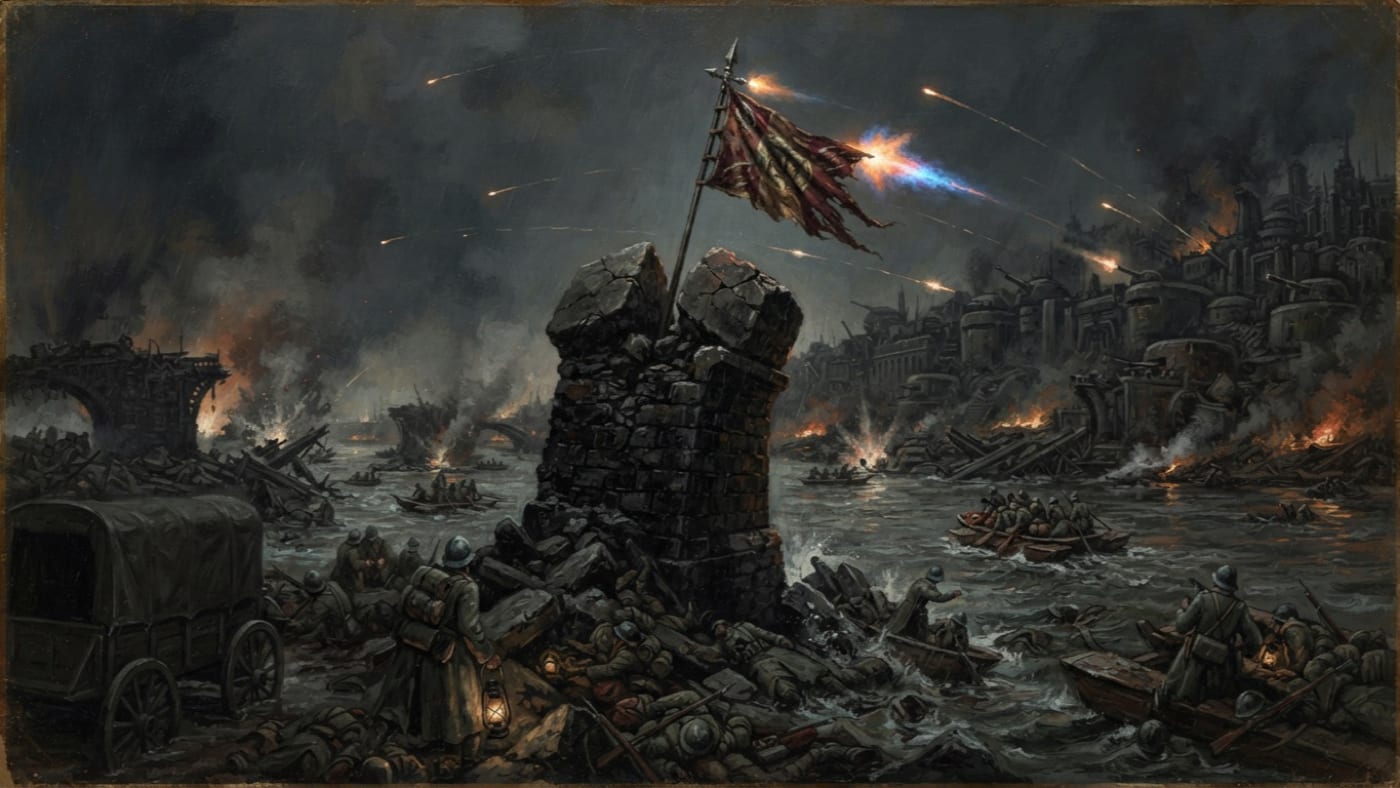
The dispatch describes a row of old bridge stumps standing out of the Danube, and among them one broken stone pier tall enough to climb. Records does not know who built the original span. It does not know the year the span fell, or whether flood, powder or neglect brought it down. It holds the name and no explanation of the name. Soldiers name a great many things they expect to die near, and they rarely explain those names either.
A Rhineland gazetteer listed the Chain-Pier among crossings demolished during the Night of the Three Bridges, set that Night on the Rhine amid refugee drownings, and dated it to a year the calendar has not yet reached.
Corrected. The Chain-Pier Ruin is a Danubian passage. Its documented incident belongs to A.S. 172 and to the forward corridor between Budapest and Bastion-Irongate. The Rhineland demolition legend is a separate matter, and this correction gives it no date.
A ruin of this sort carries nobody dry. Wagons could never have rolled across it, and a column on foot would be in the water whatever the masonry did. What it offered was fixed stone in moving water, a place where a man could get above the river long enough to be seen. War, which classifies by use, entered it as a bridge. Architecture would have entered it as debris. Architecture holds no commission in the Bureau of War.
#On the Need to Cross
The occasion was freight. A sudden enemy advance had trapped forty-seven supply wagons for the Irongate southern works against the western bank. They carried rifle cartridges, consecrated bridge-chain, three portable bell-frames, two sealed ossuary reliquaries, and enough grain to keep the Sibiu-Irongate corridor fed through the next rotation. The river was high. The bridges were gone. The enemy held the opposite bank, and Maldrake's forward batteries were ranging the exposed flats with their customary lack of manners.
Warden-Submarshal Calev Rohn commanded the Vexillators of Strasbourg under Bureau of War authority, and he sent them into all three passages at once. Three standards went into the water. They were the Crimson Pennant of Saint Marcellus, the Brass-Lipped Banner of the Sixth Levy, and Widow's Rag, which one clerk still files as Standard 14-D, Hydrological Operations. All three were consecrated at Strasbourg and stitched with pilgrim-cloth from the Continental Levy musters. Only the Brass-Lipped Banner was assigned to the pier.
The plan's arithmetic is older than its theology. A battery forced to choose among three targets chooses badly, and the hostile bank, struck in three places together, could not decide which wound to close first. The ford had its Litany-Engineers and their guide-cords. Mark Seven had its sunken floats. Chain-Pier had stone and a Vexillator willing to stand on it.
#On the Ninety Seconds
The account of what happened at the pier is short enough to fit on an altar card, which is where Doctrine has put it.
Lorn of Metz, Vexillator, bearer of the Brass-Lipped Banner, climbed the broken pier. Lorn fixed the staff between two stones. Enemy fire struck sparks from the finial. For ninety seconds the banner stood upright with no hand upon it.
That is the whole of the documented act. The record does not say where those ninety seconds fell on the night's clock. They may have come while the assault was still in the water, inside its first seven minutes. They may have come while the ragged line was forming on the eastern mud by the ninth minute, or after the first wagon chains began hauling by the fourteenth. The record does not say why Lorn's hand left the staff, where it went, or whether it came back. I have heard sermons answer all three questions. The sermons were eloquent, and every answer was invented.
The record does establish enough for any Vexillary instructor. The Vexillators exist because men follow cloth when voices fail, when drums are lost, and when officers have become business for Records. A standard above the smoke tells a soldier in the river that someone has decided which way is forward. At Chain-Pier the cloth went up on the one object in that reach of water that did not move. Seen from the current or from the far bank, the Brass-Lipped Banner was a fixed point. The sparks show that the enemy treated it as a target. The men below it were meant to treat it as a direction. The dispatch does not say which men, how many, or to what effect, and the Codex will not improve on the dispatch.
Saint Hermas asked one thing of a banner-bearer: Keep the cloth upright. The prayer does not say whose hand must keep it so. Doctrine has noticed this.
#On Sign One
The Bureau of Doctrine cites the ninety seconds as Sign One. The citation covers the unattended banner at this ruin and nothing more. It is distinct from the miracle of locomotion, War's classification of the whole crossing, under which the men were carried. It is also distinct from Sign Two, which belongs to Mark Seven and to the men who rose there downstream. A pilgrim who confuses the three will be corrected, at length, by any Tribune-Chaplain within earshot.
The veterans point to the weighted socket. Every standard in the Vexillary arm has one, and the maintenance forms say plainly that its purpose is to let a banner stand without a hand. They also point to Lorn's balance. By that they mean a Vexillator who can climb a wet pier under fire and wedge a staff between two stones firmly enough for it to stay has done a hard thing competently. Their explanation needs no Sign. It needs a socket, two stones and a capable soldier, and all three are on file.
Both explanations have been filed, and Records keeps them in the same folder, which Doctrine considers generous. Only one is recited at commemorations. Veterans may voice the other under the pastoral tolerance clause, since a man who was in the river has earned the right to be wrong about it out loud. A civilian who repeats the veterans' account in a public house is trivializing ratified grace and will be fined in proportion to their accuracy.
The Codex records the act and both readings. It rules on neither. I have examined the testimony, the equipment schedule and the masonry as described. In every case the banner did exactly what both parties say it did, which is more than most Signs can claim.
#On What the River Returned
The column was across by dawn. The supplies reached Irongate, and its southern works held through the winter. Whatever Sign One was, it came attached to a result the Bureau of War could count, and War likes its miracles countable.
The bodies came back on the river's schedule. Some washed against the western bank by morning. Some lodged among the broken pier masonry, and stumps that had served as a crossing for one night went on serving as a sieve. Records has not established how many caught at Chain-Pier, or whose they were. Its figures cover the whole operation. The original roll counted 4,200 casualties or men otherwise removed from formation. The Bureau of Records later revised that to 1,800 casualties and 2,400 martyrdom-translations. Nobody has computed a subtotal for the pier. I looked for one. A translation leaves no pension to divide by location.
Three standards survived the Night, along with twelve staff-fragments and one bell. The bell belongs to Mark Seven. The record does not say which fragments came from which staff or whether Lorn of Metz came down from the pier alive. It does not say where the Brass-Lipped Banner now rests its socket. The Codex leaves all three questions where the record left them.
The annual rite uses three bowls of river water, three soaked banner-cloths and one empty pair of boots. It commemorates the whole Night. It establishes no shrine at the ruin, and pilgrims who arrive with candles should bring their own paperwork.
What the documented record holds of Chain-Pier is two stones, a staff, a finial struck by fire, and ninety seconds that two institutions read in two different ways. The Vexillary schools teach the Night, and the Night includes the pier. Doctrine teaches the Sign. The veterans teach the socket.
No one has asked the masonry.