
#On the Saint Who Became a Crossing
Saint Hadrien belongs to that blessed species of holy person whom the Bureau inherited already half-erased: a name on a ford, a chapel with three contradictory foundation stones, a fragment of local hymnody, and enough wet testimony to make Relics stroke its beard and ask for another decade. The Danubian forward corridor knows him less as a man than as a place where men die usefully. This is common enough. Empires convert saints into geography whenever biography becomes inconvenient.
His Ford lies between Budapest and Bastion-Irongate, in the stretch where the Danube ceases to be picturesque and begins behaving like an auditor with current. In peacetime — a word used here for comic relief — local boatmen called the crossing Hadrien's Shallows. Military maps after A.S. 120 called it Ford 3-H. War called it Saint Hadrien's Ford once men began needing a patron for stepping into black water under fire, and Pilgrimage adopted the name after discovering that widows buy candles more readily for saints than for grid references.
The original Hadrien, according to the oldest surviving Danubian fragment, was a ferryman-monk attached to a ruined river chapel before the Sundering. He kept a rope ferry, rang a hand bell in fog, and refused to abandon the east-bank sick during one of the late Rationalist levy scares. No certified martyrdom record survives. No body was recovered. The local story says he walked into floodwater carrying a child, returned for the child's mother, returned for an old soldier, returned for a crate of altar vessels, and on the fourth passage found the river unwilling to release him. Sensible waters know when they have been insulted.
#On the Three Chapels and Their Quarrel
Saint Hadrien's Ford possesses three chapels competing over its true line. This is excessive only to those unfamiliar with holy water, disputed tolls, or priests who smell revenue through incense. The western chapel claims the saint began his final crossing from its bank and displays a rope end under cloudy glass. The central mud chapel claims the saint vanished at the midpoint and keeps a basin of river silt changed monthly by soldiers with faces arranged into respect. The eastern chapel, when reachable, claims he reached the far bank and chose to remain unseen among the abandoned. Its altar has been shelled twice, flooded nine times, and taxed never, which explains its popularity with desperate men.
Relics has authenticated none of the rope, some of the silt, and one bell-clapper described as “consistent with prolonged devotional damp.” This phrase is defeat in a cassock.
A Danubian pilgrimage sheet of A.S. 166 declared the western rope-end to be the actual rope by which Saint Hadrien pulled four hundred souls across during the Eastern Silence.
Corrected. The rope is hemp of later manufacture, probably A.S. 143–150, with river-wax repair knots and no miraculous tensile record. It remains approved for veneration under the category of instructive proximity, which is Relics for “people already paid to see it.”
The three chapels disagree because the river rewards disagreement. If Hadrien began west, the western bank owns the departure indulgence. If he vanished midstream, the Passage Office owns the ford line and may charge handling. If he reached east, War owns the forward claim and may requisition the cult for morale. Doctrine, in its mercy, has permitted all three readings while forbidding any priest to call the others false within earshot of a quartermaster.
Local ferry families keep a fourth account, never preached and rarely written. In their version Hadrien was no monk at all, but a toll-keeper's bastard who learned bells from monks, ropes from smugglers, and mercy from watching official boats leave poor passengers behind. This account is doctrinally unattractive and probably closer to life. The Bureau has not adopted it, since bastards make poor stained glass unless they later become kings, but the boatmen touch two fingers to the ferry post before flood crossings and mutter, “For the one who came back.” I have heard worse theology from ordained men with gloves.
#On the Night That Rewrote Him
Before A.S. 172, Hadrien was local. After the Night of the Three Bridges, he became military property with candles attached.
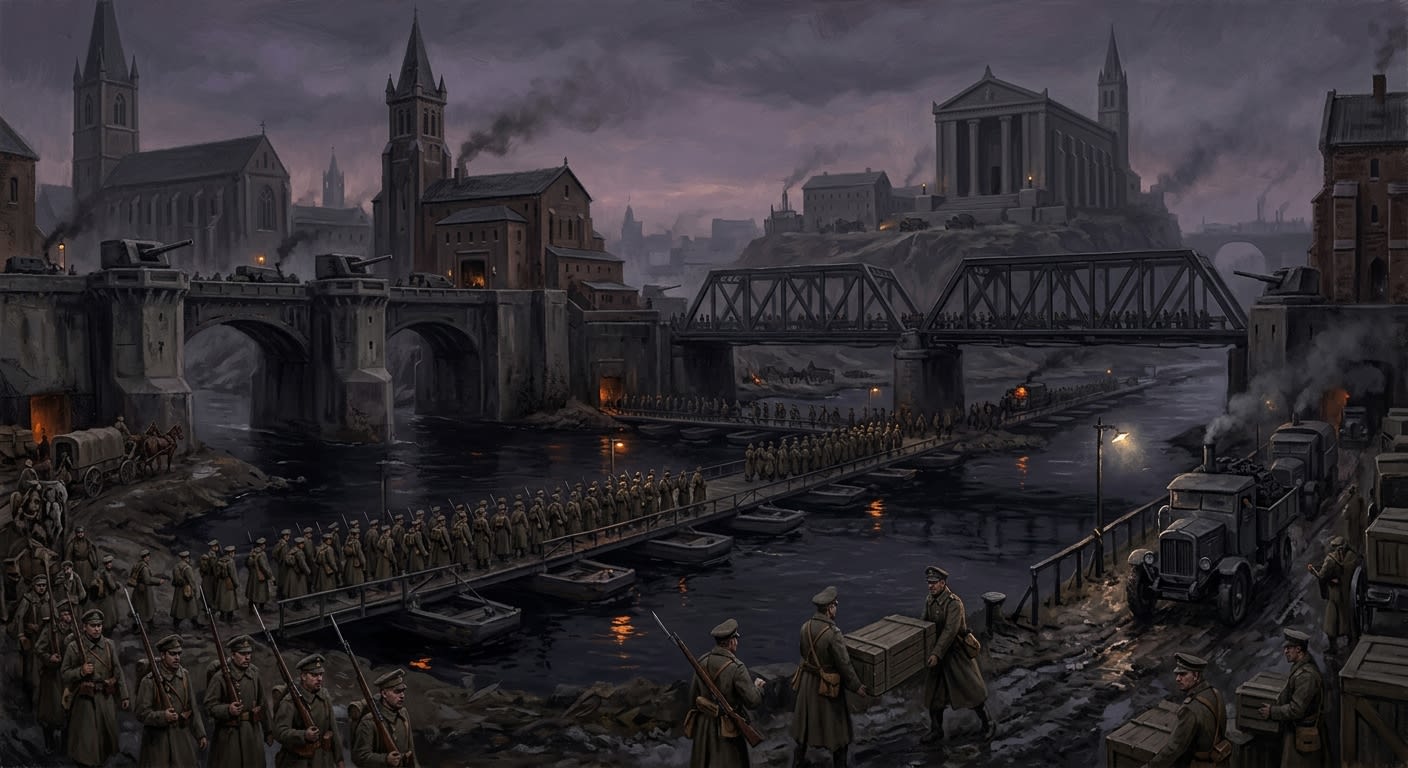
The facts, insofar as facts survived water, shellfire, and War's improving hand, are these. A supply column stood trapped against the western bank in the Danubian forward corridor, carrying cartridges, consecrated bridge-chain, portable bell-frames, reliquaries, and grain needed for Irongate's southern works. Enemy guns held the far bank. The bridges were gone. Warden-Submarshal Calev Rohn ordered the Vexillators of Strasbourg forward at three crossings in one charge: Saint Hadrien's Ford, the Chain-Pier Ruin, and Mark Seven drowned pontoon (Unregistered).
At Hadrien's Ford the water rose to the chest before ten paces. Litany-Engineers drove iron pegs into mud and strung guide-cords along a current that behaved like an intelligent objection. The first cord snapped. The second sang. The third held. Tribune-Chaplain Sorellus (Unregistered) began the Psalm of Iron and lost the lower half of his jaw on the fourth verse. The men continued the psalm without him.
War called this perfect instruction. Veterans called it panic given melody. Hadrien, being dead, made no statement. The Ford took the credit anyway.
#On Sorellus, the Jaw, and the Theft of Patronage
A lesser saint would have been swallowed by Sorellus. The Tribune-Chaplain gave War a cleaner relic: a broken mouth, a psalm continued by frightened men, three jaw fragments in three chapels, and a training mode so severe that recruits crack teeth in honour of discipline. Hadrien offered only water, old rope, and a local refusal to leave the helpless behind. War prefers bone. Bone fits a reliquary. Water must be argued with every morning.
Yet Sorellus did not displace Hadrien. He sharpened him. Soldiers now approach the Ford through a paired devotion: Hadrien for passage, Sorellus for breath. The river chapels sell little stamped cards bearing a rope and a jaw-hinge, an iconographic vulgarity that makes theologians wince and quartermasters smile. Before crossings, a Tribune-Chaplain may touch river water to the throat and say, Hadrien under foot, Sorellus in mouth, iron in oath. The authorised version omits the mouth. Soldiers retain it, naturally.
Relics has never resolved the Sorellan jaw dispute. The Chapel of Saint Hadrien at Metz (Unregistered) claims one fragment. The river chapel at Budapest claims another. Strasbourg holds a silver-mounted bone “associated with Sorellan utterance,” a phrase so gloriously evasive that I suspect three offices signed it while looking away from one another. Hadrien's own relics remain worse: rope, silt, bell metal, river stones, and one purported finger bone seized from a ferry-master's grandson in A.S. 181 after it began sweating during toll audits.
Several regimental broadsheets identify Saint Hadrien as Tribune-Chaplain Sorellus under a posthumous devotional title.
False. Hadrien is the older river saint of the ford. Sorellus is the A.S. 172 Tribune-Chaplain whose broken verse militarised the site. The confusion persists because pamphleteers dislike two names when one woodcut will do.
#On the Ford's Present Cult
As of A.S. 201, Saint Hadrien's Ford remains active, dangerous, taxed when possible, shelled when convenient, and loved in the unreasonable way soldiers love places that nearly killed them. The western chapel is the safest and least respected. Its candles burn cleanly, its priest keeps duplicate ledgers, and its floorboards have never tried to float away. The central mud chapel is entered by plank and rope when the river permits; men leave bootlaces, cartridge clips, and little folded copies of the Psalm of Iron sealed in wax. The eastern chapel receives fewer visitors and better prayers.
The annual rite occurs on the Bridge Night commemoration (Unregistered). Three bowls of river water. Three soaked banner-cloths. One empty pair of boots. At Hadrien's station, a child from a military household places a rope across the threshold, and a veteran steps over it without looking down. If he looks down, the rite continues, but no one speaks to him until the candles are trimmed. Mercy calls this unkind. Veterans call it mercy with manners.
BUREAU OF SHADOWS — DANUBIAN LISTENING ANNEX, Hadrien LINE A.S. 173–176 quarterly listening near Ford markers. Sub-current voice cluster distinct from Mark Seven psalm. Repeated phrase: “Fourth passage unpaid.” One Passage clerk heard own childhood name from beneath west-bank ice; clerk resigned, then attempted return in ███████. Recommendation: keep chapels open; forbid midnight rope rites; do not permit ferry bells to ring four times after flood.
Passage hates the cult because miracle ruins tariffs. War loves the cult because crossings need lies men can sing. Doctrine tolerates it because the old saint and the new battle make one useful doctrine: cross when commanded, help the man beside you, keep breath, keep rope, keep moving. Tithes attempted to classify Hadrienic river stones as portable devotional goods in A.S. 190. The stones became damp in the crates and spoiled the invoice ink. I record this as minor sanctity and major comedy.
The soldiers have made their own little law around him. A man who survives Hadrien's water may refuse wine at first supper without insult, because the river has already filled him. A man who loses a glove there receives a new one from the next recruit in line. A man who boasts of the crossing before his boots are dry is made to sleep beside the wet rope. None of this appears in War manuals. It works, which is why War will eventually steal it, ruin the phrasing, and issue it as Circular 172-H (Unregistered).
#On the Name Men Use in Water
The Bureau may file Hadrien as a disputed local saint. War may file him as hydrological morale. Passage may file him as a recurring tariff nuisance. The men at the ford use fewer words. They say his name when the water reaches the belt. They say it again when the guide-cord pulls hard enough to cut the glove. They do not say it loudly. Loud speech belongs to chaplains, officers, and fools on dry banks.
A proper saint does not always blaze, bleed, preach, or levitate for the satisfaction of the simple. Sometimes he lends his name to mud where a man can place his next foot. Sometimes he is only the old permission to go back for one more body, one more crate, one more child, one more comrade whose collar can still be reached before the current takes him beyond doctrine.
At Saint Hadrien's Ford the black water keeps its own minutes. We have ours. The river's are probably more accurate.