

#On the Present Compilation
Documentary compilation, A.S. 201 / 1911 CE. A review of the surviving account. No new inspection was made.
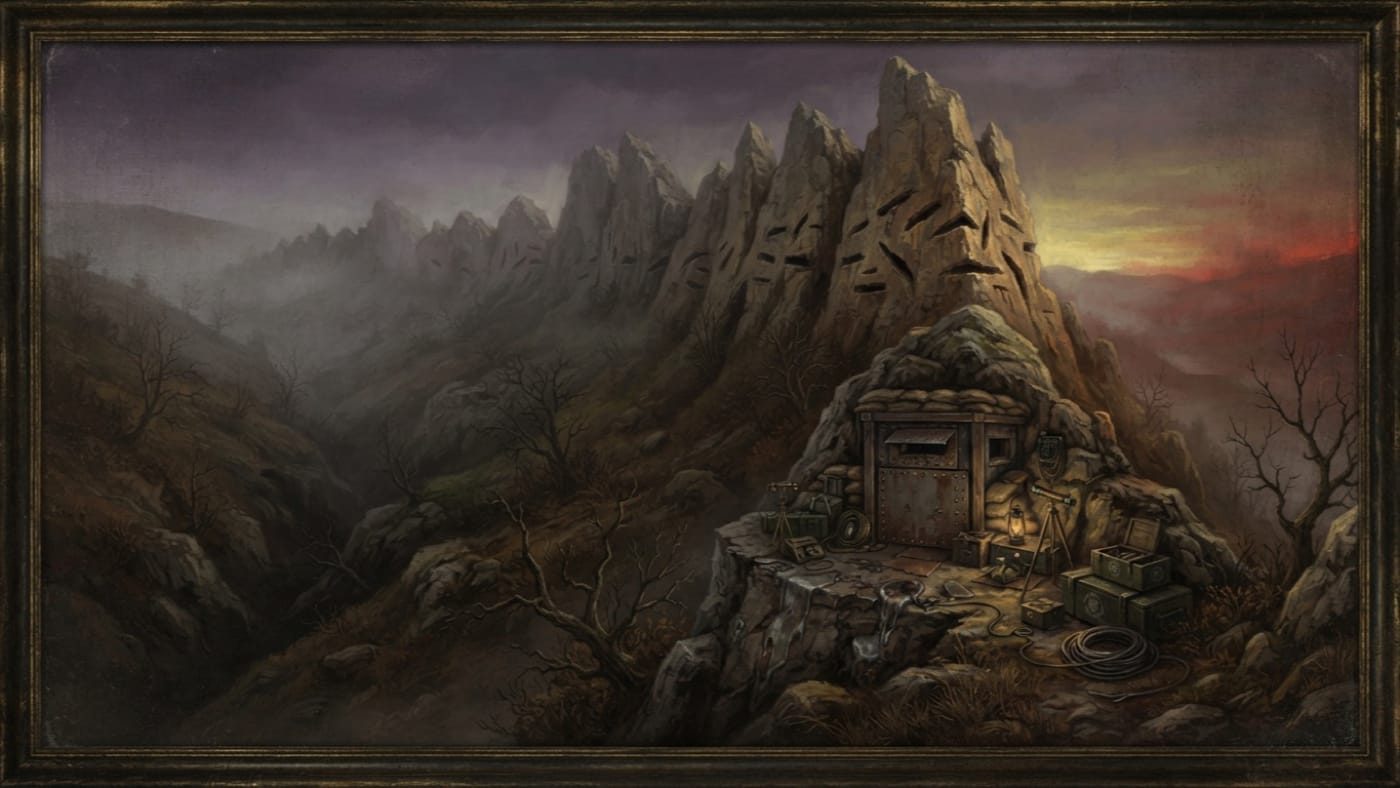
The Chalk Teeth are a line of limestone fins above the western gullies of the Balkan foothills, on the broken approaches that climb toward Bastion-Shipka. They are stone. They have no garrison of their own in the record, no surveyed plan, and no founding date. They became a matter for the archive because of a few modest cuts that men made in them and the sounds that came through those cuts afterward.
This compilation was assembled at the desk in A.S. 201 from what the Codex already holds. I did not climb to the fins. I did not put my ear to the stone. I took no measurements, so none are given here. Readers who want a gazetteer of distances may write to the Bureau of War, which will send a map. The map will be wrong in a different way.
The name is a hill name. Seen from below, the fins stand along the ridge like the worn incisors of something that died while grinning. Nobody has shown that the rock is true chalk, and nobody needs to. Soldiers name terrain for what it resembles at dusk. Geologists can correct them in peacetime.
#On the Stone and the Cuts
The fins were there before anyone cut them. That is the first distinction the file has to keep, and it gets blurred more often than it should. The limestone formation is natural. What is human is the work of the Bureau of Engineering, which cut listening slots into the fins during survey work in A.S. 147 / 1857 CE. The slots face east.
That is the whole of the construction record. The account does not give the number of slots, their width, their depth, the tools used, the officer who ordered them, or the unit that carried them out. No original Engineering log has turned up. I could invent a captain with a chisel and a lantern for the reader, and the Bureau of Engineering would be within its rights to sue me in triplicate for libel.
The year 147 belongs to the cutting and to nothing else. It is not the year the fins rose, which no ledger records, or the year they were discovered, since shepherds knew them long before survey men did. It is not the year of the first strange sound, either. Engineering arrived with the surveyors' habits of trust in instruments and doubt about weather, and it left gaps in the rock.
Their purpose is easy enough to infer from the setting. In the foothills, sound behaves badly. The parent account says a bell heard from Shipka may arrive late, early, doubled, or already answered, and it says bellwardens of the Bureau of Bells check every peal against touch: a palm on the rail, a boot-sole on the stone. In ground like that, a fixed stone ear pointed east toward the enemy's country has obvious appeal. How the slots gather, sharpen, or pass on what they catch is not recorded. I leave the acoustics to the acoustics.
#On What the Slots Carry
The reports describe three conditions. I give them in the account's order, and with its attribution.
On clear days, the slots carry furnace clang that the reports place in Thrace: hammering, a metallic ring, the noise of a forge at work below the horizon. That is the country of Maldrake, whose Wrath presses north-west out of the Thracian plains as heat, red haze, and the sound of work that never stops. The association is regional and old. The reports make it, and I record that they make it.
On fog days, the slots carry lullabies. Fog in these foothills is the instrument of Syrion, whose Sloth comes over the high passes as grey stillness, delayed sound, and hours with soft edges. A lullaby suits that country well. That is all the record allows me to say. The reports name no singer, and the file contains no words or melody. No notation was ever filed.
On bad days, the slots carry both, and the account says they carry them in harmony.
That last condition is the one the file cannot digest. Wrath and Sloth have been rivals as long as the Bureau of Inter-Infernal Analysis has been keeping cabinets on them. Their mutual hostility is doctrine and the foundation of whole shelves of Analysis. Nearby, the Maldrake-Syrion Contact Zone shows what happens where furnace weather meets time-fog: rain that burns upward, frost turned to glass, a composure that insults doctrine. Even so, a meeting of weather is one thing and a concord of voices is another. The Chalk Teeth reports belong to the second kind, and the second kind has no doctrinal drawer.
One entire watch crew woke, the account says, convinced that Maldrake and Syrion had composed a hymn.
Here is what the file actually establishes: a crew of watchers, at a post and in a year the account does not name, slept through or near one of these bad days and came out of sleep sharing a single conviction. The conviction is attested. The hymn is not. Nobody wrote it down, or nobody has produced what they wrote. Whether two Sin-Generals composed anything, whether either of them sang, whether the harmony came from the throats of devils or from rock, distance, and fog, the record does not say. I will not say it either.
Working index entry, this compilation: "Chalk Teeth — site of the Maldrake-Syrion hymn."
Struck before sealing. The record holds a crew's conviction about a hymn, which the index now lists as testimony. It does not hold authorship, and the Codex will not make two princes of Hell co-authors on the evidence of men who had just woken up.
#On the Three Months of Seals
The Bureau of Doctrine answered the matter the way Doctrine answers most things it cannot classify. It shut the openings.
According to the account, Doctrine sealed the slots for three months. It gives no start date and no end date. It does not name the material, the signatory, or the clerk who wrote the order. It does not even say whether the three months came straight after the cutting in 147 or years afterward. The account ties the sealing to the sounds, not to the calendar, and this compilation does the same.
The seals then failed. The source gives the failures in sequence and leaves them unexplained: the seals melted, slept, and fell off, in that order.
I keep the order because the order is all there is. Melting needs no gloss on a slope that faces Thrace. Falling off is the ordinary end of every seal ever pressed by a man in a hurry. Sleeping is the hard word, and I decline to soften it. The account does not say what a sleeping seal looks like, how anyone could tell, or whether the watch reported it in plain earnest or in the dry idiom foothill crews use about everything. It went into the file as a stage of failure, between melting and falling, and it stays there.
Nothing in the record says Doctrine resealed the slots after the third failure, and I report no further remedy. That silence is the most eloquent document in the file.
#On the Present Disposition
What survives is a paragraph, not an archive: a ridge of limestone fins, east-facing cuts dated to the survey year 147, three reported conditions of sound, one crew's shared conviction, and three months of seals that failed in a recorded order. This compilation sets those items down in sequence with their sources. It certifies nothing beyond them.
It cannot certify the present state of the slots. The foothills remain held, contested, and watched only intermittently, and the parent account says so plainly. Whether the cuts are open, choked with scree, quietly blocked again, or listened to by any current watch is unknown at this desk in A.S. 201. Nor can it certify a line. The Chalk Teeth face toward two pressures, but no fixed boundary between Wrath's country and Sloth's has been surveyed here. The Bureau's standing instruction for the region forbids calling the Contact Zone a border, and I will not draw one through a hill I have never seen.
The wider practice of the foothills is the only sensible guide for anyone who hears what the slots carry. Posts that keep fire and fog ledgers set heat against haze, bell against pulse, and sound against what the stone does underfoot. Sound alone lies in this country. A hymn heard by sleeping men lies most gracefully of all, and grace was never evidence. Records may file the reports. Analysis may annotate them. Doctrine may go on wishing it had never heard of the place.
The fins still stand, presumably. I have not been to look.