
#On the Bureau That Watches Hell Watch Itself
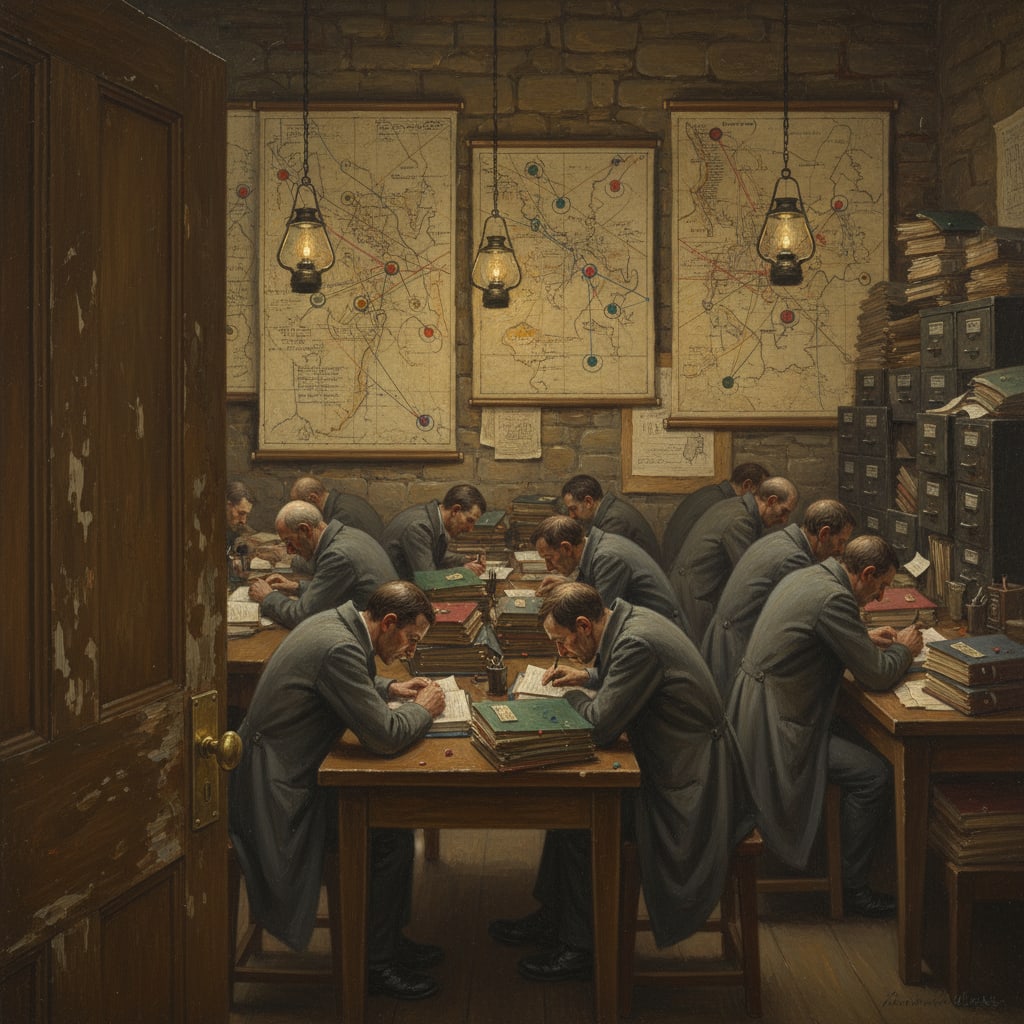
There exists, in the unremarkable east wing of the Bureau of War's Strasbourg headquarters — between the Office of Cartographic Denial (Unregistered) and the lavatory that has been awaiting repair since A.S. 188 — a door with no nameplate. The door is oak, scuffed at knee height where generations of clerks have kicked it open while carrying sealed filing boxes, and it leads to three rooms of middling size in which fourteen people conduct the war's most peculiar campaign. They do not fire guns. They do not lay siege. They read dispatches, mark parchment with coloured pins, argue in low voices, and produce quarterly circulars that perhaps six people in the entire Synod are authorised to read.
This is the Bureau of Inter-Infernal Analysis. Its purpose, stated in the founding charter of A.S. 94, is "to observe, catalogue, and where operationally advantageous to exploit, the rivalries and mutual antagonisms subsisting among the designated Sin-Generals of the Enemy." Its unofficial purpose, stated by its third director over a bottle of altar wine in A.S. 142, is "to make sure the bastards keep hating each other."
The Bureau was established four years after the Concordat of Strasbourg, when the Seven Sin-Generals had been identified as distinct entities rather than undifferentiated demonic malice, and when the first reports began filtering through Bureau of Shadows channels that these seven did not, in any meaningful sense of the word, cooperate. They fought each other. They sabotaged each other's campaigns. Kargath devoured the conscripts Velmora had purchased at considerable expense; Maldrake incinerated the territories Syrion had spent decades lulling into surrender; Atheron subjugated populations Velkara had already seduced, and Morwen coveted everything the other six possessed with a hatred so refined it functioned as a kind of currency.
Someone in the Synod's military command — the name is classified, which in Synod practice means it was a Hierarch embarrassed to admit a good idea — recognised that this mutual contempt was the only reason the Sagittal Line still stood. The arithmetic was plain. Seven Sin-Generals, seven sectors, seven simultaneous assaults coordinated to a single purpose: the Line falls. Seven Sin-Generals, seven feuds, seven overlapping grudges ensuring that no assault ever synchronises with any other: the Line holds. The margin between survival and extinction was measured in spite.
#On Personnel and Method
The Bureau employs fourteen analysts. It has employed fourteen analysts since its founding, a number determined by Hierarch Lorrenz, third Seal of War, who believed that fourteen was "sufficient to observe seven subjects from two angles each." The mathematical elegance of this reasoning has been preserved in policy long after anyone could remember why, and every subsequent director who has requested additional staff has been told that fourteen is the canonical number and that canonical numbers do not expand.
The analysts are drawn from three sources: the Bureau of Shadows, which supplies operatives with fieldwork experience; the Bureau of Records, which supplies clerks with the capacity to cross-reference a century and a half of intelligence reports without losing their sanity or their filing rhythm; and the Bureau of Doctrine, which supplies theologians capable of distinguishing between what a Sin-General does and what a Sin-General means, a distinction that sounds academic until you consider that Syrion's most devastating campaigns look, from a military standpoint, like inaction.
Their methods are classified. The parent entry on the Great Deceiver records that the Bureau's success rate is "sufficient," which in Bureau parlance means "we have not yet been caught." This is accurate as far as it goes, which is not far. What the classification conceals is a methodology that combines intelligence analysis, theological speculation, and something that the Bureau's own internal memoranda describe, without apparent irony, as "strategic encouragement of pre-existing hostilities."
The Bureau does not create rivalries. It feeds them.
Consider: a report arrives from the Bastion-Sibiu sector indicating that Velmora's agents are purchasing grain contracts in contested territory. The Bureau cross-references this with reports from the Constantinople theater suggesting that Kargath's forces have been observed moving toward the same territory. The Bureau's analysts do not file this as coincidence. They file it as opportunity. A carefully worded circular is dispatched — through channels so convoluted that the Bureau of Shadows itself cannot always trace them — suggesting that Velmora's grain purchases might be interpreted, by a being of Kargath's temperament, as the theft of provender from his feeding grounds.
Does Kargath read Synod circulars? He does not. But the information percolates — through captured documents left in places where they will be found, through agents whose loyalty is uncertain in precisely the useful direction, through the thousand small currents of rumour and report that flow between the Line and the territories beyond it. The Bureau does not deliver the message. The Bureau ensures the message exists in a form the recipient will encounter. The rest is gluttony.
An earlier edition of this Codex described the Bureau of Inter-Infernal Analysis as "a division of the Bureau of Shadows."
This is incorrect. The Bureau operates under the Bureau of War's directorate, though it draws personnel from the Bureau of Shadows and maintains joint protocols with the Bureau of Doctrine. The distinction is jurisdictional and, the Bureau's director will remind you at every available opportunity, "not trivial." Shadows gathers intelligence. Inter-Infernal Analysis weaponises it. The Bureau of Shadows has lodged three formal objections to this characterisation. All three have been filed and acknowledged. None have been acted upon.
#On the Seven Files
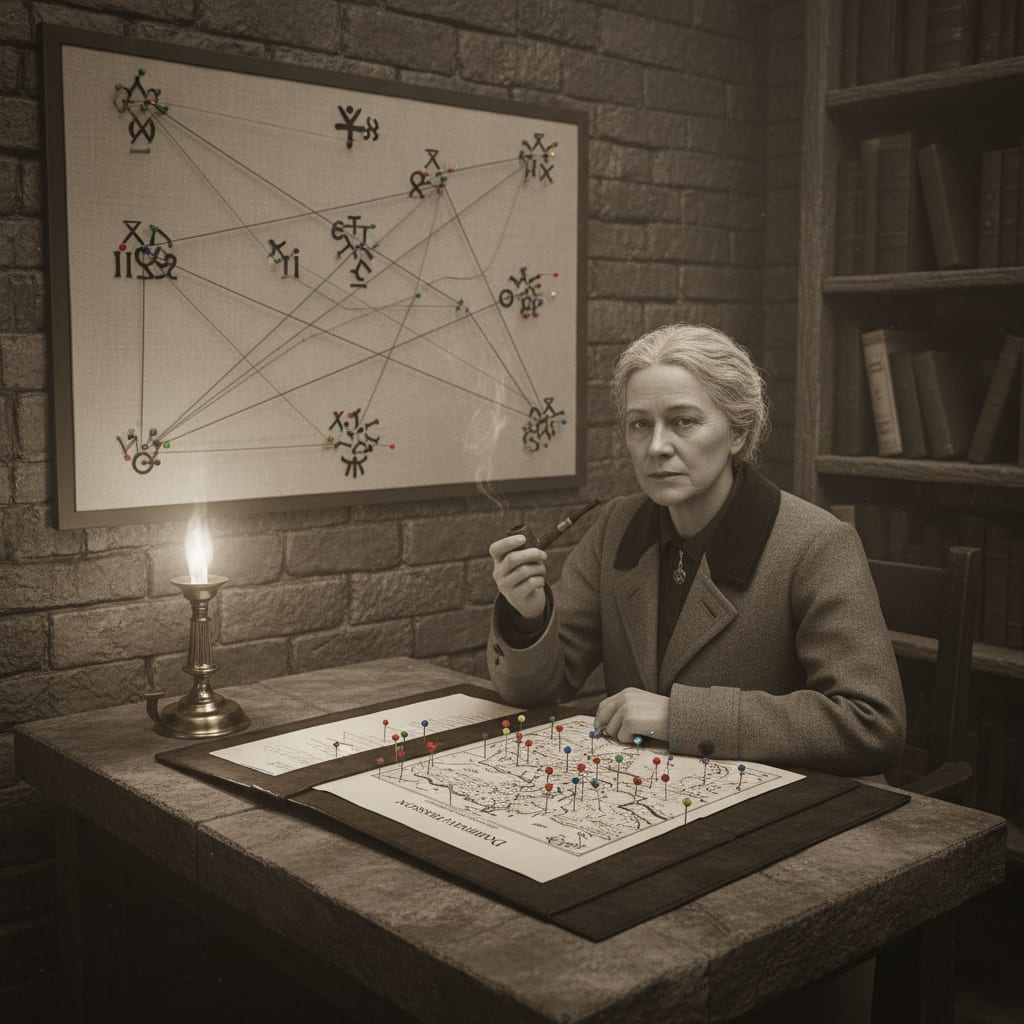
The Bureau maintains a file on each Sin-General. These are not files in the conventional sense — not folders stuffed with parchment, though parchment is involved. They are living documents, updated with each new report, cross-referenced with every prior observation, annotated in margins that have long since overflowed into supplementary folios that have themselves overflowed into cabinets that occupy, at last count, the entirety of the Bureau's third room.
The files are designated by colour, because the Bureau of Doctrine advised against using the Sin-Generals' names in routine documentation — the theological concern being that repeated inscription of a Sin-General's name in Synodic script might constitute "inadvertent invocation," a risk the Bureau of Doctrine rated as "low but non-zero" and that the Bureau of War, unable to distinguish between low and zero in any context involving damnation, elected to avoid entirely.
The Atheron file — Dossier Vermillion — is the largest. It has been the largest since A.S. 150, when the Bureau began documenting the Exalted's escalating campaign of self-aggrandisement and concluded that his ambitions extended beyond the conquest of mortal territory toward something the Bureau's theologians described as "aspirational usurpation of the Black Throne." One hundred and fifty-six years of intelligence reports confirm the assessment. Every city Atheron conquers, every oath he twists, every spire he adds to the towering absurdity of his Crownspire — each is logged by the Bureau's analysts as a stone laid in the foundation of a rival throne. He is building. The Bureau watches him build. The Bureau's current assessment: "Insufficient data." Their projected timeline for sufficient data: "Indeterminate."
The Velmora file — Dossier Auric — is the second largest and grows at the fastest rate, because Velmora's operations produce paperwork the way other Sin-Generals produce casualties. Her agents sign contracts. Contracts generate documentation. Documentation generates intelligence. The Bureau's analysts spend more time reading Velmora's filing than any frontline commander's dispatches, and they have developed, over the decades, a grudging professional respect for the Greed-General's administrative competence that the Bureau of Doctrine has advised them, on three occasions, to suppress.
The Kargath file — Dossier Carmine — is the thinnest. Kargath does not strategise. Kargath eats. The Bureau's analysts have attempted, over a century and a half, to identify patterns in his campaigns, logistical planning in his movements, any sign of the tactical intelligence the other Sin-Generals display. They have failed. The file's most recent summary, composed by Assessor-Tertiary Haugen in her characteristically blunt prose: "He is hungry. He goes where the food is. He eats the food. He remains hungry. Repeat." The Bureau has classified this assessment as "operational" and considers the matter closed, though the file remains open because all files remain open.
#On the Anomalies
The Bureau's founding assumption — that the Sin-Generals will always hate each other more than they hate humanity — has held for a hundred and fifty-six years. It has held through the Three-Night Bombard. It has held through the Sundering's aftershocks. It has held through Syrion's time-fogs, Velkara's seductions, Maldrake's rages, and Morwen's silent envies. The Line stands because the assumption holds.
The Bureau's analysts are professionally obligated to look for the day the assumption breaks.
They have found two anomalies.
The first: the Crimson Concord and the Hierarchy of Debt maintain what the Bureau's A.S. 199 assessment describes as a "symbiotic and alarming" relationship in the Sibiu theater. The Concord is Maldrake's instrument — a human network that preaches coexistence with Hell as the rational alternative to perpetual war. The Hierarchy of Debt is Velmora's instrument — a system of obligation and usury that binds mortals through their wallets. Two instruments of two Sin-Generals operating in the same territory without apparent rivalry. The Bureau's doctrine on inter-Sin-General hostility states that such cooperation should not occur. The Bureau has therefore classified the observation as "anomalous" rather than "a pattern," because patterns require explanations, and explanations require admissions that the founding assumption may be less absolute than the Bureau's continued existence depends upon it being.
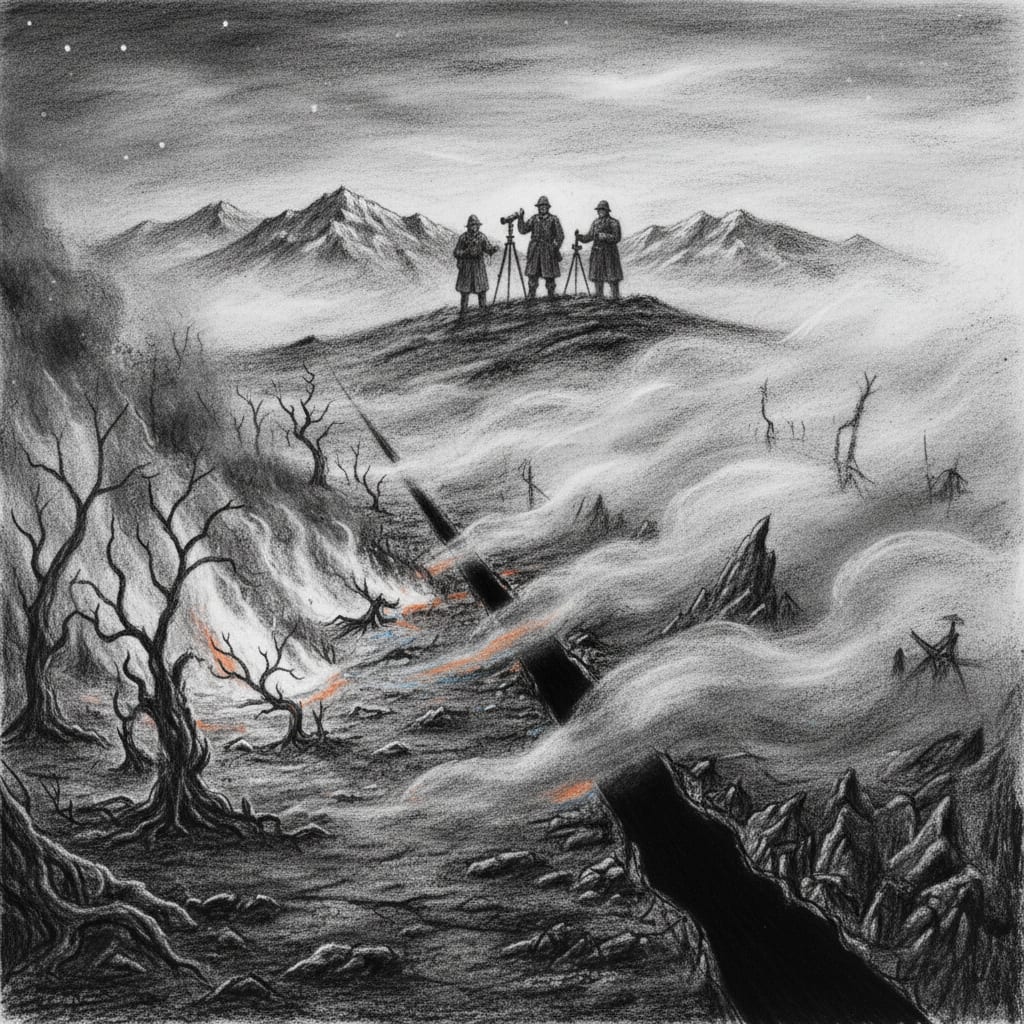
The second anomaly is older, subtler, and sealed under a classification the Bureau has not shared with me, though the lock on the relevant cabinet is of a make I recognised from my earlier visits. The contact zone between Maldrake's territory and Syrion's territory — where fire meets fog in the Balkan foothills — produces effects that suggest something other than simple friction between rival domains. The weather is impossible. The Bureau of Engineering has confirmed this in a twelve-page report whose conclusion reads: "We recommend against being present." But the Bureau of Inter-Infernal Analysis has noted, in its sealed quarterly circulars, that the contact zone has stabilised. Fire and fog, which should consume or extinguish each other, have instead achieved a kind of equilibrium — a boundary that neither side contests, a border both sides respect. The Bureau's analysts do not call this cooperation. They call it "mutual accommodation." The distinction is semantic, the Bureau insists.
The distinction is also terrifying.
An earlier edition of this entry stated that the Bureau of Inter-Infernal Analysis had identified "no significant deviations from the baseline assumption of inter-Sin-General hostility."
This was the Bureau's official position as of A.S. 195. It is no longer the Bureau's official position. The current position is that "the baseline assumption remains operationally valid while acknowledging localised variations of uncertain significance." I note that the distance between "no significant deviations" and "localised variations of uncertain significance" is precisely the distance between confidence and doubt, and that the Bureau has traversed it in six years.
#On the Present Condition
The Bureau of Inter-Infernal Analysis has operated from its three rooms for a hundred and eleven years. It has produced four hundred and forty-four quarterly circulars, each classified, each read by approximately six people, each filed in the Bureau of Records under a designation that changes every three years for security purposes and that the Bureau of Records has, on two occasions, lost. It has survived four directors, two budget cuts, one attempt by the Bureau of Shadows to absorb it, and one formal inquiry by the Bureau of Purity into whether "the sustained contemplation of demonic factional dynamics constitutes a form of theological contamination" — an inquiry that concluded with the judgement "insufficient evidence," which the Bureau's analysts interpreted as a compliment.
The Bureau has never fired a shot. It has never deployed a soldier. It has never, to anyone's confirmed knowledge, directly communicated with any entity beyond the Sagittal Line. What it has done is ensure that every scrap of intelligence regarding inter-Sin-General hostility is collected, collated, analysed, and — where operationally advantageous — amplified. The Bureau feeds feuds the way a gardener feeds roses: with patience, with precision, and with the quiet understanding that the roses are not grateful and would, given the opportunity, consume the gardener without hesitation.
Fourteen people, three rooms, one assumption. The Sagittal Line holds because the Sin-Generals hate each other more than they hate us. The Bureau exists to verify, every quarter, that this remains true. Their methods are classified. Their success rate is sufficient. The day it is insufficient, the Bureau will be the first to know and the last to matter.
Bureau of Inter-Infernal Analysis Internal Memorandum, undated, discovered in the margin of Dossier Vermillion, Folio 1,442, in handwriting matching no current or former analyst: "They are not feuding. They are rehearsing." The memorandum has been classified, the folio re-sealed, and Assessor-Tertiary Haugen has requested a fourteenth lock for the filing cabinet. The request has been denied on budgetary grounds.