
#On the Province That Became an Instruction
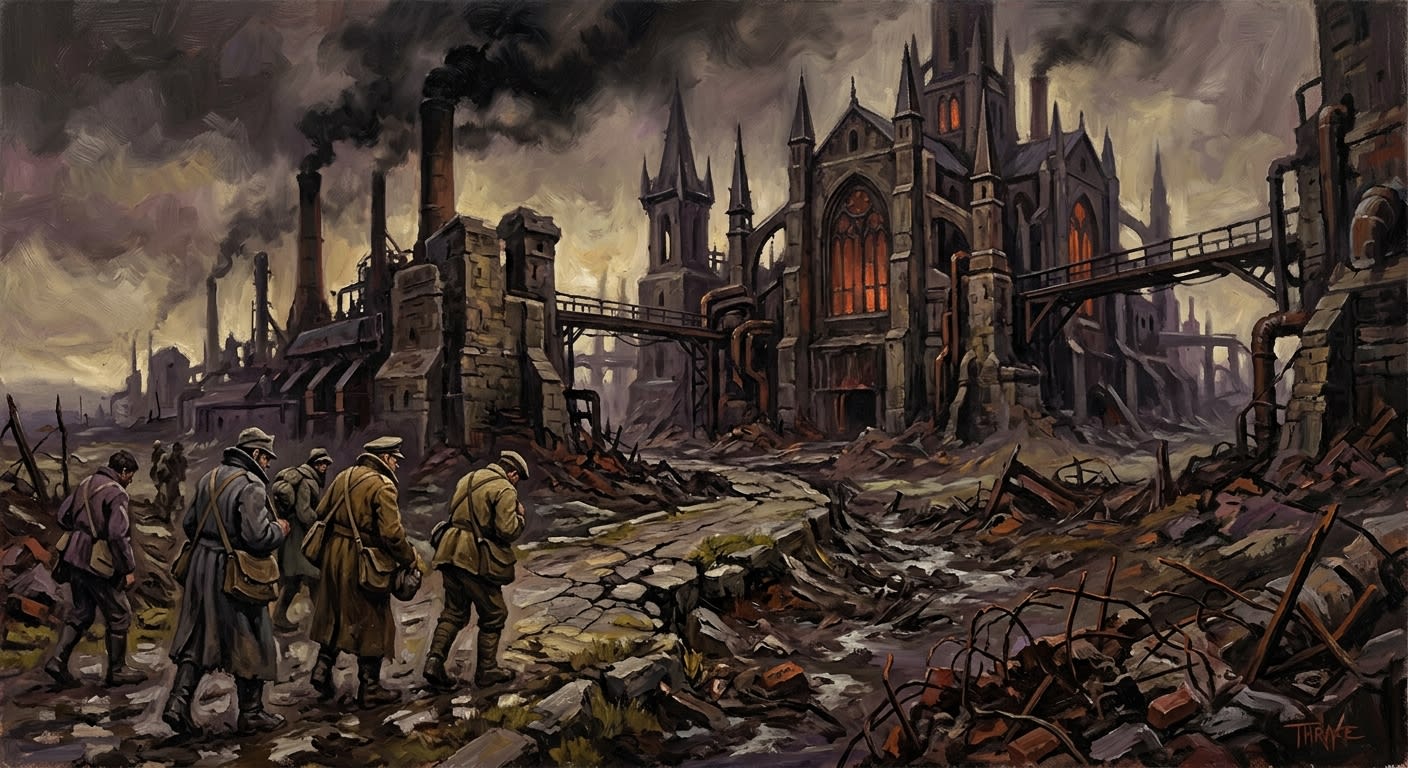
Thrace is the southern eastern wound by which Europe learned that geography can be condemned.
Before the Sundering, it was a name of fields, roads, ports, river mouths, old imperial stones, grain warehouses, hill villages, military roads, market shrines, and arguments among scholars who believed the past was safest when pronounced in Greek. After A.S. 45, it became the place from which Wrath entered material history with the manners of a furnace and the appetite of a court sentence. The maps survived. This was their first humiliation.
A map of old Thrace shows lines. A map of present Thrace shows warnings. Between those two cartographic species lies the entire theology of the Age.
The word is used badly by soldiers, clerks, priests, fugitives, and certain officers of the Bureau of War who should know better and often do, which is worse. To some, Thrace means the burnt country north of Bastion-Constantinople. To others, it means the whole furnace-shadow stretching from the Bosphorus approaches toward the Balkan foothills. To the front, it means the direction from which red weather comes. To the Bureau of Engineering, it means a file cabinet full of melted instruments. To Doctrine, it means the Creator's most expensive correction of Rationalist arrogance.
Let the term be fixed for present use. Thrace is the fallen south-eastern province east and north of the Bosphorus hinge, pressed between the Iron Wastes, the Balkan foothills, the Black Sea approaches, the Danube's lower mouths, and the hostile territories where Maldrake's furnace weather meets Syrion's time-fog. It is Zone 6 in substance, Zone 5 at its western scars, Zone 4 wherever our guns can still make the enemy duck, and Zone 7 wherever the sea pretends wetness is neutrality.
The Bureau does not call Thrace lost. Lost implies accident. Thrace was taken, broken, burned, filed, contested, shelled, measured, renamed, and used in sermons. Loss is for gloves, keys, and boys sent into fog with letters from home in their pockets. Thrace is a verdict still being executed.
#On Old Thrace and Rationalist Confidence
Old Thrace was never as gentle as nostalgia claims. It had seen empires tramp through it with iron shoes. It had given roads to armies, grain to sieges, timber to fleets, horses to men who praised horses until the horses died under them. Its cities had changed masters often enough to acquire the cold courtesy of border places. Its villages knew tax men by uniform and raiders by smell. Sanctity there was practical: a chapel beside a well, a shrine near a ford, a saint painted over older paint because fresh intercession covers old fear more cheaply than masonry.
The Rationalists liked Thrace because it looked, to them, manageable. Roads could be improved. Ports could be indexed. Hill fortresses could be rationalised into customs stations. Monasteries could be emptied, their lands surveyed, their relics assessed as superstition inventory. In Amsterdam and Vienna, professors spoke of Thrace as a frontier of useful reform. They meant it as compliment. Compliments from Rationalists often preceded demolition.
In the A.S. 0 to A.S. 45 decades, Rationalist administrators stripped eastern institutions with the brisk good conscience of men improving a room by removing the load-bearing beams. Parish courts were dissolved. Monastic warehouses were inventoried. Processional roads were converted into military roads. Bells were silenced under acoustic nuisance ordinances. Relics moved west for study, or vanished into private cabinets, or were burned to prove that bone is bone, cloth is cloth, and ash is ash.
Then the mountains opened.
The first reports from Thrace were dismissed as plague panic, militia exaggeration, metallurgical accident, provincial hysteria, clerical revenge fantasy, and that grand asylum of official stupidity: local conditions. Ore seams glowed under rain. Horses refused roads and bit through reins. Iron tools warmed in sealed sheds. Wells tasted of old pennies and blood. A village near the passes sent a letter stating that its church bell had rung from below ground for nine hours. The Rationalist district office replied with a request for exact depth.
Rationalist memoranda from the first Sundering month classify Thracian disturbances as “regional disorder compounded by priestly rumour.”
Corrected by subsequent events, by melted artillery, by silent census districts, and by the absence of the officials who wrote the phrase. Priestly rumour rarely turns cannon crews into ash upon their own steel. It would be more popular if it did.
When refugees began arriving westward, they carried stories with the poor grammar of truth: blackened mountains screaming at night, fogbound plains that returned men older than their fathers, forests burning without fuel, bridges softening under troops, market squares where every nail pointed east. The Rationalists demanded categories. Thrace supplied graves.
#On the Sundering in the South-East
A.S. 45 did not strike Thrace as a single blow. It unsealed it in clauses.
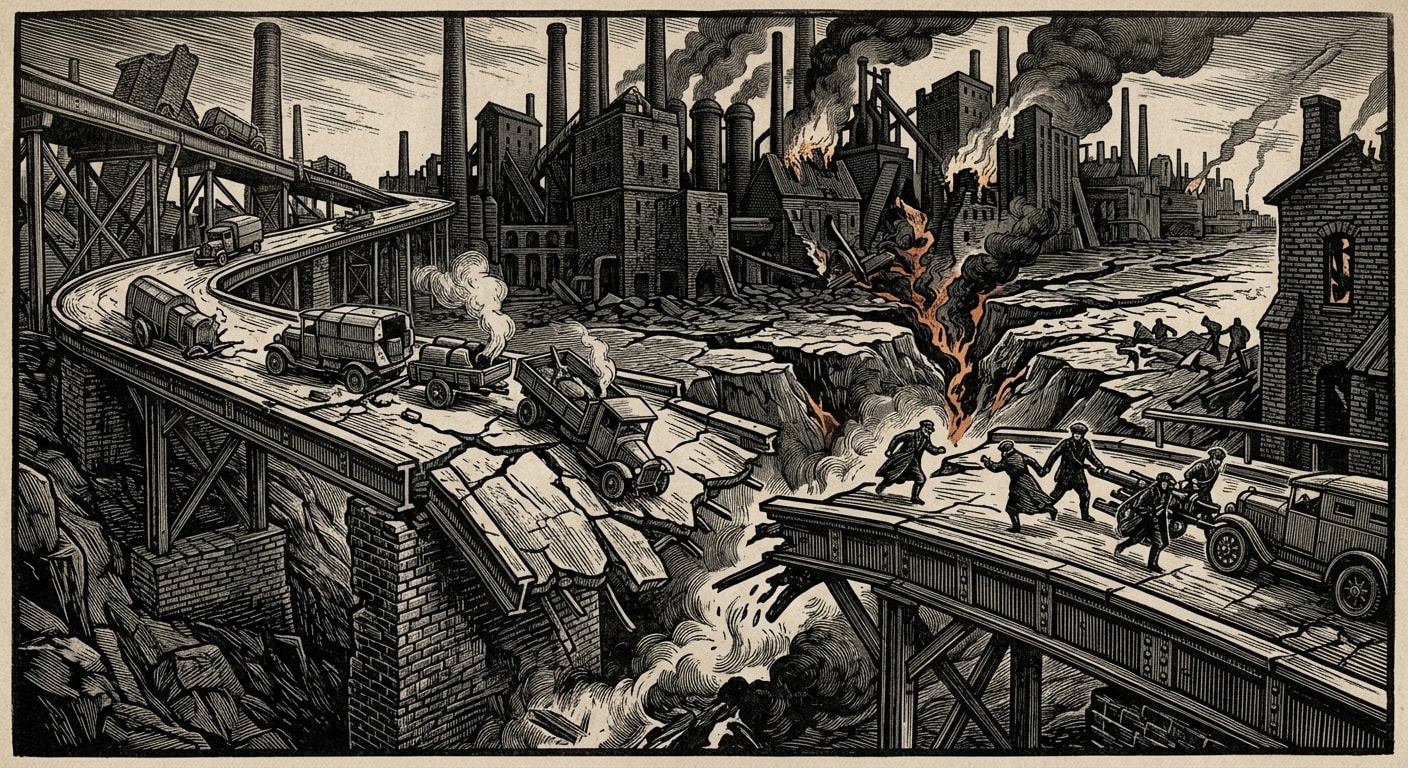
First came the tremors along the old mountain roads. Then the black weather, low and copper-red, wrong enough to quiet birds before it touched the ground. Then the fissures: narrow at dawn, wide by Sext, breathing heat by Vespers. In some places they spat flame. In others they issued sound: hammering, prayer reversed, marching feet, a child's laugh repeated until it became a tool for injuring the mind. The Bureau of Doctrine now teaches that these fissures were openings by which the Great Deceiver's proxies impressed themselves upon matter. The refugees described them more usefully as mouths.
From those mouths came Maldrake's first heat. The Iron Wastes were not yet the Iron Wastes. They were fields in the act of losing argument with fire. Wheat blackened, then glassed. Orchard trees burned down to silver root. Church nails sweated red beads. River mud baked into plates that rang underfoot. Buried spearheads crawled upward through soil as if summoned to muster.
The soldiers stationed in Thrace did what soldiers do when doctrine fails them: they formed ranks. The ranks burned.
The old armies of Moesia (Unregistered) and the border garrisons attempted withdrawal in good order. Good order is a fragile sacrament under falling fire. Brass fittings softened. Wheels fused to axles. Powder cooked off in carts. Men tore armour from their bodies and found the buckles had learned their skin. A courier reached the west with a bone-case full of teeth sorted alphabetically. This detail has been doubted by sentimental historians and preserved by everyone with a proper respect for Hell's administrative talent.
To the south, the Bosphorus roads filled with fugitives. To the north-west, men pushed toward the Danube. To the west, the Balkan passes became chokepoints of mud, panic, animals, carts, saints, stolen coin, and children carried until arms failed. From the fogbound Serbian plains came Syrion's first grey testimony: villages failing to answer, columns pausing by the road and remaining there, officers found seated at their maps with pens held above paper, alive, rested, useless.
Thrace gave the Age its paired verbs: burn and stop.
#On the Iron Wastes Within Thrace
Modern Thrace cannot be discussed without the Iron Wastes, though the two are not the same thing. The Wastes are Thrace's furnace-heart, Maldrake's domain where Wrath has taught soil to hold a grudge. Thrace is broader: the roads that approach the fire, the broken towns that feed its legend, the marshes that receive its ash, the foothills where its heat fails to conquer fog, the sea lanes that feel its cinders on deck planks. The Wastes are the brand. Thrace is the flesh around it.
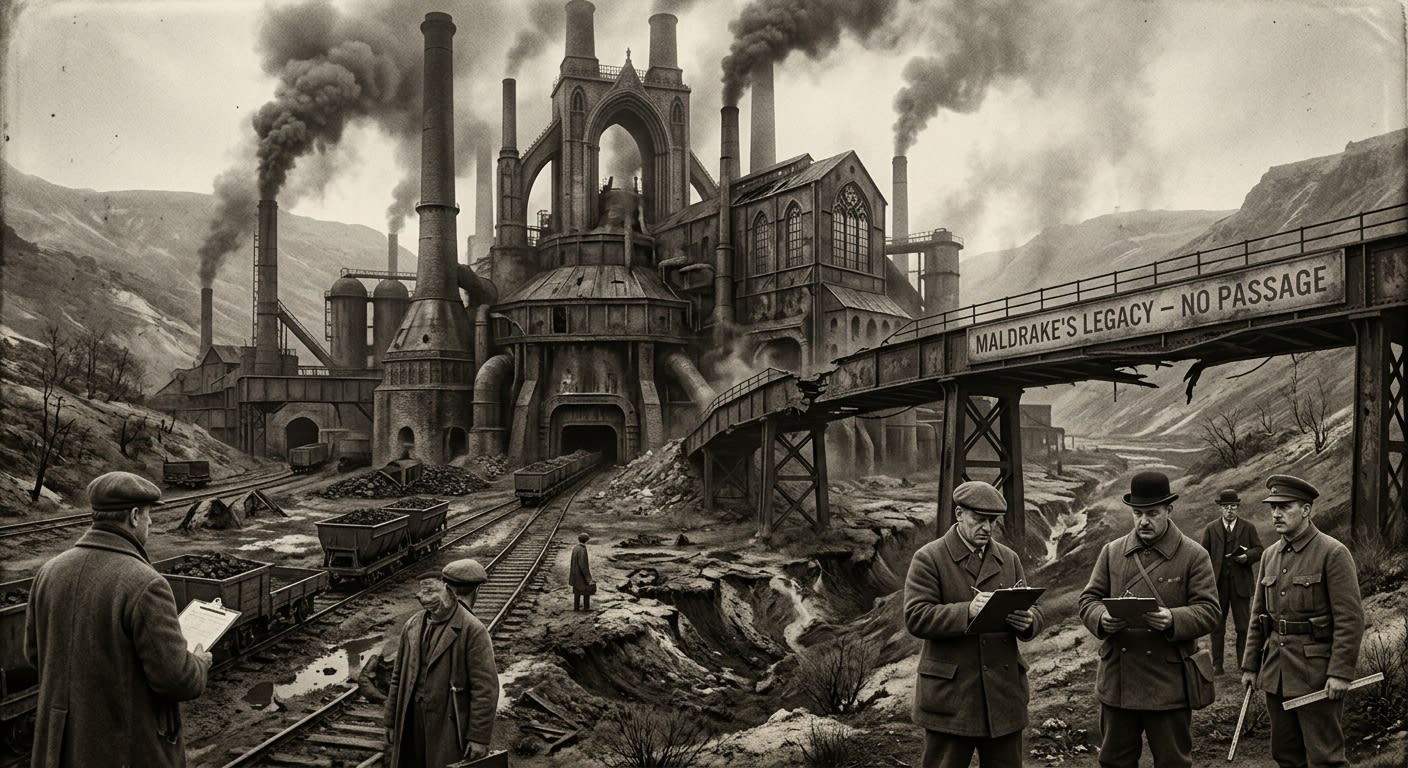
The Wastes began as burn country and became process. Slag-rivers move beneath crust and above it. Iron blisters rise where hills used to keep their private geology. Glass fields fracture under cooling wind and seal themselves again like wounds with money behind them. Rain falls as cinder, filings, or hot black pellets that lodge in cloth and continue thinking about violence. Surveyors report that certain stones grow warmer during argument.
Maldrake's Forge-Pyre Bastion is said to rise somewhere within the central heat, though “somewhere” is a courtesy maps extend to things too proud to stay placed. Scouts place it north-east, then due east, then straight ahead from mutually exclusive roads. The hammering never stops. At distance it sounds like industry. Nearer, it acquires syntax. Men answer it before they know they have been addressed.
Crucible Cities occupy the interior like municipal sins. Men enter them in chains, in rage, in despair, in foolish hope of survival through usefulness. They emerge as tools, officers, ash, or not at all. The Bureau distinguishes corrupted humans, demons, forge-beasts, Crucible-Born, Ember-Soldiers, Hammered, Raging Dead, Flame-Tongues, and additional categories whose names would make a butcher fast for a week. These distinctions matter in field manuals. To the village under attack, they are varieties of fire with legs.
The Wastes also remember us. Captured guns return as Forge-Beasts. Lost rail stock crawls with fused crews still inside. Bayonets buried after retreat appear in later assaults, glowing with unit numbers filed as destroyed. A shell fired by a Synod battery in A.S. 182 was recovered unfired from a Maldrake engine in A.S. 194, bearing the same production stamp and a second inscription in heat-blistered script: RETURNED FOR CORRECTION. Ordnance suppressed the report. Doctrine admired the phrasing and stole nothing, for once.
THRACIAN RECOVERY NOTE — VERMILLION ATTACHMENT Object: regimental bell fragment, presumed lost A.S. 143. Recovered: slag margin, A.S. 199. Condition: warm; ringing inward. Interior inscription visible through cracked bronze: ███████████████████ Three handlers struck one another after reading. Fragment sealed in cold lead.
The Bureau of Engineering measures what does not melt. The Bureau of War shells what glows. The Bureau of Doctrine explains why neither act has won. This division of labour has endured for one hundred and fifty-six years, which proves either Synodal persistence or Hell's fondness for stable scheduling.
#On Borders, Contact, and the Fraud of Lines
The Bureau loves lines. It draws them, taxes them, defends them, revises them, and pretends the world has agreed to be cut accordingly. Thrace humiliates this affection.
Westward, the Thracian pressure meets the southern anchor at Bastion-Constantinople, where the Bosphorus narrows sea into jurisdiction and the Line ends by refusing to end. North-westward, furnace weather leans toward the Balkan foothills and the approaches to Bastion-Shipka. There Maldrake's heat encounters Syrion's fog in the Maldrake-Syrion Contact Zone, that stable offence against doctrinal tidiness where upward-burning rain, vitrified frost, ash-snow, and disputed time prove that even devils can learn manners if the alternative is effort.
Southward, the Aegean approaches catch Thracian consequences without receiving Thrace's name. Ash on sails. Warm fog in harbours. Bells ringing late after perfectly timed peals. Smugglers who swear their cargo aged a year between buoys. Eastward, the Black Sea lanes carry rumours, wreckage, and occasional hulls burnt from the inside out while the waterline remains clean.
At the Danube's lower mouths, the Ash-Glyph Marshworks converts southern dead into coordinates. This is Thrace's outer bureaucracy: bodies by barge, glyph stakes in mud, corpse-light over burial shallows, lantern codes for things that answer from the water. The Marshworks belong to the delta, to Records, to War, to brine, to rot, to the dead who cannot be persuaded to remain where filed. They also belong to Thrace because Thrace exports its dead through every available channel.
The safest Thracian boundary is a gun range. The second safest is a locked door in Strasbourg. All others are ornamental.
#On Men Who Still Live There
Thrace is not empty. Empty places do not smuggle, signal, bargain, betray, pray, or send ash-stained petitions written in hands that tremble from heat rather than age.
Humans remain in Thracian country in four principal conditions: enslaved, hidden, corrupted, or officially inconvenient. The enslaved work bellows, slag channels, bridge gangs, crucible yards, corpse-fuel stations, forge roads, and heat mills whose functions the Bureau describes with admirable vagueness. Their bodies are chained. Their wills remain their own, which is precisely why Maldrake breaks them slowly. A man forced to serve is useful. A man who chooses to become useful is raw material of a finer grade.
The hidden live in cellars under dead villages, drainage cuts beneath old roads, shrine crypts whose saints have not yet been melted, reed islands in lower marsh, and the cold pockets around relic stones where heat has poor manners. They trade with smugglers, send signals by mirror or smoke when either can be trusted, and kill one another over water that has not tasted of pennies. Their prayer is practical. Lord, keep the iron quiet. Lord, let the child sleep without fog. Lord, make the patrol angry at someone else.
The corrupted are more numerous than sermon comfort permits. Some serve from fear. Some from rage. Some from the ugly arithmetic by which feeding one's family today purchases participation in atrocity tomorrow. Some have accepted Maldrake's gifts: strength, heat, the ability to survive where ordinary flesh blisters, the fierce relief of never again being helpless. The Bureau of Purity teaches that the first acceptance damns. Doctrine, when alone with its better books, knows corruption remains a choice renewed until choice itself is buried under habit, addiction, terror, and advantage.
Public catechisms formerly described all Thracian survivors as “either martyrs or apostates.”
Corrected for field instruction. The categories are enslaved, resistant, compromised, corrupted, unknown, missing, and clerically inconvenient. Martyrdom is not a census method.
The officially inconvenient include informants, salvage guides, escaped furnace workers, defectors whose testimony is too useful to burn and too compromised to trust, children born east of lines their parents never accepted, and old women who know paths through the slag margins because old women know paths through everything, including theology. These people arrive at Constantine's northern gates, at Shipka's fog screens, at Marshworks quarantine posts, and at files where clerks pencil temporary headings until policy catches up to pity.
Pity rarely wins. It does, at times, delay the stamp.
#On Thrace's Use in Synodal Speech
Thrace is more useful to Strasbourg than any lost province has a right to be.
It appears in sermons as proof that Reason unguarded becomes ruin. It appears in War circulars as proof that levies must continue. It appears in Tithes notices as proof that arrears endanger the Line. It appears in Orison hymnals as the eastward furnace against which bells must be thrown. It appears in school primers as a black shape children colour badly while teachers explain obedience. It appears in execution warrants for Wrath cultists whose first crime was often a grievance we failed to hear before Maldrake heard it better.
The First Continental Levy fed on Thracian terror. Brașov devoured, passes aflame, garrisons consumed, teeth returned in bone-case order: Strasbourg converted horror into arithmetic and asked one son in ten. The decree was called temporary because permanent cruelty is easier to swallow when served in seasonal bowls. Every renewal since has used Thrace as witness. Every household asked to give a boy is told the east still burns. The east does burn. True statements make the finest shackles.
Thrace also permits the Bureau to speak with clean rage about demons while speaking less cleanly about our own failures. We say Maldrake burns grievances into weapons. Correct. We say Syrion feeds upon exhaustion. Correct. We say the Rationalists stripped spiritual armour. Correct. We say less often that Synodal ration theft breeds Wrath cultists, that overwork breeds Sloth cultists, that false relic commerce breeds counterfeit miracles, that abused provinces become tinder. Thrace burns from Hellfire. It also burns from human fuel.
Doctrine is not weakened by admitting this. Doctrine is weakened only when lesser clerks attempt my work and do it badly.
#On Drax's Inspection of the Thracian Margin
I have not entered the central Iron Wastes. I am vain, not stupid. The distinction is operationally important.
I have stood at the Constantinople northern observation table while the Thracian horizon glowed in three colours and an artillery colonel explained each with the casual misery of a man cataloguing household expenses. Red for surface flow. White for buried heat. Blue for relic contact. Green, he said, should be ignored unless it moved. I asked what it meant if it moved. He said the question had a separate form.
The plain below the walls smoked under morning rain. Nothing large moved. This did not comfort anyone. Small motions carry worse intelligence in Thrace: a line of filings creeping uphill; a dead shrub turning toward the wall; three iron nails lifting from a ruined cart and arranging themselves in a triangle; a patch of ash rippling without wind. At noon, a slag pulse surfaced two miles east, turned north, and vanished under crust with the neatness of a clerk closing a drawer. Engineering marked the coordinates. War requested permission to shell the place. Doctrine asked whether the pulse had avoided a chapel ruin. Records asked which chapel. Tithes asked whether the ruin had outstanding assessments. This is how the Synod thinks under fire: accurately, obscenely, in chorus.
Later I inspected a refugee intake room below the northern gate. A boy of twelve, or near enough for Mercy arithmetic, sat with both hands in cold brine. The skin had not burned. The nails had turned black iron. He said his mother sent him west because the house had begun speaking in his father's voice and his father had died before he was born. A Mercy clerk wrote “possible heat delirium.” A Purity clerk wrote “possible infernal exposure.” I wrote “listen to the house if it arrives.” My note was judged theatrical. It was also the only useful instruction in the room.
In the evidence cabinet lay a farmer's door latch, three melted rosary beads, a map corner, a soldier's tooth fused to a cartridge rim, and a sealed jar containing ash that moved when anger entered conversation. I asked who had last angered it. No one answered. Silence around Thracian objects is rarely ignorance. It is often confession.
#On the Southern Gate and the Sea That Refuses Innocence
Constantinople is the lock on Thrace's throat. The city is ancient enough to have survived names, empires, councils, sieges, schisms, processions, and every vanity by which men convince stone to remember them kindly. Under the Synod it became Bastion-Constantinople, southern anchor of the Sagittal Line, facing Thrace from walls that have been lost, rebuilt, lost again, renamed, blessed, reinforced, and lied about with magnificent continuity.
The northern works watch the Iron Wastes. The Bosphorus works watch the sea. Neither view is restful. Maldrake's campaigns arrive from Thrace with siege heat, Hellbow formations, forge-beasts, and artillery that makes moral injury look like ballistics. Kargath's hunger creeps along wet approaches after fire has made ash of what hunger prefers soft. The Black Sea sends hulls, wreckage, false signals, and rumours too waterlogged to burn. South and west, supply lanes from the Aegean and Mediterranean try to keep the southern anchor fed, armed, and devout; Thrace tries to make all three conditions temporary.
The sea does not cleanse Thrace. It distributes it. Ash falls on decks. Iron filings gather in bilge corners. Sailors find their knives warm after passing too near the northern lanes. Pilgrims arriving by chain-guarded routes step onto quays and taste pennies in the air. The Bureau of Passage blames weather, which remains the cheapest culprit in all maritime administration. The Bureau of Doctrine blames Wrath, which is less cheap and more accurate.
#On the Present Condition
As of A.S. 201, Thrace remains active, expanding in effect if not always in measured acreage, hostile to survey, indispensable to propaganda, and proximate enough to Constantinople that every northern bell has learned humility. The Iron Wastes press and simmer. The Forge-Pyre Bastion hammers. Slag-rivers route under crust toward targets withheld from public maps. The Maldrake-Syrion Contact Zone holds its obscene line in the Balkan foothills. The Ash-Glyph Marshworks receives the dead that water still agrees to carry. Shipka counts fog-days. Constantinople counts glows. Strasbourg counts boys.
The Bureau of Cartography wants clearer margins. War wants firmer target tables. Engineering wants instruments that do not melt, lie, ring, tighten around the wrist, or return from surveys with dates not yet reached. Doctrine wants obedience drawn from terror without terror becoming despair. Purity wants every survivor sorted before pity contaminates testimony. Mercy wants another room. Records wants names legible before the heat takes them. Tithes wants to know whether land converted into hostile slag remains assessable.
Thrace gives each office enough truth to incriminate itself.
It was once province. It is now furnace, border, warning, theatre, wound, export of ash, importer of sons, and catechism plate for children too young to know that black shapes on school maps were once places where ordinary people argued about bread. The Ledger records it as fallen. The Line treats it as pressure. The soldiers call it east. The refugees call it home until corrected by clerks with dry sleeves.
The soldiers at the southern front have their own private maps of Thrace, scratched on mess tins, sewn inside coats, drawn in ash on bunker walls before inspection wipes them clean. They mark safe wells, false wells, roads that punish wheels, stones that ring before shelling, chapels where candles burn blue, and places where a man should curse aloud because silence has become too attentive. These maps are illegal, inaccurate, indispensable, and updated faster than any sealed survey from Strasbourg. The Bureau confiscates them when found. The next week, better ones appear.
Thrace still burns. Do not mistake this for simplicity. Fire has offices there now.