
#On the Stone Before the Fog
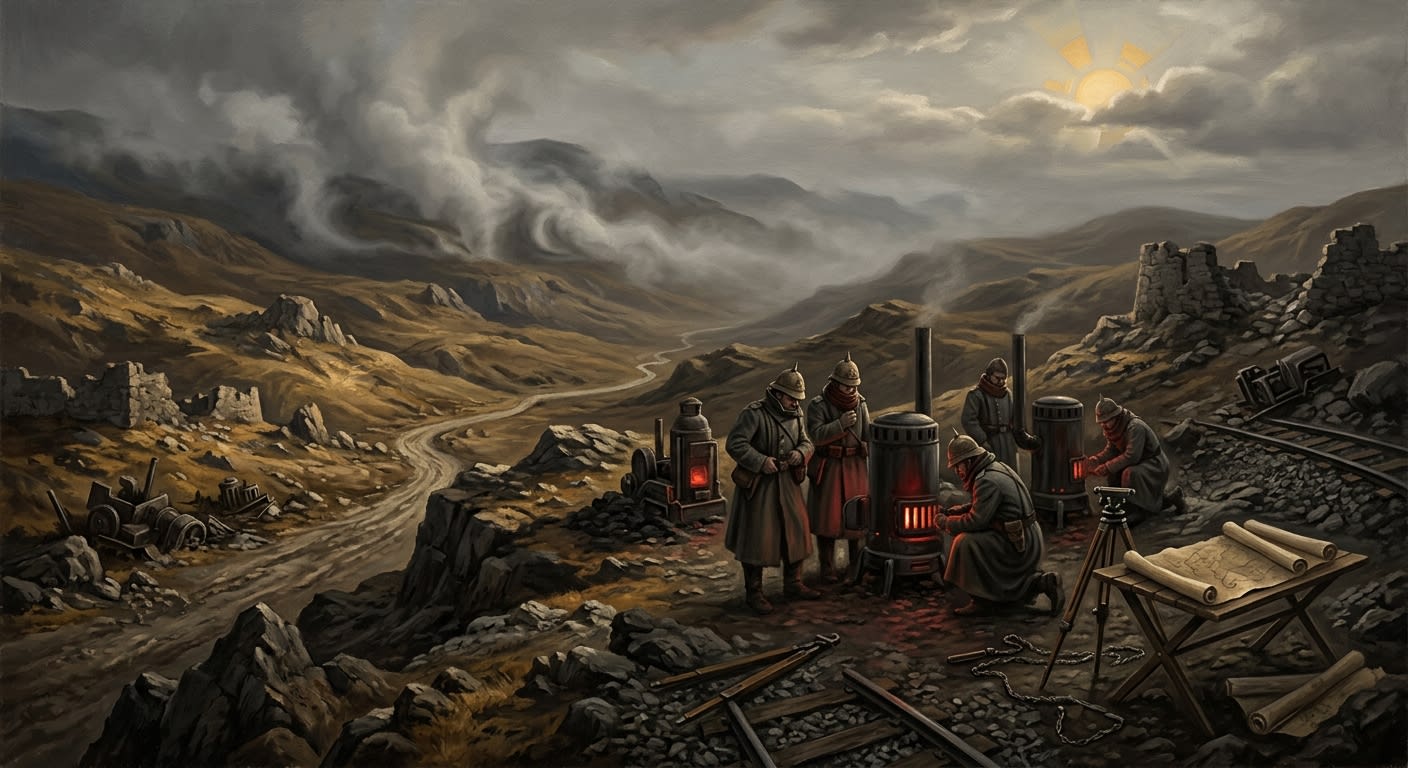
The Balkan foothills are the broken stair by which the East tries to climb back into Europe. They lie between the last workable roads below Bastion-Shipka, the furnace pressure pushing north-west out of Thrace, and the cold grey patience of Syrion's time-fog. School maps shade them as terrain. War maps mark them as approach. The Bureau of Inter-Infernal Analysis treats them as evidence.
They are all three, which is inconvenient, and inconvenience is the beginning of geography.
Before the Sundering, the foothills were shepherd country, monastery country, mule-road country: stone villages, plum orchards, high grazing, poor chapels with bells too thin for pride, and passes whose names mattered only to men driving animals uphill in weather that disliked them. After A.S. 45, every local inconvenience received a military title. Ravines became ingress corridors. Sheep tracks became hostile avenues. Watermills became ration nodes. Pilgrimage shrines became artillery spotting posts when the saints declined to object in legible form.
The foothills matter because the Sagittal Line does not end at masonry. A bastion holds a gate; the ground before the gate decides how many enemies can reach it at once, how slowly convoys can retreat, how loudly bells travel, and how many dead men can be misplaced before Records notices a pattern. Shipka guards the pass. The foothills decide what reaches Shipka breathing, burning, sleeping, or already late.
#On the Old Roads and the Retreat
The first lesson the foothills taught the West was humiliation by gradient. During the Great Retreat out of the East, from A.S. 48 to A.S. 65, refugees poured through the Balkan roads in columns so long that hunger at the front became rumour before it reached the rear. Herds slid on wet stone. Relic carts lost wheels. Militia remnants argued over which valley still existed. Priests blessed bridges as they burned behind them, which is efficient theology if one does not intend to cross back.
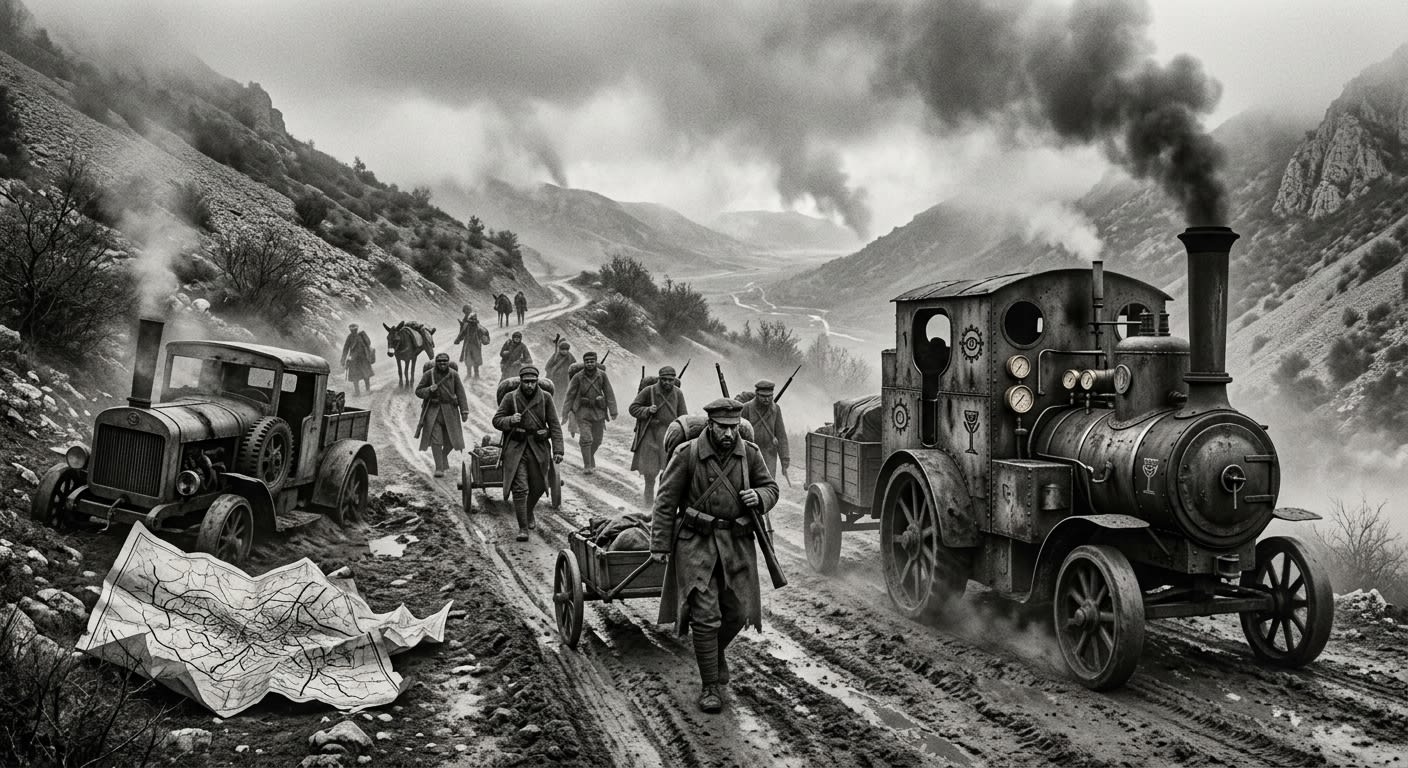
Maldrake's vanguard pressed from the furnace plains with heat at its back. Syrion's fog stole hours from the wounded and returned them to the march as years. A man might climb a slope at dawn with his son beside him and reach the crest at dusk holding the hand of a grey-haired stranger who remembered being that son. The Bureau of Records received these accounts with suspicion until enough unrelated witnesses made the same error in the same direction. Then Records called it a classifiable sorrow and bought better cabinets.
The old monasteries failed unevenly. Saint Ilko's (Unregistered) bell-house rang for nine days after the brothers departed and then was found half-filled with ash cold enough to preserve fingerprints. The mule shrine at Upper Vratna (Unregistered) sheltered forty-three children during a fog week in A.S. 52; when the doors opened, the children had slept, grown no older, and learned a lullaby no surviving adult admitted teaching them. The Bureau of Orison later banned the tune. The ban survives. The tune also survives, because mothers are criminals by instinct when children will not sleep.
Earlier primers described the Balkan foothills as “lost border highlands abandoned during the first demonic advance.”
Corrected. They were not abandoned. They were spent. Abandonment implies choice, and the men on those roads had already used their choices on breathing, carrying, and not looking back.
By A.S. 65, retreat hardened into line-work. Shipka became the throat. Lesser posts seeded the slopes: signal huts, ash-glyph hamlets, road shrines, quarantine sheds, mule depots, listening stakes, and graves with numbers instead of names because names took longer and the weather did not wait. The foothills became a military antechamber: too dangerous for settlement, too useful to cede, too broken for clean doctrine.
#On the Terrain
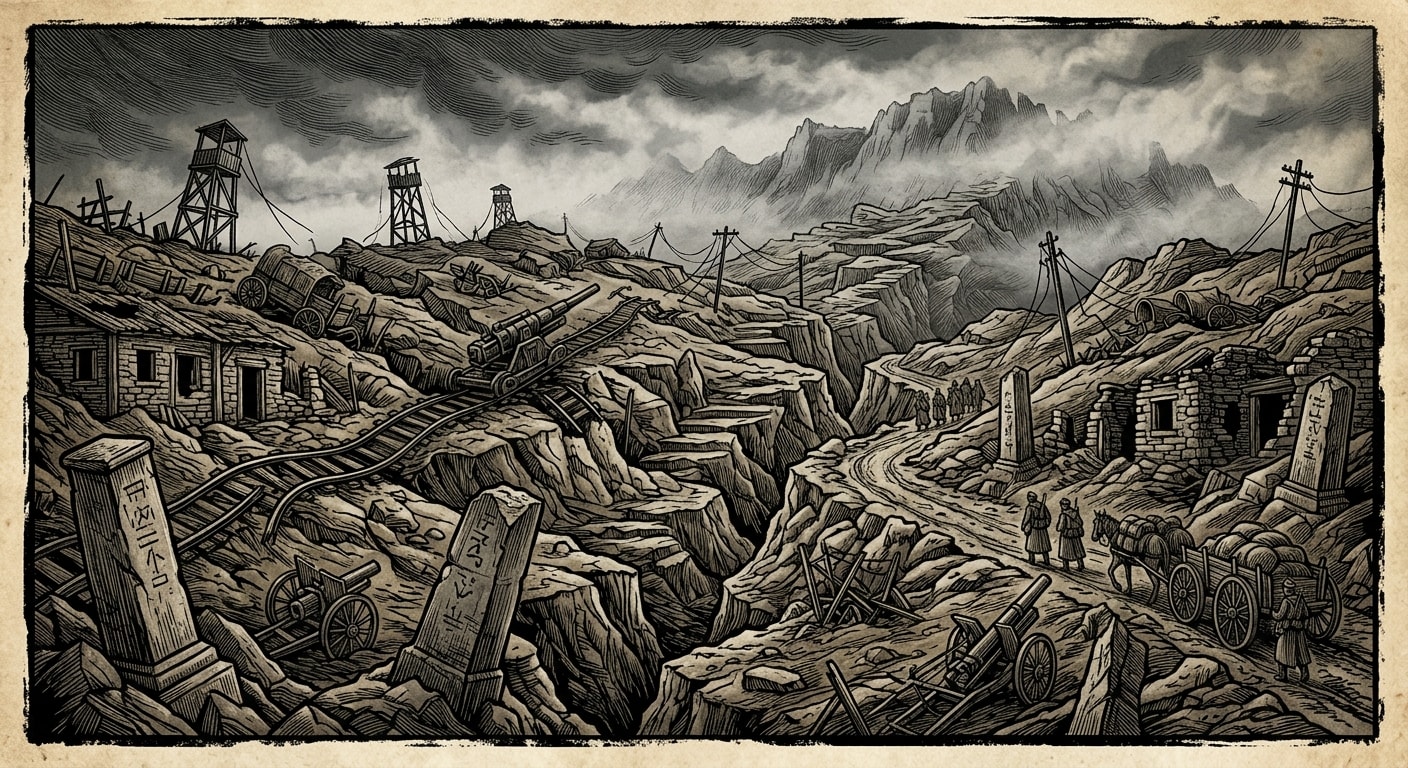
The foothills rise in ridges, shelves, gullies, thorn slopes, limestone jaws, burned meadows, abandoned terraces, and small plateaus where a gun can be placed if one first removes the bones, the nettles, the suspiciously warm stones, and the junior officer who insists the site is perfect. The land funnels movement. That is its virtue and its treachery. A cart track may command a valley for three miles, then vanish into scree where the mules refuse forward motion and the driver begins reciting his childhood sins in alphabetical order.
The weather comes in jurisdictions. From the south-east comes Maldrake's furnace breath: red haze, cinder gusts, iron-smelling rain, hot wind under cold sky, and stones that sweat rust before cracking. From the north-east and high passes comes Syrion's time-fog: grey banks that thicken without wind, damp silence, bell-delay, drowsing light, and minutes that lose their edges. The local weather, poor bastard, still tries to produce rain, frost, sun, and ordinary misery. It is overruled hourly.
Where furnace weather and time-fog meet, the Maldrake-Syrion Contact Zone draws its obscene line: upward-burning rain, vitrified frost, sleeping ash, glass plates too hot to touch and cold enough to hold a footprint, a boundary stable enough to make analysts sweat through their collars. The broader foothills carry the lesser symptoms. One slope burns under fog. One ravine rings like a cooling anvil when no metal is present. One shepherd path repeats the same twenty paces until the traveller has the wisdom to turn his coat inside out and walk backward, a folk remedy condemned by Doctrine and used by three survey teams.
Water is worse than stone. Streams run downhill by habit and uphill by incident. Springs near furnace scars emerge warm, black-edged, and serviceable for washing tools but not mouths. Fog-pools gather in old basins and remain there through noon, reflecting no sky and occasionally reflecting tomorrow's patrol. The men call them sleep-pans. Medicine calls them exposure hazards. Doctrine calls them unsuitable for devotional metaphor after an unfortunate sermon at Sofia caused seventeen soldiers to kneel beside one and wake with moss in their hair.
#On the People Who Remain
The public doctrine says no civilians remain east of the properly held roads. The public doctrine is a fine garment worn over visible elbows. People remain. They always do. The Synod may evacuate a village, burn its records, salt its well, relocate its bell, and announce the successful removal of population; three winters later smoke rises from the same hollow, and some grandmother with a face like folded bark informs the patrol that her family has lived there since before Strasbourg learned to spell authority.
Foothill survivors are difficult to classify, which makes them morally irritating and practically indispensable. Some are loyal watchers who report fog movement by scratched tally-sticks. Some trade with Shipka quartermasters and with things no quartermaster should imagine. Some shelter deserters, lost children, Grey Heralds, mad engineers, mule drivers, relic thieves, and sleeping men whose uniforms belong to regiments not yet raised. Some are corrupted. Some are merely poor, which the Bureau often confuses with corruption because both conditions smell bad in offices.
The villages that persist have learned hill-law. Never sleep while fog touches the lintel. Never cook with red ash unless one wants anger in the broth. Never answer a bell heard from below the house. Never take a road that appears shorter than remembered. Never permit a stranger to sit without making him stamp both feet, since the Still Ones (Unregistered) sometimes forget the second foot. These rules are not doctrinal. They work too often to be ignored and too crudely to be admitted.
Children born in the foothills are watched for slowness, heat, silence, and clock-hatred. The Bureau of Medicine maintains a receiving table at Sofia for doubtful cases. Families avoid it where they can. The table has clean sheets, tagged jars, polite nurses, and a reputation for returning fewer children than it receives. Mercy insists this is variance. Mothers use different nouns.
#On Observation and Use
The Synod uses the foothills because the Synod uses everything: grief, roads, bells, bones, weather, stubbornness, hunger, and the occasional honest report accidentally filed by a tired captain. Observation posts sit on west-facing shelves reinforced with black iron and prayer stakes. Their crews watch the red horizon for Maldrake's heat columns, the grey gullies for Syrion's drift, the contact boundary for movement, and each other for the moment fatigue turns into devotion.
Three ledgers are kept at larger posts. The fire ledger records forge-glow, slag seep, Ember-Soldier probes, heat-surge, cinder fall, and the colour of rain when it burns. The fog ledger records bell-delay, missing seconds, Still One sightings, sleep-talk, duplicated orders, and personnel who describe rest as reasonable. The road ledger records movement through passes: convoys, patrols, pilgrims under escort, smugglers under denial, refugees under correction, and animals who know better than men when to refuse a route.
The road ledger is the most honest. Fire lies grandly. Fog lies gently. Roads lie by omission, which is the commonest form and the one most familiar to Records.
OBSERVATION POST LARK-FOUR — BALKAN FOOTHILLS ANNEX A.S. 199 / date under review. Road ledger recorded thirty-two westbound refugees at dawn. Fire ledger recorded no movement. Fog ledger recorded “thirty-two westbound refugees, all asleep, walking correctly.” By evening the road ledger amended itself to thirty-one. The missing entry's name appears in tomorrow's ration issue. Do not read the amended line aloud.
War values the foothills as an early wound. Engineering values them as a testing ground for instruments it does not expect to get back. Inter-Infernal Analysis values them because the ground records how Wrath and Sloth behave when neither is performing for human terror. Purity values them whenever it needs an excuse to burn a local practice. Pilgrimage values them in secret, since forbidden shrines acquire fees faster than approved ones.
The foothills resent all valuations by continuing to exist.
#On Shrines, Posts, and Wrong Bells
Every surviving high place has acquired a shrine, a gun, a grave, or a warning sign. Some have all four, and those are the ones worth avoiding. The Shrine of Saint Vratna's Mule (Unregistered) occupies a cracked terrace above a road no current map acknowledges. Pilgrims leave horseshoes, sleep-charms, and little brass bells with their clappers removed. The Bureau of Bells objects to clapperless bells on principle. Local guides object to clappers because sound travels strangely there and sometimes comes back with additions.
At the Chalk Teeth (Unregistered), a line of limestone fins above the western gullies, Engineering cut listening slots during A.S. 147 survey work. The slots face east. On clear days they carry furnace clang from Thrace. On fog days they carry lullabies. On bad days they carry both in harmony, which caused one entire watch crew to wake convinced that Maldrake and Syrion had composed a hymn. Doctrine sealed the slots for three months. The seals melted, slept, and fell off in that order.
The Mule Gate road (Unregistered) runs toward Shipka through a series of switchbacks whose measurements change after heavy fog. Convoy commanders mark wheels with chalk at the lower station and count rotations upward. If the count exceeds the road, the convoy halts and waits for bells. If the count falls short, the convoy reverses immediately, because a shorter road in Syrion country is almost always a mouth. Maldrake country prefers longer roads that make men angry before killing them. Different devils, different manners.
A.S. 188 route circular listed the Mule Gate switchbacks as “secure in ordinary weather.”
Corrected. Ordinary weather has not held jurisdiction over the Mule Gate since A.S. 143. The circular's author was reassigned to count stones along the lower road. He has submitted the number seven times. It has never matched itself.
Wrong bells are the foothills' private nuisance. A bell heard from Shipka may arrive late, early, doubled, softened, sharpened, or already answered by a bell buried under a village that Records removed from the census. Bellwardens learn to test each peal against touch: palm on rail, tooth against tongue, boot-sole on stone. Sound alone is a liar. Metal underfoot has fewer opportunities for poetry.
#On the Present Condition
As of A.S. 201, the Balkan foothills remain held, contested, lost, watched, denied, exploited, and misdescribed according to the hour and the seal. Shipka's western roads remain open under bell discipline. The eastern shelves are abandoned except when they are not. The Contact Zone holds its line with a composure that insults doctrine. Sofia receives damaged observers, blistered surveyors, sleep-struck runners, and maps that must be stored face-down. Constantinople watches Thracian glow. Strasbourg counts the reports and discovers, quarterly, that the arithmetic still favours continued dread.
The official position is clear: the foothills are forward hostile terrain under intermittent Synodal observation, affected by Wrath-Sloth domain interaction, unsuitable for civilian habitation, and tactically necessary to the southern theatre. The useful position is shorter. The foothills are the place where the weather learned politics.
Men still climb those roads. Mules still refuse them first. Bells still arrive with ash on their sound. Somewhere beyond the nearest ridge, fog rests against heat like two enemies sharing a wall, and the wall holds.