

#On the Present Compilation
Documentary route survey, compiled at the desk, A.S. 201 / 1911 CE. No surveyor climbed for this entry. The surviving account did the climbing, and it is quoted here.
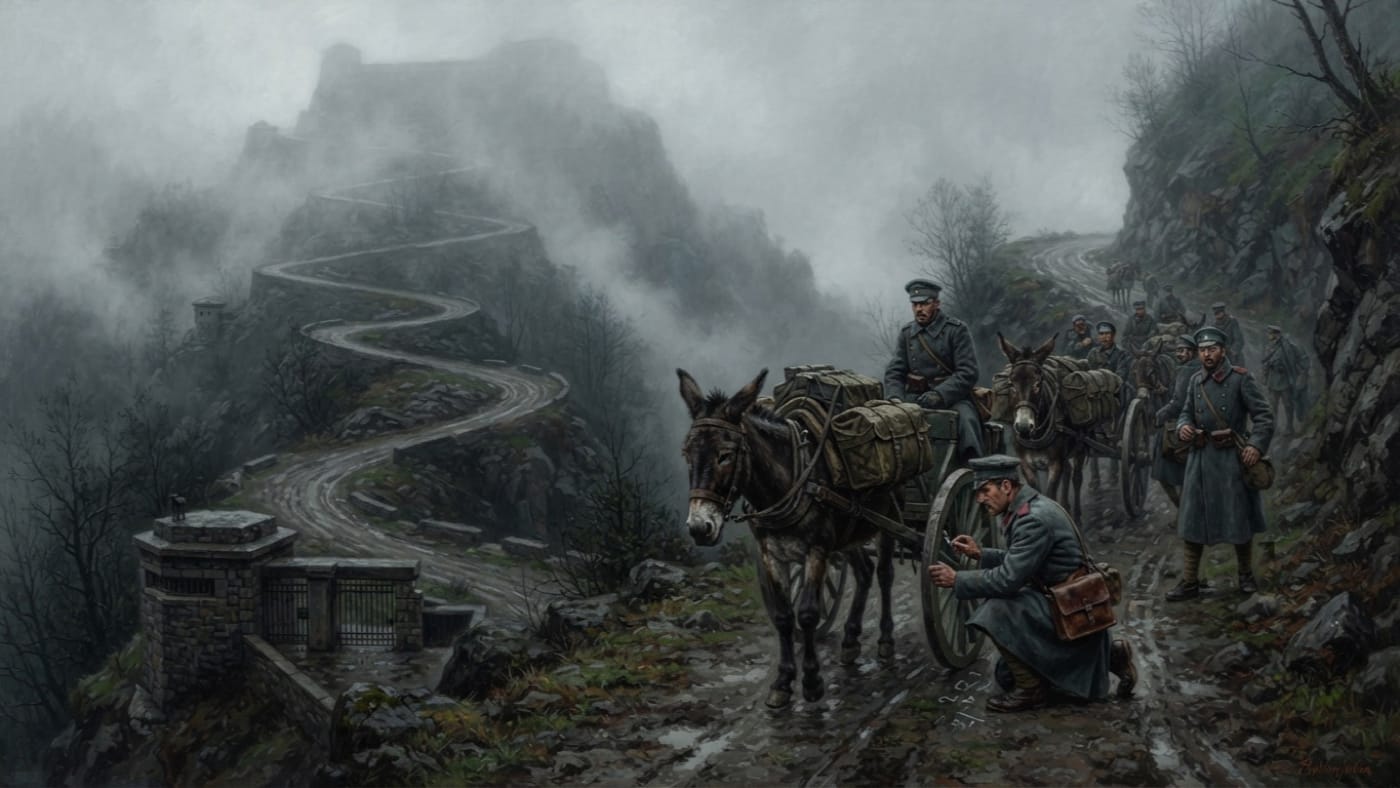
The Mule Gate road climbs toward Bastion-Shipka through switchbacks in the Balkan foothills, the broken stair below the pass and north-west of the furnace glow of Thrace. This survey is compiled in A.S. 201 from what the Codex already holds on the road. A quartermaster would call that too little. The road would call it too much. The survey gives no founding year, because none is documented. It gives no length, because the road keeps none. It names no terminus beyond "the lower station" at the bottom and the direction of Shipka at the top. The record names nothing more, and an invented milestone is the first entry in an invented convoy's casualty list.
The stakes need no invention. Shipka guards the last bottleneck before Thrace, on the southern stretch of the Sagittal Line. Its garrison rotates every four months because longer service produces men who can no longer count days, and it carries more Bellwardens than any other post on the Line. Whatever goes up to Shipka on mules — rations, powder, relief, replacement men who can still count — goes up on roads of this kind. Mule Gate is one of them.
#On the Switchbacks and the Fog
The geographic record fits in one sentence: the switchbacks' measurements change after heavy fog. I have read it the way one reads a short scripture, slowly and with suspicion of anyone who claims to have read more into it.
The fog in question belongs to Syrion. His time-fog lies over the highlands south of Shipka and comes down the north-eastern gullies in grey banks that thicken without wind, delay bells, and blunt the edges of minutes. The sin-general's wider territory is known for ground that will not hold still and for corridors where time runs at its own tariff. That is regional fact. It does not certify that the Mule Gate switchbacks are one of those corridors. No office has classified them that way, and I will not do it on the strength of a good paragraph.
From the south-east comes Maldrake's furnace pressure: red haze, cinder gusts, rain that smells of iron. Where the two weathers meet, the Maldrake-Syrion Contact Zone holds its hostile line somewhere in the wider foothills. No published account draws that line across Mule Gate, and this survey does not draw it either. The Bureau of Inter-Infernal Analysis has not assigned the road's behaviour to either general. The road, so far as anyone knows, has not offered an opinion.
#On the Chalk and the Count
The procedure is recorded as follows. At the lower station, convoy commanders mark their wheels with chalk and count the rotations on the way up. If the count runs long against the road, the convoy halts and waits for bells. If the count runs short, the convoy reverses at once.
That is the whole procedure as the Codex holds it. The account gives no normal count, no wheel size and no tally of how many marks go on which wheel. It does not say who keeps the count when the commander is busy with a mule that has seen something, or how often the count is checked during the climb. I have supplied none of these. A false baseline would get a convoy killed with a stamp on it, and that is the worst way for a convoy to die, because it ruins the audit.
What the record does give is an asymmetry, and the asymmetry is the doctrine. A long road earns a halt. A short road earns a retreat with no waiting and no consultation. In practice this means a lengthened road is a delay to be waited out and a shortened road is a threat to be refused. The chalk mark itself is a check and nothing grander. Chalk can be smudged, miscounted, rained off or recounted by a frightened sergeant until it agrees with him. It still has one virtue over fog: it turns once with the wheel and makes no other claim.
Balkan Foothills, "On Shrines, Posts, and Wrong Bells": "the convoy reverses immediately, because a shorter road in Syrion country is almost always a mouth."
Corrected to attribution. That is the reason given on the road, and I wrote it in my own voice because it was a good sentence. Records holds no anatomy for it: no throat measured, no tooth recovered, nothing swallowed and returned for inspection. The reversal stands as procedure. The mouth stands as the convoy-men's word, which they are welcome to keep.
The same entry added that Maldrake's country prefers longer roads that make men angry before killing them. I stand by the manners. I withdraw any suggestion that they work as a diagnosis. A long count at Mule Gate does not come signed by Wrath, and a short one does not come with Sloth's seal on it. The commanders do not need to know which devil is responsible. They only need to know which way to turn the mules.
#On Bells, Which Also Lie
A halted convoy waits for bells. In the Balkan foothills that is an act of faith, and the Bureau would prefer to call it discipline. The parent account records that bells heard from Shipka may arrive late, early, doubled, softened or sharpened, or already answered by a bell buried under a village Records struck from the census. Bellwardens in the region test a peal against touch — palm on rail, boot-sole on stone — because sound by itself cannot be trusted.
The record does not say which bell a halted Mule Gate convoy waits for, how long it waits, or what it does once the bell arrives. It records no local test for a wrong bell on this road, and I have not invented one. The Bell Codex can standardise a peal. It has no jurisdiction over the air the peal travels through.
Waiting is still the right answer to a long count. A bell that may lie is a lesser danger than a road that has already been caught lying.
#On Those Who Count and Those Who Wait
The documented people of the Mule Gate road are categories, not names. Convoy commanders keep the chalk. Observation crews at the larger foothill posts keep road ledgers, which record convoys, patrols, escorted pilgrims, smugglers under denial and the animals that refuse a route. The parent account calls the road ledger the most honest of the three foothill ledgers. Roads lie by omission, and Records knows that habit from long acquaintance.
Then there are the civilians who, by public doctrine, do not remain in the foothills, and who remain. Their unwritten hill-law includes a rule I quote in full: Never take a road that appears shorter than remembered. The convoy procedure and the folk rule agree. The record does not say whether one learned from the other, and no clerk has asked. Peasants seldom cite their sources, and the Bureau dislikes them for it.
The friction is easy to predict. A commander who halts on a long count arrives at Shipka late, and Shipka keeps time more fiercely than most garrisons, since time is what it is being robbed of. A commander who reverses on a short count arrives nowhere, and some desk in Sofia or further west will want to know why the road was shorter than the paperwork. Records has no column for a convoy that obeyed procedure and delivered nothing. Every lost day becomes a disciplinary question, every reversal becomes a form, and the ration sacks wait at the lower station while the question goes up the chain.
#On the Limits of the Record
The surviving account permits a reader to know four things. The Mule Gate road climbs toward Shipka by switchbacks. Their measurements change after heavy fog. Commanders chalk their wheels at the lower station and count on the ascent. A long count means halt for bells, and a short count means reverse.
Everything else is unrecorded: who built the road and when, its exact route, its length in fair weather or foul, where it ends above, what stands at the lower station, whether a convoy could use it this season, and what moves the switchbacks. It should not be confused with the other roads of the Shipka sector, including the reed roads of the older bastion files. Neither the Chalk Teeth nor the Shrine of Saint Vratna's Mule has any recorded distance from it or connection to it. Those places are its neighbours on the foothills page and nothing more. The Southern Theatre has enough documented horror. It does not need me to lay out a second road from rumour.
Records will accept the count. Nobody has asked the road.