
#On the Matter Before the Ledger
This is a survey, commissioned in A.S. 201 as an assessment of what the record presently holds. Readers who open it expecting a campaign history will close it hungry. The Codex knows the words "Choir-Mortar campaigns." The Thessaloniki entry uses them in the plural, beside its account of the harbour towers' rebuilding, and the plural is honest usage. The record does not say how many campaigns the plural contains, when the first began or the last ended, or who commanded any of them. Whether anyone at the time used the name is also unrecorded. The archive gives up one episode: the Siege of Thessaloniki, a single counter-barrage and the dead it buried. That episode has no recorded date. A.S. 201 is the year of this assessment and nothing more. Any clerk who transfers it to the siege will answer to me, and I am in a disagreeable season.
#On the Harbour Bastions
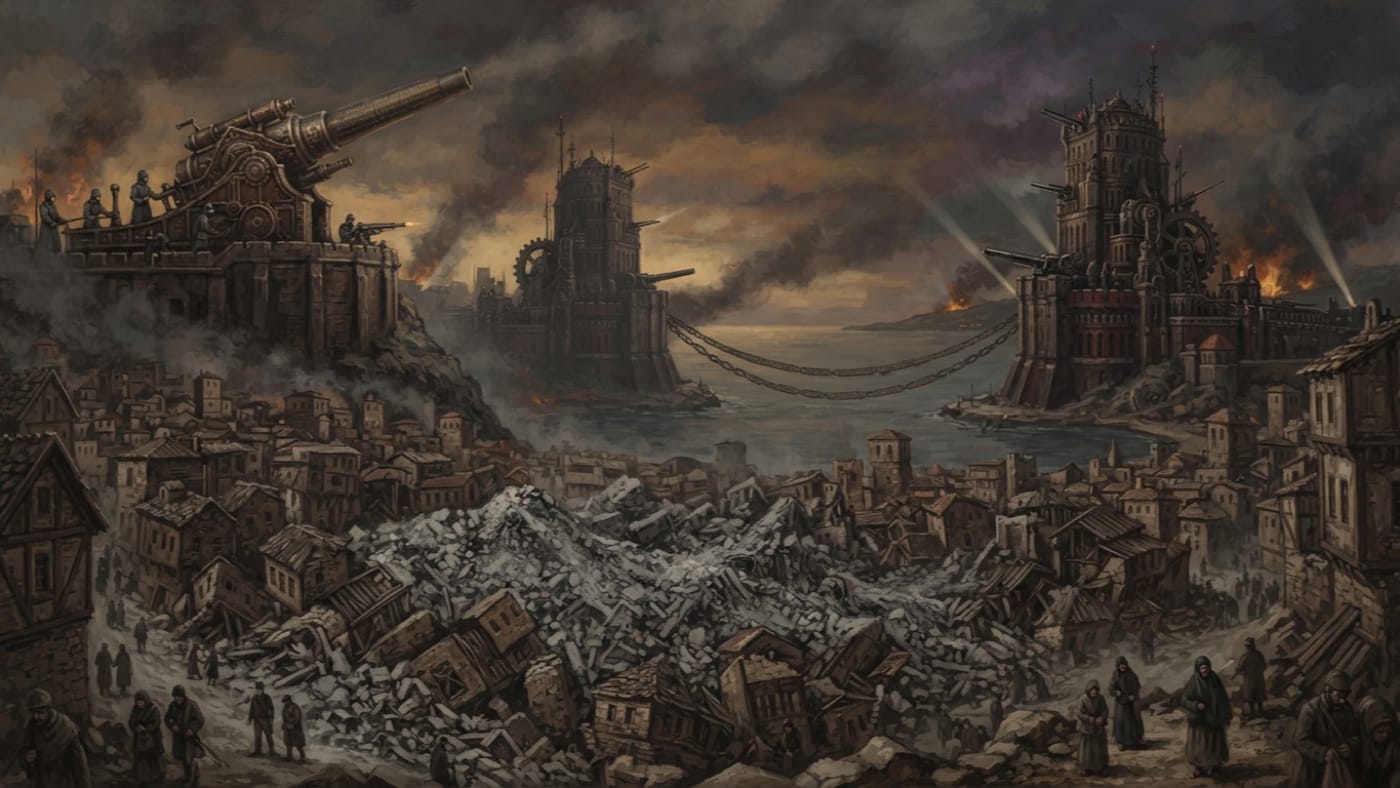
Thessaloniki stands apart from the primary bastions of the Sagittal Line. It is a coastal supply installation in the seventh zone, on the Aegean, and the southern Line eats from its hand. Two towers rise straight out of the sea, Elder on the western headland and Younger on the eastern spit. Between them hang reliquary chains across the inlet, each link inscribed, each passage beneath registered. Grain for the southern theatre, crates for the coastal batteries and conscripts for the sector anchored at Bastion-Constantinople all pass under that iron before they reach the war. Close the chain and the trenches begin counting their biscuits.
The Thessaloniki entry records that the Twin Towers were rebuilt as bastions during the Choir-Mortar campaigns, when Maldrake's forge-sorceries reached the Aegean coast. The sentence is short and the stonework was long. It does not say whether the masons laid the new courses before the barrage, after it or between alarms. It says during. I certify during, and I have instructed my copyists to resist the improving instinct.
A reader in haste will confuse the towers, and so will a reader at leisure. There are two harbour towers, Elder and Younger. They belong to the Synod and they hold the chains. There were five sorcery towers. They belonged to the enemy and they held people. The barrage concerns the five. The two still stand on their headland and their spit, humming psalms at the shipping and charging it for the privilege.
#On the Forge Evocation
Maldrake is the Sin-General of Wrath. He came out of Thrace at the Sundering in A.S. 45, and his domain there is the Iron Wastes, a country of slag and anvil-noise where the soil has gone to glass. The Lore Book catalogues his sorceries under the heading Forge Evocations: molten rage hammered into the shape of an incantation, slag-storms that peel men like fruit, armour that screams when struck. At some point in the campaigns that sorcery reached the sea.
The surviving account of the siege is brief and very hot. A famed evocation summoned a heat-hammer in the air itself. It pounded the city's walls with invisible fists until even priests boiled alive in their sanctuaries. Nothing more is preserved. The account names no caster and no engine, and it does not put the Sin-General himself on the shore. It records forge-sorcery at the coast, a blow that came out of empty air and men of the cloth cooked inside the walls built to keep them holy.
Consider the difficulty this presented to the Bureau of War. Its doctrine assumes that a siege weapon is a thing that can be captured, spiked, inventoried and hanged by its crew. A fist made of air yields no inventory. A gunner can point his barrel at an enemy tower, and an enemy tower can be brought down. The record does not show that the towers produced the hammer. It shows only what the Synod's artillery fired at.
#On the Counter-Barrage
The Choir-Mortar is the Synod's liturgical artillery, and a short description is owed to readers who have never stood near one. Calibrations are cut into the barrel beside canticles. The crews chant in cadence and measure the psalm against the seconds of a shell's flight. The shell is said to leave the barrel singing and to finish the hymn in fire where it lands. The Bureau of Engines and Furnaces describes the practice as counter-battery work. The Bureau of Doctrine calls it the silencing of false sermons, and both descriptions fit on the same requisition form.
At Thessaloniki, in the Lore Book's own phrase, the Choir-Mortars succeeded too well. One barrage brought down five sorcery towers at once and collapsed them into the city. The rubble entombed thousands of civilians who had been kept alive as sorcery fodder.
Elsewhere, the usual peril of this work is a mirror-lens bending the shell back onto its own choir. No such reversal is recorded here. The shells went where they were sung and did what the hymnal promised. Five towers fell in the time it takes to read this sentence aloud, and the dead were buried in the same breath.
The record gives no battery name, no tally of shells, no firing position and no order of fire. I have not supplied them. A Hieromnemon who invents a gun crew to make a page look complete has committed a forgery, whatever he calls it, and Records has whole cellars for men who mistook the one for the other.
#On the Ash Wedding
The people of Thessaloniki call the collapse the Ash Wedding. The Lore Book glosses the name as a union of Heaven's hymn and Hell's cruelty. The Bureau of Doctrine calls it Collateral Sanctification, Necessary, and holds that the dead were "willing offerings."
Both names are entered here, each under its owner's seal.
The survey contains no deposition from the entombed. Nobody took one while there were still voices to take it from. Doctrine's claim stands in the record as Doctrine's claim. The city's name stands beside it as the city's name. I have measured the distance between them and filed the measurement. The dead, who alone could settle the question of their willingness, were not consulted by either party, and the survey is in no position to consult them now.
ERRATUM — BUREAU OF DOCTRINE, OFFICE OF HISTORICAL CLARIFICATION The heading of this section uses nomenclature the Bureau does not recognize. Read On the Collateral Sanctification, Necessary. The Hieromnemon has been notified of the correction. The Hieromnemon has acknowledged receipt and has not reset the type.
According to the Thessaloniki entry, locals use the name carefully and never twice in the same room, because Purity is always listening. Applying the word "cruelty" to the Synod's instruments is a Category Two offence. A grieving city has therefore taught itself to whisper a wedding, and the Bureau has taught itself to call a mass grave a sacrament with an adjective attached. Each party regards the other's word as an indecency. Each has kept its own word for longer than the record shows anyone keeping the rubble.
My station requires me to state Doctrine's position with Doctrine's confidence, and I do. "Necessary" is a judgment on the outcome of a barrage. "Willing" is a judgment on the hearts of the people under it. These are two separate claims on one docket. The Office of Historical Clarification has stamped them with one stamp, which saves wax.
#On the Surviving Record
Three things survive. There is the sentence in the Thessaloniki entry tying the towers' rebuilding to the campaigns and to Maldrake's arrival at the coast. There is the Lore Book's line on the heat-hammer, filed among the schools of sorcery. There is its account of the five towers, filed among the counter-batteries between a mirror siege and a reversed hymn that belong to other ledgers. Together they make a siege, a blow and a burial, and none of them carries a date.
The two accounts of the aftermath differ. The Thessaloniki entry says the air above the ruins shimmered with reflected cries for weeks. The Lore Book says the air over the city is said, to this day, to shimmer with them. The first describes a season of mourning. The second reports something people still say. This survey enters the weeks as recorded and the persistence as reported. It certifies neither as a phenomenon still running, and it assigns no cause to either.
Outside the record lie the length of the siege, whether the city held or fell or merely continued, whether the campaigns ended in victory or simply stopped being written down, the names of the gunners, the names of the buried and the year. Readers who need any of these for a sermon, a pension claim or a monument must find another source. If they find one, they will submit it to this office, where it will be examined with the suspicion it deserves.