
#On the Guns and the False Sermons
"Aim with the psalter. Correct with the slide-rule. Confess with whatever remains." — Battery saying, origin unrecorded
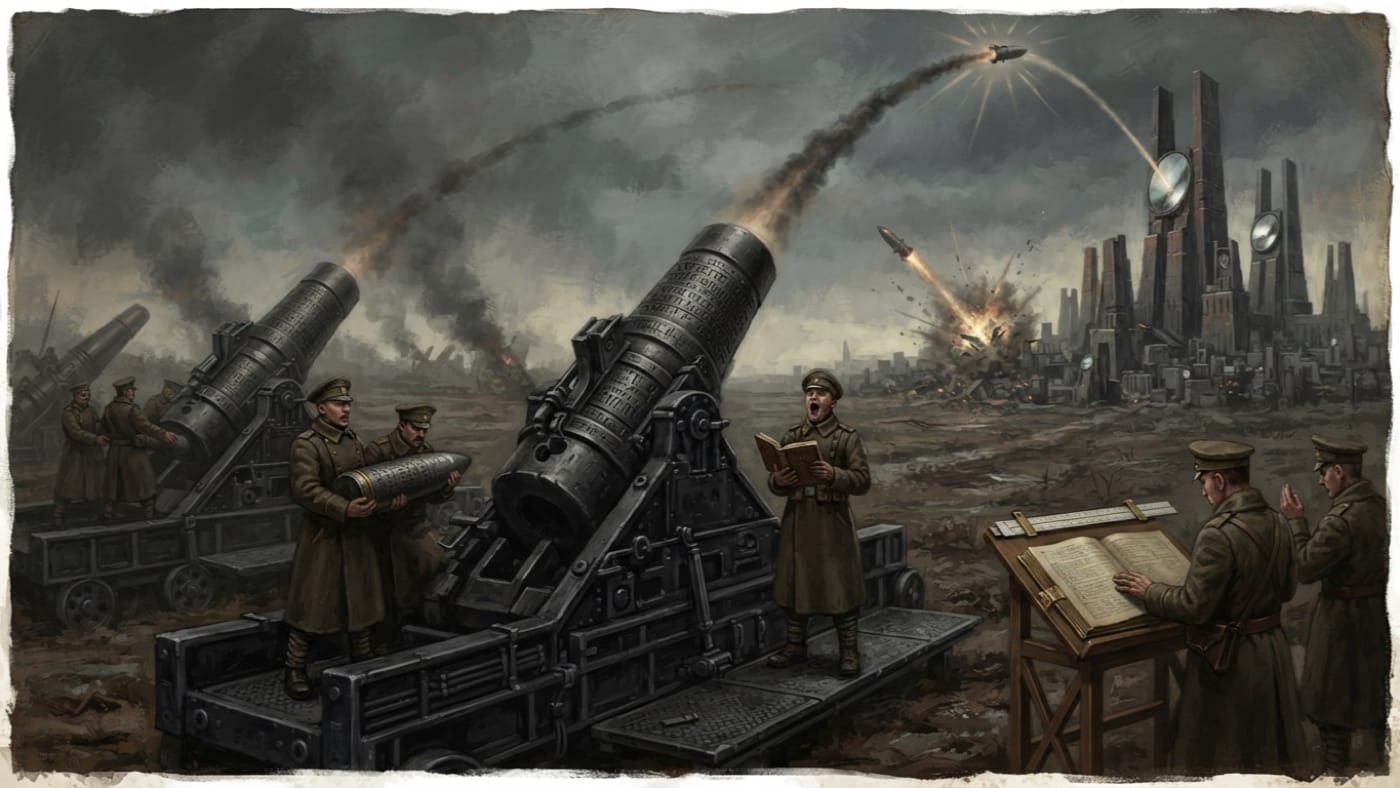
Artillery was the Rationalists' gospel, and the Great Deceiver, who has never written an original line in his existence, stole its pages. His servants raise towers of glass and mirror across No Man's Land, heretical steeples that hurl sorcery the way honest armies hurl shrapnel. These mirror-lenses bend light into lances. They turn prayers into static. On a bad morning they turn the air itself into panes sharp enough to shave a company down to its buttons. One tower left standing can blind a battalion, and the Church does not have so many battalions that it can lend them to the dark.
The Covenant answers with the Choir-Mortar. Pamphleteers in the rear speak of a Choir-Mortar Order, with a chapter house and a Grand Master in a regrettable hat. They are inventing a faction the War Bureau never chartered. The War Bureau keeps guns, crews to serve them, and a list of towers that must come down. The rest is liturgy, and liturgy is my department.
#On the Canticle and the Trajectory
Every barrel carries two inscriptions, and a gunner who confuses them does not serve long. The first is calibration: cold graduated marks for reckoning elevation and confessing error. The second is canticle, cut into the same metal by hands that know the psalter as well as the elevation table. So a Choir-Mortar is read twice before it fires, once by the eye that measures and once by the throat that sings.
The crews chant in cadence. Their psalms are measured against seconds of trajectory, so the verse and the flight begin together and must end together. A gunner who loses his place in the hymn has lost his place in the sky as well. The engineers keep their tables. The singers keep their hymnals, swollen with damp and blackened at the thumb-edge. The battery stands in its own smoke and chants arithmetic at the Creator.
The shell sings as it leaves the barrel. Men who have stood beside the guns describe the note thinning as the round climbs, a held vowel carried off into the haze. When it lands, it does not simply detonate. It concludes the hymn in fire. The earth takes up the final refrain, the tower answers with the sound of glass discovering gravity, and a false sermon stops mid-sentence.
To an outsider this looks like calculated counter-battery fire. To the Church it is the silencing of heresy at range. Both descriptions are on file, but only one of them is sung.
The record places Litany-Engineers beside these guns, and their trade suits the work: numbers and prayer in the same breath, as their own manuals have it. I decline to say they serve every battery. The record declines as well, and I never contradict the record when it agrees with me.
#On the Reflected Hymn
The enemy's tower is the lesser danger. The greater danger is its reflection.
A mirror-lens, properly angled or improperly blessed, will take a Choir-Mortar shell in mid-flight and send it back to the battery that fired it. Somewhere above No Man's Land the hymn turns to heresy, and the fire arrives with perfect accuracy at the wrong address. Many a choir has burned itself up in the act of song. The Bureau of Doctrine holds that such reversals prove insufficient fervor. Engines & Furnaces mutters, below the level of the minutes, that the angles simply lined up against us. Doctrine has the larger seal. Engines & Furnaces has the protractor. The dispute will stay open as long as both offices draw a budget.
Every party's proof-text is the Mirror Siege of Olmütz. For three days a triad of mirror-lenses returned every shell the Choir-Mortars sent against them. Every one. Entire batteries sang themselves into oblivion and left behind smoking craters, bent barrels and shattered hymnals. The surviving guns kept firing because they had been ordered to fire. The order was never rescinded, because no one left alive in the batteries held the rank to rescind it.
On the fourth day, a single shell struck true.
The account sets beside that shell a fusilier's dying cry, which struck the glass and warped the reflection as the round arrived. Doctrine declared a miracle. In the margin of the same report, Engines & Furnaces wrote two words: structural fatigue. I have read that note in the original. The hand is steady and the ink is cheap.
The ruins at Olmütz still glitter with warped glass. The War Bureau has issued no instruction that fusiliers be wounded near mirror-lenses for tactical advantage. Any gunnery sergeant who proposes one will answer to me before he answers to Purity.
ERRATUM — BUREAU OF WAR, ARTILLERY NOMENCLATURE (4TH REV.) For "misfire," read "trial by trajectory." For "collapse," read "voluntary surrender of ground." Battery returns using the superseded terms will be refiled at the submitting officer's expense. Any officer who uses both in one sentence will be invited to reconsider the sentence.
#On Cadence Broken
A shell does not have to come back as fire to come back as ruin.
At Saint-Verrine a squad of Litany-Engineers miscalculated their chant. The psalm-shell went up in flawed cadence and came down in corrupted form, as a dirge. It killed no enemy. For three nights the Covenant's own trenches sobbed. Commanders reported mass paralysis. Men wept too hard to lift their rifles, and sentries could not see over the parapet for their tears. A whole stretch of line grieved more thoroughly than any chaplain had ever made it grieve by sermon.
The Ash Chaplains broke the effect in the way the Church has always broken a bad hymn: they sang louder. The record does not say whether the grief gave way to the better verse or simply could not hear itself over the noise. I would not trust a record that claimed to know.
The Bureau of Purity ruled the engineers heretics. The Bureau of Records sealed the incident under "unhymned munitions," a category that now holds that file and, I am assured, nothing else. The engineers' later careers are recorded with admirable brevity.
#On Thessaloniki and the Ash Wedding
"Heaven's hymn and Hell's cruelty, married in one barrage." — Local gloss, spoken quietly
Thessaloniki is a Zone 7 port on the Aegean. It is a coastal installation, not one of the seven primary bastions, and every pew in the Synod should understand what that means. The Sagittal Line runs north to south with Bastion-Constantinople as its southern anchor, and the southern Line eats whatever comes through Thessaloniki's harbor. Strike the port and the trenches go hungry. Maldrake understood this. Wrath reads ledgers too.
During the Siege of Thessaloniki, a forge-sorcery out of the Iron Wastes raised a heat-hammer in the air above the city and pounded the walls with invisible fists. It needed no gun, no crew and no hymnal. Priests boiled alive inside their sanctuaries, at the altar, partway through the office, cooked in their own vestments.
Against this the Church sent its Choir-Mortars, and here the Choir-Mortars succeeded too well.
One barrage brought down five sorcery towers, and all five fell into the city. The enemy had been keeping civilians alive inside and beneath them as sorcery fodder. There were thousands of them. No ledger I have consulted gives a firmer figure, and I will not invent one to flatter the arithmetic. The towers came down on the people they had been eating, and the rubble entombed them where they stood.
As a counter-battery strike it was flawless. Every tower targeted fell, and the forge-sorcery's instruments went silent in a single sung volley. A gunnery officer reading only the battery return would have requested a commendation. Several did.
The Bureau of Doctrine holds that the dead were willing offerings. I record the holding. Nothing in the file shows that anyone asked them, and a captive kept as fodder is poorly placed to volunteer. The people of Thessaloniki call the barrage the Ash Wedding, a union of Heaven's hymn and Hell's cruelty. They say it softly, in rooms they trust.
The air above the ruins is said to shimmer with reflected cries. I have heard this from gunners and from fishwives, and I have no office competent to explain it. Doctrine has offered explanations. Engines & Furnaces has offered none, which is the more honest position and the harder one to fund.
The Twin Towers of the Harbor-Chain were rebuilt as bastions during the Choir-Mortar campaigns. That rebuilding has its own history, its own ledgers and its own dead, and the reader will find it elsewhere.
#On the Approved Account
The Church does not retire a weapon because it has once buried the wrong congregation. The Choir-Mortar is still inscribed, sung, aimed and argued over. When a shell strikes true, Doctrine credits fervor. When a shell comes back, Doctrine debits fervor and the battery is entered as having undergone a trial by trajectory. When the trenches weep, Records opens a new category. When the towers fall on the faithful, the dead are re-entered as offerings and the event is filed under Collateral Sanctification, Necessary.
Engines & Furnaces continues to submit its angles. They are received.
I have read every battery return I could requisition. I find the instrument sound, its crews brave and its paperwork immaculate. If a tower still stands after our hymns, the fault lies with the gunners, the angle, the glass or the Great Deceiver, and the War Bureau will tell you which once the forms are in.