
#On the Barracks That Learned to Breathe in Shifts
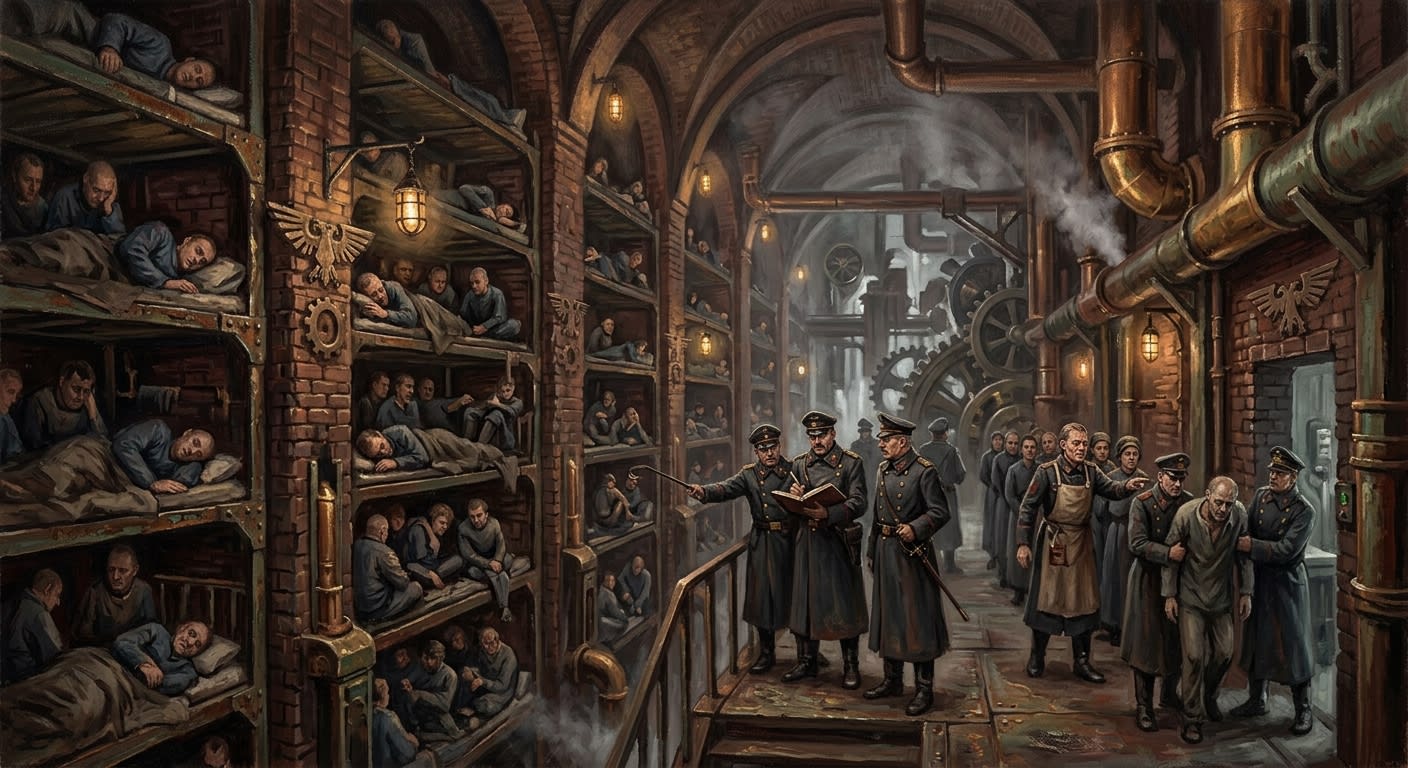
The Throat Dorms are the Choir Barracks of Essen-of-Hymnsteel, though no singer uses the official name unless an Orison Provost is close enough to count teeth. Two thousand calibration voices sleep, bleed, steam, bargain, mutter, train, fail, and wait inside those long brick lungs above the Foundry Core. The Bureau of Orison and Song calls them dormitories because a dormitory implies rest. The singers call them the Throat Dorms because honesty survives best in slang.
They stand between the Hall of Measures and Ledger Row, near enough to the furnaces that the walls sweat soot in winter and near enough to Records that every cough may be entered beside a work number. Boilers feed the herb rooms. Vents carry foundry heat upward through iron grates. Racks of drying throat-cloths hang in the galleries like surrendered flags. At any hour one may hear gargling, scale-practice, quota recitation, suppressed weeping, supervised silence, and the wet scrape of a singer checking whether the morning note still exists.
Essen lives by calibrated steel. Calibrated steel lives by prescribed song. Prescribed song lives by human throats, and human throats are soft, treacherous, finite instruments, which is why the Synod keeps them in barracks and calls the arrangement civilisation. Every bell-cannon throat shipped to Bastion-Przemyśl, every hymn-drive housing bound for Bastion-Constantinople, every reliquary rivet pressed for the Sagittal Line has passed through a voice before it passes through fire.
#On the Foundation Under the Tri-Bureau Compact
The Dorms took their present form after the A.S. 110 Tri-Bureau Compact ratified Essen as the Synod’s hymnsteel city. Earlier guild singers had lived above taverns, in church lofts, in rented attics, and in the unregulated warmth peculiar to towns where iron, beer, and bad judgment share a street. The Compact abolished that disorder with admirable violence. Voices became infrastructure. Infrastructure required housing. Housing required oversight. Oversight required locks.
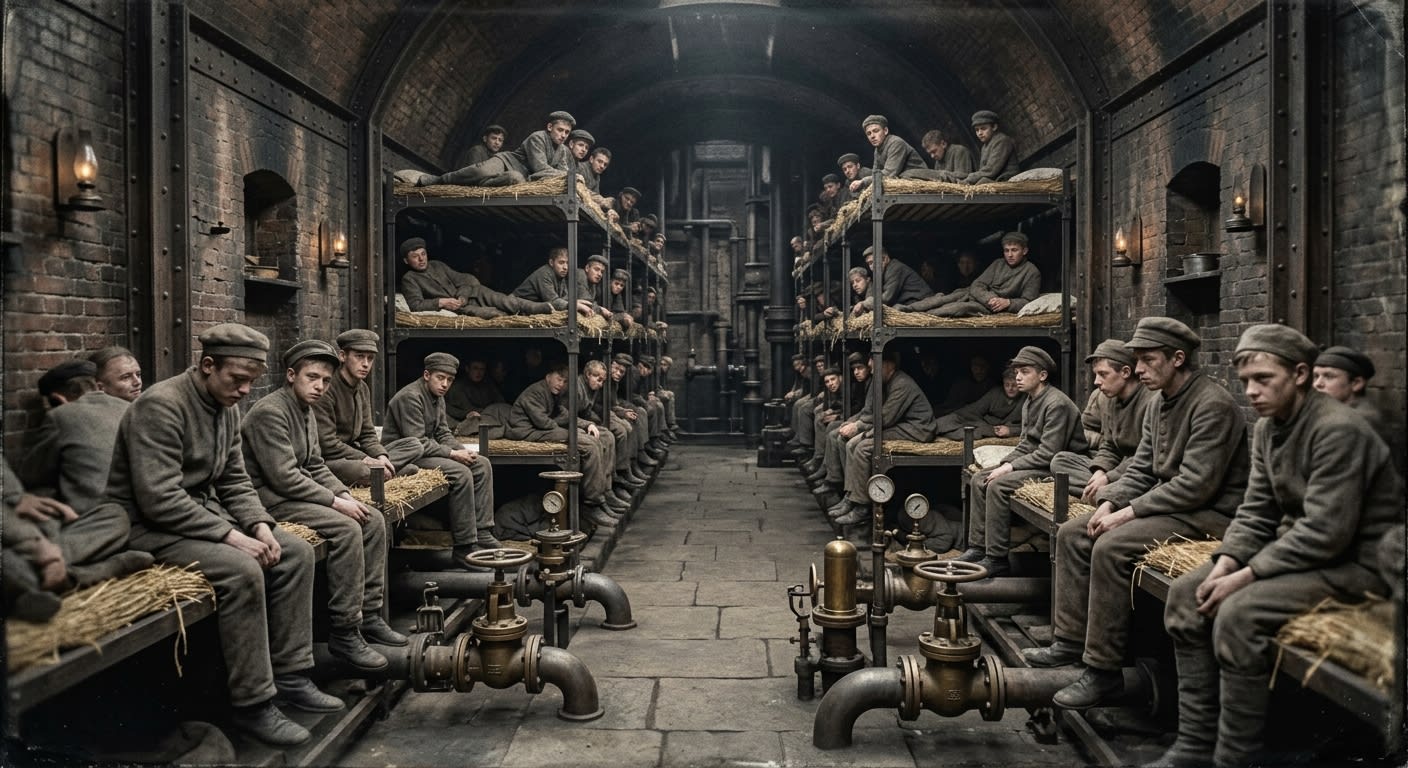
By A.S. 115, as the Foundry Core consumed the old artisan quarter, the first Orison barrack block rose along the north furnace terrace. The workmen used brick from demolished guild halls and bone-lime mortar assigned from a reliquary batch deemed too poor for bastion walls. The dedication sermon described the building as “a sanctuary of lawful resonance.” The first residents called it the Cough House. Both names were accurate, which is irritating but unavoidable.
The formal expansion came in A.S. 118, when Essen received its sanctified suffix and became Essen-of-Hymnsteel by decree. The voice tithe was enlarged. Certain families in the Ash Warrens owed one child’s throat per generation if pitch marks met Orison standard. Condemned labourers with tolerable hearing could commute lash sentences into chorus duty. Refugees with clean voices received warm bunks, ration priority, and the right to ruin themselves for the Line at closer range.
Municipal guidebooks once described entry into the Throat Dorms as “voluntary vocational devotion.”
Corrected. Voluntary is withdrawn. Devotion remains, under protest from every word that has ever meant anything. The usual paths are tithe, debt, sentence, family bargain, orphan transfer, and the rare genuine calling, which Orison displays in pamphlets the way a butcher displays parsley.
The Dorms were built to prevent dispersal. Singers kept together can be trained, watched, replaced, compared, disciplined, and blamed with unusual speed. A voice that cracks alone is a tragedy. A voice that cracks on the Dorm register is a staffing issue. The difference is the whole genius of the Synod, bound in brick.
#On the Rooms, Racks, and Lesser Miseries
The Dorms consist of six principal barrack ranges, three herb houses, two steam galleries, the Pitch Court, the Witness Stair, the Scar Room, the sealed archive of vocal failures, and a lower corridor whose official floor plan has the cowardice to stop before the last door. Range One holds first-year singers and transfer children. Range Two holds standard pour voices. Range Three holds basso labour assigned to furnace drones. Range Four belongs to alto and tenor rotation groups. Range Five houses retired voices awaiting reassignment. Range Six is empty on paper and never empty after Ninth.
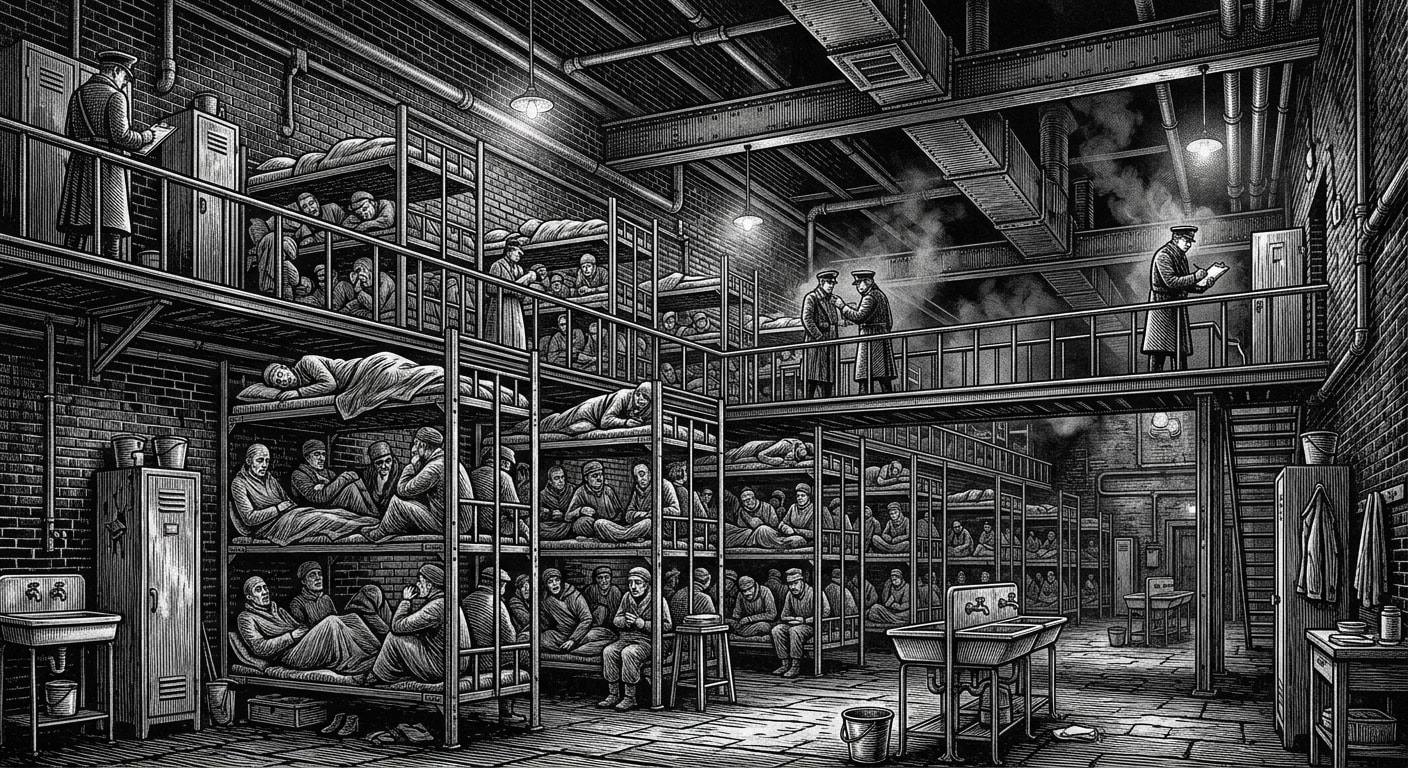
The bunks are narrow. The pillows smell of mint oil, vinegar, and fear. Range stewards keep the lists on Ledger Row forms, and every correction passes through a clerk trained to treat hoarseness as a fiscal event. Every bed has a slate at its foot with name, range, pitch class, medical caution, ration grade, and last approved stanza. Singers sleep by cohort so that the body learns to breathe in common. They wake by bell, drink bitter steam, submit to throat inspection, hum the morning gauge, receive their shift slips, and walk down toward the Hall of Measures with scarves wrapped tight against soot.
The herb houses are the Dorms’ unofficial chapels, tolerated by the Bureau of Orison and Song because even a Bureau that owns music cannot yet requisition saliva. There the singers trade salves, rumours, insults, and small heresies disguised as health advice. Licorice root is rationed by pitch class. Honey is contraband unless prescribed, which has made honey the city’s most tender sin. Salt gargles are issued before long pours. Laudanum is kept behind a wire grille and accounted for with more care than several categories of child.
The Pitch Court sits under an iron skylight blackened by decades of soot. Every morning the court fills with rows of singers, each one lifting a note toward a brass standard suspended from the rafters. The standard answers true, sharp, flat, or silent. True goes to shift. Sharp goes to correction. Flat goes to steam. Silent goes to the Scar Room. The room has no dramatic apparatus. That is what makes it effective. A chair, a lamp, a physician, an Orison clerk, and a table of instruments polished to a pastoral shine.
#On Labour, Bleed Shifts, and the Price of Pitch
A calibration singer is valued, expendable, supervised, and lied to. The career lasts nine years by Essen’s average, though averages are the Bureau’s way of placing a veil over an execution queue. Some voices fail in three. Some last fifteen and become instructors with the terrible patience of survivors who know the trap well enough to decorate it. The voice frays. The pitch drifts. The throat scars. The ear betrays. Breath shortens. The singer is reassigned to lock duty, slag sorting, clerical whisper work, or the Ash Warrens duct crews.
Orison calls this completion of service. The Dorms call it being spent.
Bleed shifts are the old scandal. Officially they no longer exist. In practice a bleed shift is any pour in which singers remain at station after throat-surface rupture, because the metal is too far into cooling and the Line needs the batch and the foreman has already signed the quota prayer. Blood in the mouth alters tone. Orison insists trained singers can compensate. They can. That is the horror. The throat bleeds, the singer adjusts, the steel cools true, and the report congratulates the cohort for disciplined devotion.
MEDICAL ANNEX — RANGE FOUR, A.S. 198 Eleven singers presented with arterial throat-spray after continuous Second Measure sustain. Batch retained. Seven returned to duty after steam sealing. Two reassigned to non-vocal labour. One died during notation. One produced a clear note post-mortem for four seconds according to three witnesses. Witnesses transferred. Cylinder sealed. Batch shipped east.
The Throat Line, the singers’ barracks union and monastery-brotherhood, arose from bleed shifts. It is not a union in the sentimental western sense. It does not issue pamphlets about dignity. It negotiates pause lengths, herb quality, corpse routing, and whether a singer’s family keeps heat credits after failure. Its slowdowns are disguised as liturgical caution because treason gets hanged and caution gets reviewed by committee. Mara Nine-Notes, missing three front teeth from a failed basso countermeasure, holds enough range loyalty that even Sister Rauth listens before refusing.
#On Stanza Sheets and the Mirror Risk
No place in Essen is better suited to the Mirror Choir than the Throat Dorms, and no place is watched more heavily for that reason. The Choir does not need a chapel where exhausted singers already gather in rows, whisper through steam, and handle authorised hymn sheets with cracked fingers. It needs one changed syllable. One breath mark shifted by a tired copyist. One quarter-tone taught during cough practice. One beautiful correction offered to a singer whose approved line tears the throat and whose forbidden line feels merciful.
The Bureau of Purity has hunted Mirror Choir traces in the Dorms since A.S. 187, the year of the Ash-School Scandal. The timing is the kind of coincidence Records likes to sit on until it stops moving. That year a Furnace Catechist taught causal fire to a clever apprentice; that year altered sheets began moving through Essen with a discipline that looked educated; that year Orison discovered that singers who understood why a line hurt were harder to keep grateful for the injury.
Compact notices claimed stanza contamination entered the Dorms through refugee agitators from the Ash Warrens alone.
Corrected A.S. 201 after three licensed Cantor-Scribes, one Orison copyist, and a Records hand from Ledger Row were implicated in variant circulation. The Warrens carry hunger. They did not invent handwriting.
The standard audit is intimate enough to offend a corpse. Provosts inspect teeth for scale-fractures. Clerks oil the fingers and press them against page edges to catch illicit chalk. Steam cabinets expose hidden breath marks. Singers recite approved lines backward, forward, whispered, mouthed, and tapped against the sternum. A cough at the wrong place becomes evidence. A beautiful tone becomes suspicious because beauty not requested by authority is always halfway to revolt.
The Alto With No Name is said to have slept in Range Six, Range Three, the steam galleries, or nowhere at all. One story calls the Alto a ruined singer whose voice failed but whose correction sense sharpened. Another calls the Alto a Records clerk who never sang and conducted by page weight. A third claims the Alto is not a person, but a title passed by pitch. Purity files all accounts as masks. Singers file them as hope, which is far more dangerous.
#On the Quiet After Bloom
When a Resonance Bloom strikes Essen, the Throat Dorms become either hospital, prison, or oracle, depending on which Bureau reaches the doors first. Tools hum in lockers. Teeth ache in even intervals. The Pitch Court standard trembles without being struck. Singers wake with blood on their pillows and notes in their mouths they were never taught. The foundations answer from below the Foundry Core, and the Dorms, being packed with trained human instruments, answer back before any order can stop them.
After the A.S. 199 Bloom under the southern measures, Range Two fell silent for three days. Not quiet. Silent. Footsteps vanished. Bells struck outside and failed to enter. A singer cut her palm and watched the blood fall without sound. Orison declared the range sealed for acoustic sanitation. Purity declared it a suspect choir mass. Medicine declared it unhealthy, which was brave of them, given the competition.
The singers remember that silence as luxury and threat together. Licensed silence belongs to the Quiet Gradient and costs more than a worker earns in a year. Bloom silence costs nothing at first, then everything. In it, singers heard the body rather than the Bureau: pulse, lung, swallow, bone. Several refused to resume Ninth Peal after the range reopened. They were not punished publicly. Public punishment would have implied a doctrinal dispute. They were reassigned, which is cleaner.
#On Present Condition
As of A.S. 201, the Throat Dorms are overfilled, under-rested, watched by Orison, courted by the Mirror Choir, raided by Purity, taxed by Records, and required by Engines to produce more song than human cartilage was designed to bear. Strasbourg’s latest procurement mandate demands tripled output for hymn-drive siege engines. Sister Rauth refuses to accelerate without stability guarantees. Furnace-Marshal Kord threatens conscription. Arch-Notary Veyl prepares forms for either outcome and will profit by both, because Records is the only Bureau that hears screaming as an opportunity to standardise intake.
The practical changes since the Ash-School year remain visible. Private tutoring is restricted. Chalk is dissolved after lessons. Singers may not keep personal copies of warm-up lines. Range stewards report any voice that improves too quickly. Honey ration violations now carry acoustic suspicion. The Dorms have become a mouth under inspection: opened by command, probed by instruments, praised for obedience, blamed for rot.
A rumour moves through the bunks after Ninth. Second voice, third bell, old plate. It appeared first under a Hall of Measures lectern, then on a herb-room tile, then inside the cover of a cough ledger, then carved beneath a Range Five bunk by a singer whose hands were bandaged at the time. Sister Rauth has ordered each mark burned, scraped, dissolved, or blessed. The phrase returns with the manners of an unpaid invoice.
The Dorms will sing tomorrow. They will rise at First Bell, drink steam, submit to inspection, lift approved notes toward brass, and descend to the furnaces in rows. Some will bleed. Some will sing true. Some will sing a syllable that was not on the sheet and swear later that the metal asked for it.