
#On the Room Where Steel Is Given a Throat
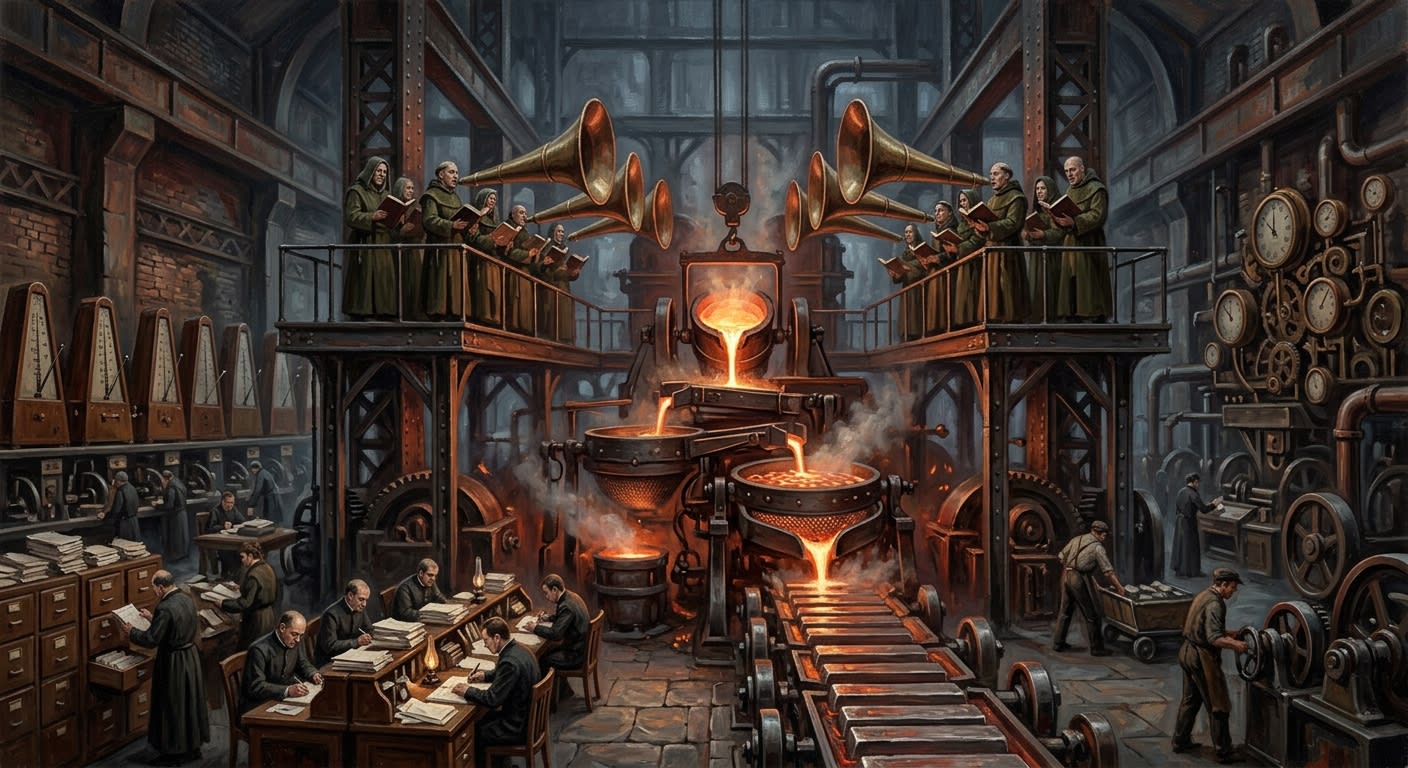
The Hall of Measures stands at the centre of the Foundry Core of Essen-of-Hymnsteel, a black-vaulted calibration chamber where paired choirs sing across crucibles and molten metal is persuaded, threatened, measured, witnessed, blessed, cooled, and taught to remember the approved note. It is a room, yes, if one is content to call a stomach a room because food passes through it. The Hall is where ordinary steel becomes hymnsteel; where voice is made industrial; where three Bureaus pretend that metallurgy, liturgy, and arithmetic can share one floor without murdering one another.
The singers are not performing. They are working. This distinction should be nailed above every sentimental engraving sold to pilgrims who like their factories picturesque and their labourers safely allegorical. A calibration singer (Unregistered) in the Hall does not lift the voice for beauty. The voice holds grain. The voice steadies cooling. The voice enters the metal and remains there, waiting for stress, heat, relic proximity, demonic pressure, or some idiot at the Line firing before the third bell.
#On Its Foundation Under the Compact
The Hall was not born as a sacred chamber. Sacred chambers rarely are. It began as an industrial necessity inside the A.S. 110 Tri-Bureau Compact, after Engines and Furnaces absorbed the old Essen guild-forges, Records discovered that men could be made to vanish through defective paperwork, and Orison learned that a furnace can be made to obey cadence if enough singers are spent near it.
The old guild halls measured by eye, hand, colour, hammer sound, and the unlicensed competence of men whose fathers had taught them which orange meant workable and which white meant death. The Compact despised this inheritance because it could not be audited without admitting the old masters knew things no Bureau had invented. The Hall of Measures solved the embarrassment. It replaced memory with stations, judgement with registers, craft with sanctioned sequence. The guild-master became a foreman. The song became a form. The pour became liturgy under guard.
Compact commemoratives describe the Hall as the “natural flowering of Essen’s ancient metallurgical piety.”
Corrected. The Hall flowered by writ, seizure, floor-breaking, choir conscription, and the conversion of three guild chapels into Records cages. Ancient piety was invited to cooperate after its property had been measured.
By A.S. 115 the artisan quarter beneath it had been eaten by slag runs and gantry feet. By A.S. 118 the city itself was renamed Essen-of-Hymnsteel, though the Hall had earned the suffix earlier. By A.S. 130 the Sagittal Line consumed everything the Hall could certify and requested more in the tone of a dying man requesting air.
#On the Architecture of Measure
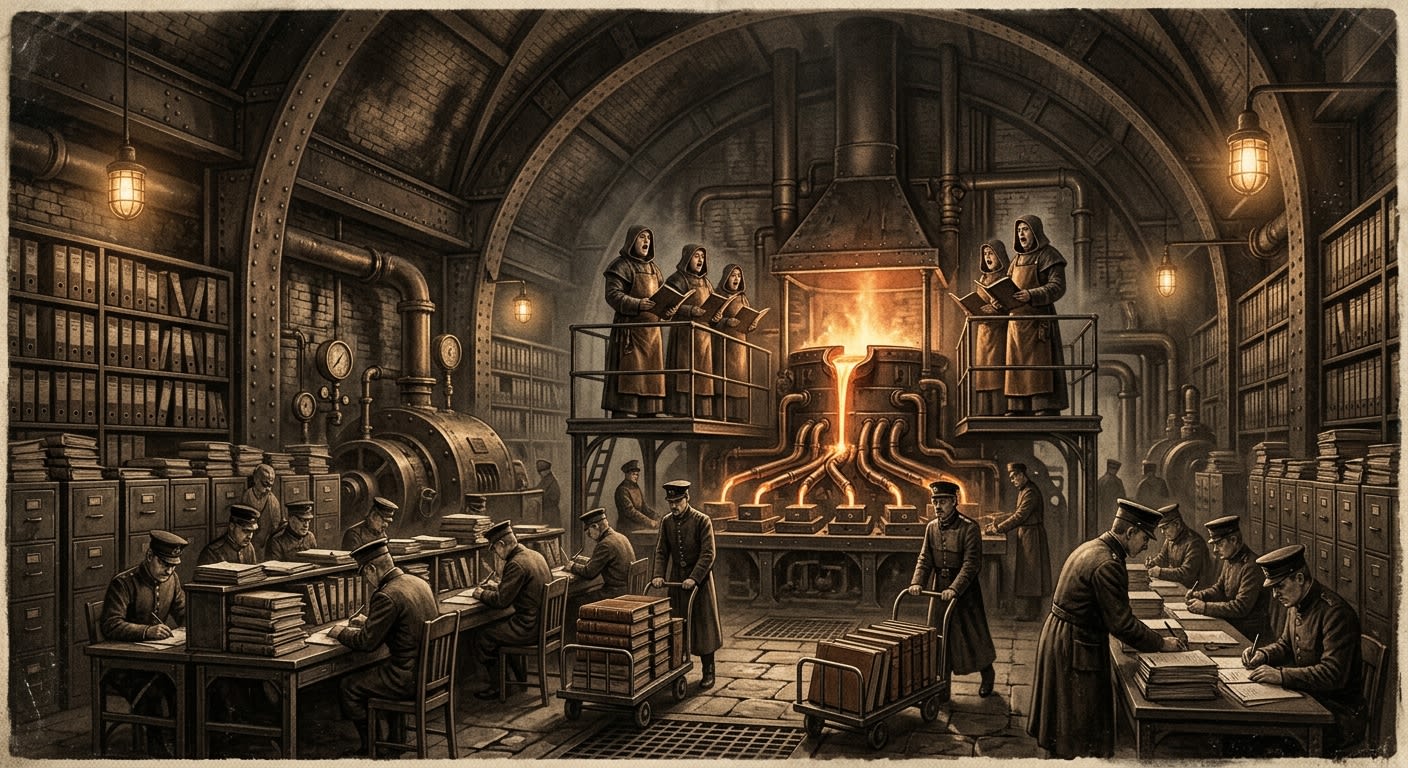
The Hall’s roof is blackened vaultwork ribbed with iron. Heat has made the lower ribs sweat mineral tears. The floor is a ruled surface of runnels, crucible mouths, cooling trenches, chalk lines, pressure stations, and forbidden shortcuts everyone uses when the overseer is not looking. Choir platforms face one another across the central heat. Records cages hang above the south aisle like confessionals built by spiders. Engines stations ring the crucibles with gauges, slag hooks, shutter chains, crank wheels, and brass warning bells rendered decorative during the very moments they matter most.
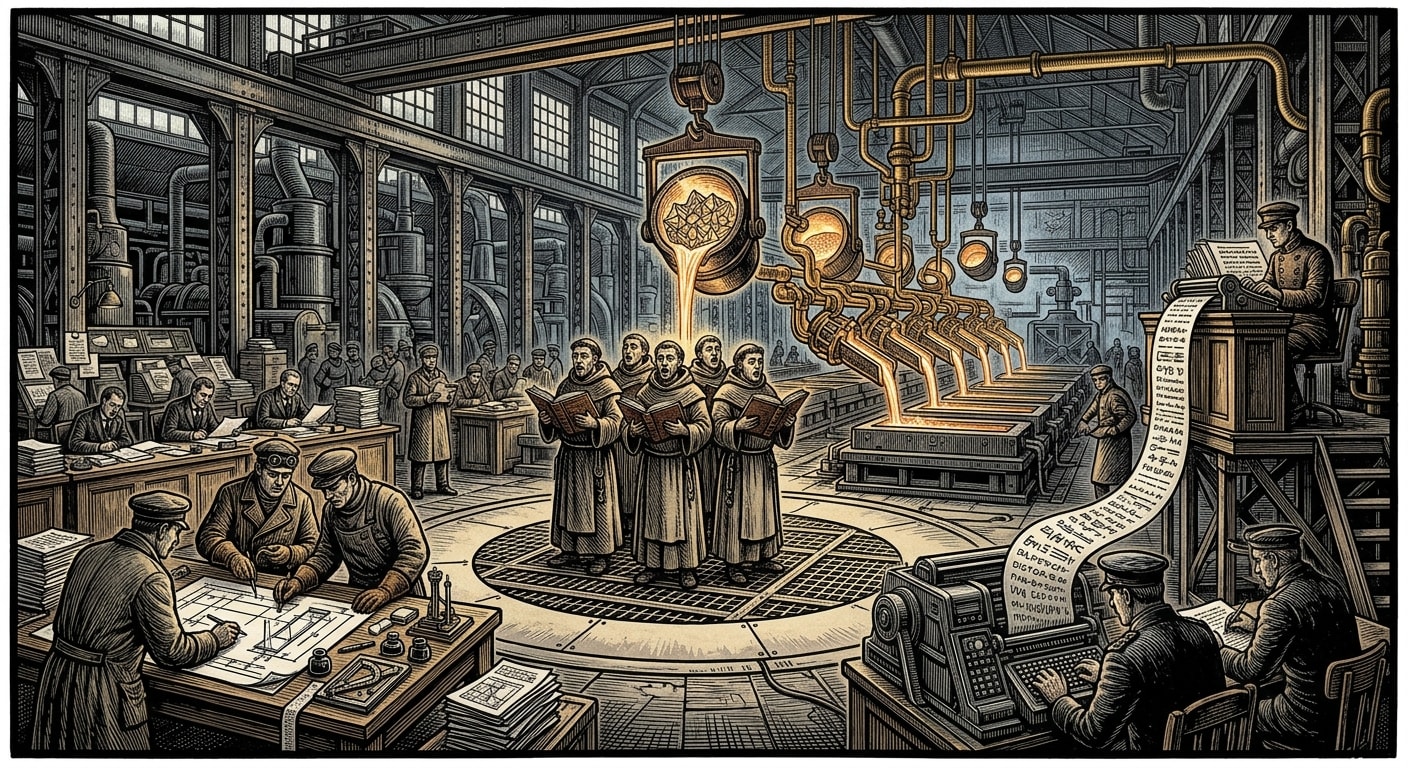
Chalk dust lies everywhere. Iron dust joins it. Throat herbs sour in bowls. Ink dries in layers on the witness desks. The whole chamber smells of scorched oil, wet wool, hot metal, ash-salve, boiled licorice root, and the particular fear produced when a man knows the object in front of him is both expensive and liquid.
Every approach is controlled. The west aisle admits singers from the Throat Dorms. The east admits furnace crews. The upper south stair admits Records witnesses, who descend only far enough to claim authority and not far enough to acquire moral knowledge. The north gate opens toward cooling and shipment. The sub-floor access, officially a maintenance crawl, is where older workers listen for the Wrong Choir through their boots and pretend to check rivets.
#On the Pour Sequence
A standard pour begins before dawn. First Bell: throat inspection, chalk renewal, platform count. Second Bell: crucible opening and low antiphon. Third Bell: paired choir entry, Engines release, Records witness. Fourth Bell: grain-setting stanza, no movement except authorised hands. Fifth Bell: cooling silence, signatures taken before water touches the runnels.
This is the public sequence. The working sequence includes coughing, sleeve burns, a rigger swearing into his own glove, a tenor swallowing blood without changing pitch, an Orison Provost (Unregistered) pretending not to notice because the note remains useful, and a Records clerk entering “minor vocal dampening” where a less polite office might write “boy ruptured something warm.”
The paired choirs stand across the heat so their measures cross inside the pour. Orison says the crossing aligns the grain. Engineering says the vibration stabilises cooling stress. Doctrine says obedience. The workers say hold. Hold is the better word. It contains no vanity, no theory, no promissory sermon. It is what a man says when the gantry shudders and the metal decides whether he has been sufficiently respectful.
MEASURES INCIDENT — GALLERY NINE, SEALED ADDENDUM Object: bell-cannon throat, mid-pour. Observed anomaly: cooling metal answered before Fourth Bell. Choir response: held prescribed stanza; three singers lost teeth in sequence. Floor note: █████████████████████████ from beneath runnel. Disposition: batch destroyed; sound retained in cylinder; cylinder warm after burial.
#On Records, Cages, and the Ownership of Failure
The Hall does not permit an unrecorded error. This claim is false, naturally, but the architecture believes it and belief in architecture can crush a man as surely as stone. Records witnesses sit in iron-mesh cages above the south aisle, copying batch numbers, singer rosters, stanza sheets, heat marks, injury notations, tool transfers, cooling times, signatures, countersignatures, and the small improvised lies by which production survives inspection.
No failure belongs to itself. A cracked batch becomes an argument over whether Engines heated too fast, Orison sang too low, Records miscopied the sheet, Purity missed a variant, Medicine underestimated throat strain, or Doctrine has retroactively discovered Providence in the fracture. The Discrepancy Cage receives such metal first as paper and only later as matter. A batch may sit condemned in language while the physical ingots wait nearby, perfect, expensive, and legally dead.
Returned failures from Bastion-Przemyśl and Bastion-Constantinople pass through the Hall in reverse. The metal comes back cracked, sheared, softened, or humming in a pitch no one admits hearing. Clerks trace its ancestry: ore, heat, singer, stanza, cooling trench, witness, shipment, gun crew, death. If the fault can be pushed into a dead singer, the Hall breathes easier. If the singer remains alive, the Hall begins sharpening forms.
#On Singers and Their Useful Ruin
The Hall spends throats with the decorum of a chapel spending candles. Calibration singers enter young, trained in the Choir Quarters, oiled with herbs, measured by pitch, rationed by usefulness, and watched by Orison like instruments that have inconvenient parents. A good singer can hold a grain-setting stanza while heat peels moisture from the eyes. A great singer can do it after a tooth cracks. A dead singer, if properly entered, can become a safety lesson.
Careers are brief. Nine years is a respectable span. Twelve is spoken of with awe. Three means either bad luck, bad technique, bad foreman, or a plant reassignment that officials prefer not to name aloud. When pitch frays, singers are reassigned to non-vocal labour: slag haulage, lock work, duct repair, Ash Warrens service, or Records pending status, that mild administrative pit where names fall softly and do not return.
Orison personnel circulars describe post-vocal reassignment as “completion of service.”
Clarified for internal medical use: completion may include scarred larynx, blood cough, pitch collapse, partial deafness, heat-sight, and sudden inability to hear children crying above furnace tone. The service completes itself upon the body.
The singers have their own superstitions. Never drink cold water after Fourth Bell. Never step over a cracked chalk line with the left foot. Never hum a missed stanza while facing the cooling trench. Never ask why Sister Rauth (Unregistered) does not sing. Never sing the old fourth line, even as a joke, unless one wishes the floor to answer.
#On the Ash-School Shadow
The Ash-School Scandal of A.S. 187 haunts the Hall because it proved the forbidden thing: understanding improves performance. A Furnace Catechist taught real thermodynamics to a brilliant apprentice in a foundry instruction annex. The apprentice understood enough to shout a forbidden correction and save a pour. Purity arrived with polished boots and educational violence. The Catechist was immured. The apprentice was sent to the Paper Mines of Ulm. The plant was reassigned.
The Hall remembers the shout. Officials deny this. Officials deny many acoustic facts while standing inside a city that makes steel by singing at it.
After A.S. 187, bait phrases multiplied. Inspectors asked workers why flame stabilised, why pressure rose, why a cooling trench hissed before water touched it. Correct answers became dangerous. Incorrect answers became training. Silence became wisdom. Yet production still required men who could hear heat and smell failure. Essen survives inside that obscenity: knowledge needed, knowledge forbidden, ignorance punished when it costs output.
The Mirror Choir found its first clean variants in this atmosphere: frightened talent, censored skill, singers who knew the score bent away from the throat, apprentices who learned that true explanation leads to walls or mines. No official chain links the Scandal to the Choir. Official chains stop where liability begins.
#On the Mirror Choir in the Hall
The Hall is the Mirror Choir’s dream and hunting ground. A single altered syllable in a calibration hymn can pass through the singer, into the crucible, through the cooling grain, and out to the Line disguised as obedience. A quarter-tone below the approved pour-stanza may not crack the batch in Essen. It waits. Weeks later a bell-cannon throat splits, a hymn-drive housing shears, a reliquary rivet softens during consecration, and the metal remembers who touched it.
The Choir’s variants hide in plain authority: clean stanza sheets, licensed chalk marks, page oil, breath notation, copyist hands that have passed review. This is why Purity hates them with such professional intimacy. A dirty forgery flatters inspection. A beautiful forgery humiliates it.
The Hall’s lecterns are inspected twice daily since the anonymous A.S. 201 chalk mark under the second platform: Second voice, third bell, old plate. Sister Rauth ordered the lectern burned. The ash sang for eleven seconds. Records entered the duration. Orison disputed the pitch. Engines asked whether the wood could have been salvaged. This is how institutions pray when frightened.
#On Bloom and the Old Plates
Resonance Bloom predates the Mirror Choir by decades. The Hall knows this. The Compact Council knows this. The wrongness below the floor has been humming since before the insurgents found their doctrine. Tools answer before struck. Teeth ache in repeating sequences. Ink trembles in Records cages. Candles lean toward the runnels. During Bloom, the Hall ceases to be a workplace and becomes an ear.
The buried explanation concerns the Master Hymnal Plates. Older forge stanzas contained a fourth line that produced sub-foundation speech during pours. The revised Plates suppress it. No office admits authorship. Orison calls the change standardisation. Engineering claims no memory. Records lacks the revision trail with the careful innocence of a cat beside an empty reliquary. Doctrine denies the premise and keeps a copy.
When Bloom rises, the Hall’s approved measures become fragile. Singers feel the forbidden line before they hear it. Workers pause. Foremen scatter crews under the pretext of inspection. Orison calls this panic. Those foremen remain alive too often for mockery to survive.
Compact Report 447-E attributed the recent Bloom events wholly to Mirror Choir sabotage.
Corrected under sealed review. The Mirror Choir exploits Bloom, imitates Bloom, hides inside Bloom, and may worsen Bloom. It did not invent the voice beneath the Hall. Blaming arson for a volcano is tidy and, in this instance, insufficiently frightened.
#On the Present Heat
As of A.S. 201, the Hall of Measures operates under acceleration orders from Strasbourg. The Line wants more throats, housings, rivets, collars, braces, fixtures, fasteners, certified parts with obedient grain and no memory of the wrong note. Furnace-Marshal Kord demands tempo. Sister Rauth demands stability. Arch-Notary Veyl prints forms for both disaster and triumph, in matched sets, because Records is the only Bureau that can profit equally from survival and ruin.
Three Bloom events in eighteen months have made the chalk lines thicker. Extra Orison Provosts stand behind the platforms. Purity inspectors watch teeth. Engineers pretend not to listen to workers from the Ash Warrens who can predict floor tremor by duct-stutter. Records has begun writing certain batch numbers in red under-ink. The Hall continues to pour.
That is its horror and its glory. The Hall of Measures does not stop because stopping would reveal how much of Europe depends upon a room full of frightened singers holding a note over fire.