
#On the Assembly That Refuses to Become an Office
"Seat of assembly: see field. Officers: see elders. Address for correspondence: midsummer." — Reply to Bureau of Records Form N-11, Northern Registry, received undated
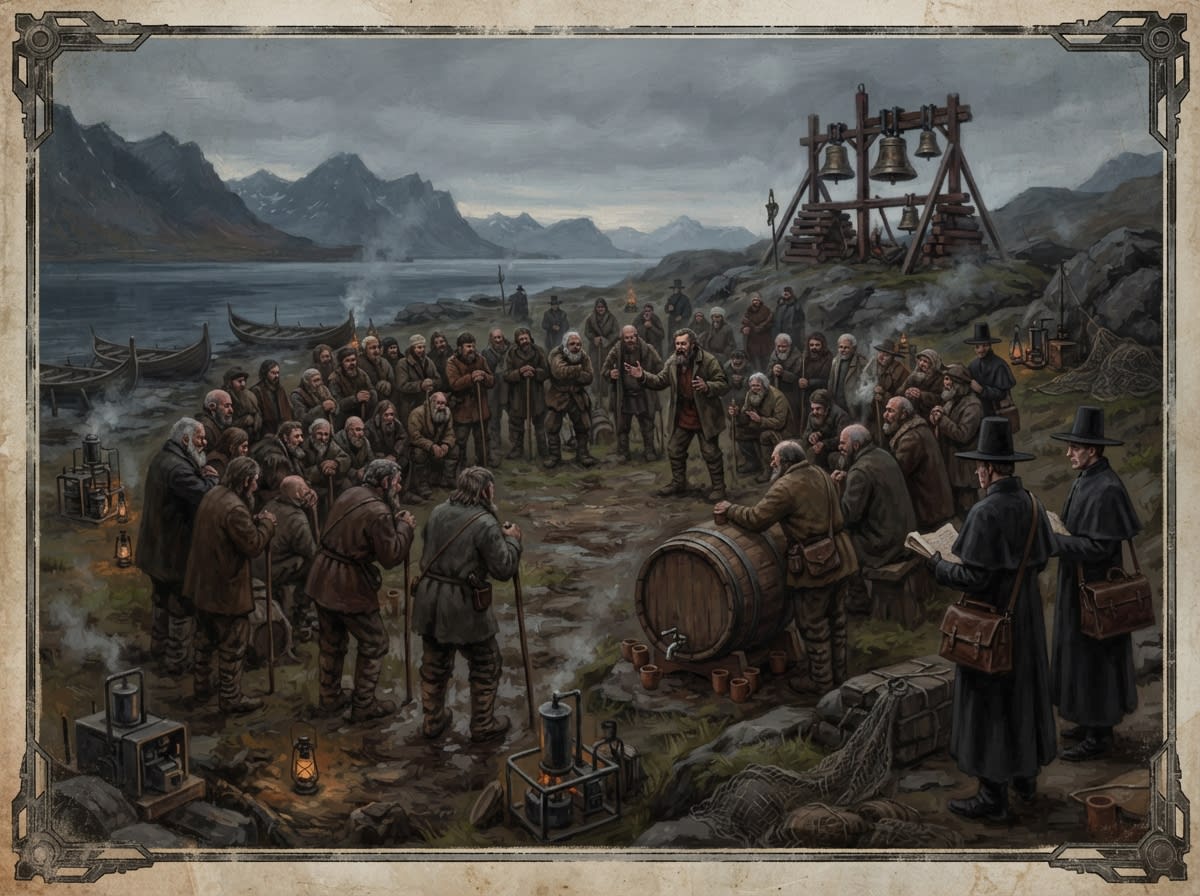
The All-Moot is the grand assembly of the Fractured North. It settles what the Clan Moots of separate valleys, fjords and island chains cannot settle among themselves. When it can be troubled to, it also conducts the North's collective business with Strasbourg. It meets once a year, at midsummer, when the sun will not set and the elders will not go home. It has met every year since the Concordat era, when the northern clans were attached to the Synod's claim through an accession. The Bureau still cannot match the seals on that accession to any surviving valley.
It has no hall. It meets in a field, and the field changes. By custom the assembly goes to open ground near whichever harbour-town lost the argument about hosting. The loser of one year's deliberation therefore chooses the ground for the next, and is obliged to feed it. No Bureau charter in Strasbourg contains a mechanism so economical.
The Bureau of Doctrine files the All-Moot as a legislature. The Bureau of Records files it as a festival. The Bureau of Tithes files it as a market and has tried to assess it, with the usual results. All three are partly correct, which in Strasbourg is the same as being wrong.
#On Who May Speak
"Here a man speaks by what his grandmother did." — Saying recorded at the Bergen approaches, A.S. 193, translation contested
The circle is made up of whoever the Moots send, and the Moots send whom they please: clan-heads, fjord-wardens and council-women. A Watch Captain attends when the business concerns the water, which is most years. There is no roll. A delegate is known by face and kin, and by the account of every winter survived and every debt paid or left standing. A speaker who lied at a Moot thirty summers ago will be reminded of it before the first sentence is finished, sometimes by someone who was not yet born when the lie was told.
Speech follows reputation. The Bureau's clerks, looking for an order of precedence, found only that the right to hold the circle passes to whoever the circle stops interrupting. Proceedings run in Old Norse, and they run fast. The mead runs faster, in volumes the Bureau of Temperance would classify as a sacramental emergency. Nobody present seems the worse for it except the southerners.
The Priors attend at the edge. The Synod maintains eleven Prior-districts on paper. Some years one Prior comes, some years three. They stand behind the elders with their papers and their hats, and are fed, and are not consulted. Prior Malthus of Hrafnvik holds more exemption-stamps than any cleric north of Königsberg. He has described his role at the All-Moot as "witness to a verdict delivered in a language I can order bread in."
#On the Business of the Circle
The docket is not written down. It is remembered, and it is long.
Feuds come first. A killing in one valley becomes a debt in three, and the All-Moot sets its price: so many barrels, so many seasons of fishing rights, one marriage between houses that would sooner drown. Where the price will not hold, oath-pledges change hands. Occasionally a son or daughter is fostered across the water for a term of years, which the Bureau of Purity calls hostage-taking and the North calls manners.
Seal-oil obligations follow: who renders for whom, and who owes lamps to a village that lost its boats in a bad spring. Then come the passage rights. The circle decides which winter routes stay open, whose cairns mark them, and which settlement takes in whose people when the ice shuts a fjord. Then the warm-papers, the northern transit documents that are honoured and forged in a proportion the Moot settles and the Bureau pretends not to know. Then the Watch, and here the elders lower their voices.
Every clause of this business rests on the same condition: no northern settlement survives alone. A fjord without its neighbours' fish starves in March. A village without its neighbours' oil goes dark in December. A bell-tower whose warning goes unanswered by the next headland rings for nothing. A hamlet the others have stopped counting is a hamlet left alone with the Grey. Nothing enforces the All-Moot's rulings except the certainty that the ruled will need the rulers before winter is out. I have seen Strasbourg writs carried by armed couriers and obeyed less.
The Bureau of Bells understands this part least. The fjord bells ring tunings older than the Bell Codex ratified in A.S. 115. They are older than the Office of Bells constituted in A.S. 52, and older, if the elders are believed, than the Sundering of A.S. 45. The Bureau has asked for those tunings three times and been refused three times. From the refusals it learned that the tunings belong to no single ringer, family or village. They belong to the circle. No elder may sell them, and no village may trade them for grain. Strasbourg could isolate a compliant Prior and supply him generously with paper, and he still could not copy the tunings out. He does not have them. The people who do have agreed at midsummer, in front of everyone who could starve them, that nobody does.
#On the Four Invitations
"The Synod's business will be heard on the last day." — Customary reply to Strasbourg, every invitation on record
The All-Moot has invited the Synod four times: in A.S. 92, A.S. 130, A.S. 174 and A.S. 193. Each time the Synod's portion of the agenda was placed on the final day. Each time the final day was held in Old Norse, at speed, after a week of mead.
The envoy of A.S. 92 went north two years after the Concordat to receive the submission of a people the Synod had already claimed. He received a feast. The Bureau of Rites dates its classification of the northern bells from his return: "pre-Concordat liturgical variants, status unresolved."
The envoy of A.S. 130 arrived in the year the Bureau of Records began counting the North. He was given numbers. They were plausible, consistent and wrong, and the circle had agreed on them before they were offered to him.
The envoy of A.S. 174 brought the Bureau of Records' chart of northern clan obligations for the elders to confirm. It was eleven feet wide and rolled on a pole. The elders unrolled it on the grass and corrected it for two days. The corrections were spoken aloud, and the chart went home unaltered. Records' own archivists later filed it as "technically correct and practically useless." The circle had reached the same verdict on the first morning.
ERRATUM — BUREAU OF RECORDS, NORTHERN REGISTRY.
Chart N-174 (Northern Clan Obligations) ratified by the All-Moot, A.S. 174.
Chart N-174 was displayed to the All-Moot, A.S. 174. The Registry has no record of ratification. The All-Moot keeps no record of anything. Elders consulted on the matter in A.S. 197 remembered the chart chiefly as the thing used to keep the rain off a cheese.
The envoy of A.S. 193 met the circle on a hillside at the Bergen approaches, above black water, with a bell-cairn on the ridge. His hat went into the fjord during deliberations. The mead continued. That same season the Bureau of Bells made its third request for the old tunings and was refused. The refusal came with a demonstration at sea, the file on which the Bureau of Shadows holds and I will not describe. That season too, a northern emissary reached Königsberg by longboat. He carried twelve pounds of salted cod and a letter asking Strasbourg to stop sending missionaries, who were frightening the goats. The Northern Office believes the letter was drafted on that hillside. The All-Moot has neither confirmed nor denied this, because it has no officer empowered to do either.
None of this was news to Aldric Moen. In A.S. 178 he sat six weeks at a Bergen cliff-post and reported that the bells worked and should not be changed. Investigation 447-N was dispatched in A.S. 199, after the sea demonstration. It reviewed fourteen settlements, sealed seven, and arrived at Moen's conclusion at considerably greater length. Harmonisation of the northern bells has been suspended as of A.S. 201. Nobody informed the All-Moot, and nobody needed to. It had never agreed to be harmonised.
#On Why Strasbourg Has Not Replaced It
The Synod could abolish the All-Moot tomorrow. It would only need to find it.
The Bureau has considered substitutes. One was a Northern Council sitting at Königsberg, with a register and a clerk. Another was a standing chancery at Bergen. A third would have ordered the eleven Priors to convene in synod and speak for their districts. That would have produced eleven men empowered to bind some 1.9 million souls (by the revision of A.S. 200) who do not recognise the districts. Every proposal breaks on the same stone. The North will attend whatever Strasbourg builds, politely, and will feed it. Then it will settle its actual business at midsummer in a field.
The All-Moot does not need replacing, and Strasbourg finds that the hardest injury to file. The North renders its oil and ships its fish. It sends its sons and daughters to the Line and keeps its bells ringing on the headlands. It is faithful. It cannot be conquered piece by piece, because every piece answers to a circle that meets somewhere new each year and forgives no one who bargains separately. It cannot be conquered whole, because there is no whole to seize. It has no capital, no archive, no army and no seal. It has a date on the calendar and the certainty that the others will be there.