
#On Their Enforcement
No one has ever seen the clause-spirits of the Steppe Gate, and the town bills for them all the same. The local registers call them wind-born enforcers of mispronounced terms. The Treaty Office lists them among the town's demonic threats, beside debt, audit and rival caravan-lords. The Office meant that list as a list of dangers. It reads better as a confession.
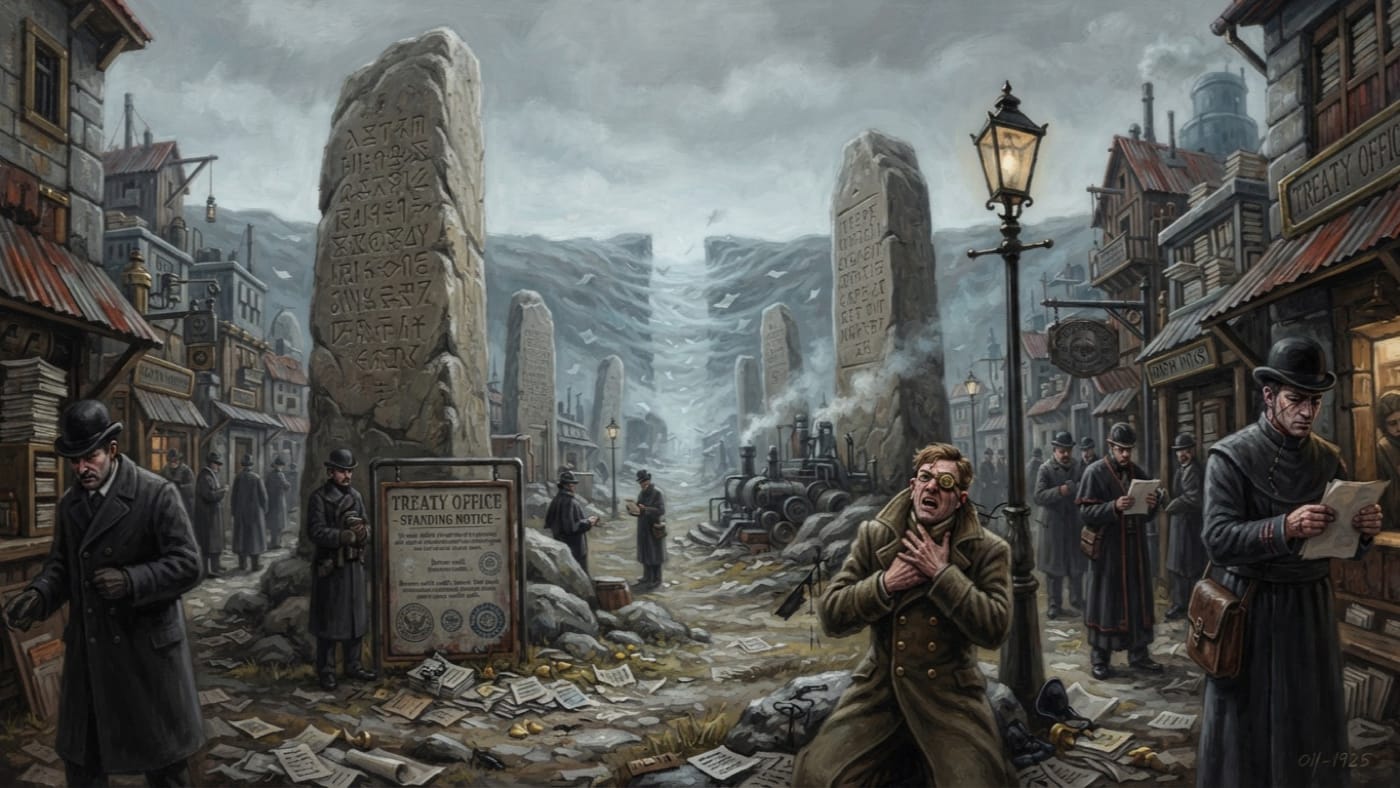
They are known by what they leave. First the throat tightens, as though someone had buckled a collar on the inside of the windpipe. Then ink comes from the ears. It is black, thin and steady, the colour of a court docket, and it looks nothing like blood until it reaches the collar. In a still room, paper edges lift and open the skin of wrists and cheeks. Documents left on a table overnight are found corrected in a hand no clerk will own: the faulty syllable struck through, the proper form written above it, the ink still wet at dawn.
That is the evidence. No anatomy is recorded. No corpse has been laid on a Bureau slab. No count has been taken, and no single spirit has been captured, named or questioned. The Ledger knows their effects as precisely as a coroner and their nature about as well as a tavern does. I file them under the bestiary because the bestiary has the larger drawer.
#On the Stones and Their Jurisdiction
The Gate sits at the narrowest gap in a limestone ridge on the eastern edge of the steppe. The crosswind there never stops, and the town has gathered around the Treaty Ring like clerks around a stove. The seven stones were raised in A.S. 76, and the settlement was registered in A.S. 78. Their faces carry treaty clauses cut in an archaic hand. When the wind strikes them at the right angles, the clauses whisper themselves aloud. Visitors say it sounds like a congregation reading under its breath.
The Caravan Court of Nine Weights sits beneath the stones. It settles passage, escort liability, salt-weight disputes and oath-breach by speech. An arbiter pronounces the binding term, witnesses hear it, scribes write it down and seals fix it. The clause takes effect in the mouth. That is where the spirits keep their office.
Ordinary talk does not summon them. A muleteer may curse his mule, a widow may haggle over tea, and a patrol rider may mangle every vowel in the dialect without a mark on his skin. The stones do not give a damn about any of it. The danger lies in binding terms under treaty jurisdiction: terms spoken where the stones can hear, or repeated after someone has spoken them badly. The town knows the difference and treats it the way one treats live coals. Lanterns near the Ring are shaded at night because the wind is said to read lips. Singing near the stones is forbidden, and so is slang in court.
The Bureau of Bells lists the Ring as a Category Four harmonic anomaly. That classifies a place. It tells us nothing about what lives in the wind that crosses it, and I will not pretend otherwise just because a number would look handsome in the margin.
#On the Red Pronunciation
The main documented case is the Red Pronunciation of A.S. 94, eighteen years after the stones were raised. Licensed Arbiter J. Sarn, Second Class, was hearing a quarrel between two Moldavian salt-convoy factions. He reached a binding settlement term on the southern face of the Third Treaty-Stone, and he damaged it.
The witnesses could not agree on how. One heard a softened consonant. One heard a swallowed final vowel. One said the wind spoke over him. I record all three and choose none. Nor will I reconstruct the word, because the Ledger has no wish to teach it to you.
The punishment did not stop with Sarn. It took the litigants, the witnesses, the scribes and the guards, and then it left the Ring. The broken syllable travelled on the wind into the Oath Inns and the Caravan Corrals. Everyone who repeated what they thought they had heard became a new target. Survivors described bleeding from the nose, the gums and the corners of the eyes. They described cuts across neck and wrist whose angles matched the letter-shapes of the broken clause. About one thousand people were dead before dawn.
What that night proves is narrow and ugly. The punishment reaches past the first mouth, and it travels by hearing and repetition. Nobody measured how far it spread or wrote down a rule for how it passed. No one can say with authority whether a man reading the clause silently in his own skull would have been spared. The full account has its own article. This one needs only the shape of the wound.
The first Registry notice reported approximately one hundred casualties.
Corrected by Bureau of Doctrine erratum, A.S. 95: approximately one thousand. The original figure counted only the bodies classified before removal. The Ledger regrets the missing zero.
#On the Licensed Mouth
The Gate's defences were invented by people standing among corpses, and they show it, for better and worse. Translator-scribes drew phoneme cards that showed lip, tooth, tongue and breath for each binding term. Seal-casters struck mouth-guards stamped with the correct syllables. Fatal clauses were marked with red caution glyphs, and court servants carry wax plugs. The Treaty Office banned repeating binding terms outside court, kept uncertified speakers out of the Ring during arbitration, and took witness statements in writing where it could. Oath-witness charms are sold at every inn door. Silence zones ring the stones.
None of these has been proven to protect anyone. They are habits, and the town believes in them the way sailors believe in knots. None comes with a warranty. Several come with a price.
That price is the other half of this article. Speaking correctly became something to sell the moment it became necessary to stay alive. The Scribe Bazaar sells syllables. The Seal-House Consortium holds the stamp, and without the stamp a certificate is just paper. The Consortium secured its monopoly while the court stones were still being scrubbed. The Caravan Court sells precedent: last year's correct pronunciations, bound and indexed, at rates that would embarrass a Lombard. The caravan lord buys a scribe. The wrangler buys a card. The refugee at the Ditch Gate buys nothing, waits, and is told that the treaty protects the weak.
The stones themselves are called impartial. That is the town's famous lie. I repeat it here with official approval, since the Synod finds it a convenient lie to administer. The wind gives every mouth the same penalty. The Gate decides which mouths may buy their correction in advance.
The Bureau of Bells sent an emergency Cantor-team, which arrived nine days after the deaths. Its report records that it arrived. It records no exorcism, no banishment and no cure. I read it twice to be sure.
#On Doctrine's Precedence
In A.S. 178 the Edict of Graphic Uniformity imposed the Triune Alphabet, and the Bureau of Doctrine went looking for a precedent. It found the Steppe Gate. The Bureau now classifies the Red Pronunciation as proleptic validation. By its reading, an event eighty-four years before the Edict showed that misspoken words kill, and so proved the Edict right in advance.
I set out the dates plainly because Doctrine prefers them decorated. The stones were carved in A.S. 76 in an archaic hand that predates Doctrine. The deaths came in A.S. 94. The Edict came in A.S. 178, one hundred and two years after the stones. The carving on the Third Stone is the older thing. It is not the Alphabet, and no surveyor has ever said it was. A vulgar mind calls this putting the cart before the bloody horse. Doctrine calls it precedence.
Proleptic validation is the Bureau's interpretation. It claims precedence without showing how anything works. Nothing in the Gate's registers shows the spirits enforcing a standard that did not yet exist. They enforced the clause as it was carved. Doctrine enforces whatever meaning later proves convenient. I serve the second kind of enforcement and draw its stipend, so I will say only that its prose is better.
#On the Clause Still Unread
During the survey of A.S. 92, Records took rubbings of the stone faces. One of them carried the clause from the southern face of the Third Stone, the clause Sarn ruined two years later. In A.S. 199 that rubbing vanished from the Burnless Archive. Paper does not leave that vault. It cannot burn there, and it is not allowed to walk out.
A blank folio now sits in its place. The ink on it is wet, though nobody has written on it. Paper Keeper Seld examines it every morning in cotton gloves. The Archive keeps Seld at that shelf because someone properly afraid makes the best first reader available. If text appears, someone must read it. If it is a binding clause, someone may say it aloud. The Steppe Gate has done that before.
Elsewhere in the same vault the Living Addenda keep appearing: treaty additions with no author, found overnight with the ink still soft. In the Bazaar, people have noticed how much they resemble the corrections the spirits leave on private documents. Resemblance proves no authorship, and the Archive has assigned none. High Arbiter Senn Vark presides over the court today and speaks no sentence without a witness present. The Null Tongue Brotherhood teaches its hand-signs in inn cellars and practises the null-walk, which means passing through without speaking a word. The null-walk is illegal and said to work. Nobody has proved that silence lies outside the stones' jurisdiction, and the Brotherhood buries its dead as quietly as everyone else.
As of A.S. 201 the Third Stone still whispers. The court still sits, and the folio is still blank.
The procedure stands as written. Do not read aloud what you were not licensed to read. Do not repeat what you heard in the Ring. If you do not know the word, do not try the word.