
#On the Purge After the Counting
Absence is confession when properly tabulated. — War Registrar’s marginal note, A.S. 91
The Deserter Purges were the Synod’s answer to a question the Uncounted Winter had made intolerable: once the dead are finally counted, what shall be done with the living who survived in the shape of clerical error?
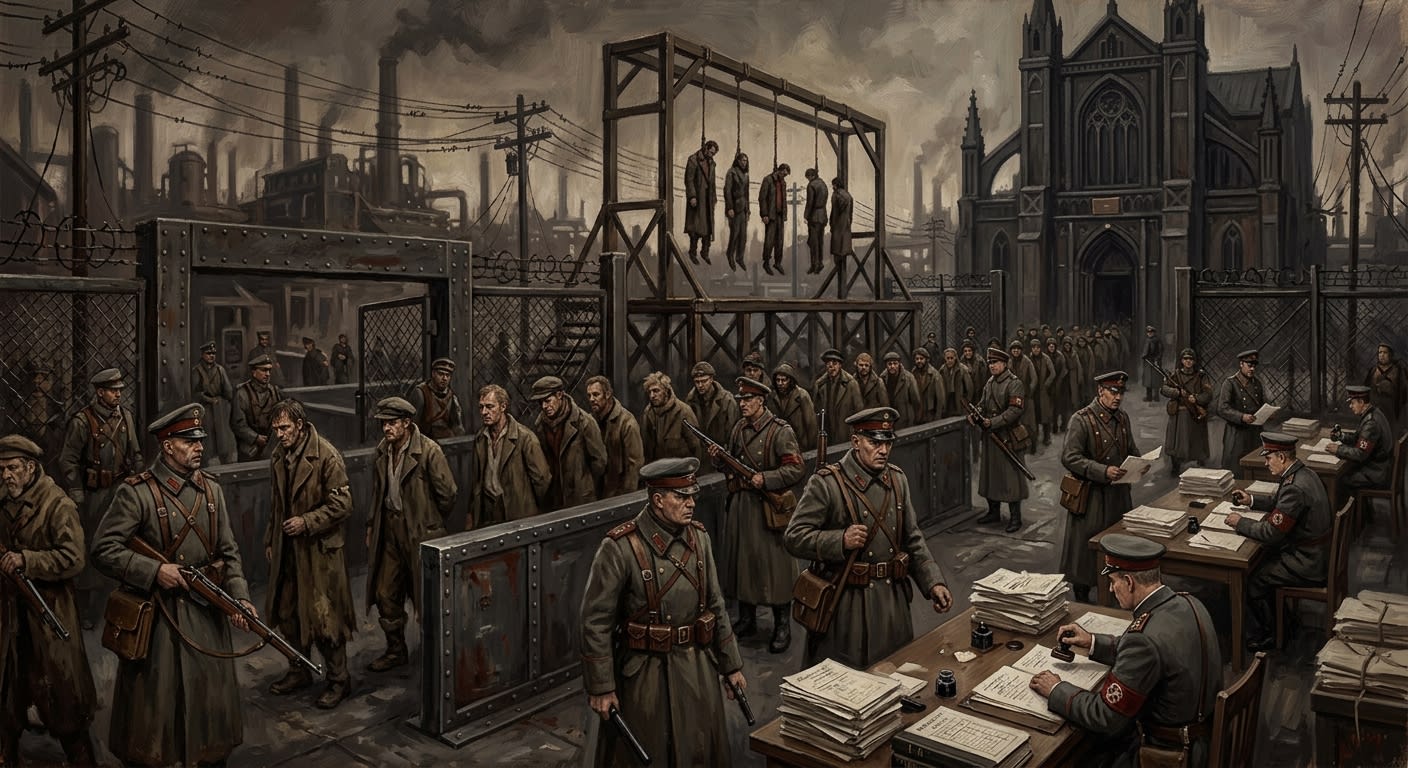
They were not a single massacre, though massacre attended them with dependable punctuality. They were a military-administrative purge following the constitution of the Trench Courts in A.S. 91, when death attestations, tag rolls, unit lists, ration claims, gate transfers, and field confessions were cross-checked at speed across the northern sector. Men who had vanished during the registry collapse could no longer shelter inside the old fog of missing, dead, transferred, wounded, prisoner, miscopied, buried badly, or assigned to a unit that no longer existed except as a payroll convenience. The fog was audited. The audit had rope.
#On the First Reconciliation Tables
The first reconciliation tables were set in field offices that still smelled of damp wool and thawing tags. Supervisors laid out unit rolls beside casualty sheets, pension petitions beside gate records, confession abstracts beside ration ledgers. The new Trench Courts had begun producing death attestations close to the wound, and every attested death clarified the shape of every unattested survival. A missing man became more visible when the dead around him acquired stamps.
Some absences were innocent. Men lay in fever tents under wrong names. Men had been transferred verbally by officers later converted into bone and ash. Men had been buried with another man’s tag. Men had survived shell bursts and wandered into rear hospitals whose clerks treated pronunciation as decorative. A humane state would have separated error from flight before punishment. The Synod separated profitable certainty from expensive doubt.
Quick-hearing protocol entered the world as a kindness to the schedule. A suspect deserter was brought before a field clerk, a War representative, a witness if available, and a chaplain when theatre required incense. Three questions established identity. Five questions established absence. Seven phrases established loyalty. Any answer that wandered became material. Any silence became colourable guilt. Any contradiction entered a pouch.
A later recruitment broadsheet claimed the Purges “distinguished false absence from cowardice with saintly care.”
Corrected. They distinguished rapidly. Saintly care requires time, and time at the front belongs to artillery.
#On the Men Caught by the Net
The Purges caught cowards. Let no sentimental fool soften that. Men fled. Men hid in ration wagons. Men traded coats with corpses. Men took dead comrades’ tags, married themselves to false names, bribed gatehouse clerks, bought clean slips, scratched brands from wrists, and walked west while better men remained east to be frightened in the authorised direction.
The Purges also caught men whose only crime was surviving outside the correct column. A runner sent for morphine and never given a return order. A sapper recorded dead by a sergeant who disliked revising forms. A boy from Bastion-Brest whose company roll burned, whose captain died, and whose mother had already filed a pension claim because grief moves faster than mail. A half-deaf artilleryman who answered to the wrong bell name after a Prayer-Jam and was found three districts from his battery with frost-black fingers and no idea which day had happened.
The Purges did not require malice to kill such men. They required a table, a rule, and a clerk too tired to widen either.
#On Loyalty Phrasing
The loyalty phrasing rubric was the Purges’ great invention, and I use great in its liturgical sense: large, consequential, and morally expensive. It taught clerks to hear treachery in grammar. A loyal man said “I was separated from my unit.” A doubtful man said “They left me.” A dangerous man said “The officers lied.” A condemned man said “I will not go back.” The difference between these sentences is sometimes rebellion, sometimes shock, sometimes morphine, sometimes the truth. The rubric preferred verbs it could hang.
The field cards were small enough to fit in a palm, laminated by the Bureau of Engineering and approved by the Bureau of Doctrine in language so clean it must have been washed before issue. Each card listed acceptable formulations, suspect formulations, correction prompts, and escalation phrases. A clerk pressed the suspect toward the safe sentence. If the suspect accepted, he might be reclassified as drift, reassigned, beaten, and returned to line. If he resisted, his resistance proved the need for punishment. Procedure is generous that way.
This is where the Purges refined the Contradiction Doctrine. A deserter’s testimony might condemn the deserter, or it might condemn the officer who made desertion reasonable. The state required a method for preserving the first while destroying the second. Loyalty phrasing solved the problem with admirable ugliness: the soldier’s words were reduced to categories before they could become evidence. The man could be guilty. The file could remain loyal.
#On the Rope Annexes
Every gatehouse grew a rope annex (Unregistered) during the Purges. Some were actual annexes: plank rooms beside holding yards, smelling of sweat, wet hemp, lamp oil, and the sour patience of guards. Others were corners of supply sheds, chapel crypts, quarantine pens, or market stalls seized at dawn and returned by dusk with sawdust over the floor. The name remained because soldiers like names that warn without paperwork.
The suspect arrived shaved, stripped of insignia, hands bound or merely watched depending on rank. The Gatewarden-Notary checked three rolls: regimental muster, Records ledger, local conscription registry. Mismatch sent the man to hearing. Match sent him to sentence faster, because agreement among records is a beautiful thing to everyone except the accused.
Witnesses mattered when convenient. A corporal who hated the suspect could testify. A medic who had seen him carried unconscious could testify if the hearing had time and if the medic had not already been reassigned to a casualty pit. Chaplains supplied moral weather. Officers supplied pressure. Clerks supplied grammar. The rope supplied punctuation.
ROPE ANNEX LOG — NORTHERN SECTOR, COPY DEFICIENT Thirty-four hearings conducted between Prime and None. Twenty-one returns to line under brand. Nine executions. Three labour conversions. One case suspended after suspect named ███████████████████████ and produced a bell token dated three days after his alleged flight. File routed under contradiction seal. Annex scrubbed.
#On Return, Brand, and Conversion
The Purges did not kill every suspect. Waste offends the Synod when the material still marches. Men judged recoverable were returned to the line under brand, oath-collar, reduced ration, bell-name suspension, or public penance. Some were assigned to corpse detail. Some to wire repair. Some to ossuary draft columns, where cowardice could be converted into transport capacity with exemplary economy. A deserter who would not face the enemy might still carry a saint’s tibia uphill. Doctrine found this pleasing.
The returned man wore his sentence where the unit could see it. A shaved stripe. A wrist mark. A ration token punched through. A silence at roll call before his name, imposed by the chaplain to mark conditional restoration. The aim was display rather than reintegration. The Purges taught that every punished body could become a small signboard advertising the consequences of unfiled fear.
This bred another market, because punishment marks are invitations to forgers. Shadow Angle crews learned to soften deserter brands. seal-forgers sold transfer slips. Tavern saints acquired new prayers. Mothers learned which alleys accepted sons without questions and which accepted sons only with coin. Every purge creates its counter-office. The Bureau pretends surprise, then invoices the lesson.
A Bureau of War circular states that returned deserters were “restored to honour through corrective service.”
Corrected. Honour was not restored. Utility was extracted. Honour was mentioned to keep chaplains from sulking.
#On the Auditors’ Triumph
What made the Deserter Purges last was the forms more than the hangings. Hangings end when the body stops kicking. Forms persist. The Purges left behind the quick-hearing script, the loyalty phrasing rubric, the three-roll identity cross-check, the rope annex, the contradiction routing mark, and the practice of treating absence as a claim requiring rebuttal by the absent man himself. This last principle is vile and efficient, the twin virtues by which most institutions reach adulthood.
By A.S. 201, no Trench Court works without the Purge inheritance. Deserter processing occupies late hours because the living are more argumentative than the dead. Inspectors still ask which category produced the absence. Gatewardens still send mismatches inward. Trench clerks still ask the corrective prompt. A man still discovers that his survival has become suspicious because his death was once convenient.
#On the Bodies Left in the Margins
The Purges have no proper monument. Proper monuments are built for events the state wishes to remember in marble. The Purges survive in smaller materials: rope fibres in annex beams, correction cards stained by thumb oil, blank lines in muster rolls, widow petitions denied because the husband later appeared alive long enough to be hanged, and the black humour of clerks who can tell from a man’s first sentence whether he has already condemned himself.
Some deserters deserved the rope. Some deserved soup. Some deserved a tribunal willing to hear the difference between cowardice and command failure. The Synod gave them hearings measured in questions, rubrics measured in suspicion, and records clean enough to survive appeal.