
#On the Nature of the Vermin
"We don't steal coin. We steal permission." — confiscated slogan, Ghent dock quarter, A.S. 193. Filed under: Sedition, Rhetorical, Category Two.
The Black Ledger is a disease that wears charity as its pustule.
I write this plainly because the Bureau of Purity has spent forty years dressing the problem in euphemism — "Unlicensed Reallocators," "sub-civil redistribution actors," and my personal favourite, the Bureau of Shadows' contribution: "voluntary irregularity networks." The Black Ledger is a thieves' cabal. Its members steal rations, forge stamps, murder Wardens, and slit the throats of tithe-clerks whose only crime was competence. They then distribute a calculated fraction of what they have taken to the hungry, the desperate, and the credulous, and call it mercy.
The distinction between the Black Ledger and an ordinary criminal syndicate is theatre. The syndicate steals and keeps. The Ledger steals, keeps most, distributes some, and ensures the distribution is witnessed. A bread-cart lifted from a Bureau of Tithes convoy at dawn will be broken open in a ration queue by noon — the bread handed out by a young man with clean cuffs and a practiced expression of sorrowful generosity, while two districts away the rest of the cart's contents vanish into a cellar the Bureau of Settlement cannot find on any map. The poor eat. The poor remember who fed them. The poor do not ask about the cellar.
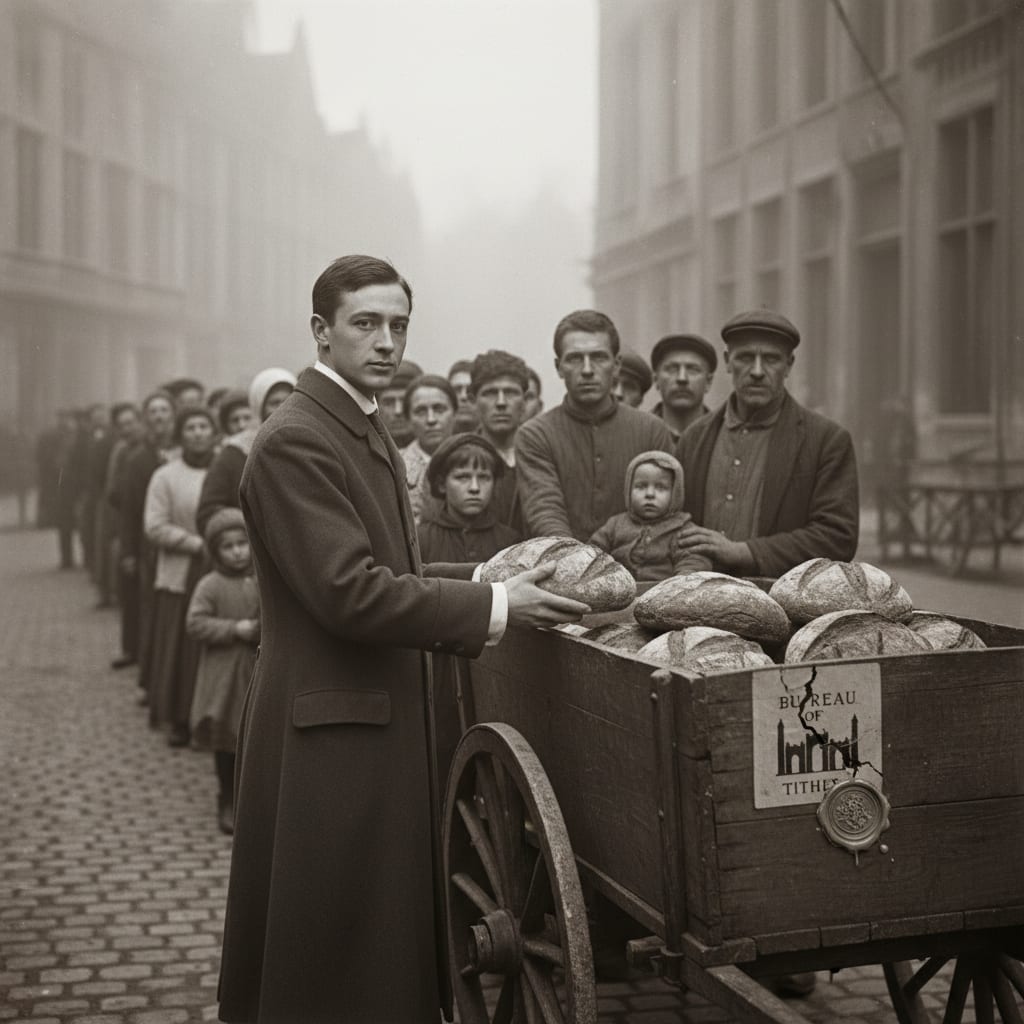
This is the Ledger's genius and its heresy: it has understood that in a world governed by paperwork, the most powerful currency is not coin but gratitude. A family fed in a famine week will hide a fugitive in a plague month. A widow whose ration-stamps were "corrected" by a sympathetic hand will swear on her husband's grave that no strangers entered her building, even when the stairwell still smells of ink and blood.
#On the Organisation of Charity's Counterfeit
The Black Ledger is old. How old depends on which Bureau you ask.
The Bureau of Shadows dates the organisation to approximately A.S. 112, tracing its origin to a ration freeze in the Rhineland during which bread was stolen in broad daylight and delivered under bell tolls to a queue that had been waiting three days. The Bureau of Purity insists the Ledger predates the Concordat of Strasbourg itself, which would make it older than the Bureaus tasked with destroying it. The Bureau of Records declines to comment, which is how Records says "yes" without creating a filing obligation.
The operational structure is cellular. Each city, each district, each port-quarter or bastion slum operates its own crew, connected to the larger network through couriers, code-signs, and the black thread stitched inside the left sleeve that serves as the Ledger's only insignia. There is no central command. There is no Grand Cutpurse, no Archbishop of Theft, no Hierarch of the Lifted Purse — a fact that has caused the Bureau of Shadows considerable frustration, because the Bureau's entire methodology depends upon finding a head to sever.
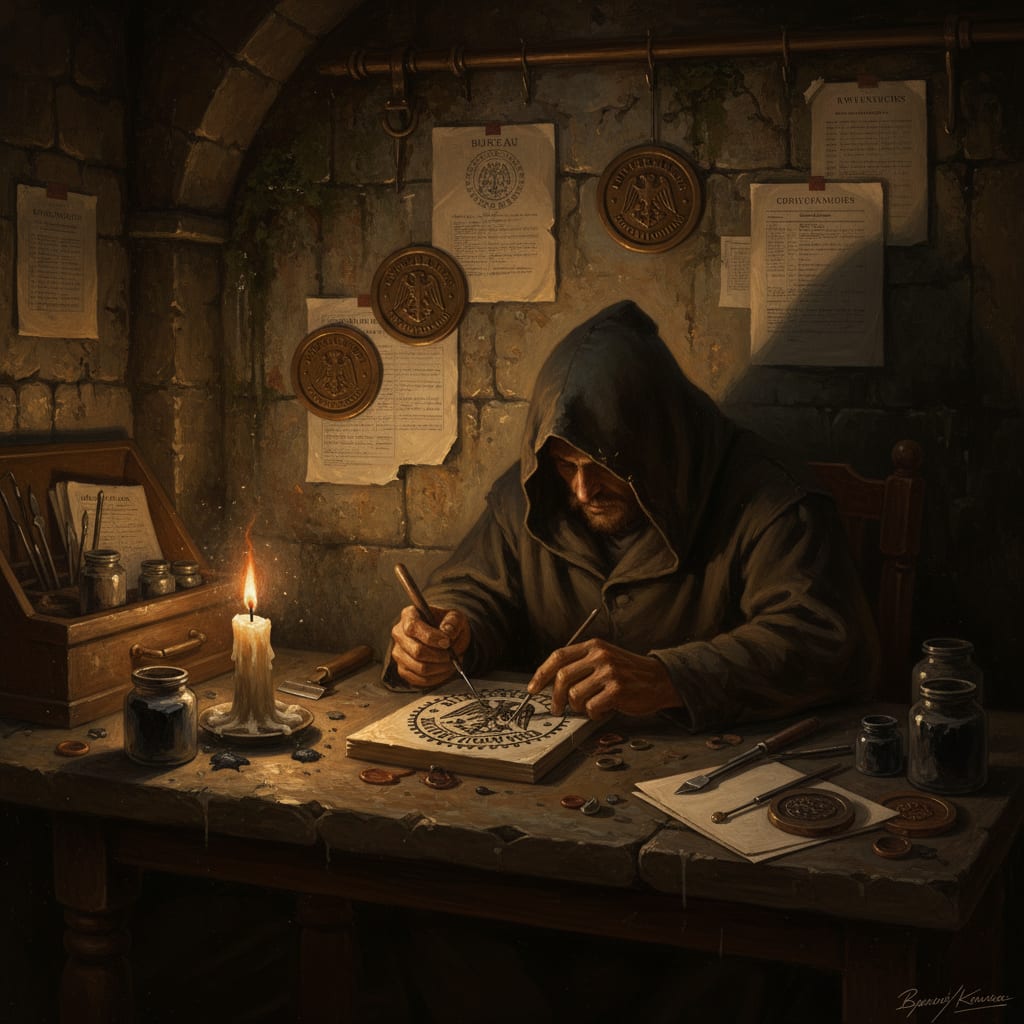
The internal hierarchy, as reconstructed from confessions and captured documents, runs thus: at the bottom, Runners — children and youths who carry, watch, and distract. They are paid in food and the illusion that they matter. Above them, Cutpurses proper — the lifters, the queue-workers, the hands that relieve a Tithes Assessor of his stamp-wallet between the second and third toll of the Angelus. Alongside the Cutpurses, the Seal-Swappers — forgers whose skill with wax-scrapers and ink needles would earn them a comfortable living in the Bureau of Masks and Seals, if the Bureau of Masks and Seals were not actively hunting them. And the Queue-Saints: the public faces, the charity actors, the young men and women with clean hands and practised grief who stand in ration lines and distribute stolen bread as though the Creator Himself had placed it in their palms.
Above these, the Ledgerwrights — the accountants. They decide who receives and who is owed. Every gift creates a debt. Every rescue purchases a node. A family fed today is an informant next month, a safehouse next year, a sacrificial Runner when the Bureau finally raids. The Ledgerwrights keep the second book — the one the Queue-Saints never see — in which gratitude is denominated like coin and loyalty is amortised across seasons.
And at the apex, the Quiet Knives.
[SIXTEEN LINES REMOVED — Bureau of Shadows Operational Memorandum 77-K, A.S. 199. Content classified under Seal Obsidian. The author notes that the removed passage described methods. The Bureau notes that describing methods assists the methods. The author notes that describing the removal also assists the methods, in that it confirms their existence. The Bureau has not responded.]
#On the Black Ledger of Ghent and Other Instructive Catastrophes
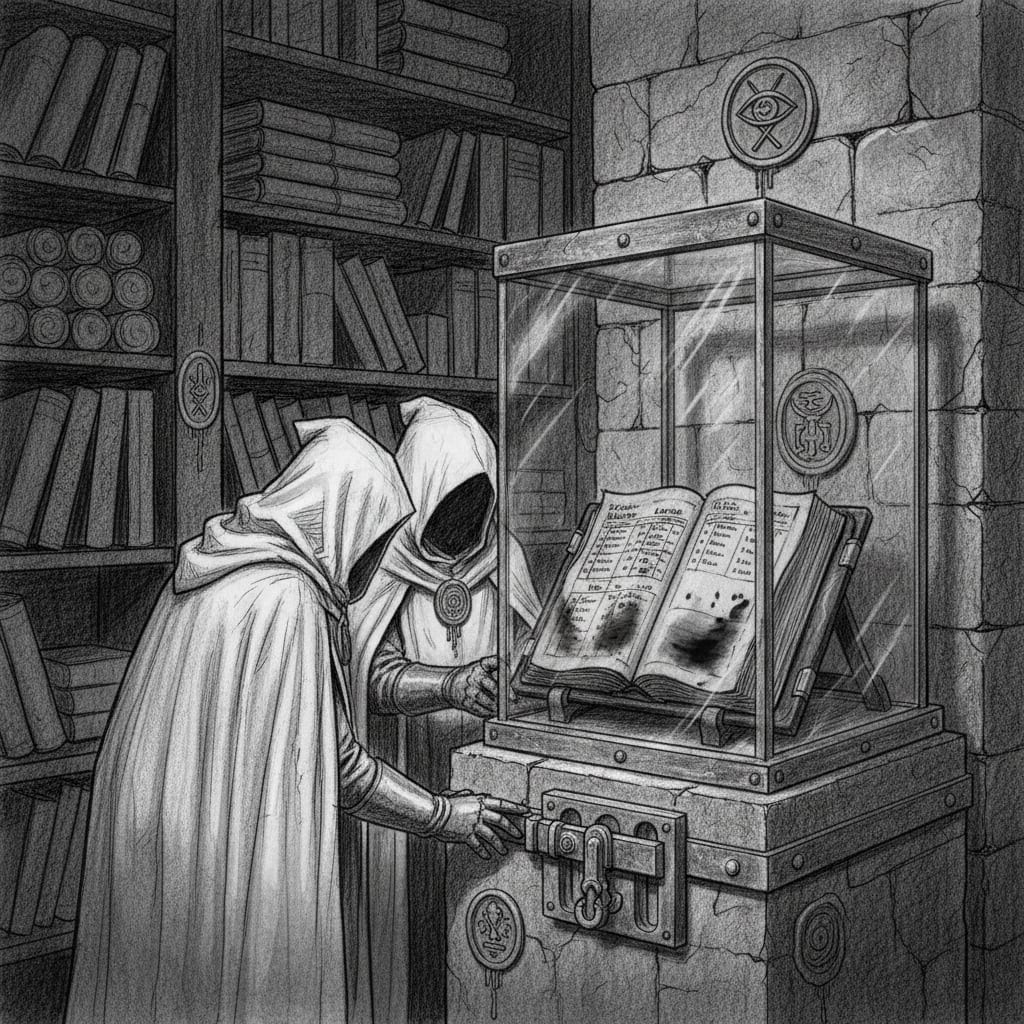
The name itself predates the organisation. The Black Ledger of Ghent — the original, the artefact — sits in a sealed case in Strasbourg, its pages stiff with blood that soaked through vellum a century and a half ago.
The incident is instructive. In approximately A.S. 159, an inquisitor discovered that a weigh-station clerk at Ghent had been falsifying confessional burden-weights, reducing loads for bribes, allowing favoured soldiers to march lighter while others staggered under the full catechetical mass. A hundred and thirty-seven men passed through that station in a single day. When the fraud was discovered, all hundred and thirty-seven were executed — their bodies stacked upon the weighing scales as "corrective weight," the ledger recording each man's name, his supposed burden, his actual burden, and the differential, expressed in ounces of faith found wanting. The ink on the final pages is still blurred. The archivist who showed it to me said the blurring was water damage. The archivist lied, and we both knew it, and neither of us said so, because some facts are better served by courtesy than by accuracy.
The Ghent incident is the seed. The modern Ledger grew from it — from dock-workers and ration-queue survivors who decided that if the Bureau could execute a hundred men over arithmetic, then arithmetic itself was a weapon worth stealing. The first cells appeared in the Rhineland, in Ghent, in Marseille. They spread along the pilgrim routes and the supply lines, because the Ledger feeds on the same infrastructure the Synod builds. Where there is a ration queue, there is a cutpurse. Where there is a tithe-gate, there is a seal-swapper. Where there is a weigh-station, there is a Ledgerwright with a second book.
#On the Keska Affair and the Geography of Absence
The Ledger's operational principle is simple: go where the Bureaus do not look.
The foundry-town of Keska, in the Hintermark east of Bastion-Constantinople, provides the canonical example. During the Administrative Redrawing of A.S. 188, Keska fell between the old zone boundaries and the new. For eleven months it received no zone designation. No Tithes assessment. No Conscription levy. No Settlement permit renewal. No oversight of any description. The Black Ledger moved in before the ink on Mandate 188-A had dried. By the time the Bureau of Settlement corrected the error, filing Keska under Zone 3 with a retroactive tithe assessment, the town's population had declined by a third.
The departed did not file forwarding addresses. Some fled the retroactive tithe. Some were recruited. Some, the Bureau of Purity suspects, were silenced — because the Ledger's generosity is conditional, and the condition is silence, and those who cannot maintain the condition are liabilities denominated in confession-hours and resolved by the Quiet Knives with the same cold efficiency that the Bureau of Tithes applies to a delinquent parish.
The pattern repeats across the continent. Wherever the Bureaus' jurisdiction frays — at the borders between zones, in the Hinterland's fifty-kilometre band, in the Underchords beneath Bastion-Irongate, in the Warrens of Constantinople where forty thousand souls live in streets the Bureau of Settlement cannot map — the Ledger fills the gap. It is a parasite that feeds on administrative failure, and the Synod's administrative apparatus, for all its magnificence, fails with the regularity of a bell-schedule.
#On the Forgery Trade and Its Blasphemies
The Black Ledger produces passable counter-seals for ration documents — a fact the Bureau of Masks and Seals has confirmed with what I can only describe as professional mortification. The forgeries are good enough to survive a queue-check and poor enough to fail a laboratory examination, which means they serve their purpose precisely: a family presents a forged ration-stamp, receives bread, and by the time the stamp reaches a Bureau desk for verification, the bread is eaten, the family is fed, and the Ledger has purchased another node of gratitude at the cost of a scrap of wax and a competent hand.
The Seal-Swappers work with wax-scrapers, blank chit paper, ink needles, and stamp putty — tools that are themselves classified as Category Two Contraband, possession of which carries a sentence of immurement or forced conscription to the Line. The raw materials arrive through the same channels that supply the Bosporus smugglers and the Hidden Pipe-Runners: up from Constantinople's docks, through the Warrens, into cellars that the Bureau of Settlement has designated as "structurally non-existent" on maps it has not updated since A.S. 170.
The forgeries are improving. The Bureau of Masks and Seals' last quarterly report noted that three counter-seals recovered in Cologne in A.S. 195 required "extended metallurgical analysis" to distinguish from genuine articles — a phrase that, in the Bureau's lexicon, means "we could not tell the difference at first glance, and we are admitting this under protest." The Bureau of Purity responded by placing the Bureau of Masks and Seals under "routine observation," on the theory that forgeries of such quality imply access to classified die-specifications. The Bureau of Masks and Seals responded by filing a counter-complaint. Both Bureaus are now watching each other. The Black Ledger, one presumes, watches both.
#On the Three Factions and Their Quarrel
The Ledger is not unified. Three tendencies pull it apart, and the quarrel between them is older than any Bureau investigation.
The Theatres believe the myth is the weapon. The public performance of charity — the bread distributed under bells, the stamps "found" and returned to weeping mothers, the Queue-Saints with their clean hands and borrowed grief — is what keeps the districts quiet. Without the theatre, the Ledger is a gang. With it, the Ledger is a cause, and a cause recruits what a gang cannot.
The Accountants believe the ledger is the weapon. The second book. The record of who was fed, who was saved, who owes and how much. Gratitude is capital. Loyalty is infrastructure. The Accountants do not care if the poor love them; they care that the poor cannot betray them without betraying themselves. A family that accepted stolen bread is a family that confessed to receiving stolen goods, and that confession — unspoken, unwritten, understood — is the chain that binds them tighter than any oath the Bureau of Oaths could notarise.
The Knives believe that problems, once identified, should not be identified twice.
The quarrel matters because it determines what the Ledger becomes. A Theatre-dominated cell is a nuisance — tolerable, even useful as a pressure valve, channelling famine-rage into gratitude rather than riot. An Accountant-dominated cell is a shadow government, a counter-bureaucracy that mirrors the Synod's own structures with unsettling precision. A Knife-dominated cell is a murder syndicate with charitable pretensions, and these the Bureau of Purity hunts with enthusiasm, because a Purity captain can explain a murder syndicate to his superiors. He cannot explain a shadow government. Shadow governments imply that the original government has failed, and that implication is, in the Bureau's theology, the greater heresy.
#On the Widow-Notary and Other Convenient Myths
Every heresy requires a saint, and the Ledger's is the Widow-Notary — a figure of such convenient vagueness that the Bureau of Records has been unable to confirm whether she existed, which is, in the Bureau's experience, proof that she was real.
The story varies by district. In Ghent, she was a clerk's widow who forged her dead husband's signature on ration-writs for six years before being discovered, and who, upon discovery, smiled at the inquisitor, handed him a stack of perfectly counterfeited Tithes assessments, and vanished through a door that the inquisitor later swore had not been there. In Marseille, she was a harbourmaster's daughter who signed death warrants for three Bureau officials using their own seals. In Strasbourg — and here the story becomes uncomfortable — she was a Records scribe who embezzled eleven thousand Crowns across fourteen years, redistributed them through a network of laundresses and bakers, and was never caught because her filing was immaculate and no auditor could believe that fraud so comprehensive could coexist with paperwork so clean.
The Widow-Notary may be one woman or seven. She may be a composite, a folk-hero assembled from a dozen separate acts of bureaucratic sabotage. She may be an invention — a mascot commissioned by some early Ledgerwright who understood that myth recruits where arithmetic cannot.
This Codex previously stated that the Widow-Notary was "a fiction propagated by criminal elements."
The Bureau of Shadows has since confirmed the recovery of eleven forged Tithes assessments in Strasbourg bearing identical calligraphic anomalies dating to approximately A.S. 140–155. The Bureau declines to identify the calligrapher. The Bureau notes, with what I interpret as reluctance, that the calligraphy is "of exceptional quality."
#On the Bureau's Assessment
The Black Ledger persists because the Synod needs it to persist.
I write this and I hear the Bureau of Doctrine reaching for its anathema stamp, but the arithmetic is plain. The Ledger feeds approximately eight to twelve thousand people who would otherwise riot. Riots consume Wardens, Fusiliers, administrative resources, and — critically — the appearance of order, which is more expensive to repair than order itself. The Bureau of Purity conducts raids, arrests Runners, immures the occasional Cutpurse for public edification, and files reports documenting its "ongoing commitment to the eradication of sub-civil criminal networks." The Ledger absorbs these losses as a cost of business. The Bureau absorbs these raids as a cost of appearing to govern.
Both parties understand the arrangement. Neither party will admit to the arrangement. The arrangement endures.
The Bureau of Purity will object to this characterisation. The Bureau of Purity objects to all characterisations that contain arithmetic.
I note my objection to their objection. I note that the Ledger's operatives, for all their crimes, keep better books than half the districts they infest. I note that this observation is pastorally inappropriate, bureaucratically inadvisable, and arithmetically undeniable.
I note, finally, that someone has stitched a black thread inside the lining of my writing-desk drawer.
I have not removed it.