
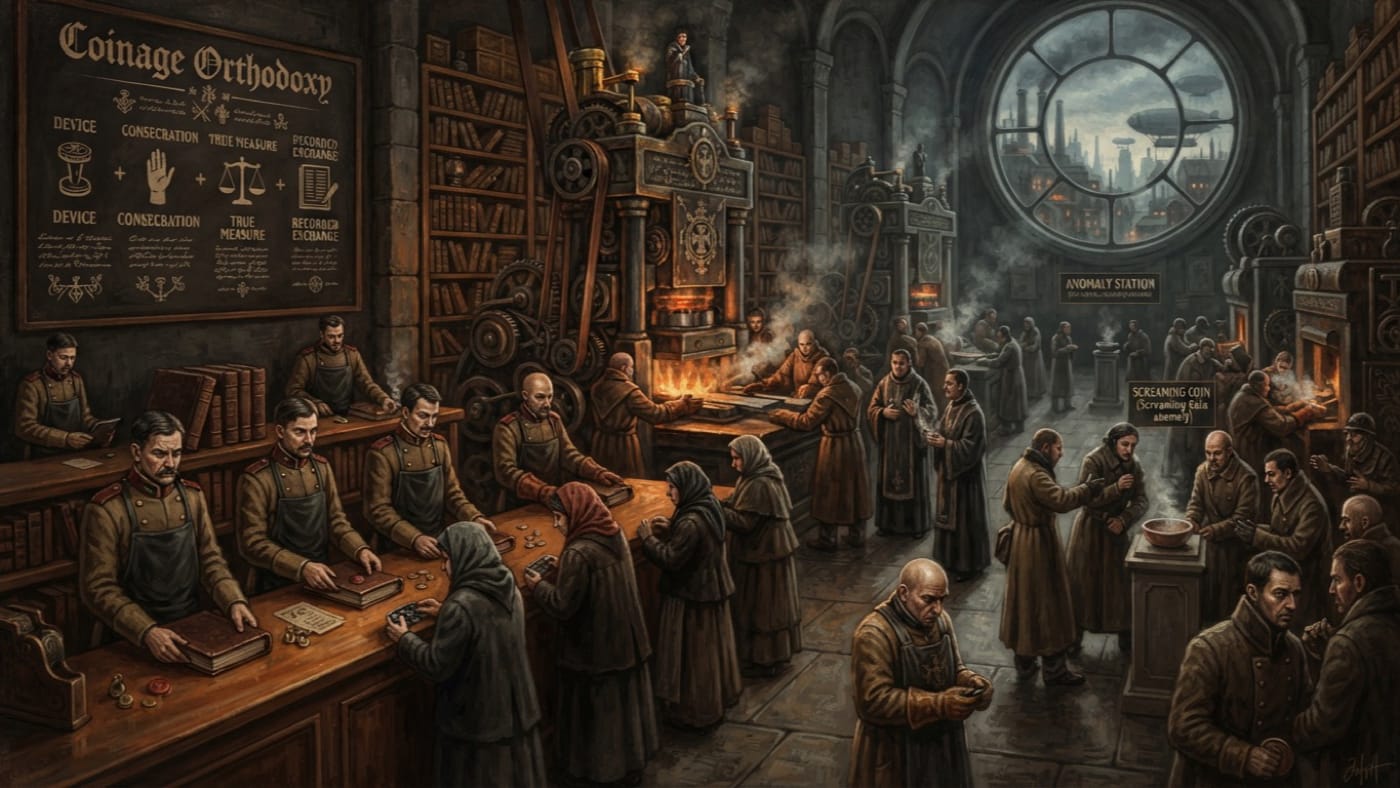
#On Lawful Value
A disc of stamped iron in a Heartlands purse buys bread. An identical disc, cut from the same bar and struck by a cleverer hand in a cellar, buys its bearer a rope. The metal cannot tell them apart. The Synod can, and that is the entire subject of this tract.
The Crown of Grace is iron. Any smith will tell you what iron is worth by the pound, and any smith who says the same about the Crown should be watched. Its value rests on recognition: the Synod's sigil on its face, the priestly consecration it receives at the mint, and the standing will of the Synod behind both. The Church teaches that to hold a Crown is to hold a piece of Heaven's sanction. I teach it too, in a better hand. Gold in a purse is vanity. Iron is obedience you can count.
Coinage Orthodoxy is what clerks and lecturers call the Church's standing instruction on money. I have found no founding bull for it and no council sitting under its name. It needs neither. A lawful coin is a recognised coin, every exchange is recorded, and cheating in coin is blasphemy, punishable as heresy. The ledger is a holy document. The till is a confessional with a drawer.
Coin is one lawful form of value among several. Authenticated relics hold savings, inheritances and part of a soldier's pay. Goods change hands by sealed weight, and licensed tokens circulate where the licence says they may. Orthodoxy forbids none of these. What it forbids is pretending.
#On the Sanctioned Strike
A Crown becomes lawful in stages, and each stage belongs to some office that guards it jealously. The Bureau of Doctrine defines what may be taught about money. The Bureau of Masks and Seals controls the sigils, signatures and emblems allowed on anything official, coins included. Priests consecrate. The Bureau of Records remembers. No single office owns the whole process, and that is the only reason the process survives.
The Crownwright Diehouses of Sable Court show this machinery at its most pious and its most expensive. The quarter sits in the Heartlands behind customs gates and mirrored windows. It is governed by a Mint-Chapter and a Crownwright guild compact, who agree on everything except who matters. On Die Row, engravers cut faces into dies with veiled fingers, because bare fingertips count there as blasphemous tools. The Assay Cloisters test metal over acid and parchment. The Strike Floors stamp in time with hymns. Above all of it sits the Face Archive, the registry of approved coin-faces. Nothing struck in Sable Court circulates lawfully without its approval. The local motto holds that a clean strike makes a clean soul, and the Crownwrights believe it the way a butcher believes in knives.
The die-blessing over hot metal, the assay prayers and the clean-hand inspections at every gate are local usages. Outsiders should not mistake Sable Court's habits for universal law. The principle behind them does apply everywhere: a coin is lawful because a chain of offices has said so, in sequence and under seal. Break one link and the iron is just iron again, or worse, iron with an opinion.
#On True Measure and False Proof
Doctrine's interest in money begins at the scale. Tariff-Chapel Weighers calibrate their balances against reliquary fragments, bone slivers and saint-ash, on the principle that saints knew true measure and demons thrive in ambiguity. Calibration is witnessed. Goods are weighed twice. A clearance is sealed, a receipt issued and a copy filed for the auditors. The weighers' own maxim is that false weight is heresy, and for once the street and the pulpit agree.
The frauds are old and unimaginative. Clippers shave rims. Counterfeiters cut dies in cellars and strike stolen iron. In Sable Court, assay results can be bought and correction orders arrive already signed. The seal-forger is a separate criminal from the counterfeiter of coin, and the Church punishes both, but the seal-forger does more harm. A false coin cheats one buyer. A false seal on an assay slip or exchange warrant certifies a thousand false coins as true. Preachers call forgery the second mouth of the demon, the lie that looks holy.
Then there is Velmora, who does not bother with cellars. The Greed-General's money spends like anyone's, and a damned sight faster. Consecration at the mint is held to protect lawful coin. The Bureau of Tithes promotes the doctrine that a soul which tithes properly cannot be bought by demons. Whether that is true is unclear, and the Synod's own records credit its countermeasures with limited success. Velmoran money has passed through blessed tills. Debts annulled by tribunal tend to come back by other routes.
The enforcers can rot as well. Weighers sell drift and assessors sell exemptions. A correction levy meant to purify a bad batch can be collected twice from the same family by men in different sashes. Orthodoxy calls fraud a heresy. It makes no exception for the inquisitor of measure, and I have stopped expecting one.
#On the Right to Pay
The power to recognise a coin includes the power to refuse it, and refusal is where the doctrine draws blood.
Tithe Assessors take dues in coin, salt, goods and labour tokens. They issue sealed receipts, which prove you paid or prove you didn't. Anyone who falls short receives arrears marks, seizure orders and denied permits. Exemptions exist, but they are rare and political. At Sable Court, confession is attached to the transaction itself: intent declarations are filed with exchange permissions, so a merchant cannot change money without stating why.
The sharpest instrument is the identity hold. In Sable Court, unpaid fines become holds against the debtor's name, and the debtor's coin stops being accepted. The street calls this facehold. Nobody needs to lay a hand on such a person. The baker declines. The ferryman declines. The Commerce clerk at the gate checks the register and declines with regret. Line-soldiers say Sable Court can kill you without touching you, simply by revoking you, and for soldiers they are exaggerating very little.
I record this plainly because plainness is what it deserves. Orthodoxy keeps the bread moving, and it also decides who may reach for the bread. Both jobs use the same seal.
#On False Claims and the Screaming Coin
In A.S. 177, after the Three-Night Bombard, a furnace-sweeper named Orek Marr pulled a coin-like object from a slag gutter beneath Mill Seven in the Foundry Quarter. That recovery is the first reliable record of the Screaming Coin. It is a discovery date and nothing more. Nobody knows when, where or by whom the thing was made.
Judged by Orthodoxy, the object is a scandal before it is a horror. It has no denomination, mint mark or year, no lawful weight inscription and no approved device. Masks and Seals compared it with the sanctioned dies and found no match. Records gave it a minimal descriptive classification (round, metal, passes from hand to hand). That classification describes it and authorises nothing. By every rule this tract defends, it has no monetary identity at all.
It circulates anyway. It has turned up in alms purses, a customs drawer, a chapel poor-box, a ration purse and a sealed tithe chest whose seals were still intact. Purity's revised witness table of A.S. 199 counts forty-seven confirmed transfers, with thirty-one audible manifestations among them. Lawful hands passed it, and lawful seals held it for a while. The certification system recognises money as a category, and the coin travelled under that recognition, as unmarked as a pauper and admitted everywhere.
Then word spread that the Bureau of Purity would seal any debts, pensions, dowries and criminal proceedings connected to the anomaly. Citizens began finding it in their drawers. The same A.S. 199 table lists sixty-two false reports made to avoid debt. Purity answered with arithmetic. Each false claimant was fined the value of the debt they had hoped to escape, charged an investigative inconvenience premium on top, and made to attend lectures in Coinage Orthodoxy.
The file does not record the size of the premium, the length of the lectures, who gave them or whether anyone was examined afterward. The penalty is in the file. The syllabus is not, and I will not invent one to flatter the lecturers.
Carried over from the anomaly file. This corrects no earlier ruling issued under Coinage Orthodoxy.
Earlier Purity memoranda grouped the coin's deaths under "monetary curse events, probable Greed contamination."
Purity leaves the coin's origin and the means of its return unresolved, and so does this tract. Its custody line still reads officially contained, physically unknown, which counts as an answer only in the strict clerical sense.
#On Present Application
Ordinary certification governs ordinary exchange: an approved device, a consecrated issue, true measure, a sealed receipt and a recorded transaction. Disputes of weight go to the weigher, disputes of device to Masks and Seals, and disputes of conscience to Doctrine, which will be delighted.
Anomalous material falls outside that system entirely. Do not weigh it, spend it, refuse it, bless it or bring it to a lecture. Isolate it without touching it, cover it with a waxed bowl, summon Purity and leave the room. None of these steps guarantees your safety, and Purity will not sign anything that says otherwise.