
#On the Disaster
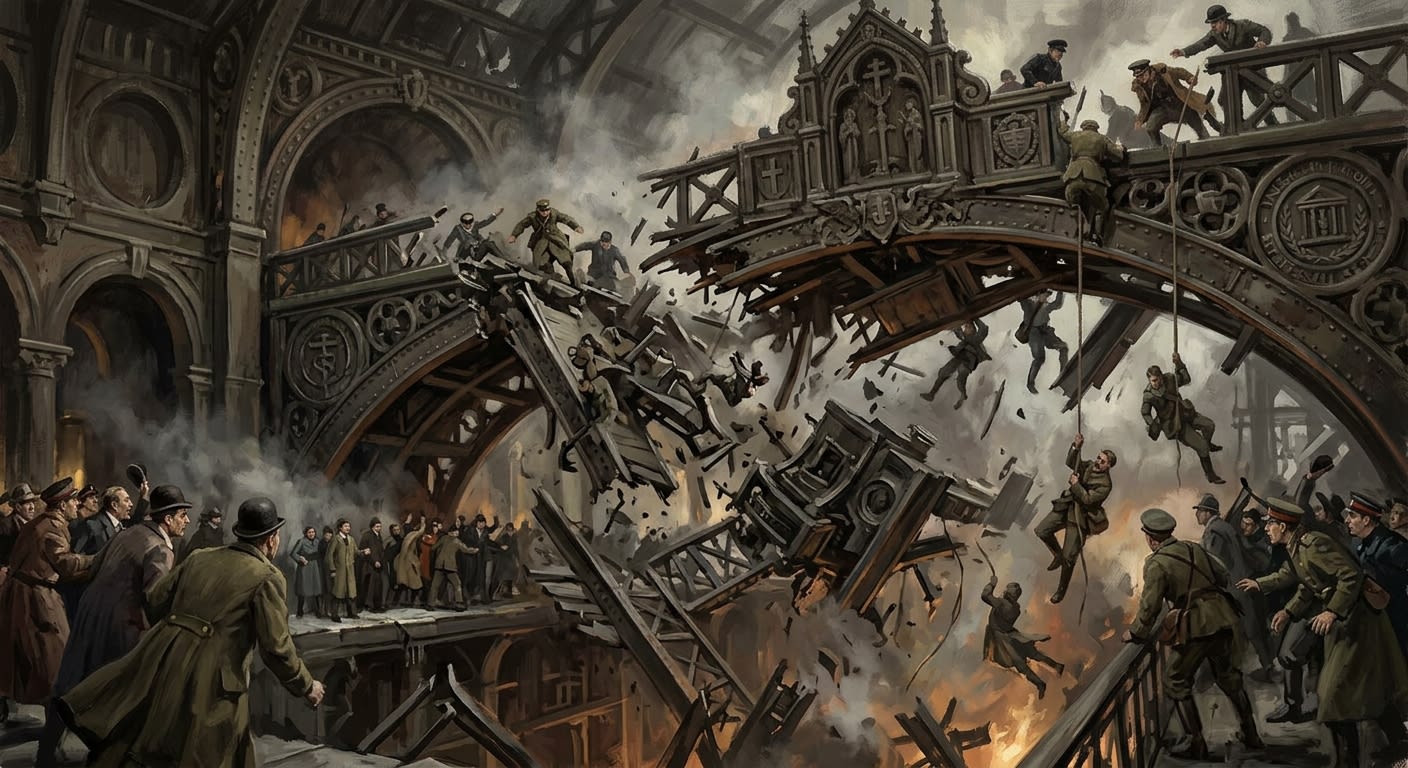
The Collapse at Prague Gate, A.S. 147, is the lesson the Shrine-Deck Crew teach with lowered voices, the lesson Engineering teaches with diagrams, the lesson Purity teaches with suspicion, and the lesson Doctrine teaches by printing two incompatible explanations on the same page and daring the bereaved to object. A Pilgrim's Ladder pattern shrine-platform entered a Silence Dome near Prague Gate (Unregistered) during an escort and crowd-correction movement. Its hymn-vox coordination died. Its cue-slates contradicted one another. Its metronome bell continued, stopped, and was later reported to have continued without sound.
Mortars fired out of phase. Several shells fell into the lower holds. Pilgrims waiting below with relic-candles, passage chits, route badges, and that soft civic confidence produced by standing near official machinery were torn apart by the reassurance sent to protect them.
Prague Gate did not end shrine-platform doctrine. Effective catastrophes are rarely granted such mercy. It became the canonical example of Psalm-backfire (Unregistered): cadence collapse beyond recovery, choir measure severed from gun rhythm, sanctified fire returning into the belly of the machine that bore it.
#On the Dome
A Silence Dome eats more than noise. It reduces command to breath, prayer to mouth-shape, and the bell to a private embarrassment of bronze. Soldiers inside one learn that a scream may die at the teeth. Officers learn that rank has no volume when sound itself refuses employment. Choir-machinery, built on cadence, hymn-vox, bell response, and disciplined hearing, suffers with particular elegance. It continues being complicated after it has ceased being obedient.
The Prague Gate platform entered under active escort conditions. Its lower holds carried pilgrims, votive crates, spare candles, and route stores. Its upper decks carried battery-chapels, chalk rings, hymn-screens, mortar racks, and enough inter-Bureau arrogance to power a small city if arrogance could be burned cleanly. The Dome fell or was entered; the surviving files disagree, and the disagreement has been protected by three locks and one promotion.
Early broadsheets claimed the platform was “ambushed by total enemy silence.”
Corrected for internal instruction: route planners had warning of acoustic instability in the Prague Gate approach. The warning passed through Orison, War, Engineering, and a clerk whose lunch break has since become historically expensive.
Within the pall, hymn-vox channels failed first. Choir Runners carried cue-slates by sight, but the slates no longer agreed with the Cadence Caller's board. The metronome bell could be seen striking. Whether it could be heard became the first argument. Whether its unheard strike still governed the guns became the second. The third argument occurred when the first mortar discharged.
#On the Lower Holds
The lower holds were not designed as coffins, which proves only that design is often corrected by use. Pilgrims had been gathered below during the Dome crossing under standard safety doctrine: keep civilians away from open decks, secure candles, maintain relic proximity, prevent panic from climbing stairs into powder work. The doctrine made excellent sense until the mortars fired inward.
Witness fragments agree on three details. The first: the relic-candles leaned toward the powder doors before the detonations. The second: several pilgrims saw the firing flashes before hearing nothing at all, since hearing had become unavailable. The third: one child continued mouthing the response to a hymn after the deck above opened and the air filled with brass, splinter, wax, and meat.
BUREAU OF SILENCE — FILE 88-K/SHRINE, LOWER HOLD EXTRACT Witness fragment 17: “The bell was below us.” Witness fragment 22: “Our candles bowed east, then down.” Witness fragment 41: “The machine answered itself.” Recovered object: relic-candle fused through thumb bone; flame absent; wick warm after fourteen hours. Restricted notation: third voice detected in ███████████████████ interval before second internal detonation.
The official casualty number has been revised six times. Records counts recoverable bodies. War counts assigned passengers. Purity counts corrupted remains separately. Orison counts singers. Engineering counts dead crew whose stations prove mechanical sequence. Doctrine counts what the sentence needs. The families counted shoes.
#On the Blame
Purity declared sabotage. Engineering declared hymn-jam interference. War declared enemy action. Orison declared acoustic severance. The Bureau of Silence declared nothing and took the useful papers. Doctrine printed the first two explanations side by side because the truth had become expensive and two lies, properly aligned, can resemble balance to a grieving public.
Purity's argument was elegant in the way inquisitorial arguments are elegant: the platform behaved as if touched by hostile intention, and hostile intention implies a host, and a host implies someone available to arrest. Engineering's argument was filthier and stronger. It traced hymn-vox failure, cue-lag, recoil desynchronisation, and bell-indicator contradiction across the platform's stations. The diagrams were excellent. Several were confiscated for being persuasive without permission.
The compromise phrase was “contributory sanctity drift.” It remains one of the Bureau's better crimes against language. Enemy action stayed affirmed. Mechanical failure remained admissible. Survivor testimony was folded into appendices. The dead pilgrims became a safety impetus rather than plaintiffs, which is the difference between reform and liability.
The Prague Gate collapse was once listed as enemy action exclusively.
Revised. Enemy action remains affirmed. Friendly cadence failure is now classified as contributory sanctity drift. The phrase is ugly, but it kept the compensation tables from developing teeth.
#On the Third Voice
Crew superstition says never hum between tolls. It invites a third voice (Unregistered). Before Prague Gate, officers treated this as deck folklore, useful for frightening Deck-Rats away from idle noise. After Prague Gate, the phrase entered sealed vocabulary. It has never left.
The third voice appears in reports as an additional harmonic during sustained off-cadence discharge. It is described as entering before the choir, beneath the bell, or behind the teeth. It gives no words in most accounts. When words are reported, they are removed. Prague Gate produced enough fragments for Orison to request custody, enough mechanical anomalies for Engineering to object, enough doctrinal stink for Purity to circle, and enough silence for Silence to win.
The hymn-vox parts were quarantined. The bell was not melted, according to War. The bell was melted, according to Orison. The bell remained audible in a sealed crate for three days, according to a Records clerk whose deposition now belongs to a shelf I am not supposed to know exists. I know many shelves. Shelves admire me.
#On the Reforms Afterward
Prague Gate produced reforms with the ghastly efficiency of a public coffin. Hymn-vox lines were doubled. Cue-slates were colour-banded. Pilgrim holds received two additional fire doors and one additional legal fiction. Cadence Callers trained in flag-code, lantern-code, rail-tap transfer, and emergency silent measure. Ordnance Deacons received authority to suspend pilgrimage carriage under acoustic uncertainty, an authority they used twice before the Bureau of Pilgrimage complained that safety was interfering with sanctified movement.
The Cadence Reforms had made the bell sovereign. Prague Gate taught that sovereignty must survive muteness. A bell unheard must have deputies: hand, light, rope, chalk, boot, blood mark. The shrine-platform became less musical and more paranoid. This improved it.
As of A.S. 201, Prague Gate is cited in every shrine-platform failure lecture, every Processional Arsenal hazard table, and every Dome-entry drill where someone with a clean collar tells soot-covered workers what silence does. The workers already know. They chew wax, touch the bell frame, and do not hum between tolls.
Prague Gate remains sealed enough to be useful and known enough to frighten the competent. That is the proper condition of many truths.