

#On the Added Confession
A confession addendum is a supplement to a pilgrim's record. It is an admission taken from a pilgrim, written down and attached to the file that already holds his count, his route and his name. This survey was compiled in A.S. 201 / 1911 CE for the Bureau of Doctrine, and it treats the addendum as a document. The sin belongs to the confessor and the Creator. The document belongs to whoever holds the copy.
Its principal context is the Pilgrim Reconciliation Statutes. They were promulgated in A.S. 97, revised in A.S. 187, and are administered jointly by the Bureau of Records and the Bureau of Pilgrimage. The Statutes name confession addenda among the matters they govern. To govern a thing is a different act from inventing it. The Statutes found admissions already being written down beside bead strings and gave the practice a jurisdiction. No file supplied to this compilation records who first stapled a confession to a movement record, or in what year. I decline to appoint an author. The Church has enough saints with doubtful paperwork.
#On the Passage from Hall to File
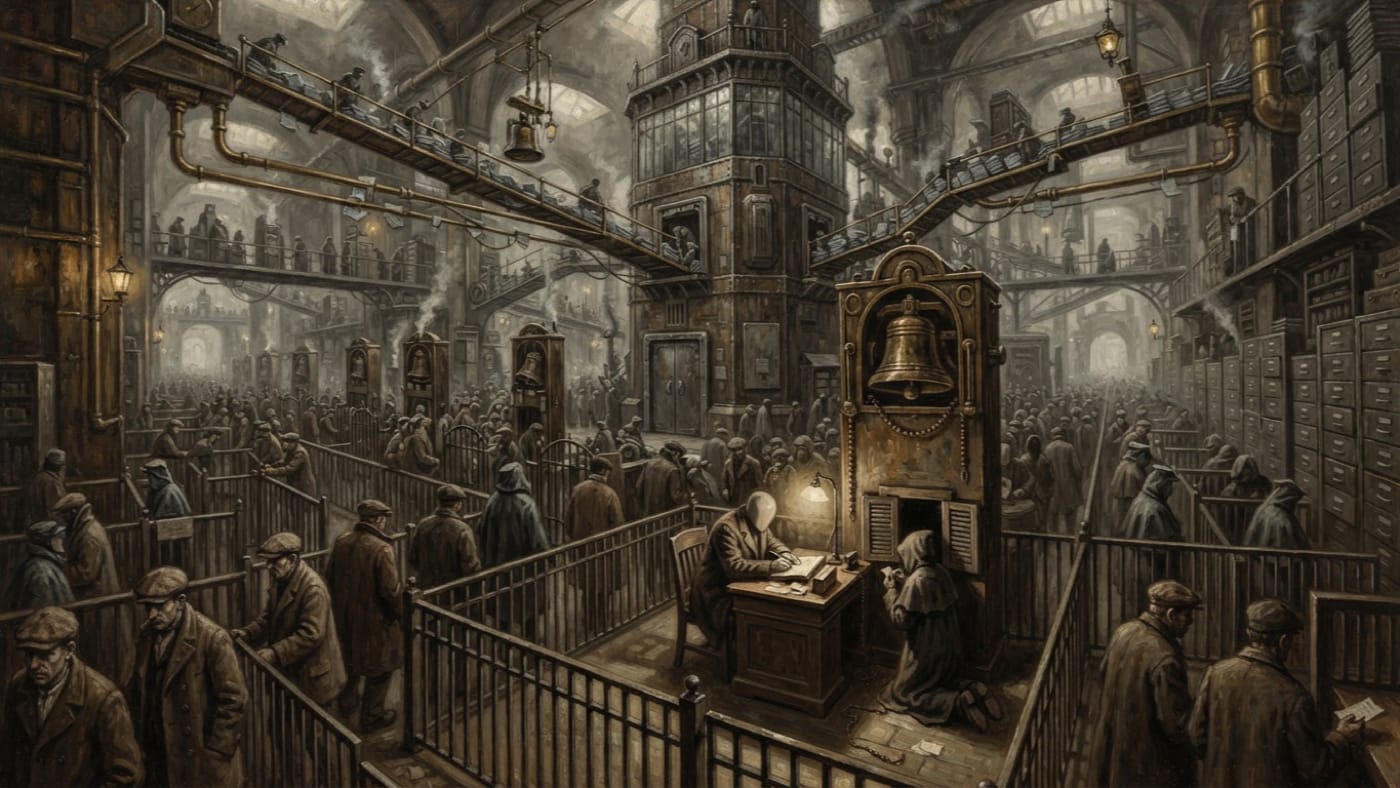
The route begins in the Counting Hall of the Cloister of Miscounted Beads, on Strasbourg's western pilgrim outskirts. Those who wait there call it the Clickery. The Chapter's registers call it the Reconciliation Spine. It is one room with three names. The Hall receives the string, checks the name, compares the route, pronounces the count, names the discrepancy, prices the correction and seals the disposition. It asks nothing about sin. The Hall detects, and explanation is another room's trade.
A disposition referred for supplementary handling travels the south spine, between the Hall and the dormitory passage, to the Supplementary Entry Office. There it becomes Form S-1, which records the discrepancy as the Hall pronounced it. The Office's own account assigns S-2 to the pilgrim's explanation and S-3 to the clerk's dissatisfaction with that explanation. Readers hoping to find the confession addendum somewhere in this numbered procession will be disappointed. S-1 is the discrepancy. No source gives the addendum a number, and I will not mint one so that the series looks complete.
What follows is a case file, and it grows. Confession addenda lie in it beside route corrections, identity amendments and sponsor reviews. They share a cord and a cupboard, and they do different work. A route correction amends where the pilgrim walked. An identity amendment amends who he is recorded to be. A sponsor review weighs another person's wax. The addendum records what the pilgrim said about himself when he was asked.
The asking is done by a confession prompter. The prompter invites the pilgrim to describe his road and then the sins he committed along it. The clerk writes, and the slip is stapled to the bead record. A theft admitted at a named station may tell the Office more about the route than the theft deserves. A companion mentioned in shame may become a witness problem. In this way testimony can inform a route correction and still remain a separate part of the file. The slip has no power over the bead count, the question of guilt or the clearance seal. Those belong to other hands.
At the Cloister, confession clerks also cross-check names, slips are added nightly, and the curfew bell has its own confession addendum, rung into the record with the rest of the day. These are the Cloister's customs. I have not found them elsewhere, and I do not export them.
#On Privilege and Administrative Use
Before A.S. 187, pilgrim pamphlets told the road that confession addenda were spiritually privileged and kept out of administrative use. The pamphlets were sincere in the way pamphlets are sincere, which is to say printed.
Pilgrim pamphlets once described confession addenda as "spiritually privileged and excluded from administrative use."
Corrected under the A.S. 187 revision, as the Office's account already records. The privilege stands and the exclusion does not. Confession addenda are spiritually privileged within the range permitted to Records, Pilgrimage, Purity, Tithes, Mercy, and any tribunal bearing sufficient seal authority.
The published accounts of the revision describe an expansion of confession routing. I have no fresh statutory transcript to set beside them, so I quote them as accounts. The distinction they draw is fine and entirely serviceable. Privilege attaches to the confession as an act between penitent and Creator. Administrative circulation attaches to the paper. The Church does not unseal a soul. It moves a slip.
The routes named are particular. Purity reads where speech raises suspicion. Tithes reads where debts touch inheritance or pledged property. Mercy reads where a slip concerns illness, despair or death among those held in Awaiting. Records keeps the copies, as Records keeps everything. Inside the Cloister, red-edged packets carry slips to the Records desk when names conflict, to Purity when words sour, and to the dorm matrons when a labour assignment needs a handle.
These accounts open no addendum to public reading, and they grant no office every slip. Each route is an interest backed by a seal. A penitent who learns of the routes may confess less. Pilgrimage, which must keep the roads full, prefers to call the routing care.
#On Custody and the Cost of Addition
Ordinary addenda stay with the active case. The Office makes three copies of its supplementary entries, one each for the pilgrim, the Office and Records. The Office copy is bound in grey thread for active reconciliation. The Records copy goes through a slit behind Desk Two toward the undercroft. That is the Cloister's practice for supplementary entries. I do not offer it as the rule for every confession supplement in the Church.
Every addition costs money. The Clickery's account says plainly that the file's confession addenda, and the amendments beside them, carry fees. The Office and the Cloister Chapter charge for filing, for the dormitory and for clerical time. Unpaid obligations become labour, and the dorm charge keeps running while the labour is served. No source gives a price for an addendum, a tariff, a required number of slips or a deadline that applies to addenda alone. I give none either. I observe only that a slip added nightly means a night spent in the Dorm Rows, and that the Cloister has never yet lost money on a night.
That last is my own judgement of the institution. Do not mistake it for the Chapter's accounts, which I have not been shown.
The Bead Vault is another matter. Under Archivist Keth it holds confiscated strings and anomaly evidence. A severe Desk Eleven case may be brought down to it under escort. The string is sleeved in salt-wax, the confession clerk carries the name slip written backward and folded inward, and the corridor stays silent. Most addenda never see the Vault. An ordinary confession sets off a fee, which is procedure enough.
#On the Sixth Stone and the Sixth Vault
Readers who have travelled will know that the phrase "confession addenda" is also spoken at the Steppe Gate of Windscript Treaty-Stones. A shared phrase does not make a shared jurisdiction. The Pilgrim Reconciliation Statutes do not govern Windscript, and the S-series does not reach it.
At the Caravan Court, petitioners whose matters concern confession addenda stand before the Sixth Stone of the Treaty Ring. The Court requires witnessed speech, a mark, a seal and deposit in the Archive, and no binding term may be spoken without a licensed translator-scribe present. The Gate's own lore records that confessions taken there as addenda go below to the Burnless Archive, where they serve as legal leverage. This is a frontier court's practice with its own logic. It proves nothing about a single form shared across the Church.
The Sixth Vault of that Archive lies beneath the eastern limestone cutbank. Its particular holdings are the collateral confessions of the Oath Inns, written on oath-note paper and filed by the Paper Keepers under date, district and sin-category. Each packet goes down to the Vault before any payment or default. Payment keeps the seal intact. Default makes the contents usable, though the proceeding in question still decides what they are worth, and custody judges nothing. Only in that Archive do Keepers handle the paper in white cotton gloves, speak in whispers and make corrections before a second Keeper. Ordinary contract addenda go to the Second through Fifth Vaults.
No record shows a slip travelling from the Cloister to the Sixth Vault. The Bead Vault is in Strasbourg, with Keth. The Living Addenda, which have touched confession summaries at Windscript, are an anomaly with an entry of their own. They belong to a different category of trouble, and a shared noun does not make them cousins.
#On Present Application
In A.S. 201 the Cloister holds more pilgrims than it was built for, as it has since A.S. 198. The Clickery feeds the Office faster than the copyists can bind, and every S-1 that arrives opens a file with room for more. A pilgrim whose route is in doubt is asked to explain it. His explanation is found wanting. The prompter asks him, in a gentle voice, what he did on the road. The slip goes into the cord, and the curfew bell rings another addendum in. Each supplement can be relevant, and none closes the file by itself. Clearance remains with Prior-Scribe Erem Vale, who does not grant it because a pilgrim has been honest.
The record keeps asking because it can. The pilgrim keeps answering because the half-door is shut and the bench is warmer than the Yard.