
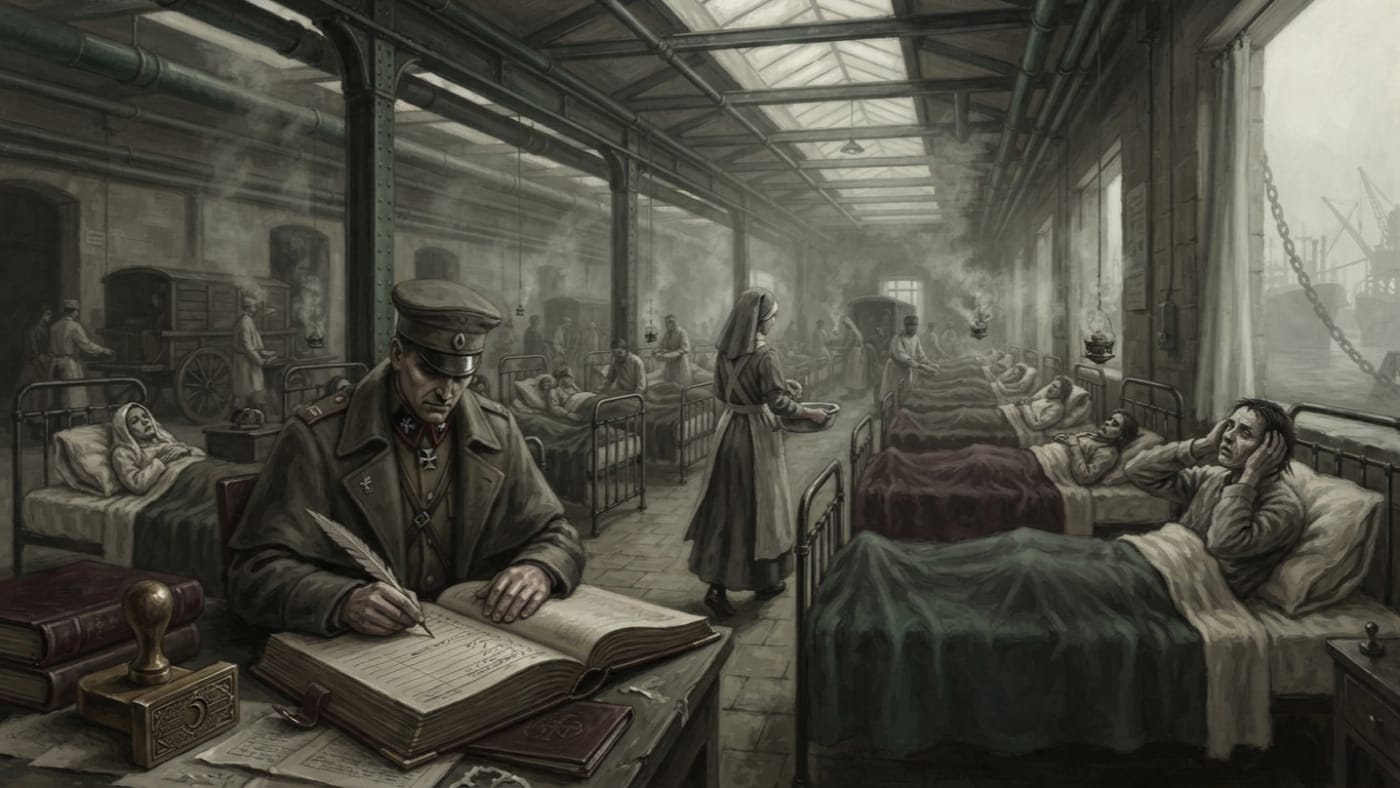
#On the Collegium's Office
"Keep plague from the Line." — Public charge of the Quarantine Collegium, Thessaloniki
The Church keeps collegia the way a sacristan keeps keys: too many, each heavy, half of them for doors nobody remembers. The reader who wanted the Collegium of Obedience, or the Bridge-Scribes, or the Time Clerks, or the gentlemen who examine silence for a living, has climbed the wrong stair. This entry concerns the Quarantine Collegium of Thessaloniki, keeper of the fenced piers and isolation wards of the Quarantine Crescent, the district between the Chainward Quays and Drowned Row. The record of the Silence mentions it once, and only to define one of its euphemisms. I intend to give it more than that.
The Crescent smells of carbolic, vomit and vinegar smoke, in proportions that change with the season and the cargo. Fumigation crews meet arriving hulls with censers of vinegar and incense and work the smoke into every hatch until the sailors weep. Behind the fence stand the wards: long limestone sheds, salt-stained to the height of a man's shoulder, their timber floors scrubbed so often that the grain stands up like a rasp. Corpse wagons go out at intervals. Nobody counts them aloud.
Its charge is to keep plague from the Line, and it does. A fever ship that reaches the trench convoys kills more soldiers than the Great Deceiver's artillery manages in a quiet month. The Collegium stands between the hull and the rail spur with a ward, a smoke-pot and a stamp. The stamp is its sceptre, and it knows this.
#On Holds and Releases
A person who comes ashore under suspicion of fever is held. The hold has no fixed term. It ends when a Warden-Physic judges the body clean and the paperwork judges the soul presentable, and those two judgments arrive in that order only on good days.
The instrument of release is the Quarantine Release Seal, and it has two halves. The medical portion certifies the flesh. The doctrinal portion requires the arrival-confession receipt that every crew member collects at the quayside booths, because in Thessaloniki one's sins are filed beside one's cargo and must be produced before either may leave. A patient who lost the receipt to a wet pocket or a thief has a clean body and a dirty file, and the file decides. Releases are read out at midday, between the public raids and the dock auctions, so the whole harbour can watch who walks out and who doesn't.
Observe the third line. The Collegium holds bodies, never names. Names belong to Prefect-Archivist Iolana and the Bureau of Records on the Ledger Steps. The chains belong to the Chainwrights, and the hours to the bells and the Bureau of Bells. The Collegium cannot erase a man, close the gate on him or change the time of his departure. It can only decline to let him out. In a port where every legal minute is rationed, that power is enough.
Holds can be shortened, and everyone in Thessaloniki knows the price list even though no one has seen it written. A hold can also be lengthened. The street calls that "quarantine extension," and the street means prison. I record both as facts about the port. The Collegium did not invent bribery. It works a quay where bribery is the ordinary way business gets done.
The ward also has a vocabulary for complaints it cannot measure. Its standard term is acoustic distress, which covers patients who hear sounds the instruments do not detect. Thessaloniki produces such patients the way the Pitch Markets produce burns, because the chains hum, the fog holds shape and the sea is attentive. In ward practice the complaint is as private as toothache. Each sufferer hears a noise of their own, and the Collegium enters one sound per bed.
#On Those Who Tend the Wards
The work is done by orderlies, smoke-crews, wagon-men, washerwomen and a small number of physicians. They are paid badly and late, which is ordinary in the trade. Linen is boiled. Fevers are sponged. Broth is carried. Men vomit into basins, and someone empties the basins. Whatever I say against the Collegium's books, I will not pretend its wards are a stage set. People leave them alive who would otherwise have died at sea, and some of them were never ill.
Warden-Physic Iri presides over the intake and the ward-book. The local reputation is a single word, practical, which in Thessaloniki is high praise. The Warden-Physic examines, classifies, files and moves on, and that is all I will say about the person, because it is all the record says.
Sister Jova is the other name the port repeats. Her reputation is also a single word: kind. More precisely, she is too kind, so kind that the Crescent has decided she must be up to something. I can find no charge against her in any file. I find only the suspicion, which follows her through the wards like the smoke.
#On the Seven Admissions
From the fourteenth to the seventeenth of Ashmonth, A.S. 198, the bells of the Elder and Younger Towers made no sound. Seventy-two hours passed, six peals were missed, and the city stopped. During those three nights the Quarantine Crescent recorded seven new admissions under acoustic distress.
All seven reported the same thing: a bell ringing correctly, in the correct sequence, from somewhere beneath the harbour floor.
The Warden-Physic filed the seven under the standard protocol. The ward-book holds no remark that seven patients from different beds and berths, kept apart behind the Collegium's own partitions, had described the same peal in the same order. The classification is on record and the sound's source is not. Seven people say they heard it, and that is the whole of the evidence.
ERRATUM — OFFICE OF THE WARDEN, SACRED LEDGER The statement above, in On Holds and Releases, that acoustic distress is a private complaint and that "each sufferer hears a noise of their own," is withdrawn. During the Silence of A.S. 198 the Quarantine Crescent admitted seven sufferers who reported one sound. The Collegium's practice of entering one sound per bed is a convention of the ward-book. The Warden had mistaken it for a law of nature.
Set beside these seven are other accounts, and none of them comes from the Collegium. Diver-Matron Sera of the Chainwrights put her hands on the submerged links during the Silence. She reports that they vibrated without pause in the dawn-and-dusk sequence the bells had abandoned, while the tower instruments recorded nothing. In the Refugee Sheds, the communal hum that protects sleepers failed on the second night. By the third dawn three children stood in the shallows making what Aunt Velka called "the bell-note, but from below." Twelve more refugees were restrained at the waterline. Chainmaster Kosta's private ledger gained fourteen names in a hand that was not his.
These are separate groups of witnesses, and I will not merge them to make a neater page. The seven patients are not known to be the three children, the twelve walkers or the fourteen names. Their accounts agree, which is the alarming part. Agreement does not prove a shared disease or a shared delusion, and it is no finding of possession. The Collegium's file says only that these seven were admitted for this cause.
My own conviction is on record elsewhere: the Drowned Choir heard the bells fall silent and answered them. That is my interpretation, signed with my name. It is no finding of the Collegium, and it is no determination of the Bureau of Rites or any other office. I mention it here because seven beds in the Crescent are the best support I have, and because the Collegium would be scandalised to learn that its ward-book has been quoted in support of anything.
#On the Present Application
It is now A.S. 201. The Elder Tower rings in the Younger's voice and the Younger in the Elder's, and the harbour opens and closes to that reversed sequence. Fever ships still come, and so do rumours of rotten rations. The smoke-crews still meet every suspect hull. The Collegium's business goes on exactly as before, because sickness ignores doctrinal determinations and the Crescent's beds were never empty to begin with.
What has changed is the meaning of a complaint. In a city whose clock now keeps the right hours in the wrong voices, a dockhand who says he hears a bell from under the water is a medical matter, and medical matters are held. The Collegium does not decide what the sea is doing. That question belongs to doctrine, and doctrine has declined to answer it. The Collegium decides only who is well enough to leave. Since the Silence, more people in Thessaloniki may come to rely on the Release Seal to certify that they heard nothing.
Each Ashmonth, on the Night of Quiet Bells, the city falls silent after the dusk peal. The Sheds keep up their hum. In the Crescent the orderlies go on boiling linen, carrying basins and sponging foreheads, and the patients lie behind the cordon listening. The Collegium writes nothing on the subject, which I take to be its policy.