
#On the Wall's Unadmitted Children
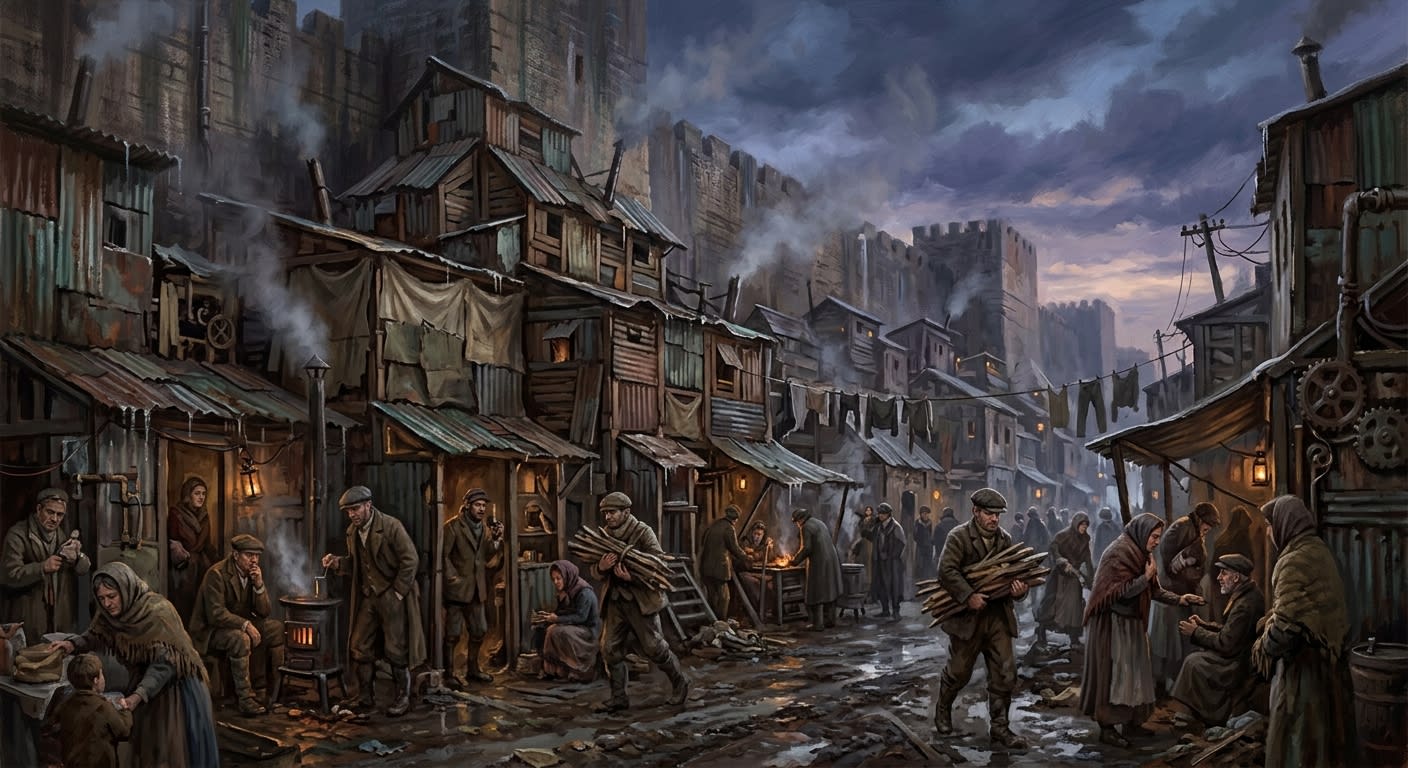
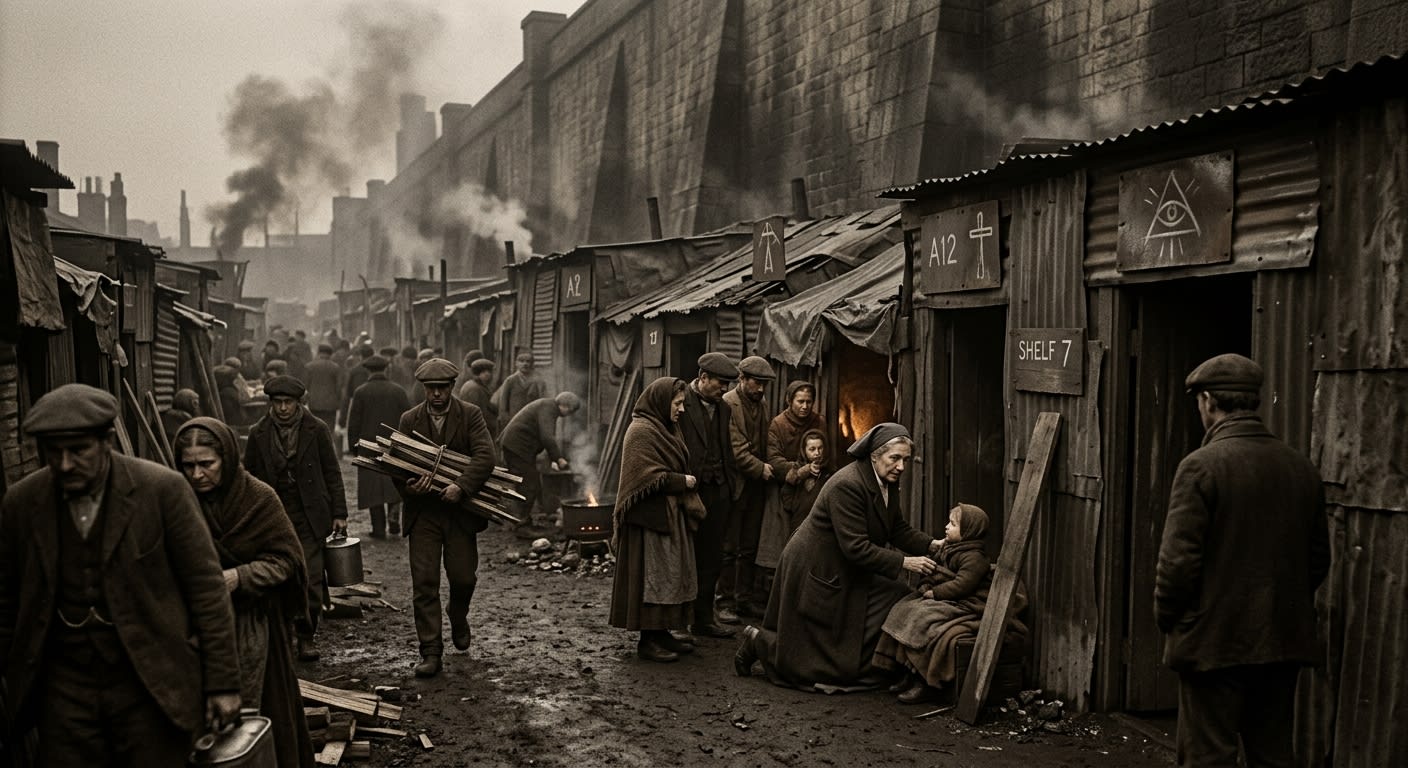
The Refugee Sheds of Thessaloniki cling against the city wall beneath Bellhouse Heights, between the legal districts and the moral weather that legality prefers not to notice. They are plank rows, tarred roofs, patched sailcloth, stove pipes, shared cisterns, pallet tiers, rope-laundry, crate-shrines, cracked pot-lids, vinegar cloth, damp wood, bad smoke, worse bread, and the particular stubbornness of people whom history has repeatedly tried to process and failed to finish.
They were built as temporary shelter. This is why they remain. Temporary arrangements, once neglected by a Bureau, acquire the tenacity of mould, debt, and unlicensed devotion. The first residents came from coastal shelling. The next came from burned farms, quarantined coves, failed convoy camps, villages where the soil had learned salt, vessels stopped at the Chainward Quays, and families whose passage papers were too wet, too late, too contradictory, or too interesting for clerks to approve without further fees. By A.S. 201, children born in these temporary rows have children of their own. The Bureau of Settlement calls this an irregular occupancy condition. Mothers call it home because the alternative is the quay.
From the tower galleries the Sheds look like a brown scab along the wall. From inside they are a city of ratios. How many bowls from one pot. How many sleepers per stove. How many names may be spoken before curfew. How many waking throats can guard thirty children from the water-song until dawn. Every plank has a memory, every leak a schedule, every stove a jurisdiction. No one in Strasbourg planned them, which explains their efficiency.
The Sheds exist at the bottom of Thessaloniki's chain of digestion. Ships pass under the Harbor-Chain. Cargo enters the Ledger. Crews enter inspection. The useful proceed inward. The suspect pass through Quarantine Crescent. The stranded, corrected, unclaimed, tongueless, widowed, misfiled, half-sponsored, and merely poor slide toward the wall. A great city needs margins. The Sheds are Thessaloniki's margin, written in damp ink and corrected nightly by old women with spoons.
#On the Founding That No One Filed
No charter founded the Refugee Sheds. This offends clerks and comforts truth. The Sheds gathered in stages after the harbor chains became the Aegean's great counting instrument, after the Twin Towers hardened into towers, after the port learned that every passage beneath iron produces both a registration and a remainder. A city that processes ships also produces failed passages. Failed passages require somewhere to sleep.
Early shelter rows appear in harbour maintenance notes after the A.S. 72 chain consecration, though those rows were likely tar stores with families inside them by night and official deniability nailed across them by day. During the A.S. 93 re-ratification of the harbor charter, when the original was discovered to have been signed in invisible ink, the Harbor Ledger Office briefly attempted to enumerate all wall-side dependents. The count failed when sixty-three persons appeared in two places at once on the forms and fourteen appeared nowhere while eating soup in plain sight. Records blamed transcription. The wall did not answer.
The Sheds became permanent after the Drowned Choir file opened in A.S. 121. That date matters. Before A.S. 121, the sea had voices, as all seas do when sailors drink and priests overlisten. After A.S. 121, the Bureau admitted that the voices had pattern, recurrence, and custody of names. Refugees housed near the wall reported sleep-singing, tide-walking, shared dreams of bells beneath water, and the gradual arrival of a communal drone used to keep children from answering the under-song. The drone predates official recognition. Most useful things do.
A municipal memorandum of A.S. 124 describes the wall-side dwellings as “uninhabited storage sheds temporarily misused by displaced persons.”
Corrected for internal use. They were inhabited. The persons were displaced. The misuse lay chiefly in the city's attempt to store human beings without admitting that storage had become settlement.
The A.S. 145 Crying Choir intake (Unregistered) fixed the Sheds into the city's conscience, though conscience in Thessaloniki is less an organ than a leak around a sealed hatch. Refugee children huddled beneath tower stone began to sing in sleep. By dawn their tongues had dissolved into salt water while the bodies remained alive. The Bureau declared them “sacrificed to silence,” a phrase so polished it should be used to cut the throats of the men who approved it. Many of those children, their kin, and later custody households were moved wall-side because Quarantine could not keep them, Records could not classify them cleanly, and the Harbor Prefect could not bear them in the Ledger Steps where visiting officials might ask why living children were filed as Port Loss (Clerical).
From A.S. 145 onward, the Sheds stopped pretending to be an accident. Rows multiplied. Stove-lines acquired order. Cloth-strip registries replaced lost parish rolls. Wall corners became shrines for villages that no longer had maps. The Bureau of Mercy produced three hundred pages on damp. Aunt Velka, years later, used similar paper to seal stove gaps, thereby improving both the Sheds and the report.
#On Boards, Stoves, and Sleeping Arithmetic
The Sheds are built badly with high competence. This distinction eludes architects, who mistake straight lines for success. A legal house has measurements. A Shed row has solutions. Tar where rain wins. Sailcloth where wind enters. A stove pipe bent through two families' sleeping shelf because the hole in the roof already exists. A cistern shared by five households and guarded by seven grudges. Boards stolen from broken cargo crates, marked still with wine, salt, ammunition, relic-lime, or the sainted absurdity of “fragile” stamped on wood now holding a roof above twelve people.
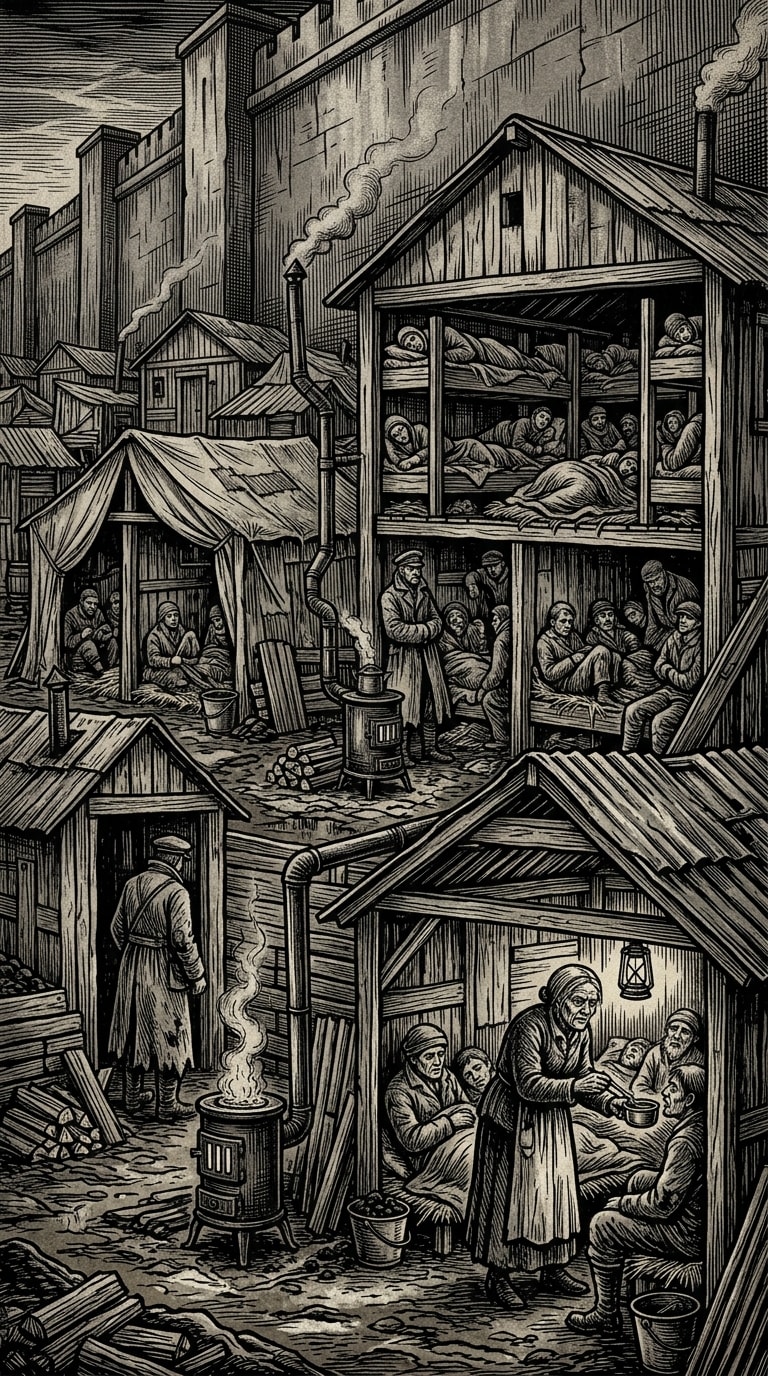
Sleeping platforms rise in layers along the inner walls. The elderly lie nearest stoves until fever weeks, when they are moved outward for air. Children sleep inward, away from the north wall, unless the family dead came by water, in which case Aunt Velka moves them again. Widowers sleep where someone can hear them if they begin answering names in dreams. Tongueless adults sleep in pairs because their distress is visible too late. A romantic would call this community. I call it triage with blankets.
Every row has a stove captain, usually a woman whose age has become a weapon. The stove captain controls pot order, fuel scraps, ash disposal, sick-room heat, and the right to shame anyone who lies about having eaten. Soup is made from lentils, fish heads, dock cabbage, scraped fat, vinegar, smuggled onions, ration crumbs, and the moral pressure of being watched by neighbours who know how thin your children were last week. No Bureau could invent this system because it requires memory unmediated by forms.
The cloth-strip registry hangs in baskets under Velka's keeping and in smaller copies beneath row beams. Each strip marks a person or household by family, ship, village, tongue, death, sponsor, debt, and caution. Red knot for water-dead kin. Blue tear for Quarantine risk. Double fold for child who sleep-sings. Black thread for tongue-loss household. Three cuts for no full name after dusk. Records hates these baskets in the private way institutions hate any archive that works without them. The marks are nonstandard. They also find people faster than the Harbor Ledger.
The last rule entered after A.S. 198. It sounds rustic. It saved lives.
#On the Hum
The communal hum is the Sheds' true wall. Stone keeps out weather badly. Tar keeps out rain intermittently. The hum keeps out the Drowned Choir often enough to justify every cracked throat in the rows.
It began as habit before anyone dared call it rite. Mothers humming babies through fog nights. Dock widows keeping tempo while mending nets. Tongueless children clicking breath against teeth they still possessed. Men with brine lungs holding a low note because silence made the water seem closer. The hum thickened over decades into a civil countermeasure: rough, ugly, low, intentionally unmusical, timed against the Elder and Younger bells and the chain-hum beneath them. It interrupts sleep-singing. It muddies names. It gives the room something human to answer before the sea offers a prettier phrase.
The Bureau of Orison and Song has tried to transcribe it. Naturally. Give a Bureau a sound and it reaches for paper as a drunk reaches for railing. The first examiner returned with seven pages of notation, a nosebleed, and an expression suggesting that music had behaved toward him with personal discourtesy. The second added symbols outside the sanctioned hymnal table and was reprimanded for orthographic enthusiasm. The third concluded that the hum lacked discipline. Correct. Discipline would make it legible. Legibility would make it vulnerable.
The hum has registers. Stove hum, used during ordinary wet nights, low and steady. Fog hum, staggered to prevent the Drowned Choir from finding a clean interval. Fever hum, shorter because the singers cough. Child hum, used when a sleeper begins shaping syllables toward the water. Burial hum, reserved for infants too small for full rites and later pressed into service when the under-note grows bold. There is also the second line, the problem no office wishes to name.
Since A.S. 199 the children have produced a lower harmony beneath the old drone. No teacher supplied it. No choir-master approved it. The tongueless and half-tongued shape it first: breath, throat, chest, click, palate, scar. When held raggedly beneath the ordinary hum, sleep-singing weakens. When sung too cleanly, the north wall sweats salt. Velka enforces ugliness with terrifying exactitude. She makes the children rasp, interrupt, cough, and stagger the note until it becomes less attractive to whatever listens below the harbour. This is theology as conducted by a spoon on a pot-lid. It works, which is why theologians resent it.
#On Aunt Velka's Government
Aunt Velka governs the Sheds without office, stipend, mantle, appointment, seal, desk, or the least decorative permission from men who own such things in surplus. She governs by soup, shame, cloth strips, throat-shifts, accurate memory, and the capacity to make grown dockhands look at their boots with one raised eyebrow. Her legal title is nothing. Her actual authority begins at dusk and ends when the last child wakes with the same name he had at supper.
She appears in records indirectly: supply petitions written by others, disciplinary complaints from Quarantine, night-watch reports noting “temporary congestion,” ration arguments settled too quickly for official preference, and the testimony of children who describe her first by smell: tallow smoke, vinegar cloth, boiled lentils, and the sharp black herb she chews to stay awake. An aunt is a terrifying political form because it hides command inside kinship. A governor needs guards. An aunt needs memory.
Her quarrels with offices follow a liturgy. Quarantine arrives with stretchers and medical custody forms. Velka asks for names. Quarantine produces seals. Velka asks for mothers. Quarantine threatens entry. Thirty women shift between the stretchers and the sleeping rows with the gentle sound of knives being remembered. The official record then notes access difficulty due to temporary congestion. I have seen infantry retreat with less dignity.
She permits Warden-Physic Iri to treat fever. She permits Bell auditors to listen from the threshold if their boots are clean and their hands visible. She permits Diver-Matron Sera to stand near the east wall when the sleep-singing thickens, because Sera's presence thins it. She does not permit Purity novices to question children after dark. Her reasoning is exact: after dark, the Choir questions them enough.
The Sheds obey her because she remembers correctly. Bureau memory is indexed. Velka's memory is applied. She knows which boy came from the blue boat, which widow's husband is alive in one ledger and dead in three mouths, which family must hear their old village name once a week or begin sleep-walking, which child curses in the lost tongue when frightened and should be allowed to curse because a cursing child is still answering the room.
#On the Silence and the Throat-Shifts
On 14 Ashmonth, A.S. 198, the bells stopped. Liss struck the Younger and found the bronze occupied by silence. Andros Pell struck the Elder and received the same absence. The Harbor-Chain Towers produced no sound. Above water, officials argued. Beneath water, Sera felt the chains keep the correct schedule. In the Sheds, the missing bell removed the spine from the hum.
Panic came second. The Sheds know panic, and know it wastes breath. The first danger was listening. Children turned their heads toward the wall. Adults stopped mid-task with spoons in hand. The ordinary drone faltered because the bells no longer marked its floor. Without the bell, the Drowned Choir found open joints in the night.
Velka struck three pot-lids with a spoon. That was the summons. No proclamation, no chant sheet, no prayer approved by a committee of throatless men. Three blows. Adults gathered. The night was divided into throat-shifts. Old women took first watch because they could lie best about exhaustion. Dock-lung men took second because their voices carried through wet timber. Frightened children were placed between singers and told to count breaths. Those who began to sleep-sing were slapped awake, kissed, named aloud, and made to drink vinegar water until they cursed. The curse mattered.
REFUGEE SHEDS NIGHT LIST — THIRD WATCH, A.S. 198 Persons restrained from waterline: 12 Children found in shallows at dawn: 3 Phrase produced: “bell-note, but from below” Names withheld by Velka pending assurance of non-seizure: ███████████████ Quarantine request: denied at Shed gate by civilian obstruction Disposition: not pursued; crowd density unfavorable
The first night held. The second frayed. On the third, something below the note entered the Shed hum: lower than men's chests, thinner than children's throats, a pitch that made stove-flames lean toward the wall. Velka did not name it. That decision preserved more souls than three printed catechisms. She changed the rotation, moved the tongueless children inward, and ordered the oldest women to sing the burial antiphon used for babies too small to receive full rites. The under-note receded. Three children still reached the shallows before dawn. All three lived.
Harbor summaries describe the Shed response during the Silence as “spontaneous civilian devotional resilience.”
Corrected for internal use. The response was organized by Aunt Velka, resisted by Quarantine staff, ignored by the Bureau of Rites until useful, and later praised in language broad enough to steal credit without creating liability.
The throat-shifts remain. They are now ordinary as damp. Each row keeps a night slate with names of singers, watchers, kettle-keepers, child-counters, and runners. The runners carry vinegar, strips, and warnings. They do not carry full names after dusk. This rule has saved more lives than several licensed sacraments.
#On Quarantine, Mercy, and Other Neighbours
The Sheds sit close enough to Quarantine Crescent to smell carbolic when the wind comes wrong. This proximity is administrative cruelty disguised as convenience. Quarantine wants bodies early, before fever, before acoustic distress, before testimony becomes contradictory, before relatives learn to obstruct politely. The Sheds want bodies kept among known sleepers until removal is necessary, witnessed, named, and reversible in the records. These desires collide at the stove-line.
Warden-Physic Iri's people are more useful than most. They bring vinegar, gauze, fever chalk, and the tired tact of medical workers who have learned that force spends trust faster than medicine can earn it. Velka lets them in when they ask properly. Purity men ask badly. Records men ask as if the answer has already been filed. Orison asks to listen. Festivals asks nothing because no festival is admitted to exist. This is one of Festivals' finer contributions to public health.
Mercy studies the Sheds periodically. The studies produce damp, crowding, malnutrition, acoustic stress, irregular guardianship, informal naming, stove-smoke injury, and “community reliance structures.” The cure proposed is usually relocation. Relocation, in Bureau speech, means scattering people whose defence depends on knowing one another's sleeping noises. Velka has defeated three relocation attempts by asking where the hum would be housed. No one has answered. The reports remain pending, that blessed limbo where bad ideas go to collect dust and occasionally breed.
Quarantine's deepest resentment concerns the tongueless. The Crescent wants them classified, observed, measured, and retained when useful. The Sheds treat them as neighbours. A tongueless adult may still mend nets, watch children, keep stove, tap warning, click a second line, and remember a mother's face. Bureau categories tend to shrink people to symptoms. Shed categories expand around function. This is why the Sheds survive and why the Crescent keeps requesting more authority.
#On the Night of Quiet Bells
The Night of Quiet Bells began in A.S. 199 without decree. The first anniversary after the Silence arrived. The dusk peal rang in reversed voices — Elder high, Younger low — and the city stopped speaking. Taverns poured without argument. Markets closed without haggling. Dockhands pointed instead of cursing. Families ate in silence. The Sheds did not fall silent. They could not. The Drowned Choir observes no anniversaries and respects no grief that cannot defend itself.
So the Sheds hum while the city withholds speech. The exception is not disrespect. It is sentry duty. The rest of Thessaloniki listens to the wound. The Sheds keep it from widening. Children are told before supper that the city will be quiet and that they must not mistake that quiet for permission. The hum begins early, before the final vibration fades. It stays ugly on purpose. Pretty notes are slapped flat. Cups are held in both hands to keep fingers from tapping the wrong sequence.
Auditors dislike the exemption because it resists their favourite disease: symmetry. If all Thessaloniki is silent, why are the Sheds humming? Because the Sheds are nearer the Choir. Because the tongueless children hear first. Because a rule that kills the poor so the diagram looks balanced deserves to be buried in its own ink. There. I have saved the auditors a consultation fee.
The Night has made the Sheds more visible and less touchable. Citywide silence can be denied as coincidence. A continuous hum inside that silence is harder to dismiss and harder to license. Strasbourg's external audit has placed the Shed practice on its question list. Velka will offer tea in chipped cups, seat the auditors where the roof drips, and answer precisely enough to prevent useful knowledge from becoming confiscated knowledge. This is custody under another office's nose.
#On the Present Rows
As of A.S. 201, the Refugee Sheds are overcrowded, damp, underfed, acoustically suspect, badly roofed, and more competently governed after dusk than several chartered districts under full civic seal. Their population shifts with convoy failures, quarantine releases, port seizures, and weather. Their actual count is unknown. Records has a number. Velka has names. Choose your faith accordingly.
The second line continues. Sera says the chain-hum recognizes it. Kosta says nothing and listens harder. Liss, from the Younger Tower, hears the reversed bell cross the harbour and asks after Shed children by initials. Quarantine has recorded fewer sleep-walk admissions in rows where Velka's ugliness discipline is strictest. Orison has requested supervised transcription. Velka has misplaced the request in a stove.
A draft recommendation from the Bureau of Rites proposed regularizing the Sheds under a licensed Civilian Drone-Matronate attached to coastal harmonic defence.
Rejected. Licensing would require training, training would require standardisation, standardisation would destroy the practice, and the practice currently keeps children from walking into the sea. Even the Bureau can identify a bad bargain when it threatens shipping statistics.
The Sheds will remain temporary until they fall down or become useful enough to rename. They have already become useful enough. Renaming has not yet occurred because renaming creates obligations, and obligations are heavier than planks. For now the wall holds them, the tar leaks, the stoves smoke, the cloth strips multiply, and the children learn which parts of their names may be sung safely after dusk.
At night, when the Elder speaks in the Younger's voice and the Younger answers in the Elder's, the Sheds begin their low rough note. It passes through tar, cloth, throat, scar, pot, plank, and damp. The sea listens. The children breathe. Velka counts by touch along the cloth strips, one knot, one fold, one cut, one life.