

#On Her Station Beneath the Chain
Diver-Matron Sera belongs to the Custodians of the Chain, that scarred Thessalonikan brotherhood-and-sisterhood of divers, riggers, windlass-men, forge-priests, rope-law clerks, and practical blasphemers whose daily work consists of touching the thing the Bureaus theorize about from dry rooms. Her formal rank is Diver-Matron. Her informal rank is what every sensible person in Thessaloniki calls her when the chain-hum changes and the clerks start looking for someone else to stand nearer the water: send for Sera.
She has not slept in four years.
This fact appears in several files under differing prose. The Bureau of Bells calls it “persistent wakefulness associated with occupational acoustic exposure.” The Quarantine Crescent calls it “non-febrile insomnia, anomalous tolerance.” The Chainwrights, who are less educated and more correct, say the chain-hum keeps her awake. Sera says, in a line I have ordered copied into three restricted memoranda, that she sleeps “when the iron stops counting.”
Her duties are physical before they are mystical, which is why the Bureaus trust her reports only when they become impossible to ignore. She descends to inspect psalm-inscribed links large enough to crush a mule. She scrapes corrosion from iron that hums through glove, skin, blood, and tooth. She checks stress fractures, barnacle load, bolt seating, relic-inlay erosion, and the tension windows by which the Elder and Younger Towers decide whether the harbour is open, closed, blessed, endangered, taxable, or merely busy.
#On Her Training and the Matronate
The Diver-Matrons arose because men kept dying politely. This is not a doctrinal statement; it is a personnel note. In the first generations after the Sundering, Thessaloniki's harbour chain was maintained by war-divers drawn from naval crews, penal labour, and those coastal families whose children learned to swim before they learned to sign their names. They were strong, obedient, and appallingly willing to perish while waiting for an order to surface.
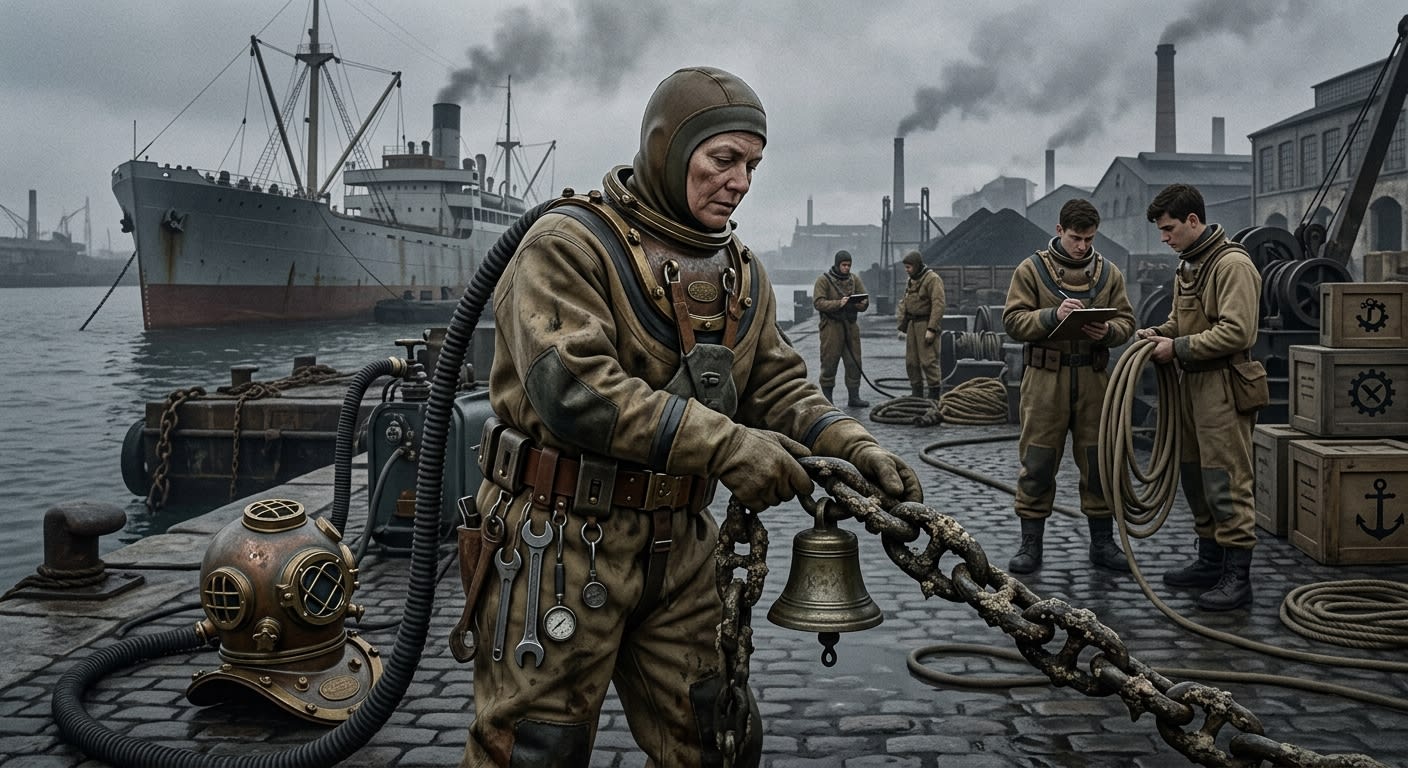
The Matronate corrected this deficiency by introducing a hierarchy of women who would surface when the water was wrong, descend when the paperwork was late, and slap a Chainmaster across the mouth if he mistook ceremony for tide. The first Diver-Matrons carried knives, slate tablets, prayer-beads, weighted lamps, and the authority to abort an inspection without requesting tower approval. This authority has been challenged eighteen times. The challenger has, in twelve cases, drowned later. The remaining six learned.
Sera entered the Matronate young enough that older Chainwrights remember her as “the eel with elbows.” She learned breath-keeping in the eel pools beneath Drowned Row, knot-reading by touch, bell-schedule through hull vibration, and the old diver's catechism: count the links, count your breaths, count your lies when you return above. She rose after the Chain-Cramp Winter, when three inspection crews seized under the lower arc and she cut two free with a scraper hook while the third tried to sing through his mask.
By A.S. 198, she was the oldest active diver still making deep inspections and the only Matron permitted to contradict Chainmaster Kosta in public without triggering a disciplinary exchange. Kosta, to his credit, appears to understand that contradiction from Sera is a maintenance instrument. Lesser officials call it insubordination because lesser officials possess ears only for rank.
#On the Silence of A.S. 198
On the evening of 14 Ashmonth, A.S. 198, the bells of the Harbor-Chain Towers stopped speaking. The clappers struck. Bell-Warden Andros Pell felt the Elder's impact in his jaw. Katerin Liss felt the Younger swallow its own blow. Instruments recorded force. Air received nothing. The harbour, which requires the dusk peal to close its chain-gate with lawful confidence, entered that administrative condition in which every manual suddenly becomes a long apology.
Kosta sent for Sera before the second hour.
She went down while the surface argued. That phrase should be carved over half the offices in Strasbourg: while the surface argued. Above, clerks debated whether a silent bell could authorize passage. Priests debated whether silence constituted a sign. Captains debated whether a ship could move beneath unchristened chains without becoming a debt to the sea. Sera descended with a brass lamp, a weighted line, bare hands, and the useful contempt of a worker for men who discover metaphysics whenever labour becomes dangerous.
At the submerged links she felt vibration.
No surface engine made it. No tide-strike explained it. Ordinary passage hum has a coarser tooth. The chain-links vibrated in the correct dawn-and-dusk sequence, the schedule the bells had abandoned: lower then higher, higher then lower, count and answer, gate and witness. The instruments above detected nothing. The towers reported nothing. Sera's palms reported the bell-schedule under black water for seventy-two hours without ceasing.
DIVER'S SLATE FRAGMENT — RECOVERED AFTER SECOND DESCENT LINKS COUNTING. BELL ABOVE EMPTY. IRON BELOW NOT EMPTY. HAND ON LINK HEARS ███████████████. DO NOT LET CHILDREN SLEEP NEAR WATER.
She made six descents during the Silence. The sixth should have killed her. Her left glove split on a corrosion spur. Salt water entered. The link beneath her hand vibrated as the Younger should have rung. Later, in the Matronate room, she refused cautery until she had dictated the sequence. The wound healed badly. The report did not.
Early incident summaries state that tower instruments confirmed Sera's observations after review.
Incorrect. Tower instruments confirmed nothing. Sera confirmed the chain. The Bureau later confirmed Sera, which is a different act and a more humiliating one.
#On the Report No Bureau Wanted
Sera's report is a simple document made terrible by its simplicity. It does not speculate. It does not decorate. It contains no theology, no simile, no plea for institutional attention, and none of the pretty connective tissue by which frightened officials pad a fact until it becomes bearable. She lists times, links, touches, pulse-counts, direction of vibration, water temperature, lamp behaviour, hand sensation, and the precise intervals at which the chain imitated a bell that refused to sound above.
The Bureau of Rites filed it as supporting material. Supporting what, no one has dared state in a way that can be quoted. The Bureau of Bells declined to request the original slate because the slate had been used underwater and lay outside ordinary acoustic custody. The Bureau of Doctrine — that is to say, my own august and mercifully literate office — used Sera's observation to draft Determination 198-K/7, “a test of fidelity administered by mechanisms beyond current doctrinal scope.”
The phrase has teeth. It also has a blindfold.
Sera disliked the determination. She did not say so in the hearing, because she is intelligent. She said it afterward to a Chainwright apprentice who wrote it on a lunch wrapper and sold the wrapper to a Records clerk who sold it to a Rites assistant who showed it to me after wine. The line reads: “If the test was fidelity, the iron passed and the bronze lied.”
I have not entered that line in the public record. I have entered it here.
#On the Drowned Choir's Attention
The Drowned Choir has noticed Sera. That sentence is not approved for general comfort, and comfort is not the purpose of this dossier.
Since A.S. 198, she reports increased tonal complexity beneath the harbour. Her inspection logs describe intervals that narrow between measurements, corrosion that resembles handwriting until copied, fog holding shape around submerged chain arcs, and sleep-singing in the Refugee Sheds that answers link-hum before the bells begin. She avoids metaphor with the discipline of a woman who mistrusts language near water. When pressed by Rites auditors for a summary, she gave three words: “It is learning.”
The auditors disliked the pronoun.
The Choir's older habit was accumulation: names sung below, names appearing in Kosta's hidden ledger, names forming in rust, names pulling sleepers toward the tide. Sera now describes something more offensive to the Bureau: correction. The chain-hum shifts when the bells misstrike. The hum anticipates fog. On three occasions, her slate marks show link vibration beginning before the scheduled peal and stopping the instant the bell-rope moved, as if the water were instructing the bells.
Children hear her before she enters the Sheds. This is Aunt Velka's observation, and Aunt Velka is not a woman whose testimony improves with embellishment; she has buried too many embellishments. The sleep-singing thins when Sera stands near the east wall. It thickens after she leaves. One child, tongueless since the Crying Choir incident's afterline cases, tapped Sera's palm in the dawn-dusk sequence. Sera did not report this for three days. When asked why, she answered, “I wanted one night without knowing.”
#On Character, Scar, and Refusal
Sera is not pious in any form that flatters a chapel. She does not declaim. She does not kneel where officials can see. She wears saint medals inside her diving collar because exposed medals snag on fittings and drown fools. Her faith is tactile: iron held, count kept, child warned, lie refused, descent made. Doctrine may have prettier categories. Doctrine has many pretty things. Most of them are dry.
She is severe with apprentices. She breaks fear down into tasks. Check the lamp. Check the line. Count the link. Touch with the palm, not the fingers. Fingers lie when cold. Palms remember. Do not answer any voice that uses your childhood name. Do not look at corrosion longer than the breath you are spending. If the chain begins the dawn sequence at night, surface with witnesses. If a superior orders otherwise, surface with the superior's name written clearly enough for his widow.
Kosta trusts her. Iolana reads her reports before breakfast, which is the Records equivalent of terror. Pell, who struck the Elder into silence, refuses to discuss the event until Sera's slate lies on the table. Liss once said Sera's hands hear better than tower instruments. The Bureau of Bells marked this as hyperbole. The Bureau of Bells has been wrong before, though rarely with such expensive equipment.
A Quarantine Crescent note recommended Sera's removal from diving duty on grounds of “sleep deficiency and fixation upon chain response.”
Withdrawn after three substitute divers failed to detect a lower-arc vibration later confirmed by Sera, two pilots, and a dog that bit through its own lead rather than cross the forge pier. The dog has not been promoted. The substitute divers have been reassigned to shallower embarrassment.
#On Her Present Condition
As of A.S. 201, Diver-Matron Sera remains active. This is either courage, necessity, or institutional negligence; the Bureau prefers necessity because it invoices cleanly. She has not slept. Her eyes show the red crescenting common to chain-hum exposure. Her left palm bears a white scar in the pattern of three half-links. Her inspection logs have lengthened. Her sentences have shortened.
Strasbourg's external auditors intend to interview her. They will bring calipers, wax tablets, acoustic diagrams, incense, sealed questionnaires, and that touching mainland confidence that terror becomes obedient once properly labeled. They will ask when the chain first changed. She will say it did not change; it began speaking in a register the towers could no longer hear. They will ask whether the Drowned Choir is divine or demonic. She will say the water does not need our categories to drown us. They will ask whether she trusts her own senses after four sleepless years. She will place their hands on the iron, if they are brave enough to offer them.
The bell reversal persists. The chain corrosion writes longer clauses. Kosta's ledger has new waiting names. Aunt Velka's children hum second lines. Pilot-King Nenos says the sea is listening too hard. Sera descends.