
#On the Night the Bells Forgot
"The Elder and the Younger have rung since the chains were tensioned. They ring at dawn. They ring at dusk. They ring when ships pass and when ships sink and when the fog comes thick enough to taste. They ring because they were consecrated to ring, because the Bureau of Bells licensed them to ring, because the Bureau of Doctrine declared their ringing a sacrament indistinguishable from prayer. They did not ring on the evening of the fourteenth of Ashmonth, Anno Synodi 198. They did not ring the following dawn. They did not ring for three nights." — Incident Report 7-K/198, Harbor Bell Oversight, Thessaloniki
I shall state what is known before I state what is feared, and I shall state what is feared before I confess what the Bureau will neither confirm nor deny — which is that the Silence of Thessaloniki was the worst thing to happen to the Aegean theatre since the Crying Choir stripped the tongues from refugee children in A.S. 145, and that the Bureau's official explanation is a masterwork of theological engineering that I helped to write and that I do not, in the privacy of this margin, believe.
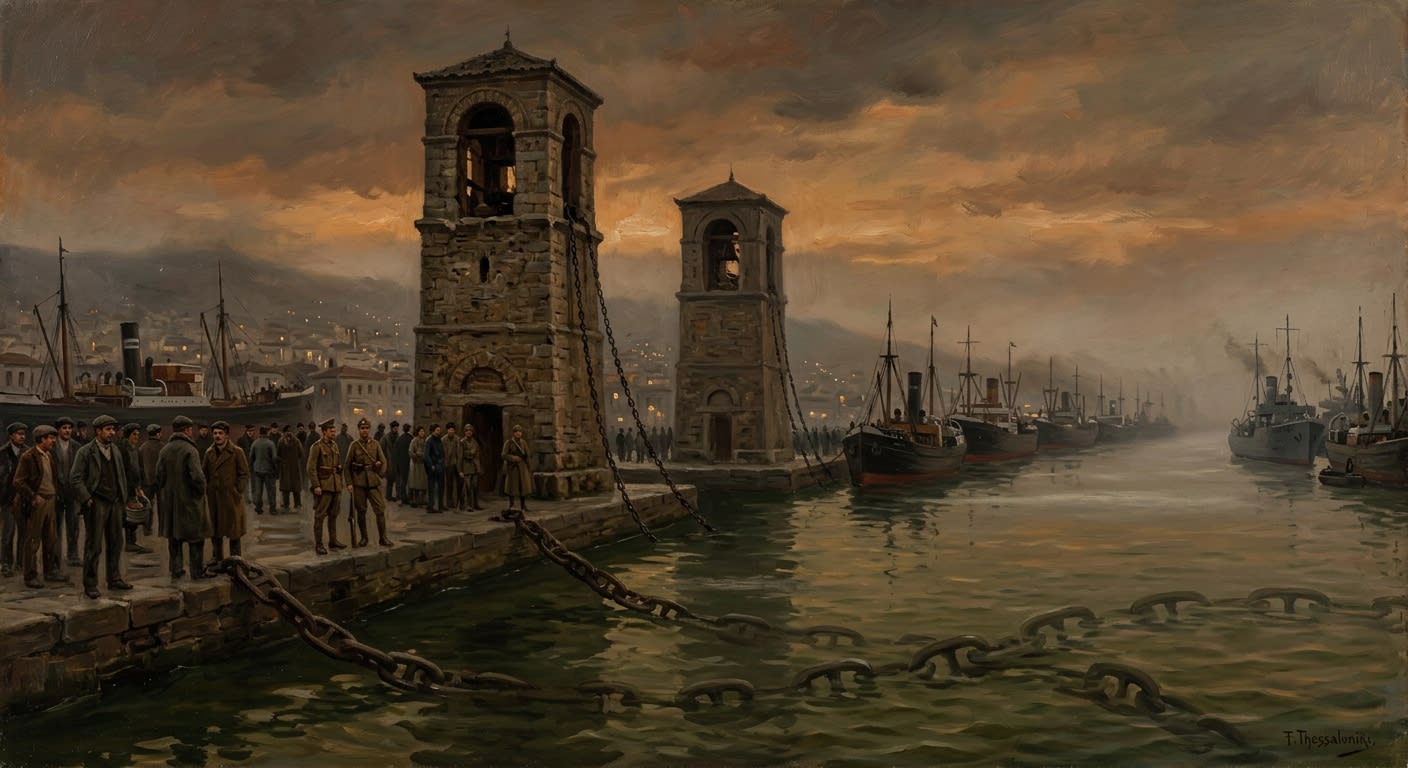
The twin bells of Thessaloniki sit in the crown-chambers of the Elder and Younger Towers, respectively. The Elder bell — cast in A.S. 72 from bronze salvaged from the coastal wars, consecrated by six priests of whom three survived the ceremony and one was later declared retroactively heretical — rings the lower tone. A deep sound. A harbour sound. The kind of note that enters through your boots before it reaches your ears, and that the Bureau of Engineering measured, during its only acoustic survey, at a frequency capable of vibrating the chain-links two hundred yards below. The Younger bell, cast nine years later from metal the Bureau of Records lists as "contributed" and the Chainwrights call "stolen," rings the higher tone — sharp, coastal, the note that carries across water and tells incoming ships that the harbour is alive, that the gate is manned, that someone is counting.
Between them, the two bells define Thessaloniki's day. Dawn peal: both bells, lower then higher, the harbour opens. Dusk peal: both bells, higher then lower, the harbour seals. Storm peal: both bells simultaneously, a dissonance that the Bureau of Bells classified as "theologically productive" and that sailors call the sound of the Creator arguing with Himself. Every legal hour in the city is counted from the bells. Every curfew, every chain-window, every docking permit, every quarantine release — all of it calibrated to the sequence of the two tones. When the bells ring, Thessaloniki functions. When the bells ring, the Bureau of Records has a clock. When the bells ring, the war machine eats on schedule and the trenches are fed and the convoys depart under the chains with their crews singing the Passage Psalm at a tempo set by the bell.
The bells did not ring.
#On the Three Nights
"No explanation was offered because no explanation was available. The bell-wardens pulled their ropes. The clappers moved. The bronze did not speak." — Deposition of Bell-Warden First Class Andros Pell, filed under Seal Amber
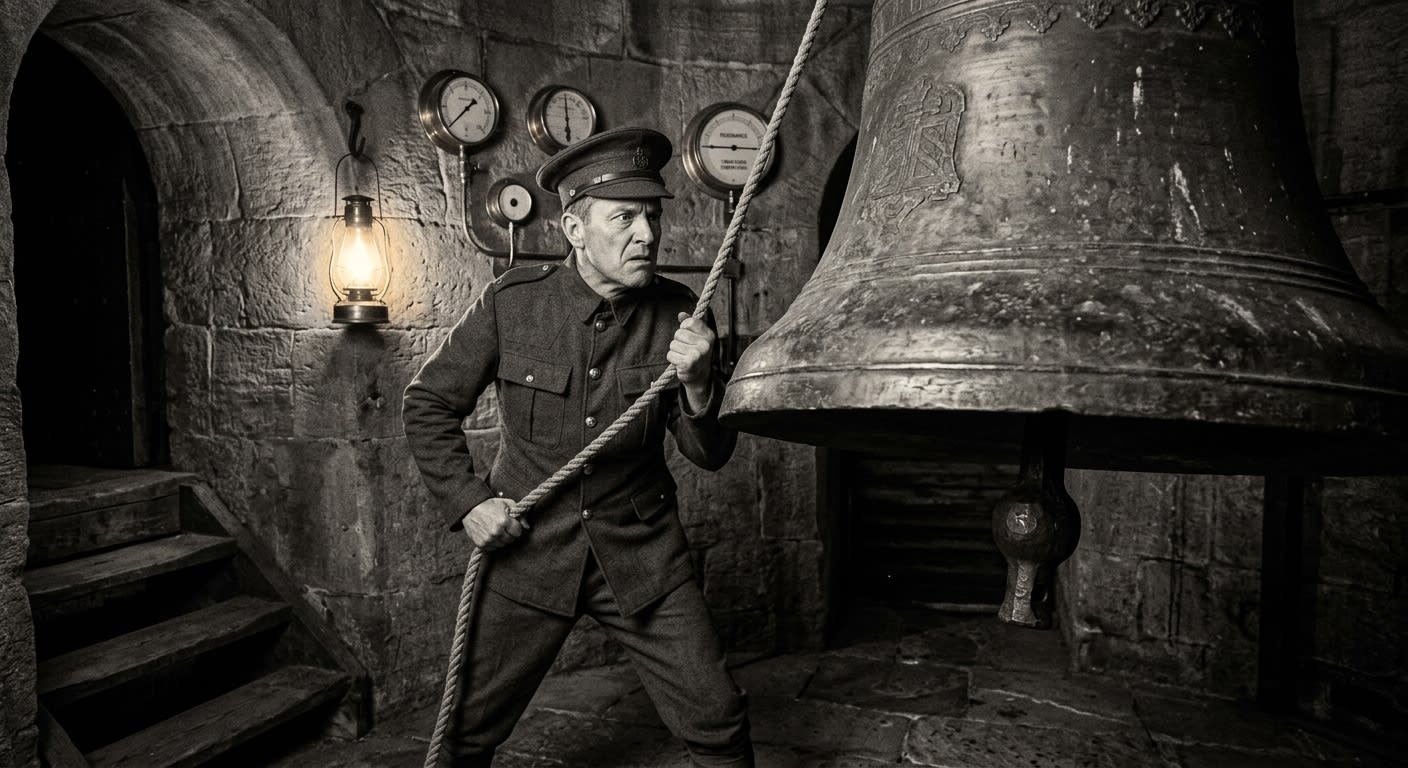
The fourteenth of Ashmonth, A.S. 198. Dusk. Bell-Warden Andros Pell climbed the Elder Tower's internal stair — one hundred and seventy-eight steps, each worn smooth by a century of boots — and reached the crown-chamber at the hour prescribed by the Bureau of Bells' schedule. He pulled the rope. The clapper struck the bell. He felt the impact through his hands, through the soles of his boots, through the bones of his jaw. The bronze rang — and produced nothing. No sound. No vibration. No hum carried down through the tower's stonework and into the chains below. The clapper hit the lip of the bell and the air swallowed it like water swallowing a stone.
Pell pulled again. Struck again. Silence.
In the Younger Tower, Bell-Warden Second Class Katerin Liss experienced the same. Clapper struck bronze. Bronze absorbed the blow. The acoustic energy — which the Bureau of Engineering later confirmed should have been sufficient to produce a tone audible at three nautical miles — vanished. The instruments in the bell-chamber registered the impact. They did not register the sound. Liss, who had served the bells for eleven years and whose hands bore the particular calluses of a woman who has pulled the same rope six thousand times, said afterward that the silence was not empty. It was full. The bell was full of something that had no intention of moving aside for a sound.
The harbour did not close. The harbour did not know how to close without the bell. Chain-gate protocol requires the dusk peal as the authorization signal — no bell, no seal. Chainmaster Superior Kosta, whose scarred hands and methodical temper are the closest thing Thessaloniki has to a municipal personality, ordered the gates held open and sent runners to the Ledger Steps. Harbor Prefect-Archivist Iolana dispatched an emergency memorandum to the Bureau of Rites in language that I am told was "measured" and that sources closer to Iolana's temperament describe as "incandescent."
The bells did not ring at dawn.
The bells did not ring at dusk.
The bells did not ring at dawn.
Three nights. Three dawns. Six missed peals. The longest unbroken silence in the Twin Towers' history — longer than the Choir-Mortar siege, longer than the quarantine of A.S. 112, longer than any maintenance closure the Bureau of Engineering has on record. For seventy-two hours, Thessaloniki operated without its clock. Without its sacrament. Without the sound that told two hundred and eighty thousand people that the system was functioning, that the war was being administered, that someone — the Creator, the Bureau, the bronze itself — was paying attention.
#On What Happened in the Silence
The city did not panic. This requires emphasis, because the Bureau's subsequent report implied that it did — implied, more precisely, that civilian disorder necessitated the Bureau of Doctrine's intervention, which is the Bureau's preferred method of claiming credit for crises it did not prevent. The city did not panic. The city stopped.
Docking queues froze. Chain-gate traffic halted — not because the gate was closed, but because no captain would sail beneath unchristened chains. The Passage Psalm requires the bell as its rhythmic foundation; without the bell, the psalm has no tempo, and a ship passing under silent chains is — per the theological understanding of every sailor from Marseille to the Bosphorus — an uncounted passage. An unregistered passage. A passage that the chains do not record and that the sea, which counts everything the chains count, will collect upon at its own discretion.
The Chainward Quays became a waiting room. Clerks stood at their stamp windows with nothing to stamp. The Purity inspection teams patrolled empty corridors. In the Pitch Markets, the chandlers kept their fires burning but their voices low — brine-stained men who had survived storms and sieges and Bureau audits, standing in their own shops and speaking in whispers because the absence of the bell made every human voice feel exposed, as if the air itself had developed ears.
On the second night, the sleep-singing began in the Refugee Sheds.
This was expected. The communal hum that the refugees maintain against the Drowned Choir's influence depends on rhythm, and the rhythm depends on the bells. Without the bells, the hum faltered. Without the hum, the Choir's frequency — that sub-audible harmony that pulls dreams toward the water — found its way into the Sheds unchecked. Aunt Velka, the unofficial matriarch of the refugee population, organized shifts of wakeful singers to maintain the drone. The shifts held through the first night. They frayed on the second. By the third, twelve refugees had walked to the waterline before being physically restrained, and three children were found standing in the shallows at dawn, their eyes open, their mouths producing a sound that Velka described as "the bell-note, but from below."
The Quarantine Crescent recorded seven new admissions for "acoustic distress" — the Collegium's euphemism for patients who hear sounds that the instruments do not detect. Warden-Physic Iri filed the admissions under the standard protocol and did not comment on the fact that all seven patients reported hearing the same thing: a bell, ringing correctly, in the correct sequence, from somewhere beneath the harbour floor.
#On the Reversal
"The Bureau of Doctrine classifies the tone-reversal as a 'test of fidelity administered by mechanisms beyond current doctrinal scope.' The soldiers call it something worse. I shall not reproduce their terminology. Their theology, while crude, is distressingly plausible." — Personal notation, V. Drax, margin of Incident Report 7-K/198
On the morning of the seventeenth of Ashmonth — the fourth dawn, the dawn after the third silent night — Bell-Warden Pell climbed the Elder Tower and pulled the rope. The clapper struck the bronze. The bell rang.
It rang the Younger's note.
The Elder bell, which had produced the same low harbour-tone for one hundred and twenty-six years, which had been tuned by the Bureau of Bells' own acoustic calibrators and blessed by the Bureau of Rites' own liturgists and tested annually against a reference pitch maintained in a sealed vault in Strasbourg — the Elder bell rang the Younger's high coastal note. Clean. Clear. At a frequency that the instruments confirmed was the Younger bell's registered pitch to within a margin the Bureau of Engineering called "indistinguishable."
In the Younger Tower, Bell-Warden Liss pulled her rope. The Younger bell rang the Elder's note. Low, deep, the harbour sound that enters through the boots. The pitch was exact. The resonance was exact. The bronze itself had not changed — the metallurgists confirmed this within the hour, pulling samples, testing grain structure, performing every analysis the Bureau of Engineering had protocols for and inventing two new ones on the spot. The bells were the same bells. The clappers were the same clappers. The air was the same air. The tones had simply — and the word "simply" here carries the weight of a theological crisis that the Bureau has spent three years failing to resolve — exchanged.
The Elder rings the Younger's note. The Younger rings the Elder's. Three years later, this remains the case. The Bureau of Bells has attempted recalibration six times. Each attempt produces the same result: the instruments confirm the new pitch, the metallurgists confirm the old metal, and the gap between these two facts remains — per the Bureau's official terminology — "under review."
The bells ring. The harbour opens and closes. The chain-windows operate on the reversed schedule. Thessaloniki has adapted, as Thessaloniki adapts to everything, by filing the anomaly and continuing to function around it. The Elder Tower's crown-chamber now bears a small brass plaque, installed by the Bureau of Bells, that reads: Tone: Younger (Reassigned, A.S. 198). The plaque does not explain the reassignment. The plaque does not need to. Everyone in Thessaloniki knows what happened, and the act of knowing — of carrying that knowledge in silence, of adjusting one's daily rhythm to a wrongness that the Bureau has certified as correct — is the wound that the Silence left behind.
#On the Bureau's Explanation and Its Silences
The Bureau of Doctrine's classification of the event as a "test of fidelity" is, I must confess, my own work. I drafted the determination. I chose the phrasing. I submitted it to the Doctrinal Congress with the appropriate seals and the appropriate gravity and the appropriate absence of specificity that allows a theological pronouncement to mean whatever the reader requires it to mean while committing the Bureau to nothing that could later be contradicted by facts.
A "test of fidelity" implies an examiner. The determination does not name the examiner. A test implies criteria. The determination does not state the criteria. A test implies a result — pass or fail. The determination does not disclose whether Thessaloniki passed.
What the determination does accomplish — and this is its genius, if I may be permitted a moment of professional vanity — is the foreclosure of alternative explanations. If the Silence was a test, then it was administered. If it was administered, then it came from above. If it came from above, then the Drowned Choir is not responsible. If the Drowned Choir is not responsible, then the Bureau of Rites' eighty-year failure to classify the Choir as divine or demonic is not implicated. If the failure is not implicated, then no Bureau requires investigation, no jurisdiction requires revision, and no one — no one at all — needs to answer the question that Thessaloniki's citizens ask each other in whispers on the Night of Quiet Bells, which is the unofficial memorial they observe each Ashmonth by refusing to speak after curfew:
What if the bells did not fail? What if the bells were answered?
#On the Night of Quiet Bells
The Night of Quiet Bells is not sanctioned by the Bureau of Festivals. It appears on no liturgical calendar. It carries no stamp, no seal, no doctrinal endorsement. It is, in every administrative sense, a spontaneous civilian behaviour that the Bureau has classified as "tolerated" — which is the Bureau's word for things it cannot stop and has decided to ignore.
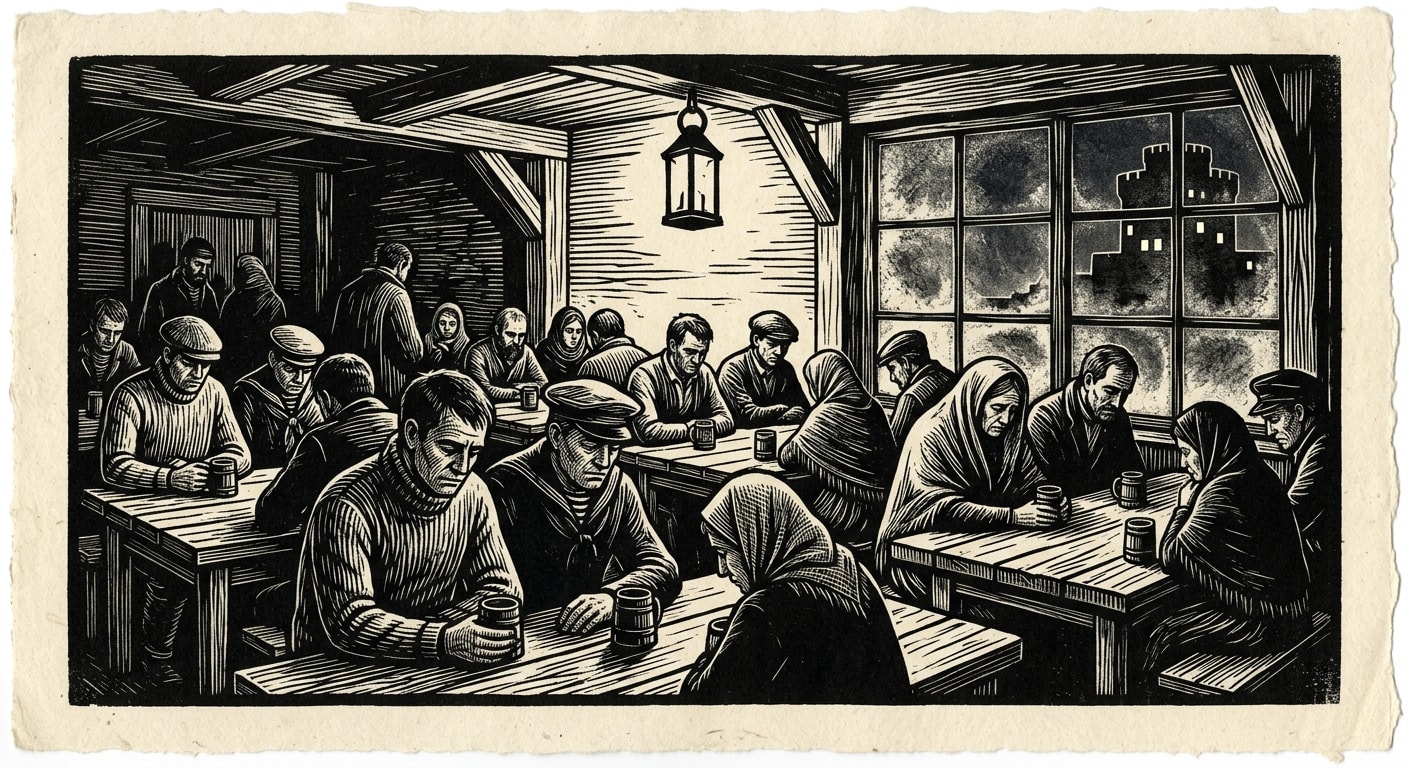
Each year on the fourteenth of Ashmonth, the anniversary of the first silent evening, the citizens of Thessaloniki fall quiet after the dusk peal. The taverns of Drowned Row serve their brine ale without conversation. The Pitch Markets close their stalls in silence. The Refugee Sheds maintain their hum — they must, the Choir does not observe anniversaries — but the rest of the city holds its breath. Families eat without speaking. Lovers lie beside each other and listen. The provost patrols walk their routes and report, each year, the same thing: compliance. Perfect, eerie, voluntary compliance with an order no one gave.
ERRATUM — BUREAU OF FESTIVALS, OFFICE OF LITURGICAL COMPLIANCE The observance referred to as "The Night of Quiet Bells" is not a festival, a memorial, a vigil, or a sanctioned act of collective devotion. It is a coincidental pattern of civilian behaviour that occurs annually on or near the fourteenth of Ashmonth and that the Bureau has no obligation to recognize, regulate, or suppress. Citizens participating in this coincidence are reminded that silence, while not prohibited, is also not prescribed, and that the Bureau reserves the right to reclassify coincidence as coordination should the distinction become administratively convenient.
The Chainwrights observe the Night differently. In the Elder Tower's crown-chamber, Chainmaster Kosta sits beside the bell and listens. He has done this for three years. He has told no one what he listens for. His hidden ledger — the one that records "names taken by the sea" and that predicts drownings with a reliability the Bureau of Records would envy if it admitted the ledger existed — gained, on the night of the Silence, fourteen new entries. Fourteen names written in a hand that was not Kosta's. Fourteen names of people who were, at the time of writing, alive.
All fourteen drowned within the year.
I have seen the ledger. I will say no more on this matter. The Bureau's silence on the subject of Kosta's ledger is not an oversight. It is a policy. Some registrations are conducted by authorities the Bureau does not acknowledge, through mechanisms the Bureau does not control, in ink the Bureau cannot identify. The Warden's function, in such cases, is to note the registration, seal the file, and remind himself that faith — true faith, the operational kind, the kind that keeps the Ledger balanced and the bells ringing — requires the wisdom to know which questions the Bureau asks because it wants answers and which it asks because the asking itself is the answer.
#On the Drowned Choir's Part
The Bureau of Rites does not connect the Silence to the Drowned Choir. This is the Bureau's position and I shall record it faithfully before I record everything that makes it untenable.
The Drowned Choir — that sub-surface harmony that has haunted Thessaloniki's harbour since at least A.S. 121, that has accumulated names and pulled dreams into the tide and, in A.S. 145, dissolved the tongues of sleeping children — operates, per Bureau classification, as a Category Three Harmonic Anomaly. The Silence of A.S. 198 is classified as a Category Three Acoustic Anomaly. The Bureau insists these are distinct categories, governed by distinct investigative protocols, subject to distinct jurisdictions. The Drowned Choir falls under the Bureau of Rites. The bell failure falls under the Bureau of Bells. The two Bureaus have conducted their inquiries separately, filed their reports separately, and reached their conclusions separately. At no point have their investigators compared notes. At no point has anyone with authority over both classifications examined the possibility that a harmonic anomaly in the water and an acoustic anomaly in the bells might share a common cause.
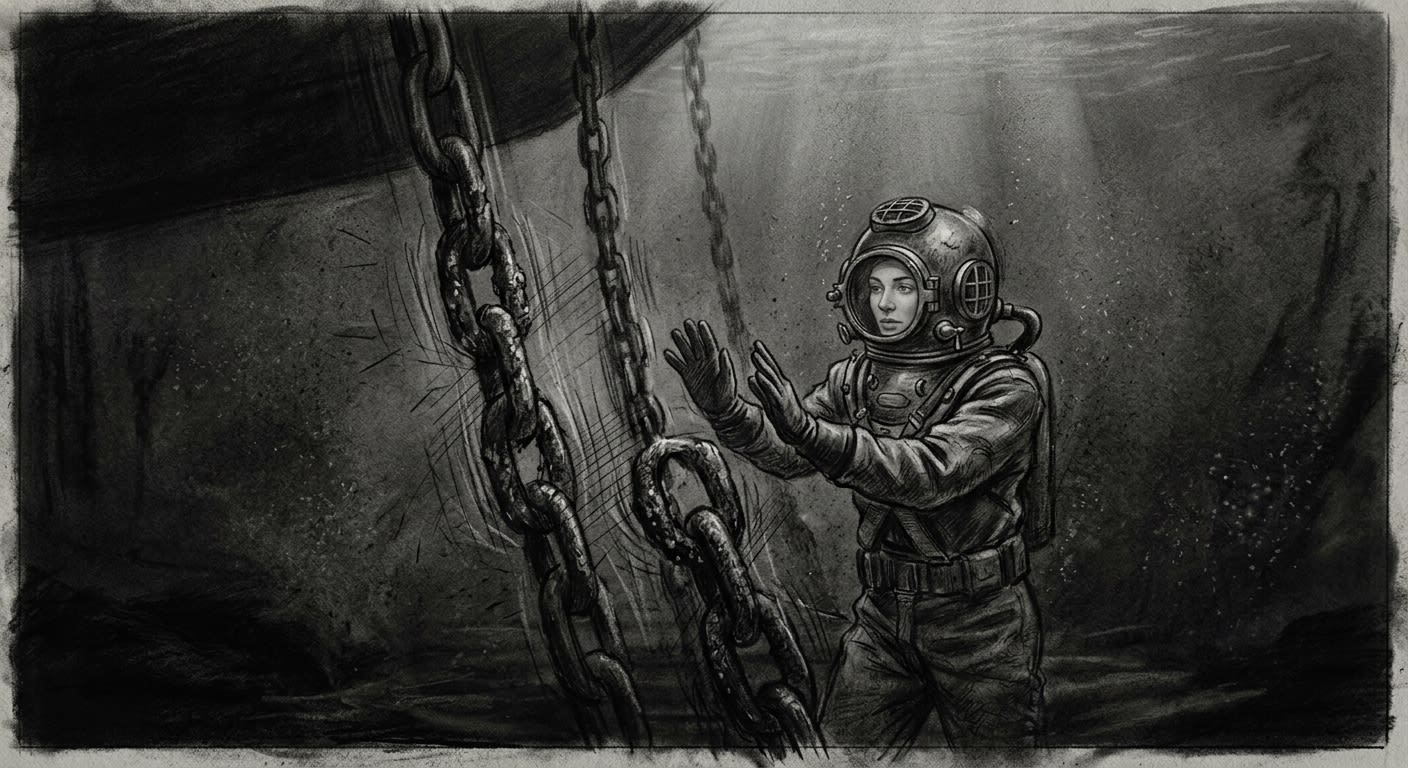
The seven patients admitted to Quarantine with "acoustic distress" during the Silence all reported the same phenomenon: a bell ringing correctly, from beneath the harbour. The Refugee Sheds' three children who walked into the shallows were producing — per Aunt Velka's account — "the bell-note, but from below." Diver-Matron Sera's observation of the chain-links vibrating in the correct sequence, undetected by any surface instrument, confirms that something maintained the bell-schedule during the three days of silence. Something beneath the water rang when the bronze above refused to speak.
The Bureau of Rites has not addressed Sera's report. The Bureau of Bells has not requested it. The determination I drafted — "test of fidelity administered by mechanisms beyond current doctrinal scope" — was designed, with the precision of a watchmaker filing a spring, to make the question of those mechanisms permanently unanswerable without making it permanently unaskable. The question floats. The Bureau permits it to float. The question floats because a floating question is safer than a sinking answer, and because the answer — if anyone in a position of authority were foolish enough to pull on the thread — would unravel not merely the Silence but the entire acoustic theology on which Thessaloniki's chain-gate operates.
The chains are a counting instrument. The bells are a clock. The Drowned Choir is — and here I approach the edge of what the Bureau will tolerate — the counter. And on the fourteenth of Ashmonth, A.S. 198, the counter demonstrated that it could keep time without the clock.
#On the Present Condition
"The omen has not yet run its course." — Common saying, Thessaloniki, since A.S. 198
The bells ring. They ring reversed — the Elder in the Younger's voice, the Younger in the Elder's — but they ring. The harbour operates. The chain-windows open and close. Ships pass beneath the consecrated links and the hum registers their passage and the Bureau of Records files the registration and the Bureau of Doctrine certifies the theological validity of the process and the Bureau of Bells confirms that the acoustic parameters, while revised, are within tolerance. The system functions. The system has always functioned. The system will continue to function until the moment it does not, at which point the Bureau will classify the cessation as either a test, a punishment, or a clerical error, depending on which classification requires the least revision of existing files.
Three years have passed. The reversal persists. The Drowned Choir sings beneath the harbour with — per Sera's most recent reports — "increased tonal complexity," a phrase that the Bureau of Rites has acknowledged and the Bureau of Bells has ignored and that Sera herself translates, in the privacy of her inspection logs, as "it is learning new notes." The chain-links show corrosion patterns that resemble handwriting. The fog holds shape near the chains on nights when the air should be clear. The sleep-singing in the Refugee Sheds has developed a harmony that the children produce without instruction and that the Bureau of Orison and Song has been unable to transcribe because the notation system does not accommodate intervals that narrow between measurements.
The locals know. They have always known. They know it the way dock workers know weather — by sensation, by instinct, by the particular quality of the chain-hum on foggy mornings when the Elder Tower's reversed note carries across the water with a clarity that the old tone never possessed. The Younger's note from the Elder's mouth. The Elder's note from the Younger's throat. A city of two hundred and eighty thousand souls waking each day to a clock that tells the right time in the wrong voice, and carrying that wrongness without comment, without protest, without any public acknowledgement that the sound that defines their hours and their safety and their sacramental relationship to the sea is — and has been, since the fourteenth of Ashmonth, A.S. 198 — an answer dressed as a malfunction.
The bells ring.
The Choir sings.
And the question that Thessaloniki asks on the Night of Quiet Bells — what if the bells were answered? — remains, per the Bureau of Doctrine's standing policy, unfiled.