
#On the Crescent of Vinegar and Delay
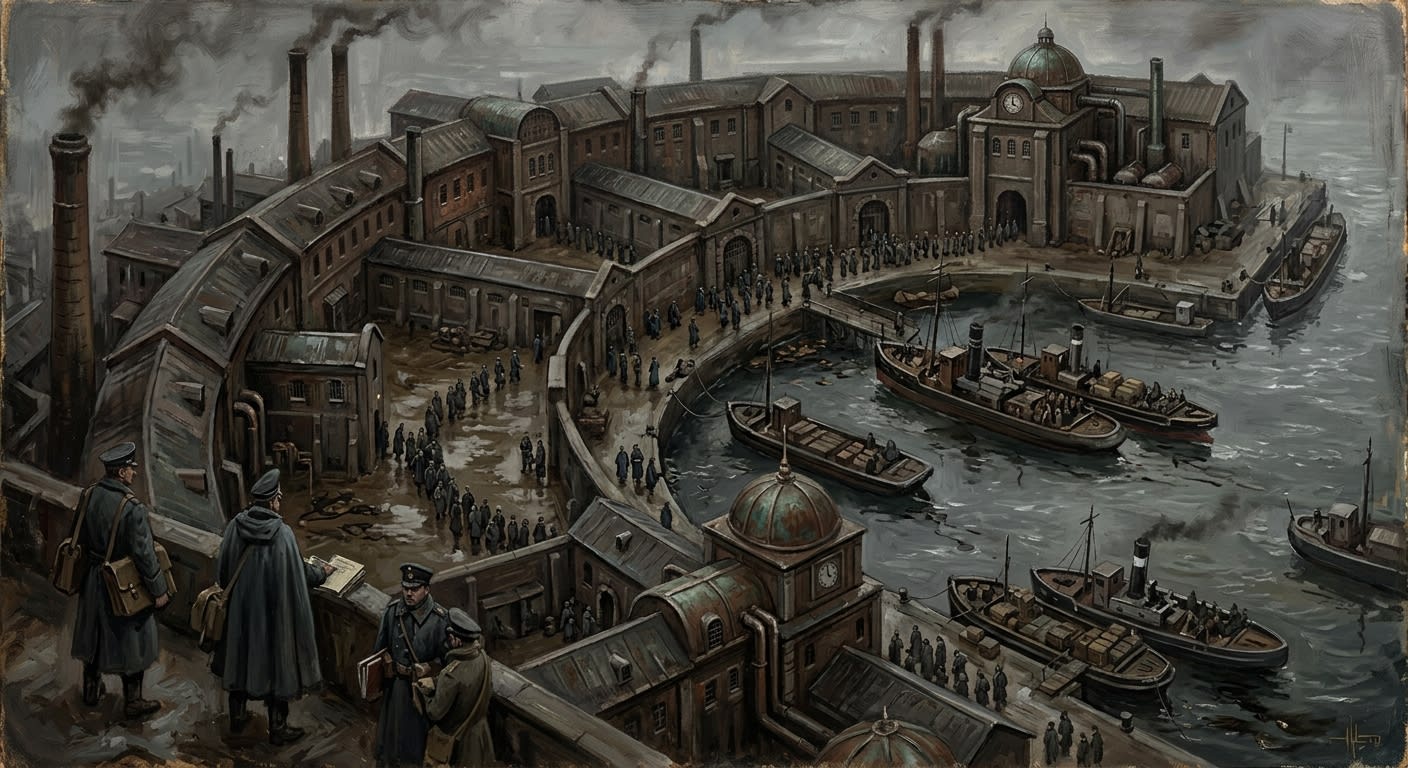
The Quarantine Crescent of Thessaloniki is the fenced curve of piers, wards, vinegar sheds, isolation decks, corpse-wash rooms, fumigation arches, medical stamp windows, and patient cages set between the Chainward Quays and the lower smoke of Drowned Row. It looks, from the tower galleries, like a white bite taken from the harbour: limewashed walls, curved palisades, piers thrust into the water like fingers testing a fevered throat. It smells of carbolic, vomit, vinegar smoke, wet linen, boiled instruments, old salt, and that delicate perfume of bureaucratic medicine: hope made to stand in line until it expires.
It is called quarantine because the Synod is merciful enough to give imprisonment a medical vocabulary. Ships suspected of fever enter the Crescent. Crews suspected of wrong speech enter the Crescent. Refugees whose documents arrive wet, late, foreign, contradictory, or too interesting enter the Crescent. Children who hum in the wrong interval enter the Crescent. Divers who hear bells under floorboards, sailors who dream water into their lungs, women whose names appear in chain corrosion before their bodies drown, and men who insist the Elder bell rang from beneath the harbour during the Silence all enter the Crescent.
The public account is simple. The Crescent protects the southern Line from plague. The true account is simpler and uglier: the Crescent prevents unregistered arrival. Disease matters. Rot matters. Marsh fever matters. Salt-lung matters. Yet the deepest terror of the Harbor Ledger Office is persons who enter without becoming entries, bodies that move before names dry, tongues that carry testimony before quarantine has decided whether testimony may legally exist.
Freedom in Thessaloniki often depends on a medical stamp. The Crescent issues that stamp at a pace best described as devotional.
#On Foundation, Fever, and the First Useful Fence
The Crescent began as a fever cordon after the Harbor-Chain charter. In A.S. 72, when the reliquary chains received formal authority and the port learned to process ships as sacramental events, arriving crews were held in rope pens while clerks determined whether they carried cargo, contraband, plague, heresy, or the usual mixture. Rope failed. Rope always fails when fear has knives. The first fence rose after a galley crew from the eastern shallows broke hold during a rot-ration panic and scattered through the Pitch Markets, coughing, bleeding from the gums, and selling fish at a discount no honest man could trust.
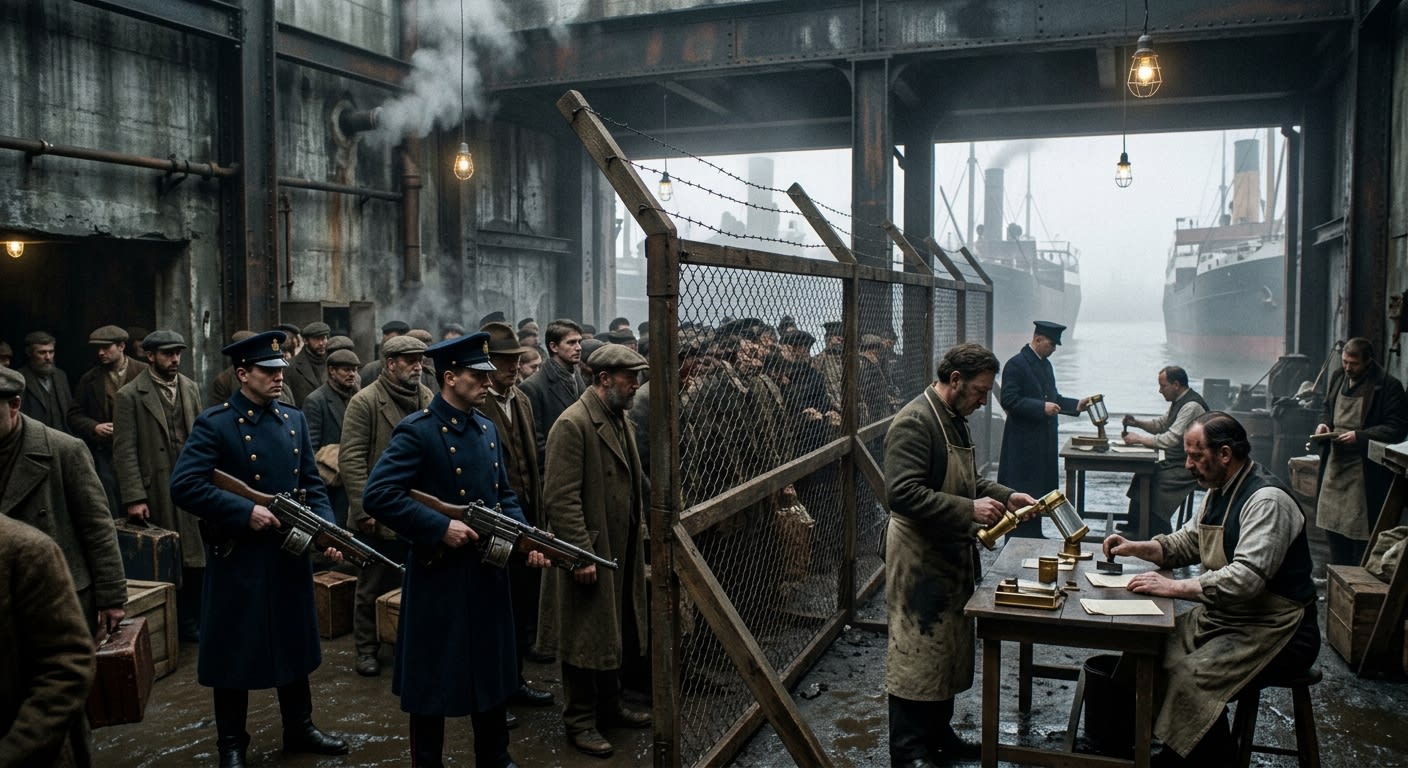
By A.S. 93, after the Harbor-Chain paperwork was re-ratified and the city discovered that even invisible signatures can acquire public consequences, the quarantine pens became a permanent district. Engineering drove piles into the curve of the inlet. Medicine demanded wards. Records demanded windows. Tithes demanded fees. Purity demanded a gate wide enough for arrests and narrow enough for theatre. The result was the Crescent: part hospital, part customs house, part debt trap, part acoustic listening post, all limewash.
Early Harbor memoranda describe the Crescent as a “temporary health perimeter attached to chain-gate operations.”
Corrected by the A.S. 104 pier tax, the A.S. 112 fever-shed expansion, the A.S. 145 Port Loss annex, and the current habit of persons being born, treated, charged, silenced, released, and dying within its fence. Temporary structures do not develop family grave preferences.
The district grew by scandal. A.S. 112 brought quarantine panic during ration rot and taught the Collegium that vinegar smoke comforts citizens even when it does little for fever. A.S. 121 opened the Drowned Choir file and gave the Crescent a new patient class: acoustic distress. A.S. 145 brought the Crying Choir children (Unregistered), tongueless and breathing, transferred from tower shelter into ward custody while the Harbor Ledger invented the category Port Loss (Clerical) to keep them alive in the book and absent from ordinary obligation. A.S. 198 brought the Silence, and with it seven admissions who all heard the correct bell-schedule from beneath the harbour floor.
The Crescent did not become cruel in a single decree. It became useful. Cruelty, once useful, rarely needs its own office.
#On the Shape of the Wards
The Crescent curves along the harbour because the first fence followed the old tide wall. Its outer side faces the water, where isolation piers receive ships under yellow salt-flags. Its inner side faces the city, where release gates open toward stamp windows, sponsor benches, debt clerks, and the narrow lanes leading either to legal freedom or to Drowned Row, depending on whether a person prefers official starvation or unofficial bread.
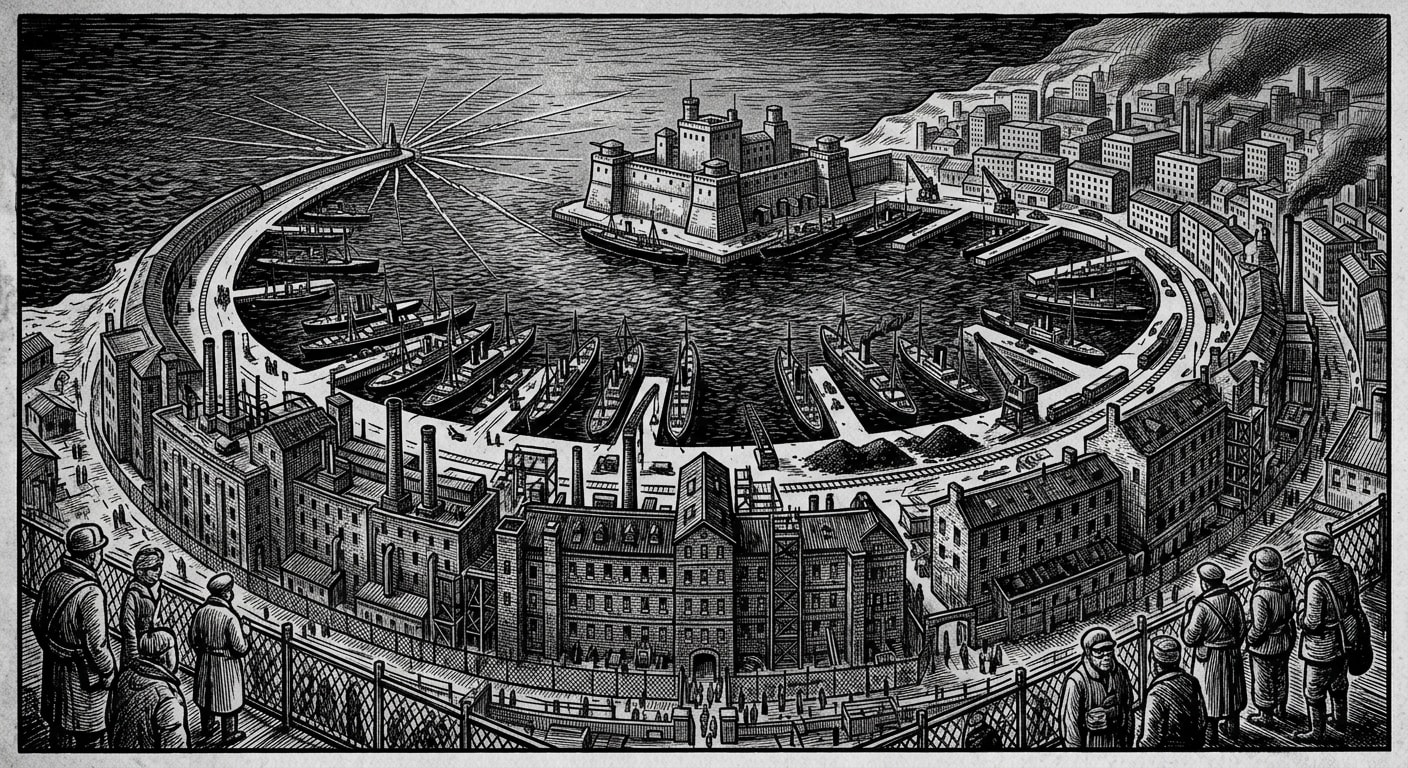
The district is divided into five named sections. The Outer Piers handle ships, cargo, crew separation, and the first vinegar smoke. The White Yard receives bodies and baggage. The Long Wards hold fever, salt-lung, rot-ration sickness, and those ordinary illnesses by which the body reminds the Synod that doctrine does not lower temperature. The Listening Rooms hold acoustic distress cases. The Quiet Annex holds persons whose tongues, voices, names, or testimonies have become administratively dangerous.
The Outer Piers are built of salt-stained stone and black timber that never fully dries. Ships enter under chain-window constraint and berth against hooks large enough to hold siege barges. Crews descend by count. Their boots are chalked. Their throats are inspected. Their names are spoken through cloth screens to clerks who mark each syllable as if sound itself might be contagious, which, in Thessaloniki, is less foolish than it sounds. Cargo is fogged, pierced, weighed, smelled, opened, argued over, closed, charged, and delayed. Every delay has a reason. Every reason has a schedule. Every schedule has a fee.
The White Yard is where arrivals lose their outer selves. Clothes are boiled, burned, stolen, mislaid, classified as contaminated, or returned in bundles damp enough to discourage complaint. Hair is cut. Beards are shaved. Children are powdered with lime until they look like small accused ghosts. The Ward Brothers chant numbers. The Sisters write them. A person who entered as sailor, widow, pilgrim, soldier, orphan, chandler, thief, or saint becomes a body under observation. Medicine likes bodies. Bodies have fewer legal opinions than persons.
The Long Wards are long because suffering is cheaper when arranged in rows. Fever beds face the sea so patients may watch the thing they are forbidden to enter. Salt-lung benches sit beneath cracked icons whose saints have been repainted with cloth masks after a local devotional improvement no Bureau admits authorising. Vinegar kettles steam all day. Incense burns at night. The mixture produces an atmosphere capable of killing weak flies and strengthening administrative confidence.
The Listening Rooms are cleaner. This should alarm the reader. White tile, copper drain slots, padded shutters, bell-drone boxes, slate boards, bed frames fitted with tapping rails, and clerks trained to record statements without answering them. Patients enter when they hear bells under floorboards, names in drains, chain-hum through teeth, or the Drowned Choir before sleep. They are not called mad. Madness would move them under Medicine alone. Acoustic distress keeps them under several Bureaus, which costs more and looks more respectable.
#On Warden-Physic Iri and Her Practical Despair
Warden-Physic Iri rules the Crescent with the authority of a woman who knows how much death can be postponed before postponement begins charging interest. She is practical. This is the highest and most dangerous praise one may give a physician in Thessaloniki. Idealists kill with clean hands. Cynics kill with excuses. Practical people keep a child breathing through the night, sell the father a release stamp in the morning, falsify the fever record before noon, and sleep badly enough to remain useful.
Iri's office stands above the second release gate. It has three windows: one toward the Outer Piers, one toward the Long Wards, one toward the Ledger Steps. There is no window toward the Refugee Sheds. I asked why. She answered, “If I watch them, I will requisition more beds.” The answer was accounting with a pulse.
Her staff contains orderlies who can carry a struggling man without bruising him where auditors look, Sisters who know which fevers smell like fraud, fumigators who drink too much vinegar to prove immunity, corpse-cart drivers with excellent handwriting, and Sister Jova (Unregistered), whose kindness is regarded as suspicious because kindness in the Crescent usually indicates either sanctity, treason, or an attempt to avoid promotion.
Iri permits necessary cruelty and hates decorative cruelty. This places her at odds with Purity. She allows isolation, restraint, tongue inspections, sponsor delays, enforced silence, and release denial when evidence requires it. She does not allow novices to frighten children for practice, inspectors to wake acoustic patients for theological curiosity, or clerks to classify living bodies as Port Loss before a physician has signed the page. Her quarrels with Records are frequent. Her quarrels with Purity are educational. Her quarrels with the sea remain unresolved.
During the Night of Quiet Bells, Iri permits patients to answer by tapping bed frames. This small mercy has saved the city several hundred unnecessary words and, by my estimate, at least twelve clerks from being struck with bowls.
#On Medical Stamps and the Price of Release
The medical stamp is the Crescent's coin, key, lash, absolution, and little idol. Without it, a person cannot leave quarantine, claim berth, enter the Ledger Steps, receive final sponsor recognition, join a convoy, reclaim cargo, retrieve children, marry across district lines, or prove that his cough belongs to yesterday rather than tomorrow. The stamp says: this body may re-enter the civic lie.
It is supposed to certify health. It more often certifies acceptable risk, paid delay, sponsor pressure, queue position, and whether the person released has become less troublesome than the person held. There is a difference. The Crescent understands it. The public does not, which is why the public sleeps at night and the Crescent does not.
Public notices state that quarantine extension is imposed solely for the protection of city health.
Corrected for internal use. Extension may also be imposed for unresolved identity, wet confession receipts, sponsor absence, acoustic exposure, debt dispute, cargo mismatch, Purity request, Records hold, witness contradiction, or because the release clerk has tooth pain and is making doctrine with his jaw.
The legitimate fees are posted on boards near the release gate: fumigation, bedding, examination, witness copy, stamp wax, cargo separation, late sponsor notice, corpse confirmation, dietary supplement, and appeal handling. The illegitimate fees are posted in faces. A tired orderly who looks at a family's shoes. A clerk who leaves a hand near the blotter. A Sister who says the word tomorrow with too much space around it. A bailiff who knows that a man will sell his wedding witness-slip for one clean exit mark.
Fast release exists. Everyone denies it. A person with money, guild backing, military utility, desirable cargo, or a cousin in the Ledger Steps may pass through fever observation in a day. A refugee without sponsor may wait three weeks beside a man whose cough has become part of the architecture. A sailor can buy steam, cloth, and witness speed. A child buys nothing. Children receive either mercy or procedure. Mercy is rarer but works faster.
The Drowned Row Syndic sells quarantine shortcuts through under-quay drains, false fumigation chits, borrowed wrist tags, and the third hatch beneath the vinegar shed. Iri knows some of this. Iolana knows more. Purity knows enough to stage raids that find exactly what the city can afford to lose. This is called enforcement. It is also called theatre by anyone whose salary does not depend on clapping.
#On Acoustic Distress and the Patients Who Hear Correctly
Acoustic distress entered Crescent practice after the Drowned Choir file opened in A.S. 121, though sailors had been hearing the harbour speak before any Bureau learned to charge for listening. The first forms were crude: hears voices, walks toward water, sings in sleep, knows drowned names. By A.S. 145, after the Crying Choir children were transferred tongueless into ward custody, the forms became more careful. By A.S. 198, after seven patients reported a correct bell ringing under the harbour during the Silence, the forms became frightened.
The Crescent treats acoustic distress with vinegar steam, bell-drone, enforced waking, throat oil, weighted blankets, salt lines, tapping boards, and supervised humming. The aim is not cure. Cure is an ambitious word and should be taxed. The aim is interruption: break the sleep-song, foul the Choir's interval, keep the patient from answering, keep the feet tied loosely enough to avoid marks and tightly enough to prevent dawn retrieval from the shallows.
LISTENING ROOM SEVEN — NIGHT ENTRY Patient: female, age uncertain, transferred from Refugee Sheds. Complaint: hears the Younger bell beneath pillow. Observation: patient tapped Elder sequence while asleep. Intervention: bell-drone box opened; vinegar steam applied. Second observation: all beds answered by tapping, including two empty frames. Action: room sealed; frames burned; ashes filed as ███████████.
Do not answer the Choir. The instruction is older than the file and wiser than several committees. In the Crescent it is written above the Listening Room doors in plain black letters. Patients who answer report relief. Then sleep. Then absence, muteness, wet dreams, future names, or faces so peaceful the orderlies cross themselves before recording pulse. Peace is not trusted in Thessaloniki. Proper patients are afraid.
Diver-Matron Sera passes the Crescent only when required. Her sleeplessness is listed there as non-febrile insomnia, anomalous tolerance, which is the Crescent's way of admitting that a woman can remain awake for four years because the iron keeps counting. Iri once recommended her removal from diving duty and withdrew the note after substitute divers failed to hear what Sera heard. Medicine, when honest, knows when its chart is smaller than a hand on iron.
The seven Silence patients remain instructive. All heard the correct bell sequence from below. All were held. Three recovered ordinary hearing and now refuse to sleep near drains. Two speak in harbour schedules under stress. One died of marsh fever after release and had his death disputed because his name appeared in a chain-flake six days later. One remains in the Quiet Annex, where he taps dawn and dusk on the bed rail with an accuracy the Bureau of Bells has quietly borrowed for recalibration.
#On the Quiet Annex and Corrective Silence
The Quiet Annex is the Crescent's ugliest kindness. It receives those whose voices have become dangerous: sleep-singers, tongueless children, witnesses to acoustic impossibilities, sailors who answer beneath fog, refugees who know drowned names, patients whose testimony would force three Bureaus to admit that the sea keeps better time than the towers. The Annex has padded doors, no mirrors, soft spoons, throat charts, wax tablets, slate boards, and windows too high for looking out.
Corrective silence is the local euphemism. It can mean a medical order forbidding speech. It can mean a gag. It can mean tongue treatment. It can mean surgical removal when the tongue itself has become an instrument nobody present has permission to hear. The phrase allows the Crescent to record all four without distressing the release statistics.
The Crying Choir children gave the Annex its terrible precedent. They survived, according to the Ledger, without tongues. They were transferred into Crescent custody, listed under Port Loss (Clerical), and thereby made alive in one column and missing in another. Some grew. Some died. Some learned to tap. Some learned to hum without mouths, which is a sentence I would strike from any subordinate's report as theatrical if the report had not been signed by three physicians and one priest who later resigned his singing office.
The Annex also serves the Harbor Ledger. A witness in silence cannot contradict a manifest. A patient under acoustic hold cannot accuse a captain, sponsor, clerk, or Chainwright until released into a stable category. A child who hears future drownings can be protected from exploitation by being isolated, and exploited by the isolation itself. The Synod delights in instruments that cut both ways and then prosecutes citizens for bleeding on the wrong side.
Iri hates the Annex. This is not the same as refusing to use it. Hatred can be a discipline. She inspects the rooms herself, reads tapping boards before breakfast, and has dismissed two orderlies for treating silence as absence. “They hear,” she wrote in a note I have seen. “They answer when safe. We are not entitled to make them convenient.” A dangerous woman. Naturally, indispensable.
#On Night of Quiet Bells Within the Fence
On the fourteenth of Ashmonth, the city falls silent after dusk peal and the Crescent changes its whole method of breathing. The Night of Quiet Bells is not a sanctioned festival, vigil, memorial, rite, or permitted civic wound. It is a tolerated coincidence, meaning the Bureau has failed to strangle it and now claims restraint.
Inside the Crescent, the Night is operational. Patients receive tapping boards. Bed bells are muffled. Orderlies wear cloth soles. The steam kettles are banked early so they do not hiss during the first hour after peal. Fever patients are warned with finger signs. Acoustic patients are not warned; warning makes them listen. The Quiet Annex lights are hooded, and every door latch is wrapped in linen. No one says this is reverence. It works too well to be admitted.
The Crescent's 14 Ashmonth night order is copied in small script and never posted where a visitor might call it reverent. Speech: necessity only. Patient response: tapping permitted. Steam banked before dusk peal. Listening Room doors double-wrapped in cloth. Refugee hum undisturbed. Outside inquiry recorded as routine quiet-hours compliance. Bureaucracy dislikes superstition until superstition reduces incident counts. Then it calls superstition protocol and changes the ink colour.
The Refugee Sheds do not go silent. Their communal hum is the plank under the city's quiet. The Crescent listens to it through the fence. When the hum holds steady, fewer patients wake. When the hum wavers, tapping begins in rooms whose occupants have not moved their hands. Aunt Velka and Iri have an arrangement written nowhere: Iri sends broth, cloth, and fever powder through a side gate; Velka sends warnings when the children's second line thickens. Neither woman calls this cooperation. Cooperation attracts men with forms.
Sera sometimes stands by the east wall of the Sheds on Quiet Night. When she does, the sleep-singing thins. The Crescent's Listening Room instruments record no cause. The children record one. They turn their faces toward the wall and quiet without command. If Doctrine asks me to explain this, I shall say occupational acoustic familiarity. If Doctrine asks whether I believe that phrase, I shall compliment its grammar.
The Night tests the Crescent by depriving it of its favourite weapon: speech. Commands shrink. Threats look foolish. Explanations become impossible. A ward run by paper, orders, questions, and release pronouncements must use hands, eyes, boards, bowls, and presence. It becomes, briefly, almost humane. This is why the Bureau must never license the Night. Licensed mercy would be examined, named, budgeted, and ruined by spring.
#On Sponsor Benches and the Waiting Families
The sponsor benches stand between the release gate and the Ledger cross-window, which is to say between the body and its return to personhood. They are long, backless, damp, lime-stained, and placed where waiting families can see the stamp desk without reaching it. Good architecture humiliates with sightlines. A mother may watch the clerk take up the release seal, set it down, reach for another file, scratch his ear, speak to a colleague, and discover that her son's paper lacks a third witness mark. She has not moved. The world has.
Sponsors matter because Thessaloniki distrusts unattached bodies. A released patient requires someone to receive him, guarantee his address, assume his debts, confirm his name, and swear that if the patient begins singing from the drains, the proper office will be notified before supper. Families serve. Guilds serve. Ship captains serve when the sailor is worth more alive than abandoned. Refugee kin serve under provisional ink and suffer accordingly. A person without sponsor becomes a medical success and civic failure, the sort of achievement the Ledger punishes by extending care.
The benches have their own trade. A cousin may be rented by the hour if his accent matches the patient's district closely enough for a tired witness. A guild badge may be borrowed against a knife pledge. A widow may sponsor three unrelated sailors as nephews and leave with one actual nephew, one future husband, and one debt nobody should inspect while sober. The Crescent condemns false sponsorship. It also depends on it whenever the wards exceed capacity. Moral outrage in a full hospital is ventilation: noisy, necessary, and rarely clean.
Children are hardest. A child released without stable sponsor becomes prey for every office that prefers small hands and uncertain names. The Orphanarium agents know the Crescent schedules. So do ship cooks, rope gangs, Mercy recruiters, Drowned Row runners, and those smiling devotional women who collect frightened girls for “temporary chapel service” with no chapel named on the slip. Iri posts Sisters near the child bench and calls it fever observation. The Sisters carry ladles. A ladle is not a weapon until swung by a woman who has seen the intake books.
Sister Jova made her reputation there by refusing to transfer a boy whose sponsor mark had been counterfeited with elegant wax and foolish haste. Records wanted the case cleared. Purity wanted the counterfeit. A rope-master wanted the boy. Jova wanted breakfast brought to the child before any man with a seal touched him. She got breakfast. Then she got reprimand. Then, after the rope-master vanished into a drain account and the wax proved linked to three prior child removals, she got no apology at all, which is how the Bureau admits gratitude without endangering precedent.
#On the Present Cordon
As of A.S. 201, the Quarantine Crescent is crowded beyond its intended shame. The external audit from Strasbourg approaches, and every office in Thessaloniki has begun laundering its own reflection. The Crescent has repainted wards, relabelled storerooms, moved the worst bedding, revised acoustic distress files, hidden the third set of release-fee tablets, and produced a display corridor in which no patient has vomited within official memory. This corridor will impress the auditors. Auditors are professionally attracted to corridors built for them, as flies to honey and theologians to locked boxes.
The real Crescent sits behind that corridor. Fever beds full. Listening Rooms active. Quiet Annex sealed twice this month. Vinegar stores low. Carbolic rationed. Sponsor benches crowded with families who have learned that waiting looks more lawful when performed while sitting. Release stamps backlogged. Three ships under yellow flag. One child from the Sheds humming the Elder sequence in the Younger's recovered voice. One orderly dismissed for selling false steam exposure slips. One Sister reassigned after refusing to list a living boy as Port Loss pending sponsor confirmation. She was Sister Jova, of course. Kindness again, causing paperwork.
A recent audit brief describes the Quarantine Crescent as “stable under ordinary seasonal pressure.” This is the kind of sentence a clerk writes when both eyes face inward. The pressure is maritime, acoustic, fiscal, medical, and theological. The Crescent is functioning because Warden-Physic Iri, her staff, the Refugee Sheds, several corrupt clerks, three illegal side gates, and the Drowned Row under-paper all conspire daily to prevent official success from killing everyone.
The sea has no respect for quarantine. It crosses fences as hum, fog, salt, dream, rust, echo, and name. The Crescent stops what it can: fever, rats, bad cargo, wet papers, infected cloth, unlicensed testimony, certain forms of hope. It cannot stop the Choir from learning. It cannot stop bells from having wrong voices. It cannot stop children from hearing what the instruments deny. It can only hold them one more night, tap once for yes, twice for no, and stamp release when release has become safer than keeping.
At dawn the Outer Piers open under vinegar smoke. A ship's crew descends by count. A child in the Quiet Annex taps the dusk sequence by mistake. Iri hears it through the wall and closes her eyes for exactly one breath. Then she opens them, signs three releases, denies four, orders broth to the Sheds, and tells a Records clerk that if he uses Port Loss before examination again she will classify his tongue as contaminated cargo and impound it.
The clerk believes her. This is evidence of intelligence.